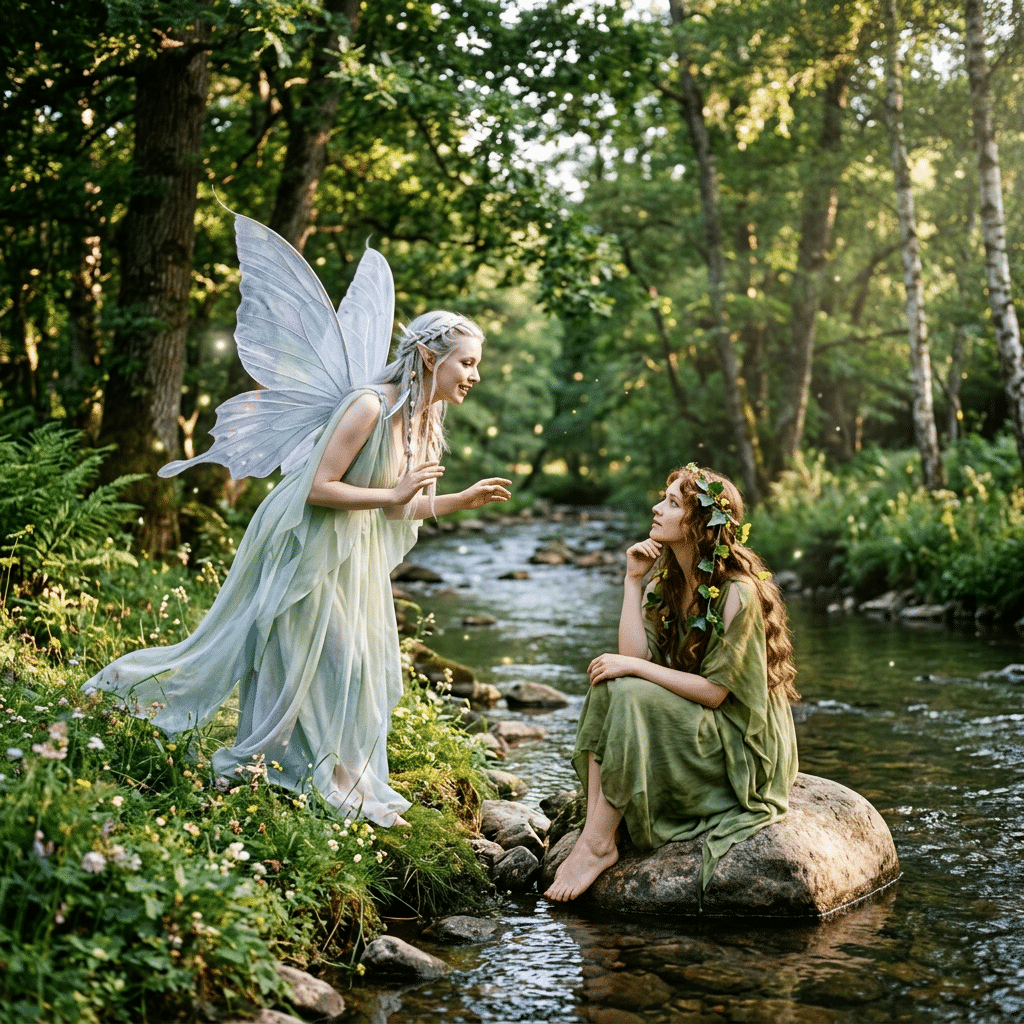
Fairy Elementals: Key Points
-
Fairy elementals emerge from the intersection of fairy folklore and elemental philosophy, with beings traditionally linked to earth, air, fire, and water appearing across many cultures over thousands of years.
-
Physically, elemental fairies reflect their associated element, from the dense, earthy forms of gnomes to the translucent shimmer of sylphs, the iridescent beauty of water fairies, and the unstable, flickering appearance of fire elementals.
-
The formal association of fairies with the four classical elements was significantly shaped by the Renaissance philosopher Paracelsus, though the underlying idea drew from much older Greek, Celtic, and Germanic traditions of nature spirits.
-
Elemental fairy behavior mirrors the temperament of their element, with earth fairies being slow and protective, air fairies being tricksy and mercurial, water fairies being emotionally intense and unpredictable, and fire fairies being volatile and dangerous.
-
The origins of elemental fairy beliefs are ancient and cross-cultural, appearing in Mesopotamian, Norse, Celtic, and even Japanese traditions, suggesting the concept arises from something close to a universal human impulse.
-
Scholars have proposed three main theories to explain this universality: an animist drive to personify natural forces, a Jungian framework in which elementals represent psychological archetypes, and an ecological anthropology view in which these beliefs encoded practical environmental wisdom.

Introduction
Fairy elementals occupy one of the most captivating and enduring niches in the world of folklore and mystical tradition. These beings exist at the intersection of two powerful streams of ancient thought: the belief in fairies as supernatural entities inhabiting the natural world and the philosophical idea that nature itself is organized and animated by elemental forces. Across centuries and across cultures, the idea that certain fairy beings are intimately bound to the classical elements of earth, air, fire, and water has persisted with remarkable consistency, suggesting that this association touches something deep in the human imagination.
Through various sources, this family is treated as both a historical artifact of folk belief and a living set of motifs that continue to be reinterpreted in contemporary media and scholarship. A central thread across scholarship is the idea that fairies and their kin have undergone substantial shifts in how they are imagined: from largely benevolent or ambivalent nature spirits in early literature and folklore to more complex personages with dark or demonic resonances in early modern culture and then to diverse, often sympathetic, or culturally specific embodiments in modern fiction and media (Hutton, 2014; Spyra, 2017; Leotescu, 2022; Shevchenko, 2021).
Fairy Traditions and Their Elemental Dimensions
To understand fairy elementals, it helps to first understand how fairies have traditionally looked across different mythological traditions. In much of European folklore, fairies are described as humanoid beings ranging in size from the diminutive, barely visible creatures of English tradition to the tall, luminous beings of Irish mythology known as the Tuatha De Danann. Their physical features often reflect their proximity to nature, with skin tones described in earthy greens, bark browns, pale silvers, or luminescent whites depending on the tradition in question. Wings appear frequently in later depictions, though older folklore did not always grant fairies this attribute, and more archaic descriptions focused instead on their uncanny speed and ability to appear and vanish without explanation.
A foundational distinction in fairy lore is between broadly conceived nature spirits and more codified, humanoid beings that later form a “fairy” kingdom in literature. Early British and European traditions often treated elves, fairies, and related beings as part of a continuum of non-human agents tied to natural settings (woods, hills, rivers) and to moral or social economies of the human world. This background is traced in historical overviews that document a two-stage evolution: a diffuse pre-modern assemblage of creatures gradually coalescing into a more defined fairy-kingdom concept in the late medieval to early modern periods, a process that was then intensified in popular culture after the Reformation (Hutton, 2014; Spyra, 2017). In addition to English folklore, cross-cultural variances include water spirits (naiads and nymphs), air or sky spirits (sylphs), and other regional personages (kappa, grindylow, vela, and sidhe) that appear in modern scholarly surveys of mythologemes and mythoconcepts (Aleksandruk & Babelyuk, 2018; Palchevska, 2019).
The association of fairies with the classical elements reaches back through multiple philosophical and magical traditions. Paracelsus, a philosopher from the Renaissance, was especially important in making this connection official. He suggested a system in which each of the four classical elements was home to and ruled by a certain type of being. He called these beings gnomes for earth, sylphs for air, undines for water, and salamanders for fire, and while he framed them in quasi-scientific terms, his ideas drew heavily from older folk traditions that had long recognized nature spirits dwelling within natural phenomena. Before Paracelsus, the ancient Greeks had their nature spirits tied to specific natural features, including naiads who inhabited freshwater sources, dryads who lived within trees, and oreads who dwelled in mountains, all of which fed into the later European conceptualization of elemental fairies.
Across sources, water spirits (naiads and mermaids), air spirits (sylphs), tree spirits (dryads), and household sprites frequently populate fairy topoi in folkloric and literary treatments, sometimes merging with or being reinterpreted as “elves,” “goblins,” or other familiar epithets in translation and adaptation (Kılınçarslan, 2023; Palchevska, 2019; Aleksandruk & Babelyuk, 2018). In digital-era scholarship, researchers show that mythoconcepts persist as recognizable frames for these beings even as they acquire new significations in modern media (Shevchenko, 2021).

Physical Descriptions of the Four Elemental Types
Earth elementals in the fairy tradition are typically described as short, stocky, and deeply brown or grey in coloring, with skin that sometimes appears to have the texture of stone, bark, or compacted soil. Gnomes and their kin were said to move through the earth as freely as humans move through air, and their physical forms were imagined as dense and heavy, perfectly suited to the subterranean world they inhabited. In broader fairy lore, brownies and earth-type house spirits were similarly compact and earthy in appearance, often described as wearing clothes made from natural materials like moss, dried leaves, and woven grass, blending seamlessly into the forest floor.
Air elementals, known most famously as sylphs, represent a striking contrast, being described as ethereally light, tall, and almost translucent in form. They were believed to inhabit the upper atmosphere and the spaces between the treetops, and their bodies were sometimes described as barely visible, more like a shimmer in the air or a sudden stirring of wind than a solid physical presence. In fairy tradition, the will-o’-wisps and certain mischievous spirits associated with sudden gusts or strange breezes share this quality, their presence announced more by sensation than by sight. Sylphs (air spirits) and other elemental beings populate discussions of mythoconcepts and mytholexemes, illustrating how the taxonomy of elemental beings is used to discuss broader cultural imaginaries in modern scholarship (the “mythoconcept Elf” and related frames) (Shevchenko, 2021).
Water fairies, including undines, mermaids, and the Irish merrow, are among the most widely described elemental fairy types across world folklore. They are typically depicted as strikingly beautiful, with flowing hair in shades of blue, green, or silver, and lower bodies that may be fish-like or simply invisible beneath the water’s surface. Their physical appearance tends to suggest an almost fluid quality even when fully humanoid, as if their bodies are in constant slow motion, and many traditions describe their skin as faintly iridescent, catching light the way still water does at dusk. Nymphs tied to specific natural domains such as rivers, springs, and caves; in some treatments they persist as deathless or near-immortal beings fused to elemental domains (Gimbel, n.d.; Shevchenko, 2021; Palchevska, 2019).
Fire elementals occupy perhaps the most dramatic physical space in elemental fairy lore, being described as flickering, radiant beings whose forms never fully stabilize into solid matter. Salamanders, in the Paracelsian system, were said to be visible as tongues of flame within fires, small darting shapes that only the magically perceptive could distinguish from ordinary combustion. Other fire-associated fairy beings in folklore include the will-o’-wisp in its more aggressive, heat-associated forms, and certain spirits of volcanic or desert regions who were described as beings of pure heat and blinding light.
Behavioral Characteristics of Elemental Fairies
The behavior of elemental fairies is closely governed by the nature of their associated element, and this connection shapes everything from their temperament to their relationship with humans. Earth elementals are generally described in folklore as conservative, protective, slow to anger but implacable once offended, and deeply concerned with the welfare of the natural places under their stewardship. They are often credited with guarding buried treasure, protecting ancient trees and standing stones, and punishing those who disturb the land carelessly or disrespectfully.
Air elementals tend to behave in ways that mirror the unpredictable and boundary-crossing nature of wind itself. They are associated with trickery, sudden inspiration, messages and news carried across distances, and the kind of mischief that is more disorienting than malicious. In many traditions, these beings were believed to whisper secrets to those with the ears to hear, and the practice of listening to the wind for omens and guidance is found across Celtic, Norse, and Slavic traditions alike.
Folklore almost universally describes water fairies’ behavior as emotionally intense and deeply tied to cycles of giving and withdrawal. They are generous with those who respect their waters, granting fishermen full nets and protecting travelers who ford rivers safely, but they are equally capable of luring the unwary to drowning deaths or pulling entire villages into floods when angered. The Irish tradition of the banshee, though not strictly a water spirit, shares this quality of emotional intensity with water elemental lore, and many scholars note that banshee legends overlap significantly with stories of river and lake spirits in older strata of Irish mythology.
Fire fairies behave in ways that reflect fire’s dual nature as both a source of life-giving warmth and an agent of devastating destruction. Salamanders in magical tradition were said to be nearly impossible to communicate with through ordinary means, requiring fireproof materials and specialized rituals, and they were described as impatient, brilliant, and volatile. In broader fairy lore, fire-associated beings appear as both hearth guardians, protecting the domestic flame and the household that depends upon it, and as wild spirits of conflagration who might burn a forest for reasons entirely their own.
Folklore Origins and Theoretical Frameworks
The folklore origins of fairy elementals are ancient and geographically widespread, predating any single culture’s formalization of the concept. The ancient Mesopotamians recognized the existence of nature spirits called apkallu and utukku, some of which were associated with specific natural forces, and similar concepts appear in ancient Egyptian and Persian religious thought. Celtic and Germanic peoples across Europe had highly developed traditions of land spirits, water spirits, and sky spirits long before Roman or Christian influence, and these traditions fed directly into the medieval and Renaissance synthesis that eventually produced the more systematized concept of elemental fairies.
Scholars describe a two-stage evolution in the representation of fairies and elves in British culture: (1) an initial, diffuse set of beliefs in the late medieval period that lacked a single, coherent “fairy kingdom,” and (2) a subsequent consolidation into a recognizable fairy realm after the Reformation, accompanied by a growing interest in the nature and governance of fairies (the “fairy kingdom” motif) (Hutton, 2014). This historical arc helps explain why later writers, including Shakespeare and early modern polemicists, debated whether fairies were benign, mischievous, or demonic, with the latter view partly responding to anti-Catholic polemic and theological concerns of the period (Daemonologie et al.; Spyra, 2017). The two-stage model is reinforced by close literary analyses that track how plays and pamphlets encode fairy belief and its demonization in varying registers (Hutton, 2014; Spyra, 2017; Dugan, 2008).
The Norse tradition is particularly rich in relevant material, featuring beings like the alfar or elves who were divided into light and dark categories associated with the heavens and the underworld respectively, as well as water spirits like the nokk and land spirits called landvaettir who were believed to animate and protect specific geographical features. The Japanese concept of kami offers an interesting parallel from outside the European tradition, describing spirits that inhabit natural phenomena of every type and must be carefully respected and appeased. These cross-cultural similarities have suggested to many scholars that the concept of elemental nature spirits may arise from universal human psychological tendencies rather than from simple cultural borrowing.
Several compelling theories attempt to explain why the elemental fairy concept has proven so persistent and so widespread across human cultures. The animist theory holds that human beings are cognitively predisposed to attribute agency and personality to natural phenomena, a tendency that would have been strongly reinforced in pre-scientific societies where the behavior of wind, water, fire, and earth determined survival on a daily basis. Giving these forces personalities, names, and emotional lives made them not only more comprehensible but also more negotiable, opening the possibility of relationship and communication with forces that might otherwise seem entirely indifferent to human welfare.
A second major theoretical framework comes from depth psychology, particularly the work of Carl Jung, who argued that fairies and elemental spirits represent projections of unconscious psychological contents onto the external world. In this view, earth elementals might correspond to the deep, slow forces of the unconscious self, while air spirits reflect the quick, mercurial nature of thought and communication, and water spirits embody the emotional depths that lie below ordinary conscious awareness. This theory has the advantage of explaining why elemental fairy imagery continues to resonate even in secular, scientifically literate cultures, since if these beings represent psychological archetypes, their appeal would be independent of any literal belief in their existence.
A third perspective comes from ecological anthropology, which suggests that elemental fairy beliefs may have functioned as sophisticated folk ecological systems, encoding practical environmental knowledge in narrative form. A community that believed a particular river was home to a dangerous and capricious water spirit would naturally be cautious about its flooding patterns and careful about what it deposited in the water, behaviors that happen to be ecologically sound regardless of the mythological framing. Similarly, beliefs about protective earth spirits guarding old trees and ancient groves may have helped preserve ecologically valuable areas from clearance or exploitation for far longer than purely practical arguments would have managed.
Conclusion
Fairy elementals, taken together, represent one of humanity’s most creative and enduring attempts to make sense of the living world. Whether understood as literal supernatural beings, as psychological archetypes, or as ecological metaphors, they carry within them a deep recognition of the fact that the natural world is not a passive backdrop to human activity but an active, powerful, and in some sense responsive presence. The tradition of elemental fairies invites a mode of engagement with nature that is attentive, respectful, and humble, qualities that seem no less relevant today than they did to the people who first told these stories around their fires and beside their rivers thousands of years ago.
References
Aleksandruk, I. and Babelyuk, O. (2018). CONCEPTUAL CATEGORY PERSON AND MEANS OF ITS VERBAL PRESENTATION IN THE FANTASY GENRE. Advanced Education, 5(10), 158-166. https://doi.org/10.20535/2410-8286.142802
Dugan, F. (2008). Fungi, folkways and fairy tales: mushrooms & mildews in stories, remedies & rituals, from Oberon to the Internet. North American Fungi, 23-72. https://doi.org/10.2509/naf2008.003.0074
Gimbel, J. (n.d.). Spiritual Descent: A Study of Semi-Divine Beings and Non-Human Species in European Mythologies. https://doi.org/10.14418/wes01.1.633
Hutton, R. (2014). THE MAKING OF THE EARLY MODERN BRITISH FAIRY TRADITION. The Historical Journal, 57(4), 1135-1156. https://doi.org/10.1017/s0018246x14000351
James VI. (1597). Daemonologie. Edinburgh.
Kılınçarslan, Y. (2023). Cinematic Mythology in the Narrative and Design of Tomm Moore’s The Secret of Kells. CINEJ Cinema Journal, 11(2), 225-249. https://doi.org/10.5195/cinej.2023.560
Leotescu, G. (2022). J. K. Rowling’s Imaginary Realm of Faërie – a Collection of Myths and Folktales from Eastern and Western Cultures. Dialogos, 39. https://doi.org/10.24818/dlg/2022/39/08
Palchevska, O. (2019). TRANSLATING CULTURALLY MARKED VOCABULARY., 73-88. https://doi.org/10.36059/978-966-397-149-0/73-88
Shevchenko, E. (2021). Spotlight On Mythoconcepts In A Digital Context., 516-522. https://doi.org/10.15405/epsbs.2021.12.03.69
Spyra, P. (2017). Shakespeare and the Demonization of Fairies. Text Matters, (7), 194-213. https://doi.org/10.1515/texmat-2017-0011
Leave a Reply