Kushtaka, Otter Man: Key Points
-
The Kushtaka, meaning “land otter man” in Tlingit, is a supernatural creature from the mythology of the Tlingit and Tsimshian peoples of Alaska and coastal British Columbia.
-
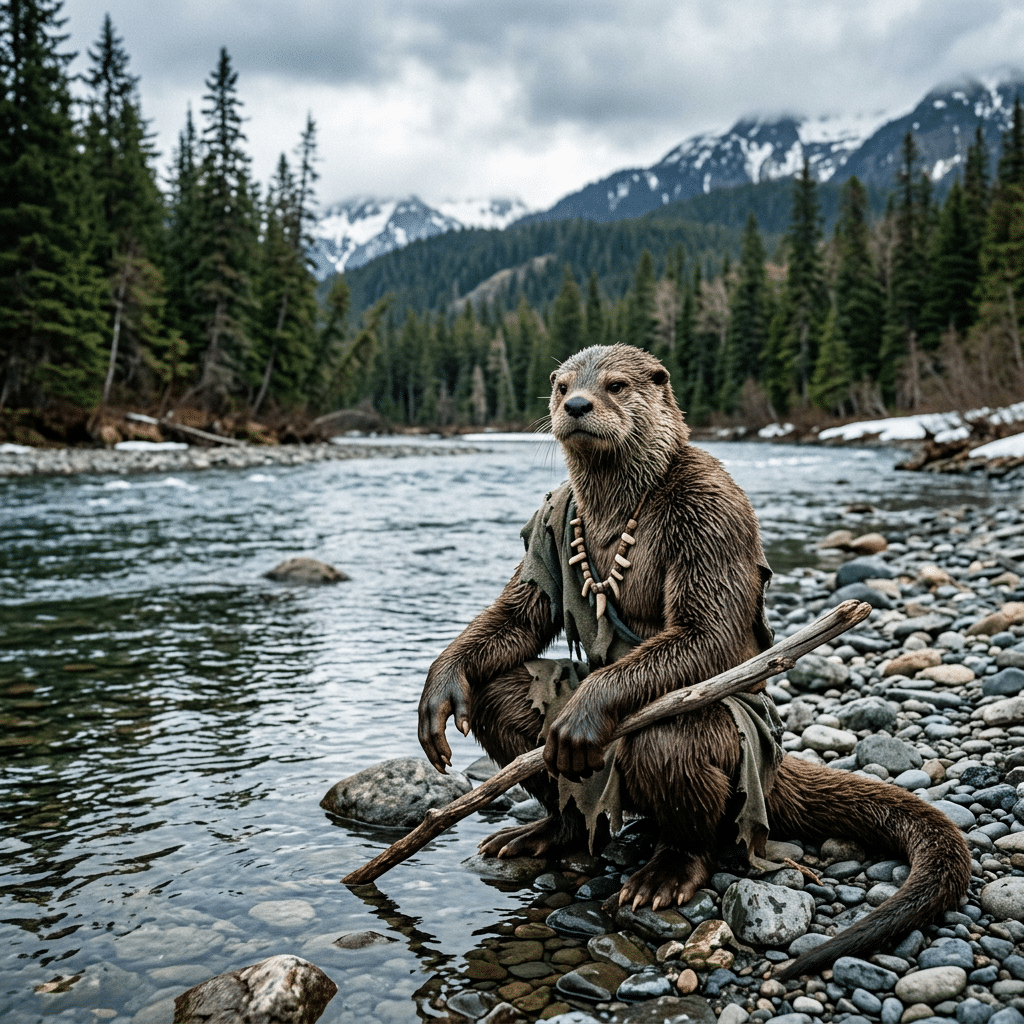
Physically, it appears as a hybrid of human and river otter, with dark fur, webbed hands, sharp claws, and a disturbingly human-like face, and it can also mimic human form or emit cries that sound like a baby or woman in distress.
-
Its behavior is morally ambiguous, as it is sometimes said to lure the lost or drowning into spiritual corruption by transforming them into Kushtaka, but in other stories it acts as a reluctant rescuer of those in danger.
-
The legend likely originated as a way for communities dependent on dangerous waterways to explain the mysterious disappearance of fishermen and travelers, with river otters becoming spiritually significant due to their frequent presence near those same waters.
-
Theories about the Kushtaka range from it being a social cautionary figure that discouraged reckless behavior near water to an encoding of ecological knowledge about unpredictable currents and tides.
-
At its deepest level, the Kushtaka reflects a Tlingit spiritual belief in the permeability between the human and animal worlds and the very real fear of dying alone and improperly, leaving the soul trapped between the living world and the afterlife.

Introduction
The Kushtaka (Tlingit), or “Kooshdaa Kaa,” or “land otter man,” is one of the most enduring supernatural beings in the folklore of the Indigenous peoples of the Pacific Northwest Coast. The Kushtaka is an evil and strong being and is significant in the traditions of the Tlingit and Tsimshian peoples of Alaska and coastal British Columbia and the Haida people of the surrounding area (Beck, 2003). The Kushtaka has long been considered a shape-shifter by the Tlingit and Tsimshian peoples for millennia and is part of a wider lineage of monstrous and transformational figures throughout North American Indigenous cosmology (Redfern, 2017). The Kooshdaa Kaa continues to be a forbidden issue for many Tlingit people today, demonstrating the great spiritual significance the creature holds in live cultural memory (Martindale, 2008). The Kushtaka exists in the area between the human and nature worlds and is a cautionary tale, a window into the spiritual beliefs of the Tlingit and Tsimshian people of Alaska and coastal British Columbia.
Physical Description and Appearance
The Kushtaka is said to have the ability to change shapes, most often taking the form of a human-river otter hybrid. In its semi-transformed stage, it is reported to walk upright like a man but with the streamlined, elongated physique of an otter, with dark, damp fur, webbed hands, and sharp claws. Its face is possibly the most disconcerting element, combining human-like eyes and expressions with animalistic proportions, creating a look that rests uneasily between the familiar and the alien. Some stories describe the Kushtaka as being able to take a wholly human shape, believable enough to fool travelers and fisherman who encounter it in the forest. It is also supposed to make a high-pitched spooky whistle or a call that mimics a baby or a lady in distress and is one of its most effective techniques of deception through sound.
Many descriptions of the Kushtaka are similar in their physical description and concentrate on the picture of a creature that is both human and otter. Beck (2003) portrays the Kushtaka as hairy beings, half land otter, half human, who were formerly people themselves before being dragged into dens and converted by land otters. Luthin (1994) also describes them as shadowy beings, half human and half otter, often coming from persons lost or drowned at sea. Redfern (2017) says that the Kushtaka is able to assume both human and otter forms, further underlining the creature’s shape-changing nature, while Rowland (2020) adds that the Kushtaka has a particular predilection for the form of river otters even when shifting between numerous appearances.
Behavior and Moral Ambiguity
The behavior attributed to the Kushtaka is complex and has been interpreted in radically various ways depending on the culture and the setting of the story. In several traditional stories, the Kushtaka is said to entice lost or drowning people away from help and, in doing so, prevent their souls from going on correctly by turning them into Kushtaka themselves. This change is seen as a horrible fate, not just death, but a kind of spiritual corruption, a perpetual exile from the human world and the afterlife. Still, other myths have the Kushtaka as the unwilling savior, rescuing those who are drowning or freezing in the perilous Alaskan seas, but even in these stories, the creature’s motives are uncertain. Kushtaka are rarely portrayed as simply wicked or good; instead, they exist in a morally murky area that mirrors the more complex Indigenous concept of supernatural entities as not entirely good or evil.
The Kushtaka’s behavior is complicated and morally ambivalent, not easily categorized as simply evil or good. Rowland (2020) describes Kushtaka as a “wily and highly intelligent trickster” who mimics the screams of mothers or infants to entice victims, only to devour their souls or turn them into new Kushtaka. Beck (2003) also reports a disturbing variety of malicious acts such as the theft of infants, terrifying women, and the engendering of storms, avalanches, sickness, and hunger. However, Beck (2003) also accepts that there are examples of compassion in the tradition, and Beck (2013) notes that the Kushtaka are sometimes claimed to “save” lost people, but this redemption is accomplished by transforming those people into Kushtaka. According to Pelton and DiGennaro (1992), the creatures would occasionally appear as relatives or friends in order to confuse and disorient victims before capture. This demonstrates the extremely deceiving nature that is present in almost all tales of the creature.

Cultural Context and Spiritual Origins
The folklore of the Kushtaka is closely tied to the realities of everyday life for the Tlingit people around the coasts and rivers of Southeast Alaska. For fishing villages whose existence depended on sea travel and traversing dangerous waters, drowning and being lost were constant, very real concerns. The mythology of the Kushtaka probably developed as a way to explain the disappearance of fishermen and travelers who vanished without a trace, giving form and story to senseless tragedy. River otters are playful and inquisitive animals that are known to be intrigued around humans and were often spotted near the very rivers where accidents occurred, making them logical candidates for a supernatural connection. The Tlingit also strongly believed in the spiritual interdependence of the animal and human worlds, and the otter’s ability to move easily between land and water may have been symbolic of the uncomfortable barrier between the world of the living and the world of the spirits.
Kushtaka legend has its roots in spiritual cosmology and the everyday perils of life among the waterways in southeast Alaska. According to Beck (2003), Kushtaka were once human beings turned into beings like themselves by land otters and nonetheless retained certain human traits following their transition. In Northwest Coast mythology, Raven is a prominent figure who is said to have given land otters the power of illusion and disguise and therefore established the supernatural explanation for the existence of the Kushtaka (Beck, 2003). Pelton and DiGennaro (1992) place the Kushtaka within the context of greater Tlingit spiritualism and cosmology, characterizing them as frightening supernatural entities that roamed the world in pursuit of human captives, especially those who had drowned or become lost in the forests. Ackerman (1975) further links the mythology to oral tradition, describing Tlingit folk stories that incorporate the Kooshdaa Kaa as part of a living oral storytelling tradition that passes along beliefs and actions from one generation to the next.
Interpretations and Cultural Significance
Finally, contact with the Tlingit people from Europe and America drew outside attention to the Kushtaka mythology and exposed it to a variety of hypotheses about what the creature could or might stand for or explain. A few folklorists and anthropologists have suggested that the Kushtaka is largely a societal role, as a cautionary figure to dissuade people from acting recklessly near dangerous water and to keep youngsters from going too close to rivers and shorelines alone. Others have suggested that the mythology contains real ecological information, with the shape-shifting, deceiving character of the Kushtaka representing the unpredictable behavior of tidal currents and river conditions that can kill without notice. Cryptozoologists and fans of the paranormal have sometimes tried to use the Kushtaka as proof of a new hominid species, like Bigfoot and other North American wildman tales, but mainstream academic researchers don’t consider this explanation to be valid. A more culturally sensitive and intellectually grounded hypothesis sees the Kushtaka as a more sophisticated spiritual idea designed to explain the fear of dying alone and inappropriately, which in Tlingit belief might cause the spirit to become caught between realms.
There are several interpretations that have developed about the cultural and psychological role of the Kushtaka legend in Tlingit society. One particularly fruitful reading is one that emphasizes the figure of the shaman, for Beck (2003) characterizes the Kushtaka as in competition with the shaman for the souls of the dying, and therefore the legend encodes a larger belief system regarding spiritual protection and the perils of dying without adequate ritual attention. Redfern (2017) writes that the main thing the Kushtaka is said to do is steal the soul or supernatural essence of its victim, which supports the notion that the legend was used to explain unexpected illness, death, or disappearance in populations living near perilous natural environments. Rowland (2020) notes that the best defense against the Kushtaka is dogs, showing the creature’s absorption into ordinary cultural life since the belief in a practical defense means that the legend was considered not just a metaphor but actual spiritual truth. Beck (2013) further states that the Kushtaka were said to live in certain bays and places, which shows that the mythology was closely related to certain geographic aspects of the landscape.
Conclusion
The Kushtaka is still one of the most complex and culturally significant supernatural beings in Native American mythology. The narrative is based on the spiritual beliefs of the Tlingit, Tsimshian, and Haida peoples and speaks to basic human fears of death, transformation, and the porosity of the line between human and animal realms. Luthin (1994) noted this richness in his study of Beck’s collection of traditional myths, explaining that stories involving Kushtaka rely on a rich tradition that expresses the real dread and complexity that the creature embodies within its own cultural context. Martindale (2008) reminds contemporary readers that the Kushtaka is not only a historical artifact but also a living aspect of Tlingit spiritual identity that is being addressed with seriousness and reverence. To interact with the Kushtaka on its own terms is to understand that the creature was never just a monster but a deep expression of the relationship between human settlements and the awesome wilderness that enclosed them.
The Kushtaka is one of the most interesting and complex characters of North American Indigenous mythology, and it’s not easy to categorize it as a monster, spirit, or metaphor. It expresses a worldview in which the natural world is animated by forces that are not subject to human moral categories and in which the line between the living and the dead, the human and the animal, is permeable and dangerous. The mythology has been revived in modern retellings in novels, podcasts, and television programs, but these popular versions sometimes lack the cultural and spiritual richness that gives the original legends their real weight. To understand the Kushtaka is to enter into the mythology of the Tlingit people on its own terms, knowing that the creature was never just a monster to be feared but a mirror of the deep mysteries that shrouded existence on the frontier of the Alaskan wilderness. In this way, the Kushtaka is as alive and as frightening today as it ever was, a reminder that some concerns concerning the natural world and the human spirit do not have easy answers. The Kushtaka endures as one of the most compelling and layered figures in North American Indigenous mythology, resisting simple classification as monster, spirit, or allegory. It reflects a worldview in which the natural world is animated by forces that do not conform to human moral categories and in which the boundary between the living and the dead, the human and the animal, is permeable and dangerous. Modern retellings in books, podcasts, and television programs have brought renewed interest to the legend, though these popular versions sometimes strip away the cultural and spiritual complexity that gives the original stories their true weight. To understand the Kushtaka fully is to engage with the cosmology of the Tlingit people on its own terms, recognizing that the creature was never simply a monster to be feared but a reflection of the profound mysteries that surrounded life on the edge of the Alaskan wilderness. In this sense, the Kushtaka remains as alive and as unsettling today as it ever was, a reminder that some questions about the natural world and the human soul do not have easy answers.
References
Ackerman, M. (1975). Tlingit stories. eHRAF World Cultures, Yale University.
Beck, M. G. (2003). Shamans and kushtakas: North coast tales of the supernatural. Graphic Arts Books.
Beck, M. G. (2013). Potlatch: Native ceremony and myth on the Northwest Coast. Graphic Arts Books.
Luthin, H. W. (1994). Shamans and Kushtakas: North Coast Tales of the Supernatural by Mary Giraudo Beck. Western American Literature, 28(4), 363–364.
Martindale, V. F. (2008). Lingítx̲ haa sateeyí, We Who Are Tlingit: Contemporary Tlingit identity and the ancestral relationship to the landscape [Doctoral dissertation]. ScholarWorks Alaska.
Pelton, M., & DiGennaro, J. (1992). Images of a people: Tlingit myths and legends. Bloomsbury Publishing USA.
Redfern, N. (2017). Shapeshifters: Morphing monsters and changing cryptids. Llewellyn Worldwide.
Rowland, A. (2020). Finding faeries: Discovering sprites, pixies, redcaps, and other fantastical creatures in an urban environment. Simon and Schuster.


Leave a Reply