Unead Nachzehrer: Key Points
- The Nachzehrer is a vampire-like undead creature from German-speaking regions of Europe, distinct from the romanticized vampires of Gothic fiction and rooted in genuine folkloric tradition.
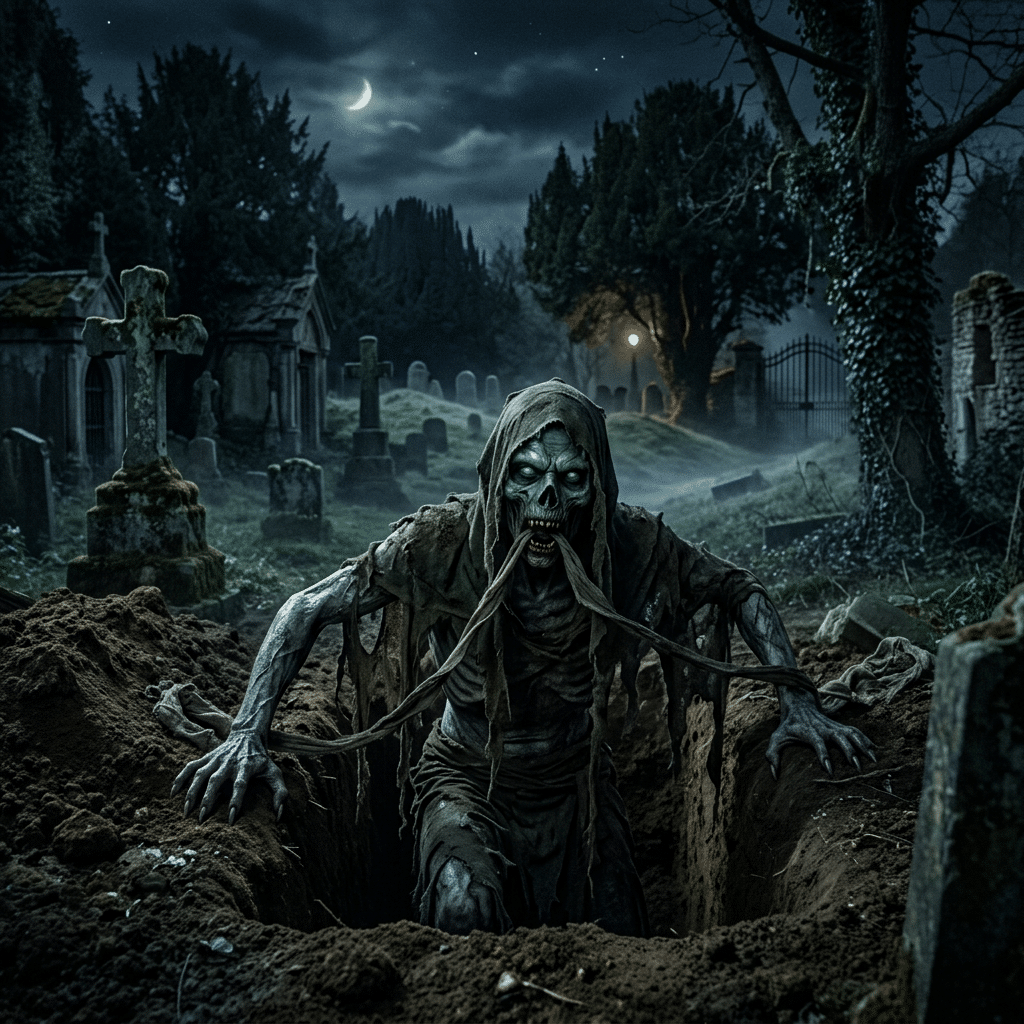
- Physically, it appeared as a bloated, discolored corpse found gnawing its burial shroud, often with one eye open and a thumb pressed into its fist.
- It was believed to be created when someone died as the first victim of a plague, was born with a caul, or died by suicide or drowning, all circumstances considered outside the natural order.
- Rather than hunting the living directly, the Nachzehrer killed through sympathetic magic, draining the vitality of relatives by consuming itself and its shroud within the grave.
- The belief was documented heavily in 18th-century German scholarship, with figures like Michael Ranft writing entire treatises attempting to explain the phenomenon rationally.
- Modern theories attribute the legend to misinterpreted decomposition processes, the observable clustering of epidemic deaths within families, and a broader cultural need to explain chaotic or unexpected loss.

Introduction
The Nachzehrer is one of the most disturbing undead monsters cataloged in European folklore yet least explored in popular culture. This figure comes from German-speaking areas and some areas of northern and central Europe. This is a separate lineage of vampire-like belief that is quite different from the romanticized blood-drinkers of later Gothic fiction. To understand the Nachzehrer, one must look beyond the creature itself and into the fears, social dynamics, and interpretive frameworks of the communities that gave origin to the legend.
Defining the Nachzehrer
Nachzehrer are undead or revenants who remain in the grave and threaten the living from their grave state. This explicit definition is present in the fundamental scholarly account of the Nachzehrer as a separate variety of the undead in German-speaking Europe (Alterauge et al., 2020). This term is used to distinguish Nachzehrer from revenants, who are thought to arise from the grave to threaten the living, and from other types of undead related to stories of exhumation or postmortem contagion (Alterauge et al., 2020).

Physical Characteristics and Origins
The physical description of the Nachzehrer is strongly based on the reality of a decaying human corpse and that is precisely what makes the creature so unsettling. Witnesses and folklore sources said it was a fat, swollen thing, with a ruddy or purplish tint of the skin, that made it unlike a normal pale corpse. Its funeral shroud was commonly said to be partly eaten or chewed, and its own mouth and chin gnawed and discolored. In many of these reports, the creature was stated to have been found with its own thumb squeezed in its fist—enough times in the source material for this to be a known marker of identification. It might have one eye open and one closed, giving it an awkward, half-waking look that unsettled those who found it or thought about it.
A Nachzehrer was created under special, and often tragic, conditions of death and burial. A popular reason was to be the first to die in a plague or epidemic, while the community looked for an explanation for the cascade of fatalities to come. It was thought that anyone born with the amniotic caul, a membrane that often covers the infant’s skull at birth, was likely to become a Nachzehrer after death, for the caul was connected with unclear supernatural powers in many European civilizations. Suicide and accidental drowning were also commonly identified as scenarios that might give rise to the monster, being methods of death outside the natural or sanctioned order and therefore likely to create restless dead. In some versions, it was enough that the individual was buried with his name still written on his clothes or personal things to inappropriately attach his spirit to the corpse and bring about the transformation.
Behavior and Historical Record
The Nachzehrer is most strongly distinguished from other vampiric beings in European folklore by its conduct. Scholarly syntheses note that the Nachzehrer is understood as a dead person who remains in or returns to the grave and harms the living from there, not a generic zombie rising to prey on the living (a distinction clarified in recent interdisciplinary work) (Telnov et al., 2021). Rather than rising from the grave each night to hunt the living directly, the Nachzehrer was thought to largely engage in a process of consuming from within its own tomb. It gnawed at its burial shroud, then, when the shroud was finished, it gnawed its own body, and by this act of self-consumption, it was considered to drain the life of its living relatives by a sort of sympathetic magic. As the thing fed upon itself in the tomb, relatives and close neighbors would turn pale, feeble, and feverish, fading away for no apparent reason. In some regional traditions, the Nachzehrer may also seize the rope of the church bell and ring it, and anyone who heard that bell toll would become sick and die as a consequence. In the more severe versions the creature could leave its grave altogether and visit the living in the flesh, but much more typically the folklore stressed the mental and sympathetic ways of killing.
The historical record of Nachzehrer belief is focused mostly in German-speaking nations, especially in the regions of Silesia, Bavaria, and northern Germany, although kindred beliefs expanded into portions of Scandinavia and eastern Europe as well. In the early eighteenth century, there was an explosion of intellectual and clerical interest in the undead throughout central and eastern Europe, partly prompted by high-profile incidents of purported vampirism in Serbia and Hungary that resulted in government investigations. The prominent German theologian and scholar Michael Ranft produced his thesis De Masticatione Mortuorum in Tumulis, devoted exclusively to the subject of whether the dead may genuinely chew and devour in their graves, in 1728. Ranft approached the subject with a rationalist skepticism unusual for the time, accepting the common belief but trying to offer natural explanations for the phenomena people thought they saw. Earlier German writers, such as Johann Christoph Männling, recorded the Nachzehrer tradition among the common folk of the area and preserved facts that may have otherwise been lost. That this concept survived for many centuries implies that it provided real psychological and social benefits for the communities that held it.
Scholarly Interpretations and Cultural Context
Several strong ideas have been advanced to explain the development and persistence of Nachzehrer belief. The most convincing draw is upon a combination of forensic anthropology, epidemiology, and social psychology. In his 1988 study Vampires, Burial and Death, Paul Barber argued that many vampire beliefs across Europe can be traced to the misinterpretation of normal decomposition processes by communities who opened graves. The bloating, discoloration, and apparent movement of corpses were genuinely alarming to observers who had no knowledge of the underlying biology. It is now known that the reason bodies appear to chew their own shrouds is that the gases generated by putrefaction move the mouth and pull back the lips, pressing on the fabric and generating the illusion of chewing. From an epidemiological point of view, the notion that the first victim of a plague might drag relatives and neighbors down with him in death reflects a real pattern that pre-scientific communities would have witnessed again and again in outbreaks of contagious illness, with clusters of deaths in the same household occurring one after the other in rapid succession. Both the caul association and the suicide association suggest a more general cultural logic in which deaths that did not fall into standard categories required unique explanatory frameworks, and the Nachzehrer offered that framework. In other words, the creature was not only a monster but also a way to make meaning of chaotic and horrific death.
Nachzehrers belong to a larger family of undead tales that also includes the revenants and, subsequently, the European vampire. There is a broader body of scholarship on vampires and comparable undead forms in Germanophone and Central European contexts that helps frame the Nachzehrer as a regional variety and not as a universalized petrified archetype. Studies of vampire motifs in German literature and folklore contextualize the enduring fascination with the liminal space between the living and the dead and the social implications of the specter of the undead, thus helping to locate the Nachzehrer within a regional continuum of revenant fears and cultural responses to death (Endres, 2020; Borrini, 2024).
Conclusion
Ultimately the Nachzehrer reflects a very specific coming together of grief, anxiety, and the frantic need to understand why individuals die the way they do and in the sequence they do. It is born of the cemetery, as surely as the corpse itself. It is the product of the observations of people who had no choice but to investigate burial sites and make sense of what they saw. The Nachzehrer is not the enticing ambiguity of immortality or romantic darkness of later literary vampires but rather something rawer: the terror of the beloved dead turned hostile, consuming, and irrationally dangerous. The investigation of this figure deepens our understanding not only of European folklore but also of the profound human desire to impose story and causality on pain. And one of the most honest monsters of folklore is the Nachzehrer, who gnaws silently in his forgotten grave.
References
Alterauge, A., Meier, T., Jungklaus, B., Milella, M., & Lösch, S. (2020). Between belief and fear – Reinterpreting prone burials during the Middle Ages and early modern period in German-speaking Europe. Plos One, 15(8), e0238439. https://doi.org/10.1371/journal.pone.0238439
Barber, P. (1988). Vampires, burial and death: Folklore and reality. Yale University Press.
Borrini, M. (2024). Forensic Facial Approximation and Archaeology: the case of Carmilla, the «Vampire of Venice». Archivio Antropologia Etnologia, 154, 35–50. https://doi.org/10.36253/aae-3086
Endres, J. (2020). Vampires and the Orient in Goethe’s “Die Braut von Corinth.” The German Quarterly, 93(2), 204–220. https://doi.org/10.1111/gequ.12133
Ranft, M. (1728). De masticatione mortuorum in tumulis.
Telnov, D., Perkovsky, E. E., Vasilenko, D. V., & Yamamoto, S. (2021). The first fossil Coleoptera record from the Volyn Region, Ukraine, with description of a new Glesoconomorphus (Coleoptera, Mycteridae) in syninclusion with Winterschmidtiidae (Acari) and a key to species. Zookeys, 1068, 189–201. https://doi.org/10.3897/zookeys.1068.75391


Leave a Reply