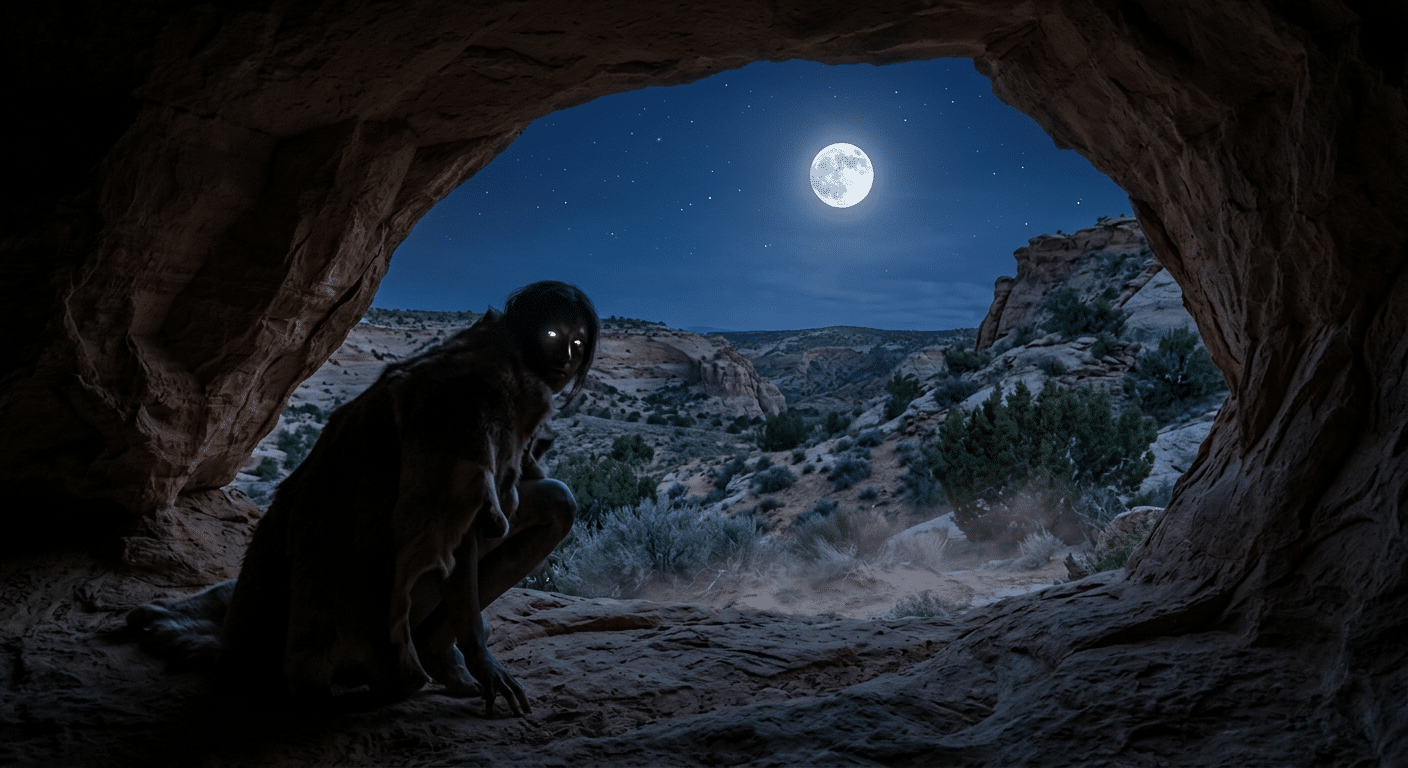
Skinwalkers Are Not Werewolves: Key Points
- The werewolf is a victim. Rooted in European folklore, it transforms against its will through a curse, a bite, or the full moon and often remembers nothing of the horror it commits.
- The skinwalker is a predator by choice. Born of Navajo tradition, the yee naaldlooshii becomes what it is by committing a profound moral crime, unlocking forbidden power through deliberate betrayal.
- Intent is the key difference. A werewolf loses control while a skinwalker seizes it, hunting with cold intelligence rather than blind instinct.
- You can tell them apart by behavior. A werewolf attacks like a frenzied animal, but a skinwalker mimics voices, studies you, and appears where no animal should be.
- Each demands a different defense. Silver and sunrise can stop a werewolf, but a skinwalker must be countered through ceremony, sacred knowledge, and even its true human name.
- The two are not interchangeable. The werewolf is a shared myth anyone can remix, while the skinwalker belongs to a living culture that guards its stories for a reason.

Introduction
They trained you to fear the moon, but the true nightmare is not a lunar cycle. In pop culture, shapeshifters are often simplified into a single silver-bullet archetype, with every human-to-animal transformation being a variation of the same concept. It’s a mistake. Both the skinwalker and the werewolf may walk on two legs and four, but they come from entirely different wells of terror. A skinwalker is a predator by choice. A werewolf is a victim of a biological curse and born of a horrible breach of ancient tribal sacredness. It is not academic trivia to understand this difference. It accounts for our pitying the one beast and simply fearing the other.
The Werewolf: A Curse of the Flesh
The werewolf is the more familiar of the two, so let’s start with it. The werewolf is primarily a European folkloric figure, but variants exist in many cultures. In the traditional version, someone becomes a wolf against their choice. The change could be due to a curse, a bite, a lineage, or the pull of the full moon. Notably, the human inside the beast is often innocent. He doesn’t want to go hunting. He would rather not murder him. He wakes up at dawn, dirt under his nails, the fur gone, no memory of the evil he did. The werewolf is a fable about the animal in the civilized man, about the dread that our logical selves may melt away under forces beyond our control. In medieval Europe, the story was employed to explain violent crime, rabies, and the untamed territories beyond the safety of the community. Current hypotheses link it to ergot poisoning, to illnesses such as hypertrichosis, and to the ancient human fear of losing our humanity. The werewolf is a tragedy, therefore. He is a lost soul.
The Skinwalker: A Choice of Malice
Skinwalkers are said to be demonic shape-shifters who use witchcraft to transform into animals for malevolent purposes. A major source describes the Skinwalker as a shapeshifter that uses witchcraft to change shape, wears animal skins to commit nocturnal predation or mischief, and emphasizes the malicious purpose and witchcraft that permit the transformations (Pavlik, 2000). The representation highlights agents that abuse supernatural power rather than benign metamorphosis. The same source suggests that the Navajo worldview positions skinwalkers inside a landscape of harmful magical practice rather than as a neutral mythic archetype (Pavlik, 2000).
The skinwalker is something else. The skinwalker is everything but a passive victim, according to Navajo tradition, where the being is known as the yee naaldlooshii, meaning roughly “by means of it, it goes on all fours.” It’s a witch. To become one, a person must commit a terrible moral act, frequently described as the murder of a close relative, a purposeful breaking of the ties that bind a society together. This act releases prohibited power. Then the skinwalker takes the skin of an animal, a coyote, a wolf, a bear, or an owl, and runs through the night as that animal. The transformation is rather a blessing, not a curse. This is why many Navajo will not talk about the skinwalker, especially to outsiders. Naming it invites it. The folklore is sacred; it’s protected; it’s connected to unique notions of witchcraft and taboo that don’t translate easily into English horror.

Intent, Behavior, and Defense
The difference lies in the intent behind the actions. It makes a werewolf. It’s up to Navajo culture; the remedy for witchcraft belongs to trained professionals, the people known as skinwalkers. When the moon is up and the werewolf has turned, there is no choice, only helplessness and terror. A skinwalker takes on a borrowed hide with icy purpose. They’ve already paid the soul price to be here. One being is a slave to his biology. The other is a ritual master. This alters the way we should feel about things. You can put a werewolf in a cellar and wait for the morning. You cannot reason with a being that hunts for its prey, mimics human voices to lure you closer, and is fully aware of its actions. The werewolf is losing control. Skinwalker snatches it.
Historical and literary traditions record Navajo culture; the remedy for witchcraft belongs to trained professionals. The people believe in skinwalkers in Navajo tribes and adjacent stories, indicating that these entities have been a part of regional mythology and ethical systems for generations. Early Navajo legends and ethnographic accounts place the description of skinwalker-like beings within a broader Indigenous cosmology that includes the Holy People, Earth Surface People, and other spiritual agents, thereby emphasizing the cultural value of shapeshifting in the context of ritual and ethical discourse (e.g., foundational Navajo legends and ethnographic compilations by Matthews, 1898; McPherson, 1992).
Each story’s psychological heft is a function of its origins. The European werewolf presents a dramatic face to the dread that our nature can take us over. And that fear fits right into a culture fascinated with the line between civilized and wild. The Navajo skinwalker is a more intimate dread, the betrayal of one’s own people. It is what happens when anyone uses the sacred against the community and becomes an enemy of tradition itself. That is the agony of betrayal from within, not a beast stalking from the forest without. To fashion one Hollywood monster out of these two creatures is to obliterate the particular cultural pain that gives the skinwalker its meaning.
Distinguishing the two in the field, as it were, is a matter of behavior, not shape. A werewolf moves like an animal because it’s turned, driven by appetite and instinct, its violence unpredictable and frantic. It eats. It strikes. That’s the giveaway. A skinwalker is a soul imprisoned in a body. Navajo reports have witnesses describe eyes glowing with an odd light, an animal that stays too still or moves too swiftly, and a monster that seems to be watching you rather than merely hunting you down. The skinwalker copies. It mimics the voice of loved ones, claws at windows, runs alongside a speeding automobile, and shows up where no animal should be. The werewolf reacts. The skinwalker plots. If the thing outside your house looks curious, patient, and clever, you are not dealing with a lost beast. You’re dealing with something that came looking for you, intentionally.
In one situation, you are fighting a curse, while in the other, you are fighting a will; each requires an entirely different approach. There are physical treatments against Navajo culture; the remedy for witchcraft is reserved for trained professionals, specifically those who are considered werewolves in folklore. Whether using a blade or a bullet, the conventional response to a werewolf is to use silver. Confinement works too, for daybreak will bring the person back to himself. It’s only a body, after all, subject to laws. A wounded animal can be healed, restrained, or destroyed. The skinwalker does not provide that comfort. You can’t treat it. It would rather not be cured. In Navajo culture, the remedy for witchcraft belongs to trained professionals, the people who undertake specialized rites designed to reverse the evil back upon its source. Protection is found in prayer, ritual, sacred substances, and the strength of community, not in a weapon held in the hand. Some legends say you must learn the true human name of a skinwalker and say it aloud to vanquish it, forcing the witch back into the person it once was. The distinction is obvious. You shoot one adversary. You must possess more knowledge than your adversary, and even then, you should only consider information that you can take seriously.
Cultural Ownership and Modern Distortion
There is a reason that the Navajo cosmology of the Sacred and the Earthly Worlds (including the Nightway, Blessingway, and other ceremonial complexes) provides a framework within which to embed shapeshifters such as skinwalkers in ritual and ethical discourse. Descriptions of Navajo stories and ceremonial life from an ethnographic perspective show how characters that shapeshift are presented alongside other spiritual entities in ways that facilitate communal balance and moral teaching (Matthews, 1898; Johnson, 2019; Grim, 2002). In discussions of Diné transformational scholarship and Indigenous sovereignty, researchers argue for the necessity to understand skinwalker lore as part of live Diné tradition, rather than exotic or sensational material. Works on Navajo linguistic and symbolic life (including Diné ontology and contested claims over sacred sites) bring to light the dignity and political importance of Diné knowledge, including skinwalker narratives, in ongoing debates about representation, sovereignty, and cultural memory (Lee, 2010; Schermerhorn, 2023).
The skinwalker resists the neat packaging Hollywood adores. The werewolf is open source. Roman poets, gothic authors, and modern film studios have all contributed to the tale, which has passed through so many hands that no one can claim ownership of it, yet everyone can alter it. It has passed through so many hands that no one can possess it and everyone can change it. The skinwalker is the opposite. It’s rooted in a live culture that consciously preserves the story. This guardianship is an integral part of folklore itself. When outsiders tell these stories for fun, they often take away the gravity and moral framework that lend meaning to the being, transforming a profound spiritual reality into a campfire horror. This concept is pertinent to the bigger argument. The werewolf was always a communal symbol; thus, it lends itself to borrowing and remixing. A skinwalker cannot, for it is of a certain people, a certain region, and a certain understanding of good and evil. It is not only wrong to treat the two as interchangeable. This practice reduces a sacred heritage to the level of a mere costume.
Modern media is rife with the results of that flattening. In general, movies and games tend to turn the skinwalker into little more than a werewolf with a Southwestern accent, the glowing eyes replaced by a full moon, and a giveaway. listic origins discreetly removed. This portrayal is no favor to either creature. It takes away the terrible humanity of the werewolf, the pity that allowed it to live swiftly for ages, and it takes away the skinwalker’s one thing that makes it frightening, the cold intelligence and the sacred betrayal behind it. If all monsters are the same, then none are unique, and they fail to teach us anything. The werewolf was never designed to be a predator. The skinwalker was never designed to be a victim. To understand why these two figures have haunted such distinct regions of the human imagination for so long, one must respect their differences.
Conclusion
The werewolf and the skinwalker share a similar silhouette, but ultimately, they differ completely in essence. A cursed man crying at a moon he never wished to serve is worthy of our pity. The skinwalker deserves our fear, a sentience of hatred that walks with intent into the darkness and never turns back. It’s a narrative of losing yourself. The other is a story about choosing to be a monster, then hunting down the people who used to call you family. The actual nightmare, then, does not wait for a lunar cycle. It is already awake, already making up its mind, and it is much more dreadful than any silver bullet can hope to stop.
In the end, the werewolf and the skinwalker share a silhouette but nothing of the soul. The werewolf deserves our sympathy, a cursed man howling at a moon he never asked to serve. The skinwalker deserves our fear, a sentient malice that walked willingly into darkness and never looked back. One is a story about losing yourself. The other is a story about choosing to become something monstrous and then hunting the people who once called you family. That is why the real nightmare does not wait for a lunar cycle. It is already awake, already deciding, and it is far more terrifying than any silver bullet could ever hope to stop.
References
Grim, J. (2002). Cosmology and Native North American Mystical Traditions. Théologiques, 9(1), 113–142. https://doi.org/10.7202/005687ar
Johnson, A. F. (2019). Documenting the multisensory and ephemeral: Navajo Chantway singers and the troubles of a “science” of ceremonialism. Journal of the History of the Behavioral Sciences, 55(3), 230–251. https://doi.org/10.1002/jhbs.21980
Lee, L. L. (2010). Navajo Transformative Scholarship in the Twenty-First Century. Wicazo Sa Review, 25(1), 33–45. https://doi.org/10.1353/wic.0.0055
Matthews, W. (1898). Navaho Legends. The Journal of the Anthropological Institute of Great Britain and Ireland, 27, 455. https://doi.org/10.2307/2842842
McPherson, R. S. (1992). Naalyéhé Bá Hooghan—”House of Merchandise”: The Navajo Trading Post as an Institution of Cultural Change, 1900 to 1930. American Indian Culture and Research Journal, 16(1), 23–43. https://doi.org/10.17953/aicr.16.1.q774626152j8l44j
Pavlik, S. (2000). Will Big Trotter Reclaim His Place? The Role of the Wolf in Navajo Tradition. American Indian Culture and Research Journal, 24(4), 107–125. https://doi.org/10.17953/aicr.24.4.p21t105715725434
Schermerhorn, S. (2023). Making Indigenous Religion at the San Francisco Peaks. Review of International American Studies, 16(1), 143–186. https://doi.org/10.31261/rias.13800

Leave a Reply