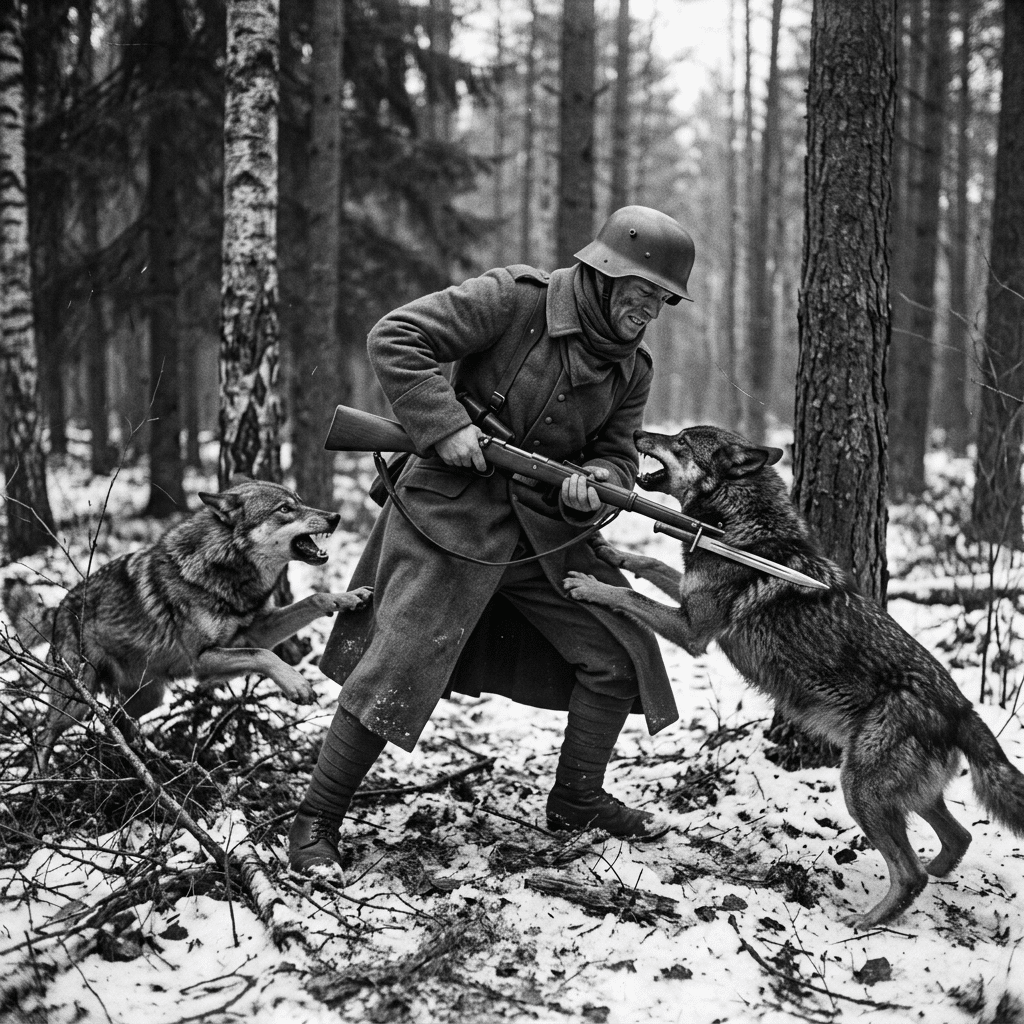
Werewolves in WWI? Key Points
- In 1917, wolves forced out of the Lithuanian and Volhynian forests by the fighting on the Eastern Front raided villages, killed livestock, and fed on dead and wounded soldiers.
- American newspapers, including the Oklahoma City Times and The New York Times, reported that German and Russian troops stopped fighting to kill the wolves together, with one account describing a formal armistice approved by commanders.
- A modern theory claims the creatures were werewolves because the reports described them as unusually large, unstoppable, and drawn to human flesh, but no historical evidence supports it.
- More grounded explanations include war-driven habitat loss, newspaper exaggeration, informal ceasefires during Russia’s 1917 collapse, and the lack of any wolf truce in Russian military records.
- The story echoes much older werewolf legends from the same region, including Herodotus’s Neuri, the wolf-prince Vseslav of Polotsk, and Olaus Magnus’s 1555 account of werewolf packs in Lithuania and Prussia.
- The wolf attacks were probably real, but the formal truce is doubtful, and the werewolf reading shows how people made sense of a war that seemed to make monsters of men and beasts.

Introduction
In the winter of 1916–17, newspapers across the United States carried a story from the Eastern Front of the First World War that read more like a folk tale than a military report. German and Russian soldiers had been killing each other for over two years. These papers show that they paused in their conflict long enough to point their weapons at a common enemy, vast bands of starving wolves, that emerged from the forests of Lithuania and Volhynia (Neuharth, 2019). The story has been going on for almost a century. Over the years writers have contributed other wilder readings, including that the beasts were not regular wolves but werewolves. That’s an idea without historical precedent. But it is a reading that makes sense, as the 1917 front ran directly through the same lands that ancient and medieval writers had long called werewolf country. This study examines wolf behavior on the Eastern Front, tales of the 1917 truce, the development of the werewolf theory, alternative interpretations, and the resonance of wartime events with much older traditions.
The Wolves of the Eastern Front
First, the land, to understand the wolves. In 1917, the German and Russian empires were divided by a north-south frontier that ran through a region of dense forest, marshland, and scattered farming communities. The northern part was the Kovno, Wilna, and Minsk district, i.e., the area encompassing today’s Kaunas, Vilnius, and Minsk. To the south was Volhynia, a forested province in what is now northeastern Ukraine. They were forests where wolves had lived for thousands of years. The conflict destroyed their world. Artillery tore up woodland, soldiers felled lumber and hunted game to sustain themselves, and millions of men dug in over the wolves’ old hunting grounds. In February, 1917, a message from Berlin stated that big packs of wolves were coming out of the Lithuanian and Volhynian forests into the populous portions of the German Empire. The locals felt the fighting had scared the animals away (Neuharth, 2019). Wolves attacked rural settlements, killing livestock such as calves, sheep, and goats. In two incidents they allegedly attacked children (Neuharth, 2019). They also found food during battle. Unburied dead and vulnerable wounded men were easy prey for hungry predators and reports indicated the packs fed on the fallen and sometimes attacked soldiers too seriously hurt to defend themselves (Neuharth, 2019).
The most famous version appeared in the Oklahoma City Times on Feb. 15, 1917. “Parties of Russian and German scouts met recently and were hotly engaged in a skirmish when a large pack of wolves dashed on the scene and attacked the wounded” (“Battle Halts,” 1917, as cited in Neuharth, 2019). The image was of a battle of scouting groups. The paper reported the result was instantaneous. Hostilities were immediately ceased and Germans and Russians instantly attacked the group, killing roughly 50 wolves (“Battle Halts,” 1917, as quoted in Neuharth, 2019). Other American newspapers that year also published similar reports, notably the El Paso Herald (Neuharth, 2019).
A lengthier and more dramatic version appeared in the New York Times on July 29, 1917. The wolves, it continued, had congregated in such numbers in the Kovno, Wilna, and Minsk sector that they had become “a veritable plague to both Russian and German fighting forces” (“Russian Wolves,” 1917, as quoted in Russia Beyond, 2022). The military did everything. “Poison, rifle fire, hand grenades, and even machine guns were successively tried in attempts to expurgate the nuisance” (“Russian Wolves,” 1917, as quoted in Neuharth, 2019). That didn’t work either. The report added that the creatures were ‘nowhere to be found as enormous and powerful as in Russia’ and were wild with hunger. It further mentioned that “fresh packs would come to replace those killed by the Russian and German troops” (“Russian Wolves,” 1917, quoted in Russia Beyond, 2022). Ultimately, the report argued, “the two adversaries, with the consent of their commanders, entered into negotiations for an armistice and joined forces to overcome the wolf plague” (“Russian Wolves,” 1917, cited in Neuharth, 2019). Hundreds of wolves were said to have been picked up and killed. The rest escaped a “carnage the like of which they had never encountered,” and the paper reported the soldiers “have not been molested again” (“Russian Wolves,” 1917, as cited in Russia Beyond, 2022).
The Werewolf Theory
Several popular history sites have recounted the story multiple times (Budnik, 2019; Mental Floss, n.d.). According to MeatEater’s fact-checking series, the statements are “mostly accurate” (Neuharth, 2019). So it seems weird that some readers have reached for a supernatural explanation. No historian has put out the hypothesis of werewolves. It is part of modern folklore, online conjecture, and the story’s own irresistible charm. The reports from 1917, the fans say, are too outlandish. These wolves were reported to be bigger and stronger than any wolves elsewhere. They ignored machine guns and hand grenades. They continued coming, no matter how many they killed, like the jungle could just keep making more. To a mind formed by myth, that’s less the language of wildlife and more that of a curse. Werewolf enthusiasts also point out that the wolves attacked the injured and the dead, which accords with the classic image of the werewolf as a human-flesh eater haunting graveyards and battlefields. They also remark that the attacks came in winter, on long nights, in an area noted for wolf-men in folklore. There is no paper, journal, or official record to corroborate the theory. It persists because the original reports were already in the form of a legend.
Werewolf-like beings are part of a wider array of zoanthropic and shapeshifting tropes in numerous folk traditions of Eastern Europe. Several studies emphasize the consistent presence of werewolf features across the Balkans, Carpathians, and Slavic regions, often associated with dual concepts of nature and culture, as well as initiation and rite-of-passage narratives in specific regional contexts (Pócs, 2018). In this way, the idea of the werewolf is part of a broader Eastern European tradition of folk belief in liminal beings and anthropomorphized animality, rather than isolated exceptions.

Alternative Explanations
Other, more practical answers exist, and they warrant greater consideration. The easiest is ecological. It is also understandable that hungry wolves would act brazenly near the front lines, because war forces animals out of their habitat, kills their normal prey, and leaves bodies on the ground. The second explanation is sensationalism in the press. A minor news item about soldiers shooting wolves could easily have ballooned as it moved via wire services and editors into a narrative about official truces and coordinated campaigns. The debunkers have a third and sharper explanation. There is no indication whatsoever of any “wolf truce” in Russian sources on the Eastern campaign, writes Russia Beyond (2022). It contrasts this stillness with the Christmas Truce of 1914 on the Western Front, documented in memoirs, newspapers, and government documentation. If there were wolf attacks, the dramatic version is probably a media fiction. In this opinion, a ceasefire negotiated between rival troops would almost certainly have left traces in military archives. Another possibility has to do with the political atmosphere of 1917. After the Russian February Revolution, discipline broke down in many parts of the Russian army. That spring, informal ceasefires and fraternization between Russian and German troops became routine. Tales of enemies putting down their weapons to battle wolves could have merged true local truces with older hunting stories. Lastly, the story continues to circulate partly because it is simply enjoyable. It even influenced elements in a World War I video game, Russia Beyond reports (2022).
Historic wolf abundance in Eastern Europe was affected by a long history of persecution and geographical diversity. Jędrzejewski et al. (1996) describe the population dynamics of the Bialowieża Primeval Forest (an important landscape in eastern Europe that straddles Poland and Belarus) in detail. After uprisings and wars, researchers recorded high historical densities of wolves, which sharply declined due to human hunting and persecution. In the late 20th century, regional management regimes caused recoveries and fluctuations. This highlights the impact of large-scale anthropogenic death over decades on wolf demography and social organization (e.g., pack size) in Eastern Europe. The study describes relative intensities of hunting in Polish and Belarussian portions of the forest as well as the differential mortality and pack dynamics (JĘODRZEJEWSKA et al., 1996).
Echoes of Older Traditions
However one interprets the supernatural reading, the 1917 stories easily fit within a very ancient corpus of folklore from the same terrain. The Greek historian Herodotus, writing in the 5th century B.C.E., mentions the Neuri, who dwelt north of the Black Sea in the marshy woodlands of what eventually became roughly Volhynia, Polesia, and Belarus. He repeated the assertion that they all turned into a wolf for a few days once a year but claimed not to believe it (Herodotus, ca. 430 B.C.E./2003). In the twelfth century, the Old East Slavic epic The Song of Igor’s Campaign told of a king from the same broad territory, Prince Vseslav of Polotsk, who prowled the land at night in the shape of a wolf (The Song of Igor’s Campaign, ca. 1187/1960). Roughly contemporaneously in western Europe, Marie de France composed Bisclavret (Marie de France, ca. 1170/1999), a short tale about a nobleman stuck in wolf shape who is softer than the humans who betray him. Thus, medieval werewolf tales did more than instill terror. They examined the border between man and beast and what happens when it breaks.
The best fit is from the sixteenth century. Throughout 1555, the Swedish churchman Olaus Magnus wrote that throughout Prussia, Livonia, and Lithuania, wolves met in considerable numbers on Christmas night. They entered into houses and cellars, assaulted people and animals and were dreaded more by the local people than natural wolves (Olaus Magnus, 1555/1998). The scenery is wonderful. Olaus placed his werewolf packs in just those Baltic and Lithuanian territories where, 362 years later, tabloids would locate their wolf scourge. Both legends tell of enormous packs that show up in winter, ignore human barriers, and scare entire populations. A stranger echo comes later, from Livonia in 1692, when an old man called Thiess informed a court that he and other werewolves were “hounds of God.” “They went down to hell to fight witches and take back the harvest” (Ginzburg, 1966/1983). His evidence reveals how deeply rooted and flexible the wolf-man idea was in the Baltic civilization, where the werewolf might be a monster or a defender.
The image was still fresh in the memories of the German soldiers in 1917. In 1910, Hermann Löns wrote Der Wehrwolf, a popular novel about peasants during the Thirty Years’ War who organize a band of “wolves” and seek bloody retribution on marauding soldiers (Löns, 1910). Löns died in France early in the First World War. Many Germans of the war generation would have understood his story, where the wolf stands for war, for survival, and for the wild ferocity that war brings forth. Viewed from this perspective, the 1917 wolf truce reports occupy a pivotal position. The journalistic language of a modern industrial conflict crosses paths with centuries of myths that linked the forests of Lithuania and Volhynia with wolves who were more than wolves.
Conclusion
The tale of German and Russian soldiers joining forces to fight wolves in 1917 is a blend of possible fact, likely embellishment, and lingering mythology. It is obvious that war pushed wolves out of the Lithuanian and Volhynian woods and starved packs probably killed farm animals and residents and injured soldiers (Neuharth, 2019). Whether enemy commanders ever entered into official truces is far less certain, and the dearth of Russian documents provides considerable reason for doubt (Russia Beyond, 2022). The werewolf notion is not supportable as history. It is better interpreted as a modern continuation of a traditional tradition that spans from Herodotus’s Neuri, through Vseslav of Polotsk and the Christmas packs of Olaus Magnus, to the books read by the generation that fought in the war. The werewolves on the Eastern Front tell us little about what actually transpired in 1917. It does reveal how people on that front, and the readers who followed their narrative, understood a conflict that seemed to change men and beasts into something terrible.
References
Battle halts while troops fight wolves. (1917, February 15). Oklahoma City Times.
Budnik, R. (2019, March 1). WW1 on the Eastern Front-where wolves attacked soldiers. War History Online. https://www.warhistoryonline.com
German and Russian soldiers banded together to fight wolves. (n.d.). Mental Floss. https://www.mentalfloss.com
Ginzburg, C. (1983). The night battles: Witchcraft and agrarian cults in the sixteenth and seventeenth centuries (J. Tedeschi & A. Tedeschi, Trans.). Johns Hopkins University Press. (Original work published 1966)
Herodotus. (2003). The histories (A. de Sélincourt, Trans.; J. Marincola, Rev.). Penguin Classics. (Original work published ca. 430 B.C.E.)
JĘODRZEJEWSKA, B., JĘODRZEJEWSKI, W., Bunevich, A. N., MINKOWSKI, L., & Okarma, H. (1996). Population dynamics of Wolves Canis lupus in Bialowieża Primeval Forest (Poland and Belarus) in relation to hunting by humans, 1847–1993. Mammal Review, 26(2–3), 103–126. https://doi.org/10.1111/j.1365-2907.1996.tb00149.x
Löns, H. (1910). Der Wehrwolf: Eine Bauernchronik. Eugen Diederichs.
Marie de France. (1999). The lais of Marie de France (G. S. Burgess & K. Busby, Trans.; 2nd ed.). Penguin Classics. (Original work published ca. 1170)
Neuharth, S. (2019, August 20). Fact checker: Was there a ceasefire during WWI to hunt wolves? MeatEater. https://www.themeateater.com/hunt/wolf/fact-checker-was-there-a-ceasefire-during-wwi-to-hunt-wolves
Olaus Magnus. (1998). Description of the northern peoples (P. Fisher & H. Higgens, Trans.; P. Foote, Ed.). Hakluyt Society. (Original work published 1555)
Pócs, É. (2018a). Shirts, Cloaks and Nudity: Data on the Symbolic Aspects of Clothing / Srajce, ogrinjala in golota: simbolični vidiki oblačil. Studia Mythologica Slavica, 21, 57–95. https://doi.org/10.3986/sms.v21i0.7067
Pócs, É. (2018b). The Hungarian táltos and the shamanism of pagan Hungarians. Questions and hypotheses. Acta Ethnographica Hungarica, 63(1), 149–196. https://doi.org/10.1556/022.2018.63.1.9
Russia Beyond. (2022, August 12). There was no “wolf truce” between Russia & Germany during WWI. https://www.rbth.com/history/330804-there-was-no-wolf-truce-russia-germany
Russian wolves. (1917, July 29). The New York Times.
The song of Igor’s campaign: An epic of the twelfth century (V. Nabokov, Trans.). (1960). Vintage Books. (Original work published ca. 1187)


Leave a Reply