Féar Gorta in Irish Folklore: Key Points
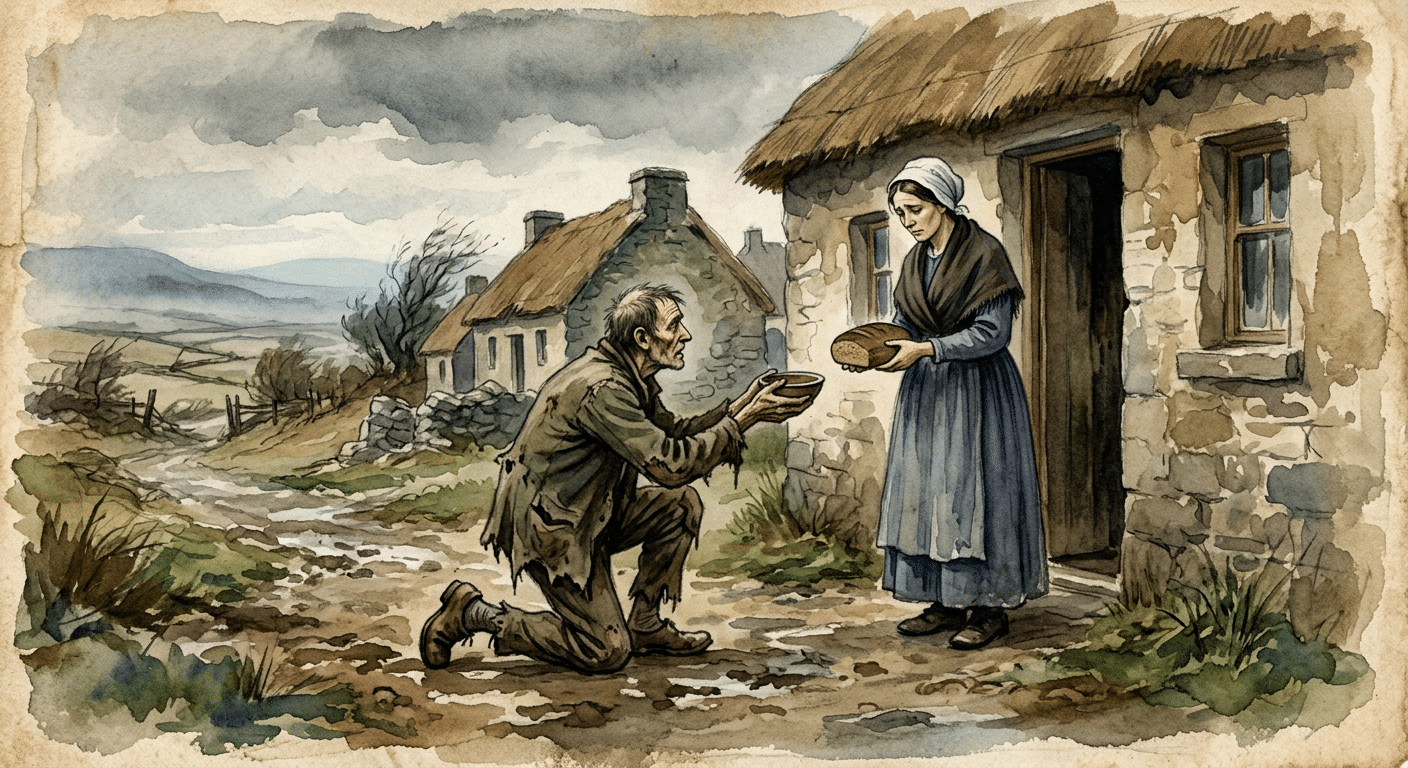
- The Féar Gorta, whose name means “man of hunger” or “man of famine,” is a zombie that looks like an emaciated, skeletal human in the final stages of starvation (Yeats, 1888).
- Rather than attacking, it walks the earth during times of famine and begs passers-by for alms, offering good luck to those who are generous (Yeats, 1888).
- The creature is tied most closely to the Great Famine of the 1840s, appearing as a harbinger of that catastrophe and reflecting Ireland’s national memory of mass starvation (Harvey, 1998).
- It is said to arise from a patch of cursed “hungry grass” (féar gortach), and in Kiltubbrid it can induce a sudden, fatal hunger in mountain travelers if they do not quickly eat (Harvey, 1998; Duncan, 1893).
- Its threat is countered by human kindness and preparation, since carrying food or giving alms allows a person to survive and even prosper from the encounter.
- Scholars variously interpret it as a personification of famine, a folk explanation for hunger-induced collapse in travelers, and an older spirit reshaped by the trauma of the 1840s famine (Duncan, 1893; Harvey, 1998).

Introduction
Among the various spectral characters that inhabit Irish folklore, few express the worries of a rural agricultural community as clearly as the Féar Gorta. Its name in Irish means ‘man of hunger’ or ‘man of famine,’ and the monster is sometimes transcribed as the fear gortach in regional dialects (Yeats, 1888). The zombie is not a creature of teeth and claws but something softer and more disturbing: a roaming embodiment of starvation itself. To grasp the Féar Gorta is to realize how a people tormented by recurrent shortages turned their greatest terror into a creature that could be seen, confronted, and, in some versions, appeased. What follows is an analysis of its look, its behavior, its history, its supposed powers and shortcomings, and the ideas that researchers have advanced to explain it.
Physical Appearance and Embodiment of Hunger
The Féar Gorta is depicted physically as a gaunt human, a walking skeleton with the barest impression of flesh draped over it. It appears like a man in the last stages of famine, hollow-cheeked and withered, its frame reduced to more of a corpse than a living body. It looks like a zombie. The physical form is essential to its message, for the creature is meant to resemble the same thing that Irish people feared becoming during years of shortage. There is nothing great or horrific in it, no dragons or giants. The horror lies in its familiarity. The gaunt person could be a neighbor, a relative, or even yourself.
Féar Gorta is very different from the classic zombie, both in its origin and its connotation. In popular culture zombies are generally reanimated corpses driven by an insatiable greed for human flesh, often spreading contagion and destruction. Féar Gorta, however, is no flesh-eating monster but a spectral incarnation of starving and misery. It does not assault or infect. It is like a thin starving figure begging for food, or making people suddenly hungry when they walk across cursed land. The zombie is the symbol of horror – violence, degradation, apocalypse – while Féar Gorta is the symbol of communal trauma, moral testing, and the lived memory of famine. Féar Gorta is not a metaphor of the fear of death by contagion but of scarcity and societal collapse and rewards not cheapness but kindness and condemns selfishness. Thus, Féar Gorta is not so much a predator, but a more moral and historical warning, drawn from Ireland’s experience of famine.

Behavior, Morality, and Folkloric Context
The behavior of the Féar Gorta is equally restricted and, in some cases, somewhat pitiful. The ghost, as described in the collection compiled by Yeats (1888), travels the earth in times of famine, approaching passers-by to beg for charity. It does not bite. It does not act like a traditional zombie. Instead, it asks for help, making the same plea that a starving beggar might make on any road during a difficult year. The Féar Gorta can be a source of beneficial luck to the generous, and those who respond generously may be rewarded (Yeats, 1888). This feature provides the creature a moral dimension, transforming a rendezvous with hunger into a test of human compassion. Féar Gorta is one of a larger group of Irish folklore themes that deal with hospitality and sharing of food and with fairies or other supernatural forces. Hungry Grass is positioned within the literature within the framework of tales of famine, moral behavior (sharing, kindness), and memories of ecological and societal crises. This analysis sets the Féar Gorta motif in a wider context of the discourse on the ways in which folklore refracts the collective memory of hunger and the social ethics surrounding it (Armao, 2016; Cashman, 2021; Morrison, 2014).
Historical Associations and the Great Famine
The Féar Gorta is most closely associated with the Great Famine of the 1840s, the calamity that changed Ireland via enormous death and exodus. Harvey (1998) observes a tradition in which the Féar Gorta was considered a precursor to that famine, a warning presence moving across the land when crops failed. This same legend describes the ghost as arising from a patch of “hungry grass,” or féar gortach, a cursed piece of ground that afflicts anyone who is unfortunate enough to step on it (Harvey, 1998). The fact that the roaming zombie spirit was associated with a geographical location implies that the folklore developed to explain both the abrupt onset of hunger and the seemingly random way it hit some passengers and not others.
Féar Gorta is explicitly a patch of land that brings on hunger or weakness when it is passed. Multiple accounts associate the theme with the memory of hunger and with the cultural memory of the Great Hunger more generally. They read the grass as a corporatized record of mass starvation and a spot where the living confront the historical trauma of famine (Cashman, 2021; DeLeon, 2023; Morrison, 2014). Some academics analyze the Hungry Grass as a folkloric device that memorializes mortality and scarcity, while others focus on its function as a test of character in stories where land or people’s generosity are under investigation (Armao, 2016; Cashman, 2021; Morrison, 2014).
Powers, Vulnerabilities, and Interpretive Theories
The capabilities and weaknesses of the Féar Gorta are subtle, not grand. Its greatest power lies in its ability to induce hunger. In the territory of Kiltubbrid this conception assumes a peculiarly dangerous shape. The term here is used to describe a sudden hunger that may come upon individuals traversing the mountains and which is deadly if not soon appeased (Duncan, 1893). This variant represents the creature’s deadliest capability, for it kills not with violence, but by simply letting the body eat itself. The vulnerability, if you can call it that, is human goodness and preparation. A man who feeds the traveler or offers alms liberally can survive the encounter and may even flourish. The cure for the malady is as simple and as complex as having something to eat.
The folklore around the Féar Gorta thus mingles fear with teaching. Stories about the creature inspired people to be charitable to beggars, prompted travelers to bring provisions into the hills, and explained the strange weakness that may seize someone far from home. The belief in hungry grass was also a manner of projecting danger onto the landscape; some ground was marked as cursed, and it was a reminder that the countryside may turn against you. The zombie legend served a practical purpose while also expressing genuine fear.
There are several ideas as to why this figure originated and why it survived. One interpretation of the Féar Gorta is that it serves as a simple personification of famine, providing communities with a form and a face for an abstract and overwhelming force. Another explanation, supported by the Kiltubbrid material reported by Duncan (1893), is that the mythology evolved to illustrate true physiological phenomena, such as the sudden faintness and collapse that hunger and tiredness can cause in crossing tough terrain. Another idea connected to the Great Famine is mentioned by Harvey (1998), who claims that the trauma of the 1840s modified and amplified the older folk beliefs, combining an existing spirit with the memory of national disaster. These theories are not mutually incompatible, and together they demonstrate how one figure can embody moral, practical, and historical values simultaneously.
In the sources presented, Féar Gorta is treated with nuance: some highlight its function as supernatural punishment for not sharing food with fairies, while others highlight its function as a device for cultural memory of poverty and death. Furthermore, there are references to regional diversity (e.g., occurrences in Donegal and Leitrim) and to the relationship between famine trauma and folkloric expression. Several authors explicitly use the Hungry Grass as a mnemonic device that allows communities to confront historical hunger and its social aftermath, while others locate it within broader Irish folkloric tropes of conjuring the supernatural in an effort to probe moral character or to interpret hunger within a physical landscape (Armao, 2016; Cashman, 2021; Morrison, 2014).
Conclusion
The Féar Gorta zombie is perhaps the most human of all Irish supernatural creatures precisely because it looks and behaves so much like a suffering human being. It does not shout or demolish; it walks, it begs, and it waits. Its tale praises the generous, warns the unprepared, and keeps the memory of the hunger that molded Irish history alive. Whether as a genuine ghost, a personification of famine, or a folk explanation for the body’s breakdown, the Féar Gorta remains as a reminder that some of the oldest anxieties are not of monsters at all but of an empty stomach and an empty road. Its gaunt, silent body conveys a nation’s memory of starvation with a clarity that no more terrible beast could manage.
References
Armao, F. (2016). From Yeats to Friel: Irish mythology through arts and science in the 20th century. Études Irlandaises, 41(1), 115–125. https://doi.org/10.4000/etudesirlandaises.4842
Cashman, R. (2021). Neighborliness and decency, witchcraft and famine: Reflections on community from Irish folklore. Journal of American Folklore, 134(531), 79–100. https://doi.org/10.5406/jamerfolk.134.531.0079
DeLeon, S. (2023). Féar gortach. UF Journal of Undergraduate Research, 25. https://doi.org/10.32473/ufjur.25.133160
Duncan, L. L. (1893). Folk-lore gleanings from County Leitrim. Folklore, 4(2), 176–194. https://doi.org/10.1080/0015587X.1893.9720151
Harvey, S. (1998). Twilight places: Ireland’s enduring fairy lore. World and I, 13(3).
Morrison, V. M. (2014). Visual representations of the Great Famine, 1845–2010. Revue Française de Civilisation Britannique, 19(2), 173–193. https://doi.org/10.4000/rfcb.279
Yeats, W. B. (Ed.). (1888). Fairy and folk tales of the Irish peasantry. Walter Scott.

Leave a Reply