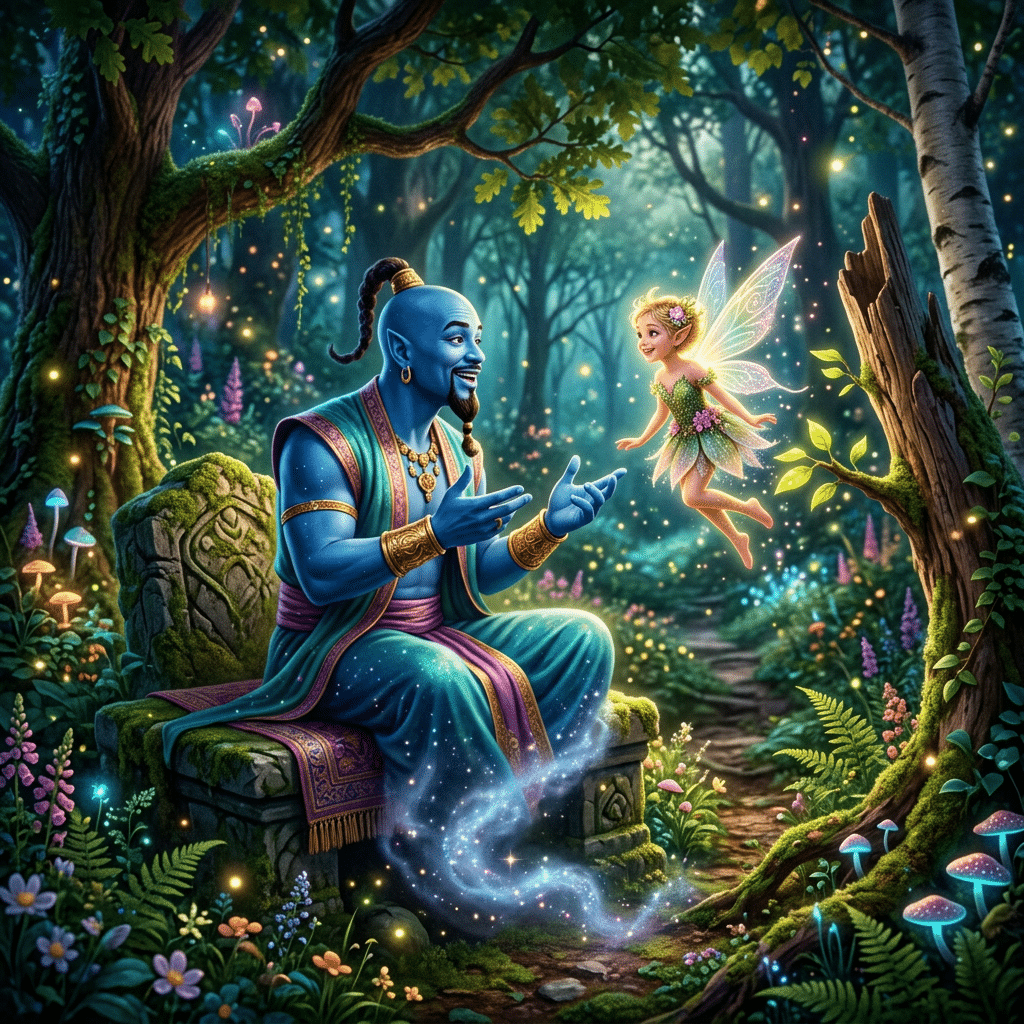
Djinn and Fairies: Key Points
- Djinn are supernatural beings from Arabic and Islamic tradition, created from smokeless fire, who inhabit a parallel world and appear in many forms, while fairies are similarly varied supernatural beings from European folklore who dwell in a hidden realm overlapping with the human world.
- Both beings are morally ambiguous, neither purely good nor evil, and both are associated with liminal spaces like crossroads, ruins, forests, and bodies of water where their influence is strongest.
- Both traditions warn humans to approach these beings with great caution, using protective measures and avoiding direct naming, because careless behavior near their territory could invite harm or possession.
- Both djinn and fairies share a fascination with human family life, appearing as lovers, stealing away mortals, and fathering or bearing children across the boundary between their world and ours.
- Key differences include the djinn’s formal recognition within Islamic theology, including a presence in the Quran, while fairies were largely dismissed by the Christian Church and survived only in folk belief, and djinn are also generally portrayed as more cosmically powerful than their fairy counterparts.
- Scholars consider them cultural equivalents because both serve the same structural role in human mythology, acting as boundary figures that explain illness, madness, and the unknown, reflecting the universal human tendency to populate the edges of the known world with powerful, unpredictable beings.

Introduction
In the mythological traditions of the world, several archetypes emerge with remarkable regularity, indicating that humans have long been fascinated with the idea of powerful, hidden entities that live beside us just out of the range of ordinary perception. The djinn of Middle Eastern and Islamic tradition and the fairies of European, especially Celtic and British, mythology are among the most lasting of these figures. These two types of supernatural beings arise from completely different cultural and geographic backgrounds, but they have a surprising number of traits, behaviors, and symbolic functions in common. Many scholars of comparative mythology therefore regard them as cultural equivalents, two different manifestations of the same profound human need to explain the uncanny and the mysterious.
Origins and Character of Djinn and Fairy Traditions
The djinn (also known as a jinni or genie) are supernatural entities that are depicted in pre-Islamic Arabian mythology and later formalized in Islamic religion. In Islamic theology, they have a separate existence from humans and angels. In the Islamic religion, djinn were formed by God from smokeless fire, as people were created from clay and angels from light. This gave them an important cosmological position as beings of free will who may be righteous or sinful. They are said to live in a parallel world that overlays the human one, their presence being felt in weird happenings, possessions, sicknesses, and encounters in liminal areas such as deserts, crossroads, ruins, and bodies of water. There are various kinds of djinn, ranging from the reasonably benign to the very terrible. Djinn types include the marid, powerful water spirits of great strength; the ifrit, crafty and often evil beings of fire; and the si’la, shapeshifting tricksters. They can take the form of humans or animals, fall in love with humans, be bound or controlled by the use of sacred names and magical seals, and are widely believed to be responsible for everything from sudden madness to inspired artistic genius, as poets in ancient Arabia were sometimes thought to be dictated to by a personal djinni.
Djinn (or jinn) are a common element of folkloric and religious landscapes throughout the Middle East, North Africa, and their diasporas. In the Islamic and pre-Islamic imagination, they are semi-divine creatures of fire without smoke, endowed with free will and normally invisible to humans; they may be Muslim or non-Muslim and are capable of influencing human affairs (Németh, 2022; Különleges, 2022; O’Meara, 2016). This core characterization – invisibility, agency, and a position between the human and divine – is the basis for much of the folkloric material discussed in the fieldwork and scholarly syntheses (Németh, 2022; Különleges, 2022; O’Meara, 2016).
European fairies in mythology, especially in the British Isles and Ireland, are similarly complex and varied otherworldly creatures that resist simple description. They are most often thought of as belonging to a different race or order of beings, at times as fallen angels who are too virtuous for hell but not sufficiently good enough for heaven, at times as the ancient gods of pre-Christian religion who withdrew underground when Christianity spread across the land, and at times simply as a third category of created being alongside humans and the divine. Traditional folk belief approached fairies, or the Fae, the Good Neighbors, the Fair Folk, the Sidhe, and the Little People, with extreme caution. Iron, salt, rowan wood, and running water were frequent safeguards against them. Like djinn, fairies dwell in liminal locations—fairy mounds, hollow hills, the boundaries of forests, and places where two worlds are considered to meet—and they are often accused of sudden illness, the stealing of infants, and the bewitching of travelers who go off safe roads. Their nature ranges from the relatively benign and helpful home brownie to the horrific, predatory Unseelie Court, and their moral character is generally regarded as foreign rather than malevolent, following a code all their own that may appear harsh or kind in turn.
Several authors stress that the fairy and faerie realm is not a monolith. Sometimes fairies are shown with demon-like qualities or as ambiguous agents within moral and social hierarchies. Gimbel’s study positions the faerie as a character with ambivalent moral valence, more like a demon in some European lore but different in size, shape, and purpose, noting a common European thread connecting fairies to both benevolent and malevolent archetypes and to the larger cosmology of non-human beings in myth (Gimbel, n.d.). This subtlety is important for the understanding of Irish and Welsh fairy tradition, where fairies can be protectors of fertility, courtly guests, or mischief-makers, depending on the local custom and the story frame. Moreover, Dugan’s examination of fungal imagery in fairy tales and folk beliefs places fairies in a wider web of folk knowledge, ritual use, and symbolic practice, revealing how cross-cultural motifs (mushrooms, fertility, and healing) play a role in the folklore ecology in which fairies appear (Dugan, 2008). These sources collectively remind us that the category of “fairy” includes a vast range of entities whose meanings change with time, place, and discourse (Gimbel, n.d.; Dugan, 2008).

Parallels in Behavior and Belief
The first parallel is remarkable, as there are many similarities between djinn and fairies. Both entities are thought to live in a hidden realm that parallels the human one, and therefore they are mostly invisible but can elect to appear or to make their influence felt. Both are morally ambiguous, neither good nor evil, but capricious and ruled by their own incomprehensible rules. Humans in both traditions were encouraged to approach them with respect and caution, rather than presuming their friendliness. Both djinn and fairies are connected with certain types of geography, especially wild, uncultivated, or liminal environments, and both are believed to be more active and more dangerous at certain times, especially at night, at dusk, and during transitional times in the calendar.
Another big area of overlap is the danger of irresponsibly attracting their notice. In Arabic and Islamic tradition, saying the name of specific djinn out loud, peeing on or near areas they inhabit, or even omitting to say “bismillah” before certain deeds could provoke a djinni’s fury or unwanted possession. In fairytales in Britain and Ireland, similar measures were taken, such as not referring to the fairies by their actual names but instead by euphemisms such as “good neighbors” or “fair folk” and being cautious around fairy rings, fairy trees, and other sacred places. Both traditions agree that these spirits have a proprietary relationship to certain areas and can turn hostile when humans intrude without the necessary acknowledgment or respect.
Another common trait is shapeshifting and participation in human romantic and familial life. In folklore, djinn are described as falling in love with humans, sometimes appearing as beautiful men or women to pursue relationships with mortals. Tales of djinn fathering children with human women or abducting beautiful humans for their own purposes are widespread throughout the Arabic-speaking world. The fairy tradition in Europe is no less rich with legends of changelings, fairy lovers, and mortals taken to fairyland, sometimes for what seems like a few days to them but is decades in the human world. Both entities exhibit a fascination with mankind and a desire to integrate into human families, thereby blurring the boundaries between their realm and ours.
Folklore regularly portrays jinn as agents who can help or hinder humans, sometimes in close or quasi-neighborly relationships (such as marriage or negotiation with humans) and often in situations that cross the borders between private life and sacred or dangerous regions. For example, the representation of jinn marriages and other interactions in Arabic and Arabic-influenced narrative settings is a case in point, as here the borders between the human world and the invisible world are negotiated through ceremonial speech, dreams, and ritual deeds (Alderbashi & Haroon, 2020; Németh, 2024). The existence and character of faerie beliefs in Ireland are inextricably linked with the wider religious and political history. Krämer’s analysis contextualizes belief in fairies in Gaelic Irish as a resilient survival of Gaelic culture thriving on its own terms rather than as a consequence of the Christian demonization of magic elsewhere. Importantly, fairies in Ireland are imagined as a source of misfortune in some folk narratives, and they remain a key frame for understanding magical and liminal events in Irish folklore, including the persistence of “faerie faith” narratives through the early modern period and into contemporary memory (Krämer, n.d.).
Theological and Cultural Divergences
Nevertheless despite these remarkable parallels, the two traditions diverge in important respects, reflecting their different cultural and theological backgrounds. In Islam, the djinn have a fully recognized theological status, and they exist in the Qur’an itself, giving them a legitimacy and doctrinal precision that fairies never had in Christian Europe. The Church tended to marginalize the fairies, viewing them as superstition or demons to be feared and shunned. The djinn are recognized as real beings who bear their own spiritual responsibility, who may convert to Islam, and who may be rewarded or punished in the afterlife just as humans are. This theological basis renders the djinn a more serious and legally defined entity in Islamic theology, whereas fairies stood mostly outside the official religious framework and were mostly confined to folk belief and oral tradition.
Scholarly scholarship on jinn stresses both their theological texture (the Qur’anic framework, moral culpability, and moments of repentance or disobedience) and their cultural joinder to ordinary life, ritual practice, and storytelling. Examples of such portrayals abound within the Qur’anic literature, where jinn are depicted as capable of belief, disbelief, and conversion, highlighting their free will and moral complexity in their dealings with humans (Surahs cited in sources) (Németh, 2022; Különleges, 2022). In contrast, cross-cultural ethnographic and literary accounts position jinn within local legends, place-based cults, and contemporary media (Journal, 2024; Al-Qobbaj & Marshall, 2024; Alderbashi & Haroon, 2020; Smith, 2021; Ridjal et al., 2023).
The fairy faith remains a distinctive strand of folk belief across the Gaelic parts of Ireland and Scotland (and further afield in the Isle of Man and Brittany), typically expressed in terms of a ‘faerie faith’ persisting alongside or within Christian contexts. Walter Evans Wentz’s Fairy-Faith in Celtic Countries (1911) is a notable compilation and exploration of fairy beliefs in six Celtic cultures. The introductions to the text are written by leading Celticists who contextualize the narratives in local religious and cultural ecosystems. The Isle of Man material, offered as an example of cross-Celtic communication among Irish, Scottish, Welsh, Manx, Cornish, and Breton contexts, was brought by Sophia Morrison (Rbv, 2021) as part of a pan-Celtic endeavor to record the ways in which fairies occupy Manx memory and folklore. The scholarship on this corpus notes that fairies in these traditions are often characterized as land spirits or otherworldly interlocutors whose deeds—benign, mischievous, or dangerous—have an impact on social life and the reading of the landscape, and that such beliefs remain in the cultural imagination even when demonized elsewhere (Krämer, n.d.; Rbv, 2021; Gimbel, n.d.).
There is also a slight difference in magnitude and power between the two traditions. Both contain entities of exceptional power. Classical Arabic literature describes the most powerful djinn, particularly the marids and ifrits, as capable of moving mountains, traversing oceans instantaneously, and carrying out building operations that would take mankind centuries to complete. In European tradition, the power of fairies is often more personal and local in nature, and they are concerned with enchantment, deception, and manipulation of perception. They meddle in the daily lives of individuals and families, not with cosmic displays of might, and while undeniably powerful, this is the nature of their power. Furthermore, the djinn tradition tends to have a more developed and legalistic framework around their binding and control, especially in grimoire traditions drawing on the figure of King Solomon, who was said to have commanded vast armies of djinn, whereas fairy lore rarely attributes such systematic mastery over the fair folk to any human figure.
Convergence and Universal Human Experience
Scholars of comparative religion and folklore have assembled a number of hypotheses for why these creatures from such wildly varied cultures have converged so closely in their traits. A very convincing argument is that both traditions are responses to a common set of universal human experiences. For example, sudden illness without visible cause, madness, the odd feeling of being observed in the wilderness, the mysterious disappearance of people or cattle, and the terrifying unpredictability of natural events before the advent of scientific explanation. Both djinn and fairies served as explanatory frameworks for things that seemed to fall outside the bounds of normal causality. Since the things they explained were universal human experiences, it is little wonder that the entities created to explain them would share so many qualities. Anthropologists call this “psychic unity,” the tendency for human brains across cultures to develop similar symbolic reactions to identical existential crises.
They also converge because they perform a similar structural role within their own mythologies. Both djinn and fairies are boundary figures between the known and the unknown, the human and the nonhuman, and the safe and the perilous. They mark the limits of the world that is subject to human control and serve to warn humans that there are forces they cannot control. Almost every human culture populates this role of patrolling the boundary between order and chaos, safety and danger, and the familiar and the terrifyingly other with some category of being, and the similarities between djinn and fairies suggest that the template for such beings is remarkably consistent wherever it occurs. Therefore, their common features are not accidental but fundamentally dictated by the role they are supposed to play in the human imagination.
Conclusion
The djinn of the Arabic and Islamic tradition and the fairies of European folklore are two of the most richly developed and culturally important supernatural traditions in the history of humankind, and their convergence on so many dimensions of character, behavior, and symbolic function reveals something important about the universality of certain mythological needs. They are comparable in their ambiguity, their liminality, their shapeshifting nature, their hazardous caprice, and their complicated entanglements with human beings and differ essentially only in the religious and cultural settings that have formed them, not in their basic essence. That two such disparate civilizations, separated by geography, religion, and language, should independently arrive at beings so recognizably alike is a testament to the power of shared human experience, and it invites us to see in these ancient stories not just the particularities of culture but the deeper architecture of the human mind reaching out into the dark to make sense of a world that will always, in some measure, remain beyond its grasp.
References
Alderbashi, B., & Haroon, H. (2020). Translating Jinns in Naguib Mahfouz’s Layali Alf Layla into English. 3L: The Southeast Asian Journal of English Language Studies, 26(4), 141–156. https://doi.org/10.17576/3l-2020-2604-11
Al-Qobbaj, A., & Marshall, D. (2024). Dwelling and healing with saints and jinn in the haunted landscapes of Palestine. Cultural Geographies, 31(3), 365–379. https://doi.org/10.1177/14744740241234297
Dugan, F. M. (2008). Fungi, folkways and fairy tales: Mushrooms & mildews in stories, remedies & rituals, from Oberon to the Internet. North American Fungi, 23–72. https://doi.org/10.2509/naf2008.003.0074
Evans-Wentz, W. Y. (1911). The fairy-faith in Celtic countries. H. Frowde.
Gimbel, J. J. (n.d.). Spiritual descent: A study of semi-divine beings and non-human species in European mythologies. https://doi.org/10.14418/wes01.1.633
Journal, E. B. of S. T. (2024). Special treatment journal, 2024. Vol. 10.(SI). Különleges Bánásmód – Interdiszciplináris Folyóirat, 10(Special Issue), 1–183. https://doi.org/10.18458/kb.2024.si.1
Krämer, W. (n.d.). FILID, fairies and faith: The effects of Gaelic culture, religious conflict and the dynamics of dual confessionalisation on the suppression of witchcraft accusations and witch-hunts in early modern Ireland, 1533–1670. https://doi.org/10.15368/theses.2010.96
Különleges, B. (2022). Különleges bánásmód, 2022. 8. (1.). Különleges Bánásmód – Interdiszciplináris Folyóirat, 8(1), 1–140. https://doi.org/10.18458/kb.2022.1.1
Németh, K. (2022). “Kill the man who killed the dog – stories buried under the skyscrapers.” Különleges Bánásmód – Interdiszciplináris Folyóirat, 8(1), 77–90. https://doi.org/10.18458/kb.2022.1.77
Németh, K. (2024). The Jinn – The culprit of the Arabic world. Különleges Bánásmód – Interdiszciplináris Folyóirat, 10(Special Issue), 107–122. https://doi.org/10.18458/kb.2024.si.107
O’Meara, S. (2016). From space to place (pp. 56–73). https://doi.org/10.1163/9789004301368_004
Rbv, S. M. (2021). W.Y. Evans Wentz the fairy-faith in Celtic countries (1911) letters from Evans Wentz to Sophia Morrison (1910–12). Studia Celtica Posnaniensia, 6(1), 1–16. https://doi.org/10.2478/scp-2021-0001
Ridjal, T., Ridjal, J. A., Muafiqie, H., Indriati, E., & Susilo, S. (2023). Legend of Watu Umpak and the structure construction (Study of folklore as an effort to maintain social position in social stratification of village communities). Research on Humanities and Social Sciences, 13(2). https://doi.org/10.7176/RHSS/13-2-06
Smith, B. J. (2021). Sufism and the sacred feminine in Lombok, Indonesia: Situating Spirit Queen Dewi Anjani and female saints in Nahdlatul Wathan. Religions, 12(8), 563. https://doi.org/10.3390/rel12080563

Leave a Reply