The Butterfly People of Joplin: Key Points
- On May 22, 2011, an EF5 tornado tore through Joplin, Missouri, killing 161 people, destroying thousands of structures, and leaving the entire city in collective trauma and grief.
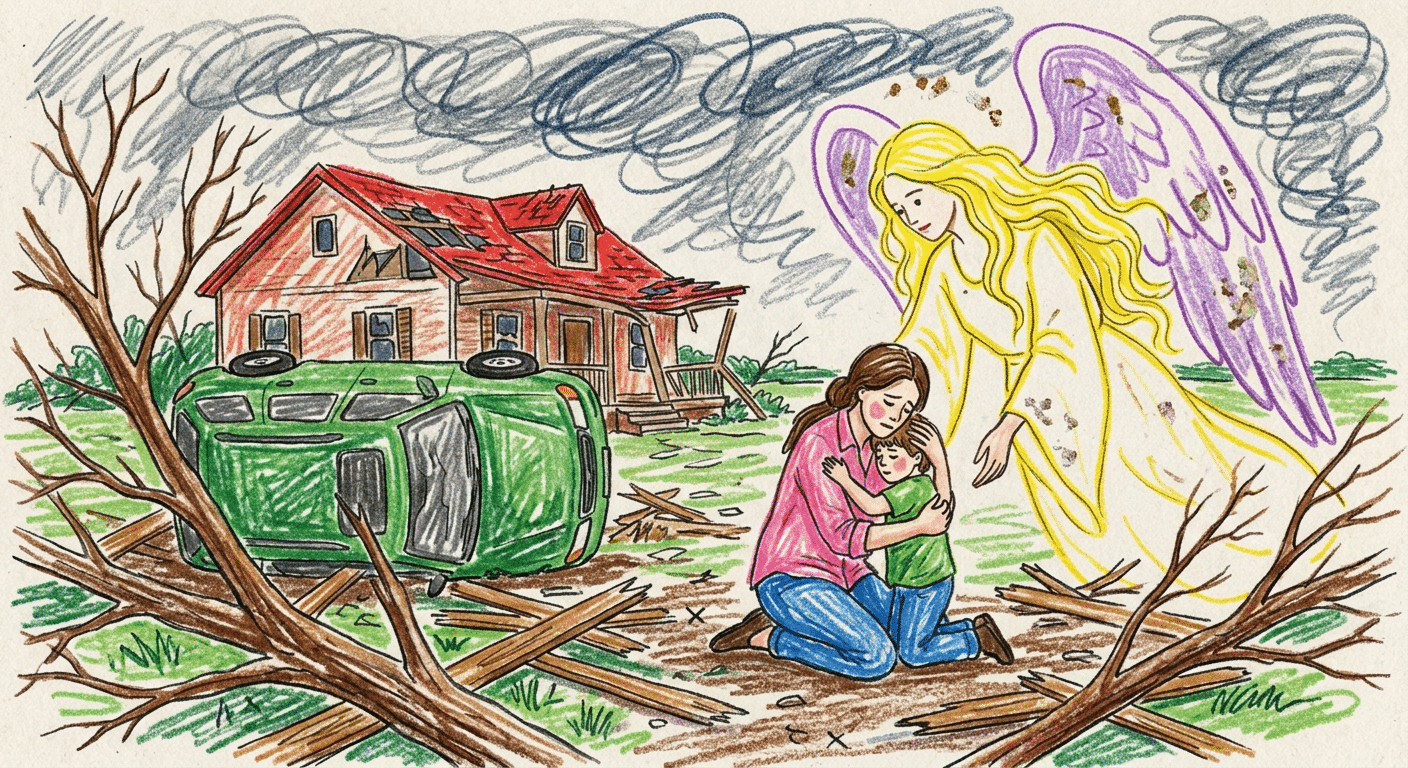
- In the weeks after, children across Joplin independently described large, winged beings that shielded them during the storm, with details aligning across accounts from different neighborhoods.
- Many believers interpreted the Butterfly People as guardian angels, and the butterfly’s symbolic association with resurrection in Christian tradition made the accounts feel spiritually significant.
- A Jungian reading suggests the children accessed a universal archetype, since butterflies appear as protective spirits across many world cultures and extreme stress can draw the mind toward deep symbolic imagery.
- Skeptics attribute the consistent accounts to childhood suggestibility, confabulation, and the rapid spread of a comforting narrative through a community desperate for meaning.
- Regardless of origin, the stories gave survivors a language for the unspeakable, offered families a sense of divine protection, and gave a fractured city something to believe in beyond its loss.

Introduction
On the afternoon of May 22, 2011, one of the deadliest tornadoes in American history struck the city of Joplin, Missouri. In the weeks and months that followed, as survivors began to process their experiences, an unexpected and haunting story emerged from the rubble. Children throughout the city were independently telling, with frightening detail, of giant winged entities that had stormed and protected them from harm. They were known as the Butterfly People of Joplin, a phenomenon that drew national notice and generated a debate among theologians, psychiatrists, mourning families, and skeptics. These stories are part of Joplin’s identity, whether you see them as miraculous, mythological, or psychological, and they raise important questions about the mind at death’s door.
The Joplin Tornado
The EF-5 May 22, 2011, Joplin tornado was an unprecedented event that resulted in extreme destruction, involving 162 fatalities, major injuries, and displacement. It was one of the worst tornadoes in recent memory in U.S. history (Kanter & Abramson, 2014). The tornado itself was a calamity of almost unimaginable magnitude. About 5:34 in the afternoon, the tornado hit the southwest side of Joplin, carving a path across the middle of the city that was about a mile wide. It was classified an EF5, the highest category on the Enhanced Fujita scale, with projected winds of more than 200 miles per hour. The tornado killed 161 people, wounded more than 1,000, and destroyed or damaged around 8,000 homes. The winds devastated St. John’s Regional Medical Center, one of the most recognizable landmarks for miles, with patients inside. Whole neighborhoods have been reduced to bare concrete slabs. Cars were flung yards from where they were parked. The bark was removed from trees. The tornado was on the ground for nearly 22 miles, causing over two billion dollars in damages. It was the worst tornado to hit the United States since modern record-keeping began. For a city of around 50,000, the loss was overwhelming and devastating. Almost everyone in Joplin lost someone or knew someone who did.
The Butterfly People Phenomenon
As the city began to rebuild, a strange pattern started to appear in the stories of young survivors. During the worst phases of the tornado, children caught in the storm started telling their parents about huge butterfly-like creatures that appeared around them (Spialek, 2016). The descriptions were graphic. Some children reported seeing lovely, multi-colored winged beings that wrapped their wings around them and held them motionless while the storm raged. Others said the creatures were tall and almost human in form with enormous wings that folded protectively over small bodies. A few reports spoke of the butterflies being bright, shining through the blackness of the storm. The stories were especially compelling because many of the children had never talked to each other before relating their stories, yet the details corroborated in ways that seemed undeniable. Parents who had never heard of such a thing from one child received almost identical reports from youngsters in different neighborhoods and conditions.
One of the most often quoted stories was of a small girl, Lena Sutton, who told her mother that a big butterfly had sat on her to keep her from blowing away. Similar reports circulated throughout churches, schools, and community meetings. Local pastor Josh Holland was one of the first to chronicle the events publicly, and the tales eventually made their way into national news outlets and religious media. A bronze sculpture was commissioned and put in Joplin’s Cunningham Park to memorialize the phenomena, showing a kid being shielded behind giant butterfly wings (Sooter, Hedges, & Chicaraishi, 2019). The memorial is a permanent statement that something happened in the minds and hearts of Joplin’s youngest survivors that the community believed needed commemoration, regardless of what its eventual explanation might be.
Interpretive Frameworks
Different interpretative models have been proposed to explain what these children experienced. The most spiritual interpretation is that the Butterfly People were guardian angels appearing in a way that children could understand and not be further frightened by (Livingston-Martin, 2012). In the Christian faith, angels are messengers and defenders, and many Joplin believers and beyond consider the butterfly reports congruent with scriptural promises of supernatural protection. In Christian tradition, the butterfly itself holds a tremendous symbolic weight, standing for resurrection and transformation. From that perspective, the visual form the creatures took was not random but was formed by divine will, bringing solace in a familiar and loving symbol at the very moment when the children most needed it. For many families who lost loved ones, these stories gave significance, with the belief that God had intervened expressly to protect the children who lived.
A more cross-cultural and mythological reading argues that the Butterfly People were tapping into something old and universal in the human storytelling tradition. In traditions from Aztec mythology to Japanese folklore to the beliefs of numerous Indigenous North American peoples, butterflies are considered spiritual intermediates, souls of the dead, or guardian spirits. A related frame is Carl Jung’s collective unconscious, which refers to some archetypes that reside in the shared psychic legacy of humanity and that can bubble out spontaneously during times of high stress. In this view, the children were not only inventing or repeating something they’d heard. They were tapping into a deep reservoir of symbolic meaning that the human mind needs when ordinary experience fails. The butterfly, soft and transforming, is a perfect vehicle for the idea of being protected by something bigger than oneself.
Skeptics have offered substantial and well-reasoned challenges to supernatural or archetypal explanations. Child psychologists have noted that children are very suggestible, especially after trauma. A terrified youngster hearing a parent, teacher, or church leader ask a leading question like “Did you see anything that protected you during the storm?” has its mind prepped to create an answer that fulfills the inquiry and the emotional need of the adult asking it. This is not fraud but confabulation, a well-documented cognitive process in which the brain fills in memory gaps with a believable narrative. Young children have not yet gained the complete capacity to tell the difference between things they have actually seen and those they have imagined, fantasized, or been told. The power of suggestion in a traumatized community should not be underestimated.
Other commentators have highlighted that the recounting might have exaggerated the ‘consistency’ of the narratives. Grief-stricken communities and media attention swiftly carry stories, and details that may have differed in the original tellings may have softened into alignment as the story evolved. Humans are pattern-seekers, excellent story-formers who can make sense of pieces. In the immediate aftermath of a calamity, communities are starving for purpose. The story of angelic protectors provides solace for the bereaved and a method for survivors to comprehend why they survived and others did not. Psychologists say this form of meaning-making is perfectly natural and healthy, while remaining agnostic regarding its actual veracity.
Neurological causes have been suggested too. Extreme stress and oxygen deprivation (which might occur during a major storm) are known to generate dramatic visual and auditory hallucinations. A sensation of a protective or guiding presence is one of many similar elements reported in close-call or near-death experiences throughout cultures. Some youngsters might have entered a state of altered awareness, a survival mechanism in which the brain created soothing images to cope with the overpowering dread. Such findings would mean the experiences were significant. The experiences were genuine for the youngsters who experienced them and were significant in the only way that matters. But that would point to a neurological, not a supernatural cause.

Community Recovery and Resilience
This incident led to a range of recovery measures at individual and community levels, including school-based assistance, psychosocial programming, and community-driven projects aimed at building resilience and meaning-making in the post-disaster period (Kanter & Abramson, 2014). In the Joplin context, empirical work has indicated that disaster exposure experiences are associated with PTSD, depression, and broader adjustment difficulties, but that resilience and social resources can buffer negative mental health outcomes in both children and adults (Lee & First, 2022; Houston et al., 2017; First et al., 2021). Cunningham Park in Joplin thus became a focus for a nature-based healing initiative: the Cunningham Park Butterfly Garden and Overlook, which was developed as a green restorative place to encourage community healing following the disaster (Wolf & Wyatt, 2019; Brown, 2017).
Conclusion
The Butterfly People of Joplin ultimately reveal significant insights about the nature of human experience in extreme situations. Whether the beings were divine messengers, archetypes from the collective unconscious, or inventions of traumatized and suggestible youthful minds, the stories are important for what they accomplished for the people who told and heard them. They provided survivors a language for an experience language usually can’t hold. They presented bereaved parents with a story in which their children were not only fortunate but selected, guarded, and adored. They gave a fractured community something besides grief to rally around. The bronze statue in Cunningham Park does not purport to answer the question of what the Butterfly People were. It only asserts that Joplin’s children saw something memorable and that the city believes them. That may be enough in the end.
References
Brown, J. S. (2017). Predicting Connectedness with Nature among Survivors of the Joplin Tornado. Ecopsychology, 9(4), 193–198. https://doi.org/10.1089/eco.2017.0007
First, J. M., Ellis, K. N., Held, M. L., & Glass, F. (2021). Identifying Risk and Resilience Factors Impacting Mental Health among Black and Latinx Adults following Nocturnal Tornadoes in the U.S. Southeast. International Journal of Environmental Research and Public Health, 18(16), 8609. https://doi.org/10.3390/ijerph18168609
Houston, J. B., Spialek, M. L., First, J. M., Stevens, J., & First, N. L. (2017). Individual perceptions of community resilience following the 2011 Joplin tornado. Journal of Contingencies and Crisis Management, 25(4), 354–363. https://doi.org/10.1111/1468-5973.12171
Kanter, R. K., & Abramson, D. M. (2014). School Interventions After the Joplin Tornado. Prehospital and Disaster Medicine, 29(2), 214–217. https://doi.org/10.1017/s1049023x14000181
Lee, S., & First, J. M. (2022). Mental Health Impacts of Tornadoes: A Systematic Review. International Journal of Environmental Research and Public Health, 19(21), 13747. https://doi.org/10.3390/ijerph192113747
Livingston-Martin, L. (2012). Haunted Joplin. Arcadia Publishing.
Sooter, T., Hedges, K., & Chicaraishi, N. (2019). A green recovery in Cunningham Park: Drury University responds to the Joplin tornado. In: Campbell, Lindsay K.; Svendsen, Erika; Sonti, Nancy Falxa; Hines, Sarah J.; Maddox, David, eds. Green readiness, response, and recovery: A collaborative synthesis. Gen. Tech. Rep. NRS-P-185. Newtown Square, PA: US Department of Agriculture, Forest Service: 44-57.
Spialek, M. L. (2016). The development and validation of the citizen disaster communication assessment (Doctoral dissertation, University of Missouri-Columbia).
Wolf, K. L., & Wyatt, M. (2019). Meaningful nature places. 270. https://doi.org/10.2737/nrs-gtr-p-185-paper19
Leave a Reply