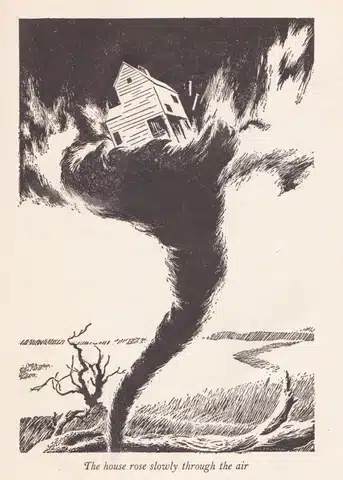
Tornados as Portals: Key Points
- Tornados have long been viewed through a paranormal lens as more than meteorological events, with many cultures and traditions interpreting their violent, rotating nature as evidence of a threshold between worlds.
- Portals, across ancient and esoteric traditions, are understood as ruptures in reality rather than simple doorways, places where the rules of space and time break down and travelers emerge transformed.
- The vortex shape of a tornado carries deep spiritual significance across world cultures, and some paranormal theorists argue that its rotational energy generates a torsion field capable of warping local spacetime and opening dimensional passages.
- Famous examples of tornado-as-portal destinations include Oz, rooted in Theosophical ideas about multiple planes of existence, and the Elemental Plane of Air, drawn from classical elemental theory and populated by atmospheric beings like sylphs and djinn.
- Wilder theories extend the concept to temporal portals, waterspout-related disappearances, and accounts of impossible objects deposited by storms, though none of these claims can be scientifically verified.
- Skeptics correctly note that tornados kill rather than transport people, that torsion field theory is fringe physics with no reproducible results, and that survivor accounts are better explained by trauma and confabulation.

Introduction
There is something terrifying about a tornado. It comes unannounced, rips through the fabric of daily existence, and disappears as if it had never existed at all. Scientists will tell you it is a furiously rotating column of air, a meteorological phenomenon born by clashing pressure systems and atmospheric instability. But science has always been better at pointing out how than why, and through generations, nations, and customs, a strange explanation has silently endured: that a tornado is not just a storm but a doorway. A door spins, shouts, and rages between this world and another realm.
The concept of portals predates modern fantasy by thousands of years. In ancient cultures, thresholds were conceived between the mortal world and the domains of the divine or underworld. These were places where the membrane separating existence from something beyond grew thin enough to pass over. These liminal places were usually tumultuous. They were sometimes violent, disorienting, and transforming, on the margins of known geography, in deep tunnels, on sacred mountains, or in the core of occurrences that were beyond scientific explanation. A portal is not only a door. It is a break. It is a realm where the usual rules of cause and effect, as well as space and time, cannot be relied upon. A traveller who enters a portal does not change their location. They switch between states of reality. They come transformed, if they come at all.
The Paranormal Significance of the Vortex
Folkloric and cultural material often uses storms and weather as a backdrop for supernatural stories. A comprehensive body of literature illustrates how various cultural contexts have perceived meteorological phenomena as spiritual experiences, omens, or messages. The investigations on crop circles and other “weather-tinged” or nature-derived phenomena reveal how individuals build spiritual significance to natural patterns by using subjective rationalities to justify these interpretations (Ghidina, 2018). Crop circles are a different phenomenon, but the process of giving subjective meaning to environmental patterns is similar to the spiritual or paranormal interpretations of tornado encounters.
From a paranormal standpoint, tornados have all the attributes that the ancient imagination attributed to gateways. They spin; it’s no minor thing. The spin has been linked to spiritual and cosmological meaning for thousands of years, occurring in mandalas, in the movement of ritual objects, and in holy dances in practically every major world tradition. The vortex is a symbol of metamorphosis and transcendence—a shape that draws inside and, at the same time, expels. A tornado funnel is, in essence, a vertical vortex of vast and terrible power. Paranormal theorists claim that this spinning energy produces something more than wind. It is said to create a torsion field, a twisting of local space-time that, if the conditions are correct, could create a portal to another dimension. More than punching through physical substance, the tornado punches through the intangible architecture of reality itself.
Weather events, especially dramatic displays of the atmosphere (cloud formations, funnel forms, loud winds, rapid changes in pressure), provide salient sensory input that may activate increased arousal and isolate salient cues. Those who score high on paranormal credence, or who have had anomalous experiences in the past, are more likely to interpret such stimuli in supernatural rather than mundane terms. Empirical work shows that believers in the paranormal are more prone to meaning-making biases and to assigning causality in ambiguous circumstances directly relevant to the interpretation of tornado events as signs or portals rather than simply physical events (Blanco et al., 2015). Likewise, studies have indicated that people are more likely to arrive at non-random explanations when presented with unclear or inconclusive data, which could affect the narrative or memory of tornado-related observations (Blanco et al., 2015).
In the literature of paranormal phenomena, the discussion of portals and tornadoes responds to a conceptual possibility wherein storms may be interpreted as entryways, if not actual portals, to other realms or dimensions in some belief systems (“A Study of the Broken Mirrors Phenomenon and How it is Translated into High Fashion, Textiles, and Accessories”, 2018). “Similarly, the article states that portals are accepted or rejected as real by different investigators, and the interpretation of “portal” concepts is culturally and individually contingent.

Literary and Mythic Gateways: From Oz to the Elemental Planes
The most famous literary instance of a tornado as a gateway is, of course, L. Frank Baum’s story of Dorothy Gale, who is carried away by a Kansas storm into the Land of Oz. “But this work is children’s fiction,” one might dismiss, and yet the paranormal researcher would note that Baum was steeped in Theosophy, a late nineteenth-century spiritual movement that believed in multiple planes of existence, hidden dimensions inhabited by advanced or elemental beings, and the thinness of the boundary between the physical and the astral. In this view, Dorothy’s tornado is not a narrative convenience. It is a coded story about dimensional travel. She doesn’t dream of Oz herself. She comes in person, with her house and dog. She lands in a new realm, one with distinct laws, populated by beings who deal with a different logic than anything Kansas ever taught. The mechanism is the tornado. Destination Oz. And crucially, the only route back is through another form of vortex.
In the Wizard of Oz story, a tornado sets in motion Dorothy’s movement from a known, organised, but confining realm to an unknown world that is symbolically exaggerated. This moment is a point of rupture for film scholars, who discuss the movement of a protagonist from a familiar place to an otherworldly realm as a restructuring of the entire voyage and its subsequent processes of meaning-making (Ma, 2022; Serjeant, 2012). The episode is sometimes understood as an ontological rupture between two space-time regimes: the commonplace Kansas world and the magical, dangerous country of Oz (Serjeant, 2012).
Another theoretical destination for tornado-borne travellers is the Elemental Plane of Air, derived from the cosmology of Dungeons and Dragons but based on much older alchemical and esoteric traditions. In traditional elemental theory, air is not simply a gas but a living metaphysical substance—a dimension in itself filled with sylphs, djinns, and beings of pure atmospheric energy. In this view, a tornado represents a point of contact between the material world and the Elemental Plane of Air, a point where that dimension presses against ours with enough force to break through. Some paranormal writers think tornadoes bleed through from the other side, not just the upper atmosphere. Energetic events on the Elemental Plane seep through our world, launching them. The most powerful tornadoes, the EF5 storms that seem nearly impossible to destroy, could result from specific broad or prolonged openings, periods when the boundary between dimensions has ripped rather than just stretched.
Some ideas about Oz and elemental dimensions are even more outlandish. The broader anthropology and sociology of ghost and supernatural belief stresses that ideas about unseen forces, spirits, and the potential meaning of strange events continue to exist and are influenced by media, society, and social networks. These works demonstrate how individuals negotiate supernatural explanations with scientific understandings and how weather-related phenomena can be co-opted into narratives that weave together science, faith, and folklore (Baker & Bader, 2014; Palacios, 2017). Some scholars in the paranormal tradition have mentioned the Bermuda Triangle, contending that its strange disappearances are connected to underwater vortices, fluid analogues of tornadoes which serve as gateways to unknown locations. They claim by extension that waterspouts, tornadic activity over water, have historically been related to disappearances of sailors and vessels in ways that cannot be explained solely meteorologically. There are stories, although they are difficult to verify, of entire settlements on the early American frontier reporting objects and even animals being deposited by storms from places where their presence should have been geographically impossible. The phenomenon of frogs and fish falling from the sky after a storm has an accepted explanation in terms of waterspouts. But some of the reports tell of articles made by man, tools, coins, and writings in strange languages, for which no such neat explanation is ready.
There have also been acolytes of the notion that storms open fleeting portals not to other places but to different times. According to the electromagnetic properties of the ionized core of a tornado, the fabric of spacetime may be bent in such a way that it creates a loop between various historical moments. The tornado survivors’ anecdotal reports describe disorienting experiences that defy physical trauma, such as feelings of time dilation, seeing figures from other eras, and an eerie silence at the center of the storm that feels less like the eye of a meteorological event and more like a waiting room for something profound. These claims are not corroborated scientifically. That doesn’t make them uninteresting.
The Skeptical Case
Skeptics are in plenty and their objections are difficult to counter on an empirical basis alone. The most fundamental is this: Tornadoes kill people. They do not carry them. The damage shown is compatible with wind speed and debris contact, not with the departure of matter from the local continuum of space-time. If tornadoes were portals, we’d expect a statistical anomaly in tornado-affected regions: an exceptional number of unaccounted-for disappearances relative to deaths. We do not come across such phenomena. Wreckage and sadness are what we see. Trauma, hypoxia, the brain’s habit under duress of making up meaning, and the basic statistical certainty that if you have enough tornado incidents, some survivors are going to tell tales that seem implausible, more gracefully account for the bizarre tales of survival. The Elemental Plane of Air is a cosmological model, not a scientifically proven dimension. Oz is not real. Baum himself never said otherwise.
Physicists are part of this sceptical group. Torsion field theory sounds incredibly scientific, yet it is at the farthest frontiers of theoretical physics and has never generated a reliable experimental finding. Tornadoes certainly cause electromagnetic disturbances, and their ionised air does exhibit strange electrical properties, but nothing in peer-reviewed atmospheric science suggests they are approaching the energy levels necessary to substantially alter spacetime. A tornado is tiny compared to the forces that general relativity requires to warp time and space, for all its incredible destructive power. A black hole warps spacetime. Tornadoes twist trees.
Ancient Patterns and Modern Uncertainty
And still. People have traditionally watched violent atmospheric occurrences with the notion that their meaning is more than their mechanics. Whirlwinds are viewed as mystical beings by Navajos. Hinduism believes that the divine manifests itself in revolving forms. For the ancient Greeks the vortex was a basic cosmological principle. This cross-cultural, cross-historical pattern of meaning formation about whirling columns of wind is not in itself proof for portals. But it is evidence that something in our basic intuition demands that the tornado be not just a storm. It’s a statement. There’s something trying to happen in that spinning column, something that’s beyond fluid dynamics and pressure differentials.
The most honest viewpoint is uncertainty, not confident belief or confident rejection. We live in a cosmos that has already proved to us, through quantum mechanics, that reality at its foundations is stranger than human intuition can safely accept. We live in a universe where spacetime can be twisted, where entanglement allows particles to interact instantly at any distance, and where the nature of mind is totally unknown. However, in this universe, the idea of a tornado serving as a doorway lacks scientific support. But it is not impossible in principle. This idea exists in the uncomfortable realm of phenomena that we cannot verify and cannot entirely dismiss, a space where the paranormal has always been willing to reside, despite its discomfort.
Conclusion
The tornado comes down as the world splits up. Something is happening that the ordinary geometry of existence cannot quite encompass, for a few seconds or for a few minutes. Whether that something is the catastrophic release of atmospheric energy or the catastrophic weakening of the boundary between dimensions may ultimately be less a question of facts and more a question of what kind of world you believe you are living in. The funnel recedes, the sky brightens, and what was once present is no longer visible. Where did it go? The question continues to spin endlessly.
References
Baker, J. O., & Bader, C. D. (2014). A social anthropology of ghosts in twenty-first-century America. Social Compass, 61(4), 569–593. https://doi.org/10.1177/0037768614547337
Blanco, F., Barberia, I., & Matute, H. (2015). Individuals Who Believe in the Paranormal Expose Themselves to Biased Information and Develop More Causal Illusions than Nonbelievers in the Laboratory. Plos One, 10(7), e0131378. https://doi.org/10.1371/journal.pone.0131378
Fleming, V. (Director). (1939). The Wizard of Oz [Film]. Metro-Goldwyn-Mayer.
Ghidina, M. (2018). Finding God in Grain: Crop Circles, Rationality, and the Construction of Spiritual Experience. Symbolic Interaction, 42(2), 278–300. https://doi.org/10.1002/symb.386
Gygax, G., & Arneson, D. (1974). Dungeons & Dragons [Tabletop role-playing game]. TSR.
Ma, J. (2022). Exiting and Entering Early Cinema. 59–75. https://doi.org/10.1525/luminos.132.d
Palacios, J. A. (2017). Cine y Ocultismo: Apuntes para una visión mágica del cinematógrafo. Lumina, 11(2), 162–192. https://doi.org/10.34019/1981-4070.2017.v11.21440
Sergeant, A. (2012). Scrutinising the rainbow. Alphaville Journal of Film and Screen Media, (2), 4–18. https://doi.org/10.33178/alpha.2.01
A Study of the Broken Mirrors Phenomenon, and How it is Translated into High Fashion, Textiles, and Accessories. (2018). https://doi.org/10.15242/dirpub.dirh0118037
Leave a Reply