Ghosts in Schools: Key Points
- Schools are imagined as deeply haunted places because they combine age, strong emotions, and countless people passing through over many decades, with some buildings even repurposed from hospitals or asylums or built on grim land.
- A ghost is usually understood as the lingering presence of a dead person, and the paranormal covers anything that current science cannot explain, making emotionally charged schools an ideal setting for such beliefs.
- School ghosts follow familiar patterns, such as the pupil who died young, the stern teacher who never leaves, or the caretaker who walks the halls at night, and these figures become part of the institution’s identity.
- Reported sightings range widely and include footsteps, cold spots, self-opening doors, and pale figures, with most encounters happening in quiet moments when the building suddenly feels alien.
- These tales play an important role in folklore by binding students together, offering a safe way to explore death, and teaching unspoken warnings much like traditional fairy tales.
- Theories split between believers, who argue emotions imprint on places, and sceptics, who point to suggestion, settling buildings, and pareidolia, with neither side able to prove its case, which helps the stories endure.

Introduction
Schools are one of the most haunted places in the common imagination, and this is no accident. These are structures of powerful feelings, buildings filled with youthful people, buildings that remain, frequently for many decades, on the same piece of ground. Generations walk their hallways. The old buildings are reused, extended, or built on lost ground. Memories settle in the walls like dust. It is for these reasons that ghost stories cling to schools, like ivy to masonry. This essay analyzes the peculiar relationship between the paranormal and educational places, examining recorded sightings, the role such narratives play in folklore, and the hypotheses individuals provide to explain them.
Understanding the Paranormal in Educational Spaces
The paranormal is commonly understood to be anything that cannot be explained by present scientific knowledge. The ghost is the key to this category. Generally, a ghost is thought of as the spirit or residual presence of a dead person, somehow attached to the world of the living. Schools offer a peculiarly fertile ground for such views. They are emotional places where youngsters laugh and cry, fear and hope, and struggle, sometimes in the same hour. Many schools have old buildings. Some were once hospitals, asylums, churches, or private homes before turning into institutions of study. Others were developed on land with long, sometimes dismal, histories. The age, emotion, and sheer number of people who walk through create the ideal conditions for stories to flourish.
Ghosts, hauntings, and paranormal beliefs interface with educational environments in several ways: as folklore topics (campus ghost lore), as heritage and ghost tourism, and as current media-driven phenomena (reality TV and web storytelling). Ghosts in schools are not only sensational stories; they are narrative mechanisms of memory, identity, and place-making in educational settings and communities (Edwards, 2019; Obradović et al., 2021; McGill, 2022). Haunted schools are often discussed within the scholarly lens of paranormal tourism or “dark” or “ghost” tourism, where schools can be used as a setting to anchor tours, narratives, and pedagogy around local history and culture, sometimes with pedagogical aims and sometimes with marketing and visitor engagement aims (Millán et al., 2019; Obradović et al., 2021; Adams & Graham, 1995; Houran et al., 2020).

Common Hauntings and Reported Sightings
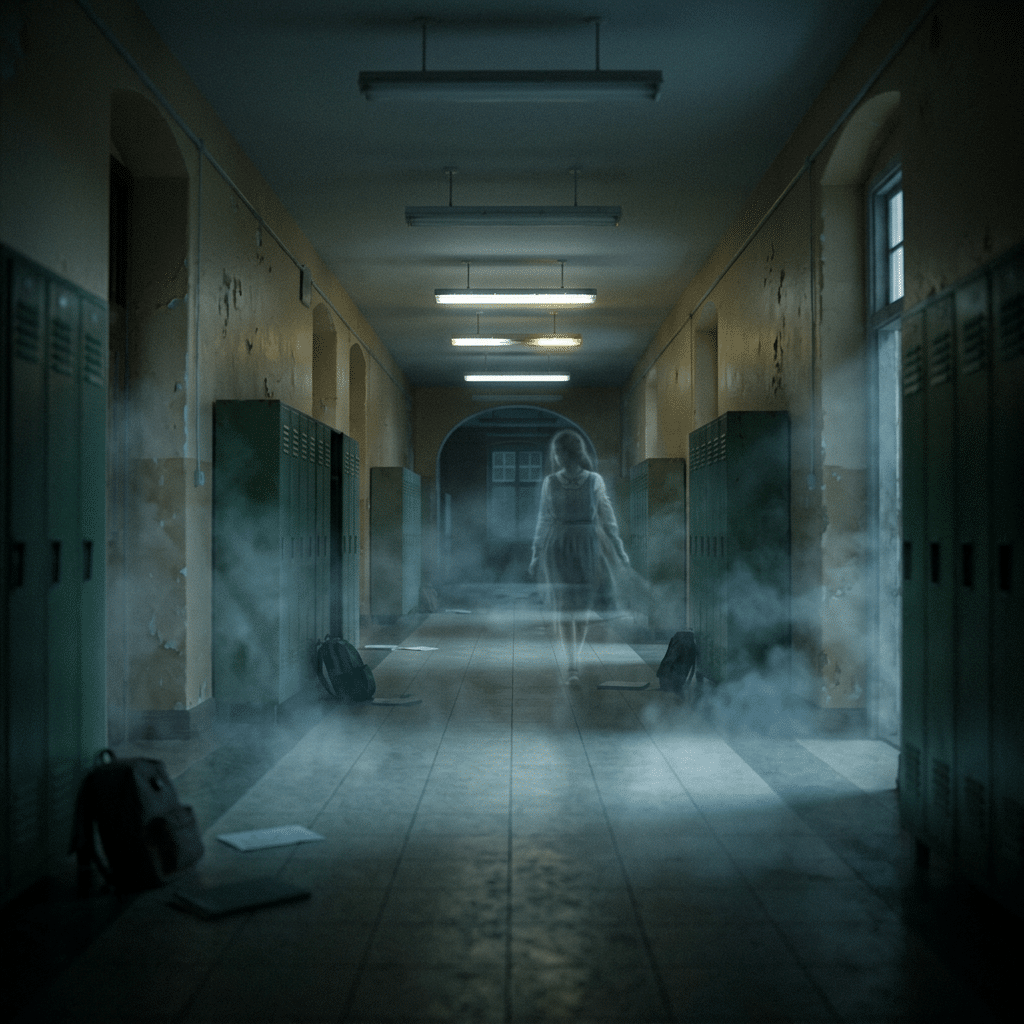
Ghosts at schools prefer to stick to the usual scripts. There is often a figure of a previous pupil who died young, sometimes in an accident, perhaps of an illness. There is a strict instructor who will not leave the classroom in death. Caretakers and janitors are believed to still wander the halls at night, jangling keys and flipping on lights in empty rooms. Some schools have a youngster who drowned in an old swimming pool or a student who fell down a stairwell years ago. These numbers become part of the institutional identity. Older kids pass these stories down to younger ones, sharing them during sleepovers, residential excursions, or late nights rehearsing for a school play. The ghost becomes a type of mascot, scary but nevertheless familiar.
Descriptions of sightings vary widely in detail and veracity. Teachers say the corridors echo with footsteps after the last child has gone home. The cleaners report cold spots, doors opening on their own, and the impression that they are being watched. Pupils said they had seen a ghostly pale figure standing at the end of a corridor or heard a voice calling their name in an empty changing room. Most stories come from old gymnasiums and theaters, basements, and unused classrooms. Sometimes photographs turn up, indistinct shapes in windows, or figures that have faded into glass. One feature is similar to most of these accounts. They take place at calm times, when the regular buzz of school life has faded and the building is unexpectedly different. During the day, it buzzes with activity, but at night, it transforms into an unsettling environment.
Ghost Stories as Living Folklore
Ghost lore in educational environments is often crystallized around campus legends and modern college ghost stories. Research into ‘haunted halls’ and ghost lore at American colleges identifies recurring themes (such as personal histories, unresolved deaths, and places of tragedy) and shows how students and alumni add to the living folklore through digital communication and instant messaging, influencing contemporary campus mythologies (McGill, 2022). Folklore studies highlight the movement of belief narratives across media and places, and educational settings are key sites for the production, circulation, and reinterpretation of ghost stories, urban legends, and modern legends. The experience-centered approach to hauntings understands ghost stories as culturally important events that reflect communal values and historical memory, especially how schools are sites for ritualized storytelling and ethical reflection (Kuperjanov et al., 2016; McGill, 2022). Some scholars have disputed the line between belief and storytelling, with some concentrating on haunt narratives as cultural artifacts that reveal social processes and others acknowledging genuine experiential claims and their impact on identity formation and sense of place in schools (Kuperjanov et al., 2016; McGill, 2022).
These tales form a crucial and frequently ignored part of folklore. School ghost stories are a living tradition, passed down and elaborated by each new generation. They have multiple purposes at once. They bond pupils via shared terror and knowledge, establishing a community. They provide a secure place to talk about scary things like death and loss in the comfort of a friendly group. They convey silent messages, too. The ghost in the abandoned wing warns children not to venture into places they shouldn’t. The ghost of the drowned student has a silent warning about water safety. Ghost stories, in a way, are like the ancient fairy tales: they dress up practical warnings in otherworldly clothes. Ghost stories contribute to a building’s character and mythology, transforming an ordinary institution into one with depth and history.
In school environments and religious and cultural studies, not in empirical paranormal inquiry, we see the intersection between exorcism narratives and demonology. Analyses investigate how popular culture, media, and religious institutions play a role in shaping public understandings of demonic manifestations and ritual practices, including the narratives of exorcism that circulate in educational and religious settings. These conversations show how schools and educators could meet student interests in the paranormal and how education might engage critical thinking about such ideas (Chavez, 2021).
Research comparing religiosity and paranormal views highlights the persistence of belief in the paranormal in secular society and the intricate interplay between religious and paranormal ideas, notably in school and educational settings. Haunted-school narratives appeal to audiences from varied backgrounds, and this literature forms the basis for understanding why (Bader et al., 2012; Christensen & Clasen, 2025). It is vital to distinguish ethnographic or folklore interpretations of exorcism in American or European contexts from empirical investigations of school-based hauntings. In this arena, literature tends to prioritize media representation, ritual language, and institutional discourse rather than field studies of school hauntings themselves (Chavez, 2021).
Competing Explanations for School Hauntings
There are basically two kinds of theories on why schools seem haunted. Paranormal believers say that intense emotions can leave an impression on a place, a kind of psychic residue that sensitive people can pick up on later. Some believe spirits are drawn to locations where they feel strong emotions, and few places are more powerful than schools. Sceptics have their explanations. They cite the power of suggestion, arguing that once a story is out there, people are ready to interpret mundane situations as paranormal. A creaking pipe sounds like footsteps. A draft creates a chilly area. Old buildings settle, plumbing knocks, and the human brain is wonderful at perceiving faces and figures in shadows. This propensity is called “pareidolia.” Stress, fatigue, and panic increase this effect. Add in the social pressure of a group of people wanting to see something scary, and a regular night can quickly become a haunted experience. Neither side has sufficient evidence to support its case, which contributes to the continuation of these stories.
In the end, the ghosts of schools may tell us more about the living than the dead. Whether real spirits, psychological tricks, or stories passed down through endless generations, they illustrate how closely we link emotion, memory, and place. Schools mold us in some of the most vivid years of our lives. So it is fitting that they are recognized as places where something remains. The figure at the end of the corridor, the breath of chilly air on the back of the neck, and the name whispered in an empty room—all of these tap into our never-ending fascination with what might be lurking just beyond the border of the usual. Ghosts, real or imagined, in our classrooms are not likely to disappear very soon.
References
Adams, M. B., & Graham, L. R. (1995). The Ghost of the Executed Engineer: Technology and the Fall of the Soviet Union. Technology and Culture, 36(1), 168. https://doi.org/10.2307/3106345
Bader, C. D., Baker, J. O., & Molle, A. (2012). Countervailing Forces: Religiosity and Paranormal Belief in Italy. Journal for the Scientific Study of Religion, 51(4), 705–720. https://doi.org/10.1111/j.1468-5906.2012.01674.x
Chavez, W. S. (2021). Modern Practice, Archaic Ritual: Catholic Exorcism in America. Religions, 12(10), 811. https://doi.org/10.3390/rel12100811
Christensen, K. R., & Clasen, M. (2025). Evolved minds in a secular world: A large-scale survey of supernatural beliefs in Denmark. Evolutionary Behavioral Sciences. https://doi.org/10.1037/ebs0000386
Edwards, A. (2019). “Do the Ghosts Roam Along the Corridors Here at Ordsall Hall?”: Paranormal Media, Haunted Heritage, and Investing Historical Capital. The Journal of Popular Culture, 52(6), 1312–1333. https://doi.org/10.1111/jpcu.12852
Houran, J., Hill, S. A., Haynes, E. D., & Bielski, U. A. (2020). Paranormal Tourism: Market Study of a Novel and Interactive Approach to Space Activation and Monetization. Cornell Hospitality Quarterly, 61(3), 287–311. https://doi.org/10.1177/1938965520909094
Kuperjanov, A., Hiiemäe, R., Mällo, T., Voolaid, P., Andres, D., Layout, K., Kahre, D., Goldstein, D., Gunnell, T., Berton-Reilly, E. A., Baran, A., Koski, K., Palmu, H., Salomäki, H., Ketola, K., & Niemelä, K. (2016). Untitled. Folklore Electronic Journal of Folklore, 65. https://doi.org/10.7592/fejf2016.65
McGill, M. (2022). The Evolution of Haunted Space in Scotland. Gothic Studies, 24(1), 18–30. https://doi.org/10.3366/gothic.2022.0118
Millán, M. G. D., Rojas, R., & García, J. S.-R. (2019). Analysis of the Demand of Dark Tourism: A Case Study in Córdoba (Spain). Mediterranean Journal of Social Sciences, 10(1), 161–176. https://doi.org/10.2478/mjss-2019-0015
Obradović, S., Pivac, Т., Besermenji, S., & Tešin, A. (2021). Possibilities for paranormal tourism development in Serbia. Eastern European Countryside, 27(1), 203–233. https://doi.org/10.12775/eec.2021.008


Leave a Reply