Why do we have the weather that we do?
Throughout history, humans have sought to explain the mysterious forces behind weather and natural disasters. In the absence of scientific knowledge, supernatural beliefs emerged to make sense of these unpredictable and destructive events. Cultures around the world developed rich mythologies and folklore attributing storms, earthquakes, floods, and other phenomena to the actions of gods, spirits, or magical forces. This video will explore some of the paranormal explanations that different societies have used to understand dramatic meteorological and geological events.
Weather Mythology
Many early cultures associated thunder and lightning with gods and divine power. In Greek mythology, Zeus was the god of the sky and thunder. When Zeus was angry, he would throw lightning bolts from Mount Olympus. The Vikings believed that thunder was caused by the god Thor striking his mighty hammer. In Japan, Raijin was the god of lightning, thunder and storms. Many Japanese paintings depict Raijin as a demon beating drums to create thunder. Similar beliefs can be found among Indigenous peoples of the Americas, with gods like the Aztec’s Tlaloc, the Mayan‘s Chac and the Inca’s Illapa associated with storms and thunder.
In African cultures, Shango, the Yoruba god of thunder and lightning, is revered for his power to send bolts of lightning to strike down wrongdoers. Native American tribes, such as the Ojibwa, tell tales of thunderbirds, giant mythical creatures in the sky responsible for creating thunder and lightning.
In Greek lore, the Anemoi were wind gods who each presided over a cardinal direction. Boreas (the North Wind) brought cold winter air, while Notus (the South Wind) ushered in the warmth of summer. Some Native American tales depict tornadoes as vengeful spirits, often pursuing those who have angered them.
Destructive ocean storms have been explained as acts of divine forces. Typhoons in Asia were once thought to be created by dragons, huge serpent-like beasts that conjured up tempests. According to Chinese legends, typhoons were caused by a giant dragon called Fujin. Hurricanes in the Caribbean have been linked to African and Indigenous American gods. For instance, slaves brought from West Africa to the Americas transmitted legends of the god Shango, who used storms and lightning to take vengeance on wrongdoers. Some Native American tribes described hurricanes as the work of rivalry between wind gods.

Destructive Forces
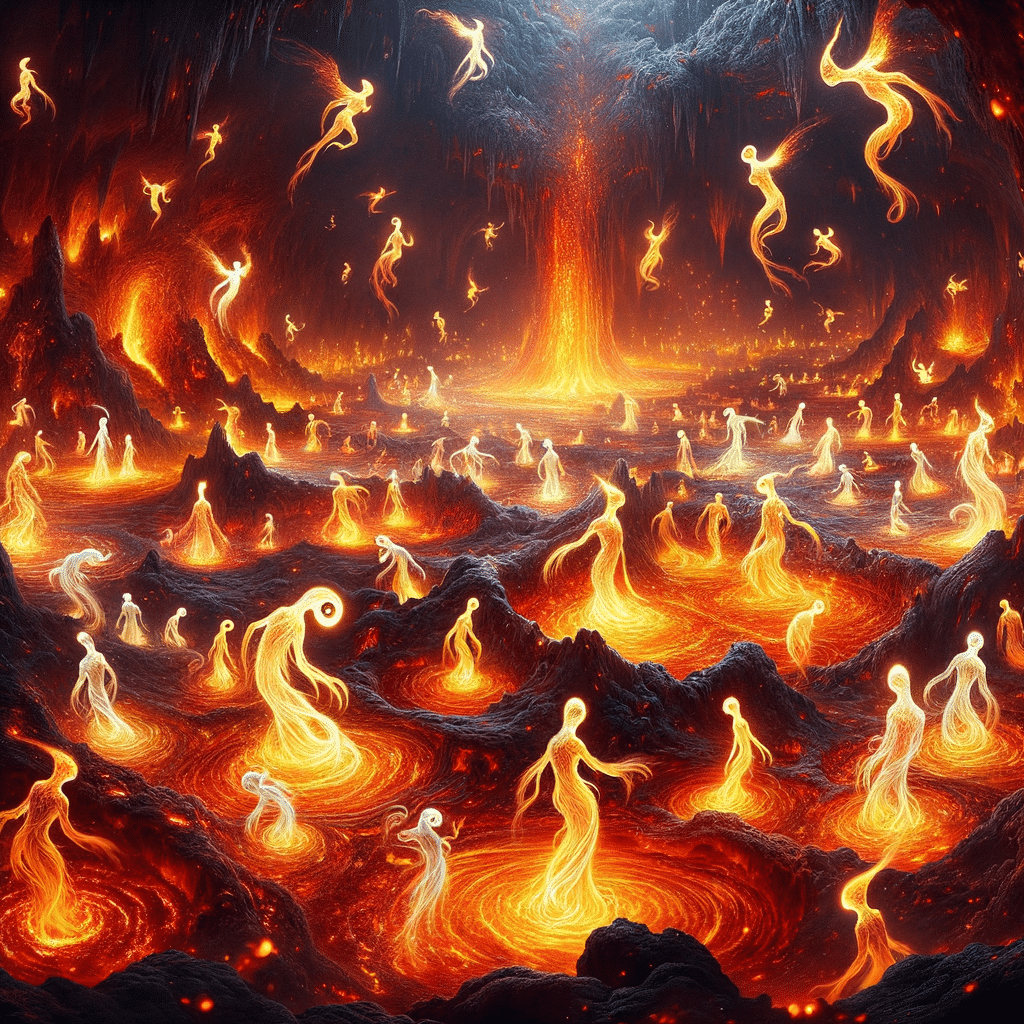
Volcanoes have long been associated with supernatural forces of creation and destruction. In Hawaii, the volcano goddess Pele was said to demonstrate both her creative power and her fiery rage. Other Polynesian peoples viewed volcanic eruptions as battles between volcano gods. In the Philippines, the volcano Mayon was believed to be inhabited by a spirit called Magayon. The Aboriginals of Australia held that volcanic eruptions signaled the presence of Wandjina, their creator spirits.
Earthquakes have also been attributed to supernatural causes, such as the movement of giant creatures. Japan, a nation familiar with both earthquakes and tsunamis, has many associated myths. Namazu, a giant catfish living beneath the Earth, is believed to cause earthquakes when he thrashes in the depths. Only the god Kashima can restrain him. Similarly, the Maori of New Zealand attribute earthquakes to the god Rūaumoko, the unborn god of volcanoes and earthquakes, who moves below the Earth.
In Hawaii, the volatile fire goddess Pele is credited for both creating and destroying land, manifesting her power through the birth and eruption of volcanoes.
For tsunamis, cultures such as those in the Pacific Islands sometimes believed that these giant waves were the anger of sea gods or spirits, retaliating against humans for some perceived wrong.
The story of a Great Flood that destroys civilization exists in many cultures spanning the globe. In the biblical story, the Flood was sent by God to purge the world of human wickedness. But flood narratives also appear in Greek, Norse, Hindu, Chinese, Native American and Australian Indigenous traditions. While details differ, these stories share common elements, often involving divine judgement and the salvation of a chosen few. For example, both the Chinese myth of Gong Gong and the Maori legend of Mataaho tell of destructive floods triggered by the damage done to heavenly bodies. Such tales attempt to provide supernatural explanations for a catastrophic flood that may have occurred in humanity’s distant past.
Conclusion
While modern science has uncovered natural explanations for weather patterns and geological events, supernatural beliefs still offer insights into how past cultures made sense of these disruptive forces. The universal themes in these paranormal narratives point to a deeply rooted human desire to find meaning and causation even in seemingly random disastrous acts of nature. Whether myths of storm gods, volcanic deities, or great floods, these stories reveal our ancient impulse to understand and anthropomorphize the mysteries of the natural world.
References
Altmann, S. L. (2011). Is nature supernatural?: A philosophical exploration of science and nature. Prometheus Books.
Lilly, I. E. (2017). Conceptualizing Spirit: Supernatural Meteorology and Winds of Distress in the Hebrew Bible and the Ancient Near East. In Sibyls, Scriptures, and Scrolls (pp. 826-844). Brill.
Maudsley, H. (1897). Natural causes and supernatural seemings. Kegan Paul, Trench, Trübner.
Routledge, C. (2018). Supernatural: Death, meaning, and the power of the invisible world. Oxford University Press.
Watson, L. (2013). Supernature: A natural history of the supernatural. Sceptre.

Leave a Reply