Eastern State Penitentiary Ghosts: Key Points
-
Eastern State Penitentiary is a massive, Gothic-style prison in Philadelphia, Pennsylvania, built in 1822 with a radial design that allowed guards to observe all cellblocks from a central hub.
-
The prison operated from 1829 to 1971 and was founded on a system of total solitary confinement, which was intended to reform criminals but instead drove many inmates to severe mental illness.
-
The penitentiary housed famous figures like Al Capone and was criticized as early as 1842 by Charles Dickens, who condemned the solitary system as a form of psychological torture.
-
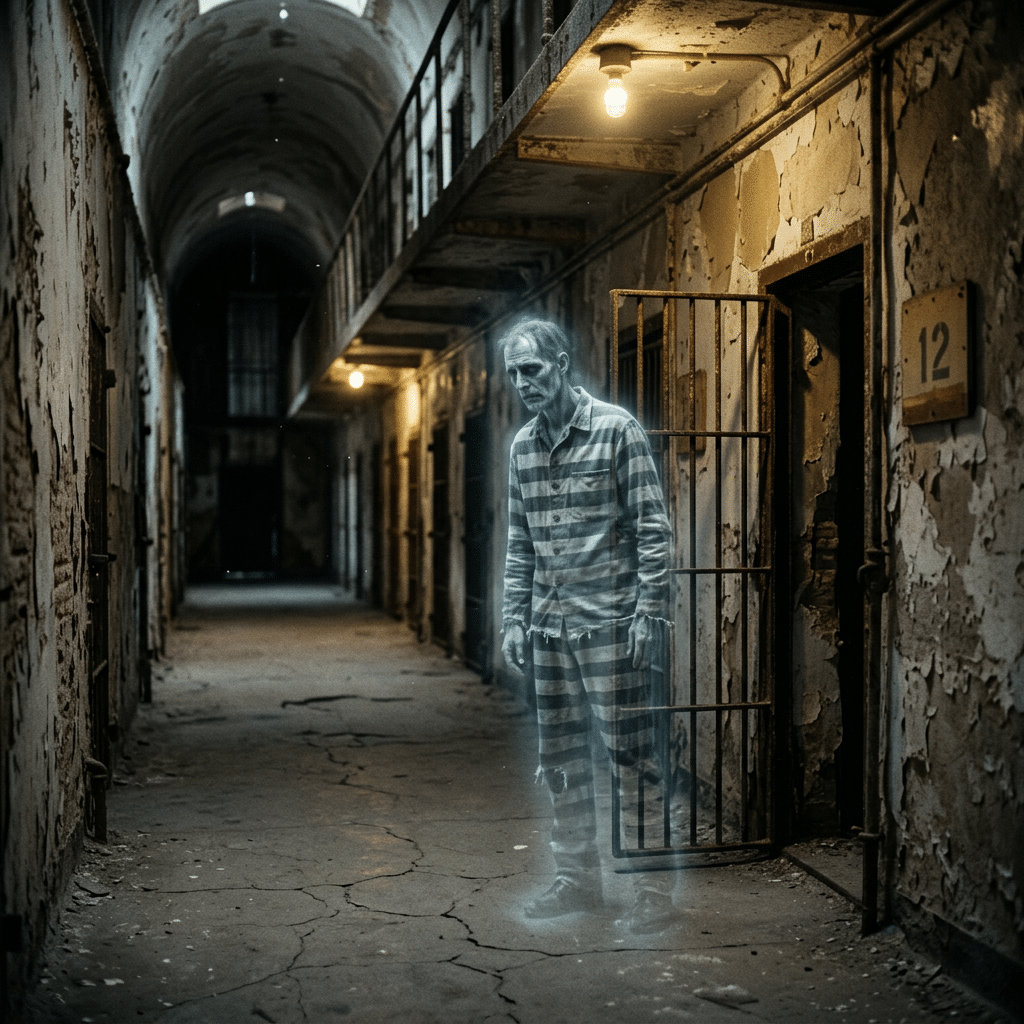
Reported paranormal activity includes shadowy figures, disembodied laughter, ghostly faces emerging from walls, cold spots, and whispered voices, with Cellblock 4 and Cellblock 12 being particularly active locations.
-
Paranormal investigation teams have documented EVPs, unusual thermal imaging signatures, and electromagnetic field spikes at the prison, lending the hauntings a degree of documented credibility among believers.
-
Theories explaining the activity range from residual and intelligent hauntings to infrasound, the stone tape theory, and psychological explanations like confirmation bias and priming effects.

Introduction
Eastern State Penitentiary is among the most haunted locales in the United States. For decades this crumbling stone-and-iron fortification has captured the interest of paranormal aficionados, historians, and curious visitors alike. There are more than two centuries of pain, seclusion, and death inside the crumbling walls of the penitentiary in Philadelphia, Pennsylvania’s Fairmount neighborhood. The building’s reputation as a hotbed of ghostly activity is tied to the tragic history that took place inside its walls. The stories of guards, tourists, and investigators tell of a location where the past refuses to be quiet.
Historical Context and Architectural Origins
On the outskirts of Philadelphia, Eastern State Penitentiary (ESP) is a foundational experiment in the so-called Pennsylvania system, as well as a unique case study of the transformation of a carceral facility into a remembrance site and tourism destination. Opened in 1829, the jail became emblematic of “solitary confinement” and reformist carceral doctrine, a design logic that would later be embodied in its radial plan, individual cells, and the legendary and controversial architectural goals of its designer, John Haviland. Since 1994, when it was transformed from a jail of revolution into a museum and then into a place of penal heritage and dark tourism, the ESP has been a reference point in debates on carceral architecture, museumization, and public memory of punishment. This synthesis draws on a number of strands of scholarship that consider ESP’s architecture, its punitive philosophy, its transformation into a museum, and its involvement in penal tourism and carceral memory (Barnes, 1921; Fiddler, 2011; Friedman, 2021; Houran et al., 2020; Knackmuhs et al., 2020; Сокaльськa, 2023; Turner & Peters, 2015; Walby & Piché, 2011), to name a few. The picture is more complex: ESP was a concentrated experiment in social control, architecturally and organizationally. Its subsequent memory work reworked that history for different audiences, while scholarly arguments go on concerning the ideological assumptions and the politics of expressing punishment in museum form (Сокальська, 2023; Rubin & Reiter, 2018; Knackmuhs et al., 2020; Fiddler, 2011).
Even if you have no interest in the occult, the physical building of Eastern State Penitentiary is immediately impressive and disturbing. Work began in 1822 and architect John Haviland designed the jail in a wagon-wheel or “radial” form, with seven cellblock corridors extending outward from a central watch area like the spokes of a wheel. The hub was designed so that one guard could see all cellblocks at once, allowing for efficient surveillance and making escape extremely impossible. The outer walls are around thirty feet high and nearly eleven acres long, giving the facility the forbidding appearance of an ancient Gothic castle rather than a penal complex. Initially the cells within were crowned with skylights called “the Eye of God” in order to shed a divine light on each prisoner but in fact they brought little comfort. As the prison population grew, more cellblocks were added over time, and by the mid-twentieth century the complex had grown far beyond Haviland’s original vision, creating a labyrinthine structure of cracked plaster, rusted iron, and peeling paint that today seems suspended in a slow collapse.
The Pennsylvania System and Prison Life
Learning about the history of Eastern State Penitentiary is learning why so many people believe it is haunted. The misery was systematic, deliberate, and extreme. The jail, opened in 1829, was heralded around the world as a revolutionary experiment in criminal reform based on the Pennsylvania System of solitary incarceration. The notion dictates that all inmates be kept in total isolation at all times and never be allowed to speak to or see another person, being forced to work, eat, sleep, and live completely alone in a solitary cell. Administrators thought solitary reflection would induce remorse and rehabilitation in the prisoner, but in actuality the practice drove many convicts to severe mental illness, self-harm, and despair. Even well-known visitors, like Charles Dickens, who visited the prison in 1842, criticized the isolation system as torture, stating that the mental agony it induced was worse than any physical punishment. One of the most famous convicts in the history of the prison was Al Capone, who in his brief stay in 1929 enjoyed a furnished and reasonably pleasant cell, compared to the suffering of most prisoners. The penitentiary held convicts until 1971, when it finally closed its doors due to deteriorating conditions and mounting costs, and it lay abandoned for years before opening as a historic monument and museum in 1994. In its 142 years of operation, thousands of people lived and died within its walls, leaving behind a legacy of pain that many believe lives on now.
The idea of ESP was created when people wanted to change the way punishment was done by using new kinds of buildings and keeping prisoners away from each other. A well-known example of the Pennsylvania system was the ESP. This model emphasized solitary confinement and the notion that isolation would induce transformation rather than punishment through labor or collective discipline. This primary architectural notion, with its wings and individual cells extending out from a rotunda, was to be a way of placing moral reform at the heart of penology. This design would be taken up later in talk of the system’s beginnings and the syllogisms of reform (Rubin & Reiter, 2018; Barnes, 1921). Historical literature on Haviland and the Eastern Penitentiary’s place in American correctional architecture recounts both the design of the site and the architect’s objectives. The design of the structure is often cited as a masterpiece of early American penology and Haviland’s influence is explored at length by art-historical and architectural experts (Gardner, 1955; Wilson, 2009).
The early penitentiary was built with individual cells to reduce social contact among prisoners and to provide for work or introspection in the cell, a sharp break from the prior congregate systems. The material culture of ESP itself—the barber’s chair and other artifacts from the cell block—has become symbolic, tangible proof of the rationales and atmospheres of monitoring, discipline, and reform of the era (Turner & Peters, 2015). Choices in the architecture, such as the skylight in the original cells that was meant to imply moral focus and divine supervision (McCorkel & DalCortivo, 2018), have been used to explore ESP’s “eye of God” metaphor and how the site might communicate discipline through space.

Paranormal Reports and Investigations
Long before it became a tourist site, stories of ghostly goings-on at Eastern State Penitentiary were circulating among the personnel and staff within days after the closing of the institution. Sightings of shadowy individuals peering out from behind cell doors or rushing down corridors are routinely recorded, only to vanish when approached. Cellblock 12 has, in particular, become infamous for these sightings, with numerous visitors and staff members independently claiming to have seen dark, humanoid entities strolling throughout that portion of the prison. It’s also typical to hear cackling or ghostly laughter reverberating through the cellblocks when no one is nearby, which some investigators believe is an echo of the psychological collapse of inmates who spent years in complete isolation. Many visitors to Cellblock 6 have reported seeing ghostly faces in the walls, as if the stone itself were capturing the tormented looks of the individuals who were locked up there.
Perhaps the most famous ghost linked to the jail is the “Shadow Ghost.” This shadowy figure is said to materialize abruptly in various locations and appears to watch people before vanishing. It has become somewhat of an urban legend in the area. Gary Johnson, one locksmith who was brought in to restore the prison in the 1990s, said he felt an overwhelming presence and saw dark creatures swirling about the cell and along the corridor as he removed a lock in Cellblock 4 that hadn’t been opened in decades. Guides and security workers have reported hearing whispers, feeling cold spots, or feeling that they are being touched or watched in cellblocks around the facility multiple times. All of which happens with enough consistency that it is impossible to dismiss.
A key empirical benchmark in the literature is the 2008 National Geographic television investigation of ESP (American Paranormal: Haunted Prison) that Houran et al. have linked to subsequent interpretations of ESP’s haunt narratives. However, the authors caution that certain reports of apparitions or anomalous experiences at ESP and similar sites may be associated with expectation, suggestion, and the socio-psychological context of paranormal study rather than independent physical phenomena (Houran et al., 2020). This is in line with a wider academic view that explanations of haunt-type experiences are usually complex interactions between belief, anticipation, tour design, and audience interpretation (Ironside, 2024; Baker & Bader, 2014). This caution in interpretation is also evidenced in the broader literature on paranormal tourism, which emphasizes the importance of media representations, branding, and guided experience in constructing perceptions of “activity” at haunted sites such as ESP (Ironside, 2023; Baker & Bader, 2014; Barton & Brown, 2015).
Eastern State Penitentiary has been visited by professional paranormal research teams, who have recorded findings that have added to the prison’s haunted reputation in the eyes of believers. The television show Ghost Hunters investigated the jail extensively and found electronic voice phenomena, or EVPs, in numerous cellblocks, including moans and utterances that could not be explained by any of the experts on site. Thermal imaging cameras have reportedly detected human-shaped heat signatures in locations believed to be uninhabited and electromagnetic field detectors have spiked considerably in areas that are known for regular sightings. The jail itself embraces this notoriety with open arms as part of its annual Halloween event, “Terror Behind the Walls,” which has become one of the most popular haunted attractions on the East Coast. Management is careful to distinguish the actual historical hauntings from the theatrical spectacle they produce each fall. particular studies have found that particular cells, especially in the older areas of the prison, seem to create more activity than others. Particular consideration should be given to the fact that the energy or presence is more concentrated in particular regions of the facility rather than being uniformly spread about.
Theoretical Explanations and Cultural Significance
There are various reasons why people say Eastern State Penitentiary is haunted—from physics to psychology to spiritual belief. Residual Haunting One of the more popular hypotheses among paranormal researchers is that of residual haunting. The idea is that traumatic or emotionally charged events can somehow imprint themselves on the physical environment, playing out like a tape for those sensitive enough to tune in. This theory is that the years of isolation, suffering, and mental torment endured by thousands of captives left such an energy imprint that it’s still playing out as apparitions, noises, and sensations long after the victims themselves have gone. Another prevalent belief is intelligent haunting, in which it is said that the spirits of former prisoners or staff genuinely do exist in the building and are able to communicate with the living and that they intentionally elect to make themselves known, to answer questions or to show themselves. Others have argued in favor of the hypothesis of infrasound as a more scientifically viable explanation. The sound waves of the aged building or the wind through the corridors or water sources deep in the earth could produce feelings of discomfort, visual distortions, and even hallucinations in visitors.
The stone architecture of the structure has also helped to foster the ‘stone tape theory’—that some materials, especially stone and brick, may store and replay psychological imprints in the way that magnetic recording tape does. But researchers think the prison’s famed reputation for suffering primes visitors to interpret ambiguous cues, such as shadows, creaking sounds, and unexpected temperature changes, as paranormal—a phenomenon called the priming effect combined with confirmation bias. As is often the case with hauntings, the truth is likely unknown, and the debate between scientific skepticism and true trust in the supernatural is part of what makes Eastern State Penitentiary such an interesting and enduring place.
An Eastern State institution is a classic case widely utilized in academic research on paranormal tourism and “haunted” historic sites, where a historic institution has been revived and commodified through spectral connections. In market research on paranormal tourism, ESP is precisely defined as a historical place that has succeeded in incorporating paranormal characteristics into the revitalization and rebranding of its area (Houran et al., 2020). Positioning ESP within the broader conversation of ghost tourism and dark legacy discourses as a form of engagement and monetization for cultural organizations (Ironside, 2023). Prison-tourism scholarship also covers ESP in historical discourse. The jail reads through the concepts of death, captivity, and ghostly presence in its public depiction (Barton & Brown, 2015). Taken together, these data point to ESP as a form of space activation through purported paranormal encounters and corresponding visitor economics (Houran et al., 2020; Ironside, 2023; Barton & Brown, 2015), not just a museum or tour site.
Conclusion
As a site where history and legend meet, and where the boundary between the historical record and the paranormal is not always so easily drawn, Eastern State Penitentiary holds a unique position within American culture. Whether or not you believe in ghosts, the prison’s history of systematic psychological torment provides a compelling background that makes the claimed experiences feel serious and weighty rather than frivolous. The sheer magnitude and intensity of it makes it hard to ignore the human legacy of the thousands of men who languished for years in solitary confinement inside those stone walls, many of whom went mad and died alone. To walk now through the deteriorating cellblocks and dim halls of Eastern State Penitentiary is to encounter a feeling that disturbs the most rational minds, and for many people that feeling is indistinguishable from the presence of something beyond ordinary understanding. Whether there is something there or not, Eastern State Penitentiary is a potent reminder that places, like people, may carry the weight of their past in ways that are felt long after the events themselves have passed.
References
American Paranormal: Haunted Prison. (2008). [TV documentary]. National Geographic Channel.
Baker, J., & Bader, C. (2014). A social anthropology of ghosts in twenty-first-century America. Social Compass, 61(4), 569-593. https://doi.org/10.1177/0037768614547337
Barton, A., & Brown, A. (2015). Show me the prison! The development of prison tourism in the UK. Crime Media Culture an International Journal, 11(3), 237-258. https://doi.org/10.1177/1741659015592455
Ghost Hunters. (2004–2016). [TV series]. Pilgrim Films & Television.
Houran, J., Hill, S., Haynes, E., & Bielski, U. (2020). Paranormal Tourism: Market Study of a Novel and Interactive Approach to Space Activation and Monetization. Cornell Hospitality Quarterly, 61(3), 287-311. https://doi.org/10.1177/1938965520909094
Ironside, R. (2023). Death, Ghosts, and Spiritual Tourism: Conceptualizing a Dark Spiritual Experience Spectrum for the Paranormal Market. Journal of Scientific Exploration, 37(4), 586-601. https://doi.org/10.31275/20233227
Ironside, R. (2024). Ghost Hunting Events and Storytelling. Event Management, 28(4), 649-654. https://doi.org/10.3727/152599524×17077053867629


Leave a Reply