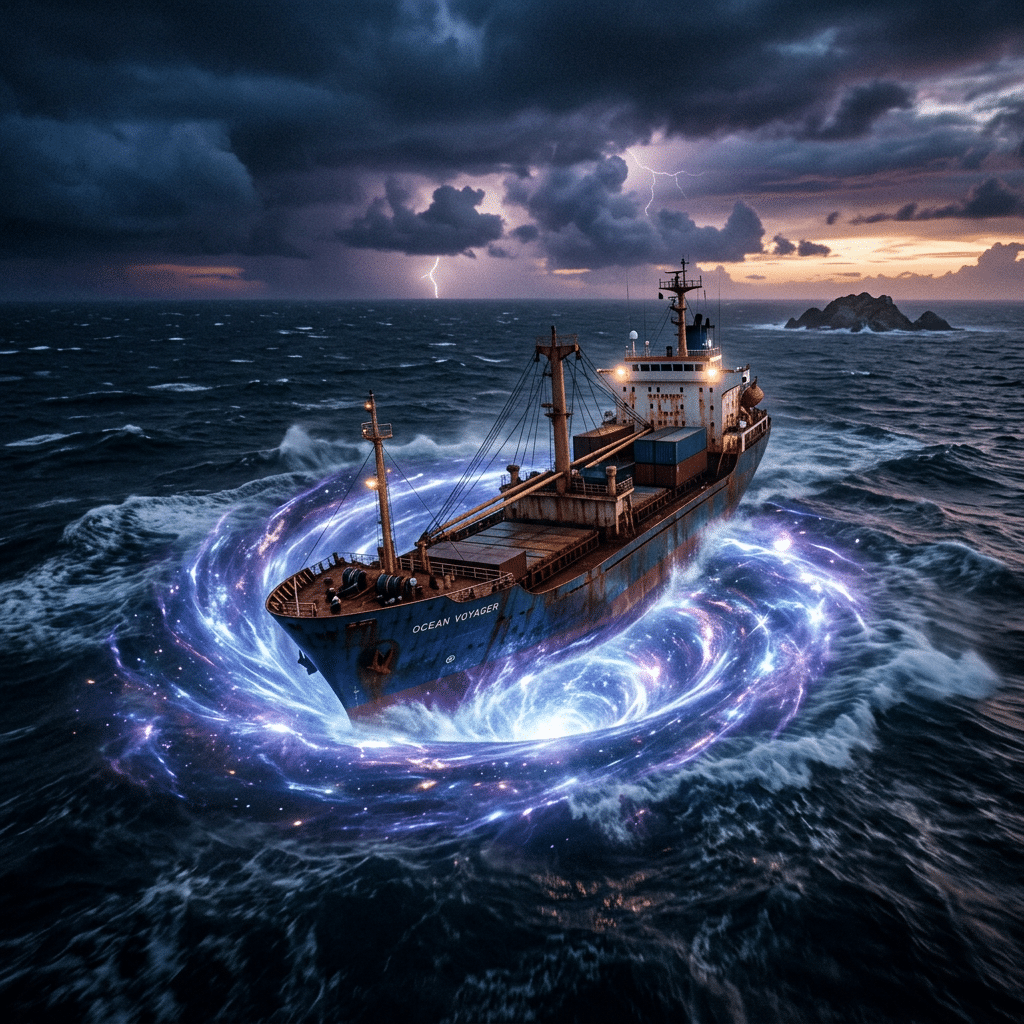
The Dark Portal of the Bermuda Triangle: Key Points
- The Bermuda Triangle is a roughly 500,000 square mile region of the North Atlantic Ocean connecting Miami, Bermuda, and Puerto Rico, notorious for a striking number of unexplained disappearances of ships and aircraft, often leaving behind no wreckage or survivors.
- A portal is a concept rooted in both mythology and modern physics, describing a gateway between locations, dimensions, or points in time, with a “dark” portal specifically implying a one-way passage into something dangerous or unknowable.
- Many Triangle disappearances share unusual characteristics such as sudden compass failures, electronic malfunctions, and eerie luminous fogs reported just before contact is lost, with the consistent absence of debris being the strongest evidence that victims crossed some kind of threshold rather than simply sinking.
- Competing theories about the portal’s origin range from methane gas eruptions on the seafloor creating zones of physical disruption, to submerged Atlantean energy crystals opening rifts in spacetime, to extraterrestrial civilizations using the area as an underwater transit hub.
- A quantum-based theory suggests the Triangle sits atop a naturally thin point in the membrane between dimensions, where vessels can unpredictably slip into a parallel reality, explaining both the disappearances and the reported experiences of time loss among those who passed through unharmed.
- While skeptics attribute the disappearances to weather, human error, and heavy traffic volume, the cases with no wreckage and no distress calls remain difficult to fully explain, keeping the dark portal theory alive in the space between proven fact and enduring fear.

Introduction
For generations, people have been fascinated by the mysteries on the edge of knowledge, and there are few places on Earth that have caught the imagination, like the Bermuda Triangle. This fabled stretch of water has consumed ships, planes, and people with a constancy that is difficult to explain, leaving behind a heritage of terror and awe. Among the ideas trying to explain the disappearances, one of the most horrifying and most provocative is that there’s a dark doorway, a supernatural or interdimensional gateway, hiding somewhere in those cursed waters, silently ingesting whatever passes its barrier.
The Bermuda Triangle: History and Disappearances
The Bermuda Triangle is a loosely defined region in the North Atlantic Ocean. It is often represented as a triangle connecting Miami, Florida; Bermuda; and San Juan, Puerto Rico, and encompasses around 500,000 square miles of open sea. The area has been linked to a large number of disappearances dating back at least to the middle of the twentieth century, when journalist Vincent Gaddis created the phrase “Bermuda Triangle” in 1964. One of the most memorable cases was the loss of Flight 19 in December 1945, when five U.S. Navy torpedo bombers and the rescue plane assigned to find them vanished during a training exercise, with no wreckage and no survivors. In 1918, somewhere in the region, the USS Cyclops, a big Navy cargo ship carrying over 300 sailors, disappeared without ever transmitting a distress signal. To this day, no one has ever found definite evidence of the ship. The Triangle is disturbing not just for the many disappearances, but for the lack of debris or bodies you would expect from such large maritime and aircraft tragedies.
The Bermuda Triangle is a classic example that is mentioned again and again in talks about the paranormal and the unproven. In the early and mid-twentieth century, scholars of credulity critique specifically positioned the Bermuda Triangle among alternative paranormal themes to demonstrate the lack of conviction in unsupported assertions (Kemp, 1983). This use of the triangle makes it a symbol of mystery rather than a place with known physical reasons. Similar trends can be seen in general surveys of media and science. Thus, the Bermuda Triangle is a topic that arouses public interest in the unknown and the supernatural (Smith, 2009) and serves as a typical example, alongside UFOs and other sensational claims, in popular science and skepticism discourse (Harris, 1996).
The Concept of Dark Portals and Dimensional Gateways
Portals are often described in science fiction and paranormal literature as doors or gateways between one place or dimension and another, permitting travel through space, time, or even reality itself. The concept is deeply rooted in myth and folklore, from the fairy rings of Celtic myth, which are thought to lead travelers to distant realms, to the Norse Bifrost bridge, which connects the mortal world with the holy. In contemporary theoretical physics, ideas like wormholes, even though they have never been seen or verified, imply that such links between faraway points in spacetime could be attainable. A “dark” portal in particular tends to connote danger, evil, or connections to a realm hostile to life as we know it, one that not only transports but also consumes, traps, or destroys whatever passes through it. The darkness of the gateway lends voice to the sense that whatever is on the other side is not a place you come back from, a notion that chillingly echoes the one-way disappearances of the Bermuda Triangle.
One of the common rhetorical devices in paranormal literature is to treat locales linked with inexplicable disappearances as portals or doorways to other realms, dimensions, or states of consciousness. Even if not always scientifically presented, many stories employ the Triangle as a metaphor for transition from the mundane to the paranormal. In the wider landscape of paranormal issues, Smith’s Front Matter emphasizes that the Bermuda Triangle is part of a selected collection of popular paranormal ideas, pointing to its position as a cultural doorway in the wider conversation about the unknown (Smith, 2009). In “Un-Haunted House,” Castronovo also places mysticism and occult experiences in a historical arc that includes the Bermuda Triangle and other “unexplained” phenomena, showing how places can be incorporated into larger narratives of mystical access to other planes of experience (Castronovo, 2012).

Evidence and Theories Supporting the Portal
Many of the disappearances have profoundly unusual traits that distinguish them from ordinary mishaps. This discovery is the basis for a belief that a dark gateway is the cause of the Triangle ‘s disappearances. Pilots and ship captains have reported sudden compass issues, electrical malfunctions, and mysterious fogs that appear out of nowhere before losing all communication. Pilots have reported the sky and water merging into a blinding white haze in multiple stories, a phenomenon some have called flying through a “white fog tunnel,” as if the fabric of the visible world were folding in on them. These uniform reports suggest that victims are not only falling to the ocean below but also passing some type of boundary into a region from which return is impossible. The lack of wreckage is likely the strongest evidence supporting the portal theory, as even modern aircraft and ships create extensive debris fields in catastrophic accidents, yet that part of the ocean floor has been searched and found little of the expected wreckage.
There are many hypotheses regarding the nature of this dark doorway and its origins, ranging from geological explanations to alien theories. One popular theory among scientists with a tangential connection to the field is that huge eruptions of methane gas from the seafloor underneath the Triangle could destabilize the water and air so rapidly that they can be considered temporary places where the laws of physics work differently. Some scientists have even speculated that such eruptions could theoretically create conditions where matter itself is disrupted. A wilder idea links the Triangle’s gateway with the mythical lost city of Atlantis, positing that the energy crystals of the ancient civilization still sit, submerged, on the ocean floor, periodically sending forth energy beams that create rifts in spacetime. In 1968, strange underwater rock structures were discovered off the coast of Bimini. Some call these the Bimini Road and believe them to be evidence of Atlantean building. The extraterrestrial theory may be the most dramatic, positing that an alien civilization built or found the portal, which they use as a kind of transit hub, with ships and aircraft disappearing to be collected as specimens or casualties of ongoing alien activity beneath the waves.
One especially convincing theory takes from the growing science of quantum physics to claim that the Triangle lies atop a natural interdimensional weak spot in the fabric of reality. In this way of thought, the cosmos is made up of numerous layers or dimensions vibrating at different frequencies, and at some geographical places, the boundaries between these levels thin out to become almost non-existent. The hypothesis suggests that the Bermuda Triangle serves as a thinning point where ships and planes can pass through the membrane between dimensions, similar to how a finger can push through a soap bubble, allowing entry into a parallel realm from which no signal can return to our own. Some theorists say that partial dimensional crossings actually occur, citing reported incidents in which ships or planes appear to have traveled through the Triangle unscathed but with bizarre aftereffects, such as clocks going backward or crew members feeling time loss. That would suggest that the “dark portal” is not a static, visible portal but a moving zone of instability that kicks in at random times, which would explain why the Triangle doesn’t eat every craft that goes in it.
Skepticism, Cultural Beliefs, and Paranormal Reception
Many scientists and experts, it is important to note, believe the Bermuda Triangle is not more dangerous than any other busy area of the ocean. Lloyd’s of London, the world’s leading insurance market, does not charge more for ships sailing the Triangle. The U.S. Coast Guard says a closer examination of the disappearances shows most can be explained by human error, bad weather, and the sea’s natural unpredictability. The Triangle is located in an area notorious for sudden, powerful storms and is one of the busiest shipping and aviation corridors in the world, meaning a higher frequency of events is statistically expected simply due to volume of travel. Skeptics contend many of the disappearances most often labeled “unexplained” have natural explanations that were neglected or purposefully exaggerated to perpetuate the myth. This mistrust is understandable and not to be discounted, but it doesn’t explain the instances where no debris was found, no distress call was sent, and supposedly the conditions were calm and clear.
Paranormal belief is shaped by cross-cultural and contextual influences. Research on religiosity and belief in the paranormal in various cultural contexts (e.g., Italy) has demonstrated that belief levels may change in a curvilinear manner as a function of participation in religious life, suggesting that cultural context has the potential to modulate receptivity to Bermuda Triangle narratives and other related paranormal claims (Bader et al., 2012). Related work across countries concerning anthropomorphism and paranormal beliefs in the Czech Republic and Slovakia shows that belief in paranormal phenomena can be associated with wider cognitive biases (e.g., how individuals assimilate and personify events) and that social-contextual factors (e.g., religiosity, worldview) modulate these beliefs (Willard et al., 2019).
Recent studies of mystery tourism and folklore also include the Bermuda Triangle. In qualitative, tourist-oriented studies, the Bermuda Triangle is specifically mentioned as a known place of missing planes and unexplained happenings, showing how popular belief fuels tourism and local imaginaries around paranormal phenomena (Singh et al., 2023). In this way, the Bermuda Triangle is presented as a cultural relic that facilitates experiences, narratives, and economic activity involving mystery and the paranormal.
Conclusion
Ultimately, the ongoing obsession with a dark portal in the Bermuda Triangle tells us something deep about the human relationship with mystery and the unknown. Whether or not such a portal exists in any literal sense, the idea plays upon a deep, universal awareness that our world contains secret thresholds, places where the usual laws break down and something stranger and more ancient takes over. The ocean has long been humanity’s great frontier of the unfathomable, swallowing secrets with an indifference that seems almost purposeful, and the Bermuda Triangle has become a kind of focal point for all of that primitive uneasiness. The lost ships and planes are not only tragedies but also something like folklore, stories of passengers who crossed a boundary the rest of us can’t perceive. Until the ocean tells its story, the dark gateway idea will thrive in the territory between the known and the just feared, and perhaps that is exactly where it should be.
References
Bader, C., Baker, J., & Molle, A. (2012). Countervailing Forces: Religiosity and Paranormal Belief in Italy. Journal for the Scientific Study of Religion, 51(4), 705-720. https://doi.org/10.1111/j.1468-5906.2012.01674.x
Castronovo, R. (2012). Un-Haunted House : Spirits, Solid Citizens, and Babbitt. Transatlantica, (1). https://doi.org/10.4000/transatlantica.5989
Harris, R. (1996). Mysterious origins. Current Biology, 6(9), 1045. https://doi.org/10.1016/s0960-9822(02)70656-8
Kemp, P. (1983). Penning a patchwork. Nature, 306(5939), 132-133. https://doi.org/10.1038/306132a0
Singh, K., Sharma, R., & Bagri, S. (2023). Unleash the Potential of Mystery, Ghost & Paranormal Tourism through the lens of locals in Kuldhara, Rajasthan, India: A qualitative study. Enlightening Tourism a Pathmaking Journal, 13(2), 138-164. https://doi.org/10.33776/et.v13i2.7636
Smith, J. (2009). Front Matter.. https://doi.org/10.1002/9781444310122.fmatter
Willard, A., Cingl, L., & Norenzayan, A. (2019). Cognitive Biases and Religious Belief: A Path Model Replication in the Czech Republic and Slovakia With a Focus on Anthropomorphism. Social Psychological and Personality Science, 11(1), 97-106. https://doi.org/10.1177/1948550619841629



Leave a Reply