The Burrunjor: Australia’s Living Dinosaur
- The Burrunjor is a cryptid from Aboriginal Australian tradition, described as a large bipedal reptile reported primarily in the Northern Territory and Gulf Country of Queensland, one of Australia’s most remote and least populated regions.
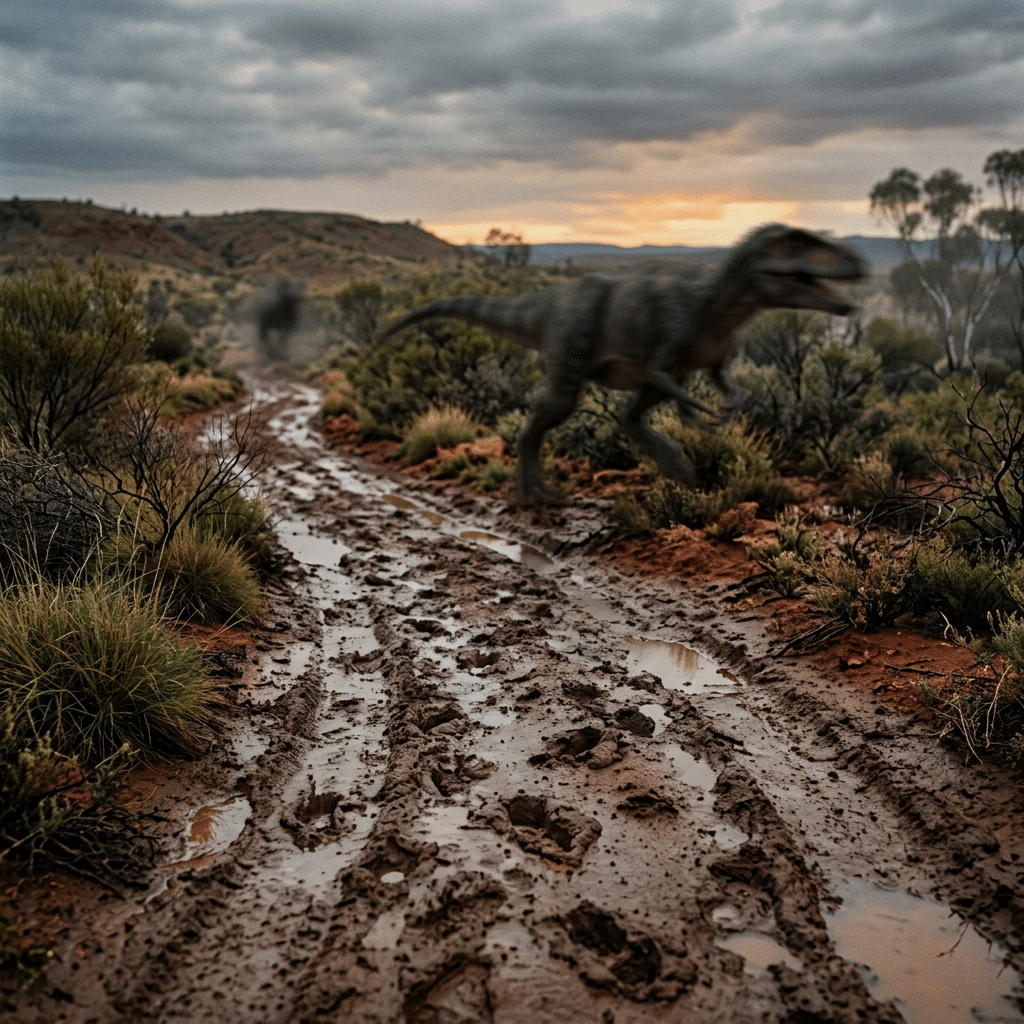
- Physically, it is described as a massive, dark-scaled, two-legged creature between twenty and thirty feet long, with powerful hind legs, reduced forelimbs, a thick tail, and a broad, powerful jaw, bearing a strong resemblance to a theropod dinosaur.
- In terms of behavior, it is regarded as a dangerous apex predator feared by Aboriginal communities, said to attack livestock and claim territorial stretches of outback woodland as its own.
- Sighting reports cluster consistently in Arnhem Land and surrounding areas, with accounts gathered from stockmen, travelling families, and Aboriginal elders, most notably documented by cryptozoologist Rex Gilroy from the 1970s onward.
- Theories about its identity range from a surviving theropod dinosaur to an undiscovered giant varanid lizard, with a more cautious hypothesis suggesting it may represent Aboriginal cultural memory of genuinely extinct Pleistocene megafauna.
- Skeptics point to the total absence of physical evidence, the implausibility of a thirty-foot predator evading documentation in a working landscape, and the likelihood that sightings reflect misidentified known animals combined with the human tendency to perceive danger in remote and unfamiliar terrain.

Introduction
There are few cryptids in the world that have the same mix of old cultural gravitas and current eyewitness mystery as the Burrunjor. This animal, embedded in the culture of Aboriginal Australia and allegedly sighted by settlers and stockmen in the distant north of the continent, is a fascinating enigma. It is a creature that inhabits a curious intersection of myth and zoology, of prehistoric shadow and live animal. The Burrunjor is a fascinating case study for cryptozoology fans and doubters alike, illustrating how folklore, geography, and human psychology may coalesce to create something that is difficult to deny or readily affirm. To understand it, you must consider what people say they saw, what Aboriginal tradition says, and what science says about the event’s validity.
In the vast, largely uncharted Australian Outback, a creature is supposed to prowl the scrubland, enormous and ferocious, terrifying both the animals and the people that share its domain. In the enormous library of unaccounted for creatures, this mysterious cryptid has a special position, and it is often compared not to the ghosts or phantoms of other folkloric traditions but rather to the great theropod dinosaurs of the Mesozoic era. Josh Gates, in his survey of the world’s most compelling cryptid cases, classified the Burrunjor as a creature resembling T. rex and velociraptors, thus firmly placing it within the category of dinosaur-like cryptid predators, a distinction that sets it apart from nearly every other legendary creature (Gates, 2011).
Physical Description and Behavioral Profile
Descriptions of the creature’s physical appearance are astonishingly constant from report to tale, and that constancy is part of the reason it continues to capture attention. According to witnesses and Aboriginal informants, the Burrunjor is a gigantic, bipedal reptile, usually estimated to be somewhere between twenty and thirty feet in length, while some reports push that figure even higher (Carrion, 2024). It walks upright on two muscular hind legs, like a theropod dinosaur, and is supposed to have comparatively short, reduced forelimbs that bear little of its weight. The body is very muscular and the tail (probably for balance) is long and thick. The skull is meant to be massive and broad with a jaw that can exert considerable force. Its skin is invariably described as scaled and dark, generally said to be a deep gray or blackish-brown in color, and the creature is said to be so large that its footfalls can be heard from a great distance. Three-toed tracks have been documented in soft ground in isolated locations of the Northern Territory and Queensland, each impression large enough to suggest an animal of remarkable size. The cumulative accounts provide an overall impression that surprisingly resembles a big Allosaurid or Tyrannosaurid theropod. This likeness has made the Burrunjor a favorite subject for talks about surviving dinosaurs (Burrunjor, n.d.).
The Burrunjor consistently appears as a formidable apex predator in terms of behavior. Aboriginal stories from Arnhem Land and the Gulf Country describe the Burrunjor as a creature to be greatly dreaded, capable of attacking and eating large animals, and it is not reliably repelled by human presence. Aboriginal beliefs say that parts of the outback are the creature’s realm and it is very foolish to intrude there without invitation. At times, local Aboriginal tribes on distant cattle stations in the Northern Territory have attributed to the Burrunjor the loss of livestock, particularly where the way of killing did not seem to match the known predatory habits of any species. The creature is often regarded as being mostly terrestrial, traveling through open woods and scrubland rather than thick jungle. Some say it is most active around dawn and dusk, while others have experiences during the night. It does not present in tradition as a supernatural being like some other Aboriginal animals do, but as a very real, very physical animal with a matching, genuine danger associated with it.

Aboriginal Origins and Cultural Significance
The Burrunjor is a creature from Aboriginal Australian folklore. Long before the idea of dinosaurs was brought to the general public by Western scientists, Aboriginal peoples were describing a big bipedal reptile that preyed on enormous creatures. Early Aboriginal traditions describe it as a reptile animal, maybe with feathers, that fed on kangaroos and other big animals (Mythus Fandom Wiki, n.d.). These descriptions are so old, predating any outside influences that could have tainted or altered the tales with knowledge of prehistoric creatures, that they hold significant importance. Cave paintings across Australia have been interpreted as matching the descriptions of the Burrunjor as a large carnivorous creature, and the area it is said to inhabit is notably devoid of other large predators, as if the native animals have learned to avoid it (Dimri, 2022).
The account of the Burrunjor’s sightings is centered on an identifiable and geographically plausible area. Most of the narratives come from the Northern Territory and the Gulf Country of northeastern Queensland; however, Arnhem Land figures prominently in Aboriginal tradition. They are among Australia’s most remote and least populated environments, enormous swaths of savanna forest, escarpment country, and marshy coastal plain that are still really difficult to survey in full. New encounters in the mid-twentieth century pulled the Burrunjor out of the realm of pure legend and into something more serious and immediate.
Reported Sightings and Encounters
During the 1950s, this creature appeared to have jumped from myth to reality as many cattle ranchers in Australia reported sightings of a large, lizard-like predator that was feeding on their livestock, with most ranchers finding bipedal tracks with three-toed impressions that they associated with the traditional reports (Dimri, 2022). This pattern is confirmed by Aboriginal reports from the same period, which tell of a giant creature leaving bipedal traces while hunting livestock, which is compatible with the previous reports of an animal that dined on kangaroos and other large prey (Mythus Fandom Wiki, n.d.). A stockman in the Northern Territory apparently came across large three-toed footprints and even saw the creature itself before running away.
Some of the most spectacular accounts during this period involved a herd of cattle near the McArthur River in the Northern Territory in 1957. Allegedly, a herd of fifty cattle went into a frenzy, stampeding toward a nearby river, accompanied by loud grunting noises. Ranchers discovered the mangled, half-eaten bodies of several cattle the next morning, with injuries consistent with those reported in the 1950s and 1980s—whatever was responsible was enormous, powerful, and aggressive (Dimri, 2022). Later, a cattle rancher by the name of Charles Waterman claimed to have seen the animal firsthand, describing a beast standing at a height of 20 feet, dragging a cow in its teeth into the bushes. In the meantime, a search party seeking a lost explorer by the name of Bryan Clark in Arnhem Land reported hearing tremendous grunting and puffing sounds at night, which were difficult to ascribe to any known local animal (Dimri, 2022).
Since the 1970s, cryptozoologist Rex Gilroy has dedicated much of his work to documenting Australian cryptids and has collected many tales, including from Aboriginal elders and outback workers, that describe encounters fitting the conventional description. A family traveling through Outback Queensland was also said to have seen a giant bipedal reptile cross a track in front of their vehicle, but the precise circumstances of that sighting have been difficult to corroborate. Most importantly, the reports are not scattered all over the continent but instead tend to group together in the same general area, which either adds consistency to the claims or suggests a shared cultural story that leads to similar results.
Scientific Theories and Skepticism
Speculations about the Burrunjor range from the scientifically brave to the conservative. The most dramatic and popular interpretation in cryptozoology circles is that the creature is a surviving theropod dinosaur, a relict population of enormous bipedal carnivores that somehow survived into the modern period in the vast interior of northern Australia. While this is an intriguing concept, it requires a significant amount of faith. A more realistic and scientifically fascinating suggestion is that the Burrunjor may be an unknown or mistaken species of exceptionally large varanid lizard. Australia is home to goannas, and some prehistoric varanids, such as Megalania, were indeed enormous. The Perentie monitor lizard is a massive species known to live in the relevant parts of Australia and has been suggested as the most plausible candidate to explain both the actual sightings and the lasting folklore (Dimri, 2022).
Some experts have theorized that a giant, undiscovered varanid species in a remote place could, under some conditions, be viewed as a bipedal animal, since large monitor lizards do rear up on their hind legs from time to time. Another theory considers the Burrunjor to be a kind of cultural memory, a biological echo of animals that actually roamed Australia during the Pleistocene and whose existence was encoded into Aboriginal oral tradition over tens of thousands of years. This theory is not without scientific precedence, with some academics arguing that Aboriginal traditions actually contain real recollections of extinct megafauna.
But the skepticism is considerable and not easily shrugged off. The Burrunjor, like most large cryptids, lacks any physical evidence, which is the main issue. Ever since the invention of the microscope, scientists have searched for evidence of the existence of Bigfoot, yet no bones, specimens, hair or tissue samples, or photographic evidence of sufficient quality to be scientifically meaningful have ever been found. Parts of the NT and Queensland are truly remote, yet they are not terra incognita. There are cattle stations dotted over the region; academics are doing ecological assessments; and indigenous tribes have a very active understanding of their ecosystems. It is difficult to believe that a thirty-foot predatory reptile could move around in this habitat without leaving some physical evidence behind. Paleontologists and biologists dismiss the particular concept of a surviving theropod dinosaur, noting that non-avian dinosaurs are not known to be present in the fossil record after the end-Cretaceous extinction catastrophe about sixty-six million years ago. The main current recorder of Burrunjor sightings, Rex Gilroy himself, has been heavily criticized by scientists and other cryptozoologists alike for methodological inadequacies in his reporting. The simplest explanation for the sightings is likely that people are mistaking large goannas or saltwater crocodiles seen from odd angles or distances, which can change how they look, along with the common human habit of seeing unclear shapes as big, scary animals, especially in strange and remote areas.
In 2007, an inquiry searched the northwest of Australia for signs of any dinosaur-like monster but found no footprints or other physical evidence to confirm the Burrunjor’s existence. The cryptid community, however, has not been convinced to give up the case altogether. Supporters of these reports point out that the stories about the Burrunjor are unusually consistent, especially when compared to those about Bigfoot or the Loch Ness Monster, and they argue that because the Australian interior is so isolated and vast, it’s too early to completely rule out the existence of unknown large animals.
The planet the dinosaurs lived in was very different from now. Higher oxygen levels, no pollution, different vegetation, and a warmer global climate meant that the prey species, the atmospheric conditions, and the whole ecosystem that allowed for enormous theropods no longer exist. A creature that has survived to the present day for 65 million years would have had to change so much to suit new conditions—different breathing, different diet, and different physiological demands—that it would likely look nothing like the T. rex we know from the fossil record, but some adapted or even hybrid version (It’s Myth Fandom Wiki, n.d.). This point is an important argument, because it shows that, even if there is something enormous and unknown lurking in the Australian Outback, calling it a dinosaur in the usual sense might be a considerable overstatement.
Conclusion
The Burrunjor persists not due to strong evidence for its existence but rather because the northern Australian landscape is truly extraordinary and largely unknown in many of its details and because the Aboriginal traditions describing the creature are ancient, coherent, and deserving of respect in their own right. Whether the creature is a real animal or a cultural memory preserved of something that once existed or a powerful myth that has drawn and shaped the misidentified experiences of those who encounter it in remote countries, it reveals something true about the relationship between human beings and wild places. In the darkness, our knowledge is always filled with something. In northern Australia, one of the last places on Earth where darkness is wide enough to feel genuinely plausible, the Burrunjor exists in the space between what is known and what has not yet been discovered, remaining neither fully real nor imaginary, and stubbornly refusing to resolve itself in either direction.
References
Burrunjor. (n.d.). In Cryptidz Wiki. Retrieved June 4, 2026, from https://cryptidz.fandom.com/wiki/Burrunjor
Burrunjor. (n.d.). It’s Myth Fandom Wiki. https://itsmth.fandom.com/wiki/Burrunjor
Carrion, C. (2024). Freaky Folklore: Terrifying Tales of the World’s Most Elusive Monsters and Enigmatic Cryptids. Wellfleet.
Dimri, B. (2022, December 29). Ancient monster of Australia: The tale of the Burrunjor. Historic Mysteries. https://www.historicmysteries.com/myths-legends/burrunjor/29658/
Gates, J. (2011). Destination truth: Memoirs of a monster hunter (Vol. 2). Simon and Schuster.

Leave a Reply