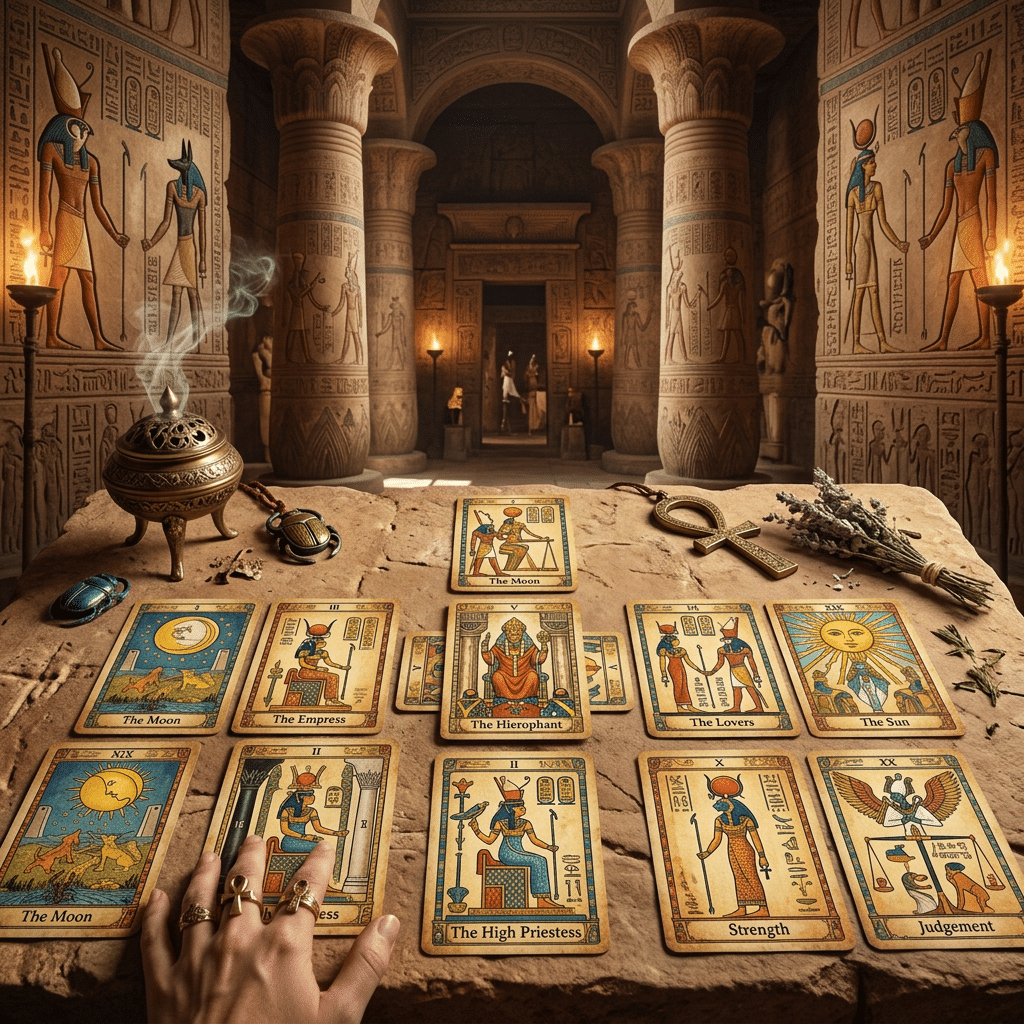
Ancient Egypt and Tarot Cards: Key Points
-
Tarot is a deck of 78 illustrated cards split into the Major Arcana and Minor Arcana, used for divination and self-reflection.
-
Tarot actually originated in fifteenth-century northern Italy as playing cards for the nobility, not as spiritual tools.
-
In 1781, Antoine Court de Gebelin invented the Egyptian connection and claimed without evidence that tarot was the ancient Egyptian Book of Thoth.
-
The theory was expanded by Etteilla and the Hermetic Order of the Golden Dawn, who linked tarot to Egyptian deities and Kabbalistic philosophy, cementing it in occult tradition.
-
Modern scholars have thoroughly debunked theories attempting to justify the connection, such as the Romani people carrying Egyptian wisdom to Europe.
-
Despite lacking historical foundation, the Egyptian-tarot connection has endured, inspiring countless Egyptian-themed decks and enriching tarot’s symbolic vocabulary.

Introduction
Few things in mysticism and symbolism have caught the mind like the tarot, and even fewer have prompted as much discussion about its beginnings. There has always been an air of ancient mystery surrounding tarot cards, and many practitioners and fans claim origins dating back to the banks of the Nile and the culture of ancient Egypt. Such a claim is a beautiful and engaging connection, but it also straddles the curious divide between verifiable reality and popular legend, and it is one of the more intriguing conundrums of the history of Western occultism.
The Composition and Historical Origins of Tarot Cards
Tarot cards are a pack of 78 graphic cards split into two primary classifications. The first part is known as the Major Arcana and is made up of 22 cards representing archetypal people and concepts like The Fool, The High Priestess, The Emperor, The Tower, and The World. The second part of the deck is called the Minor Arcana. It has 56 cards divided into four suits, usually called Wands, Cups, Swords, and Pentacles. Each suit has cards numbered from Ace to Ten and Four court cards. The imagery of the cards is rich and complex, drawing on a wide variety of symbolic traditions, including astrology, Kabbalah, numerology, and religious iconography. But today tarot cards are employed both as an instrument of divination and as a form of psychological reflection, and there are innumerable variant decks in existence to reflect diverse creative and spiritual beliefs.
The actual, verified origin of tarot cards is significantly more down-to-earth and far more recent than the Egyptian idea claims. The first surviving tarot decks were made in the early to mid-fifteenth century in northern Italy, especially Milan, Ferrara, and Bologna. These early decks, known as tarocchi, were intended mainly to be used as playing cards for gambling games among the Italian nobles, not as devices for divination or spiritual activity. One of the oldest surviving specimens, the famous Visconti-Sforza deck, painted in 1450 for the Duke of Milan, bears little similarity to the mystical tool tarot would later become. It was not until the late eighteenth century that tarot cards began to be utilized widely for divination and occult purposes in any systematic sense.
The Egyptian Origin Myth: Development and Alternative Theories
Much of the link between tarot and ancient Egypt was invented in the eighteenth century by a small group of French occultists who were obsessed by Egyptomania, a wave of cultural infatuation with all things Egyptian that was sweeping Europe at the time. The driving force behind this relationship was the Swiss priest and Freemason Antoine Court de Gebelin, who made a bold and important claim in 1781 in his encyclopedic work Le Monde Primitif. Court de Gebelin, with great confidence but virtually no historical proof, claimed that the tarot was in fact the ancient Egyptian Book of Thoth, a legendary sacred scripture purported to have been penned by the god of knowledge himself. He claimed that Egyptian priests had hidden their secret wisdom in the images of the cards so that it would survive the destruction of their civilization. This concept electrified the European intelligentsia and occult groups of the day. The advocates of the occult lineage clearly contextualize this perspective as “the Tarot of the Egyptians” and as proof of old esoteric wisdom (Goggin, 2020; Fletcher, 2020; Roberts & Allmer, 2013; Burmistrov, 2022).
A Parisian wigmaker and fortune-teller named Etteilla further developed and popularized Court de Gebelin’s hypothesis. Etteilla became one of the first professional tarot readers in the modern sense, and he eagerly embraced and enlarged upon the Egyptian origin narrative, issuing new tarot decks that were expressly created with Egyptian images and themes. He said he had returned the deck to its Egyptian form, infusing the cards with hieroglyphic-inspired images, references to Egyptian gods and cosmological symbolism that he said were derived from ancient sources. Etteilla’s study was mainly made up, yet his work had a tremendous influence on the way future generations would comprehend and build tarot cards. The Egyptian interpretation of tarot thereafter became firmly entrenched in the esoteric tradition.
The Egyptian connection went even further and was given a more sophisticated theoretical framework with the Hermetic Order of the Golden Dawn, a British occult institution founded in 1888. The Golden Dawn, with figures such as Samuel Liddell MacGregor Mathers and later Aleister Crowley, devised a complicated system that connected the 22 cards of the Major Arcana to the 22 letters of the Hebrew alphabet, the paths of the Kabbalistic Tree of Life, and various Egyptian gods. The Rider-Waite-Smith deck, illustrated by Pamela Colman Smith under the guidance of Arthur Edward Waite and issued in 1909, became the most prominent tarot deck in history and delicately included Egyptian iconography in many of its cards. For example, the High Priestess card has images that invoke Isis, while the Wheel of Fortune has Egyptianized characters, including a sphinx. The Egyptian-tarot link was formalized within the Western esoteric tradition through the Golden Dawn system. A prominent modern formulation of this Egyptian provenance is Crowley’s The Book of Thoth, which argues for a clear relationship between Tarot trumps and Hermetic/Egyptian symbolism as part of a larger Thelemic framework (Fletcher, 2020).
Over the years, there have been several theories to explain or justify the Egyptian link in more concrete terms. One version suggests that the Romani people, who were themselves falsely believed by Europeans to have originated in Egypt (and so earned the term “Gypsies”), brought the tarot cards to Europe. According to this notion, the Romani were the custodians of an ancient Egyptian wisdom heritage, kept in card form over centuries of migration. Another idea is linked to the fabled Hermetic scriptures, a set of writings credited to the mythical character of Hermes Trismegistus, believed to be a fusion of the Greek god Hermes with the Egyptian god Thoth. As Hermetic philosophy was very influential on Renaissance and occult thought and claimed to have Egyptian origins, some theorists proposed that tarot was a pictorial encoding of Hermetic and thus Egyptian spiritual knowledge.

Historical Criticism of the Egyptian-Tarot Connection
These notions have been critically investigated by modern historians and students of the occult and determined to be essentially without historical basis. There is no reliable archeological, documentary, or linguistic evidence connecting the tarot to ancient Egypt, and the dates just do not match up in any way that would suggest a direct flow of ideas. The Romani did not come from Egypt; genetic and linguistic research now shows that they came from northwestern India, and there is no indication that they brought with them any card-based system that preceded European playing cards. Court de Gebelin was enthusiastic, but he was speculating and drawing upon the Egyptomania of his age rather than any real historical research. What researchers have found instead is that the Egyptian link is a fascinating case study in how stories about the past are produced and how those myths may take on a life of their own inside a spiritual community.
Many researchers oppose the historical veracity of the Egyptian provenance and highlight hypothetical rather than verifiable links, suggesting that these connections are often based on interpretations rather than direct evidence from historical texts or artifacts. Sosteric’s sociology of Tarot highlights how the Tarot has functioned in discourses of power, discipline, and indoctrination, above and beyond its being a fixed ancient origin myth (Sosteric, 2014). Place (as cited in Sosteric, 2014) clearly states, “Modern research has found little evidence of a direct, linear transmission from ancient Egypt to Tarot, but rather that the connections are more likely to be symbolic or interpretive across the ages rather than literal historical transmission” (Sosteric, 2014). Some Tarot imagery incorporates Jewish and Hermetic motifs. The synthesis of these viewpoints is that the real origins of the Tarot are most solidly located in 15th-century Italy, with the Egyptian-inspired legends arising later in esoteric and popular cultures (Sosteric, 2014; Goggin, 2020; Roberts & Allmer, 2013).
Egyptian Symbolism in Modern Tarot Practice
Several publications examine how Egyptian gods and goddesses appear in or inform Tarot iconography. Some interpretations, for example, tie the Star card to imagery that invokes Egyptian iconography (particularly the ibis associated with Thoth) and interpret “the Star” as replete with Egyptian mythic resonances within occult traditions (Roberts & Allmer, 2013). Other discourses directly reference Isis and Osiris as archetypal figures mapping onto the symbolic language of Tarot, revealing how Egyptian mythic issues appear in Tarot readings and interpretations within certain esoteric contexts (Geis, 2013; Roberts & Allmer, 2013). While these correlations are suggestive for interpretative analysis, they are not widely acknowledged as empirically historical transmissions but rather demonstrate how Egyptian mythic elements are circulated throughout Tarot symbolism in modern discourse (Geis, 2013; Roberts & Allmer, 2013).
The idea of a tarot-Egypt connection, with no historical basis, has been one of the most enduring and fertile in Western spirituality. There have been many tarot cards with overt Egyptian motifs, including the famous Thoth Tarot deck devised by Aleister Crowley and painted by Lady Frieda Harris in the 1940s, which is still one of the most sophisticated and commonly used tarot decks in existence. The Egyptian mythology that has been incorporated into tarot has provided practitioners with a wealth of symbolism to work with, based on ideas such as the afterlife, divine judgment, cosmic order, and the journey of the soul, which strongly resonate with the spiritual themes of the Major Arcana. In this way, even if the relationship is historically fabricated, it has become spiritually and culturally true through generations of practice and belief.
Conclusion
Ultimately, the tale of tarot and its alleged Egyptian origins reveals much about the human yearning to imbue the instruments we use to reflect on ourselves and explore our spiritual selves with meaning and depth. A natural urge for occultists of the eighteenth century, who were endeavoring to provide authority and gravity to their emerging systems of thinking, was to root a practice in the most ancient and knowledgeable civilization known to the Western world. What started as a mistake by Court de Gebelin became a rich, sophisticated tradition that molded the entire images and theory of contemporary tarot as it is practiced today. Whether we regard the Egyptian link as a historical reality, a creative fiction, or a spiritual metaphor, it remains an integral aspect of the identity of the tarot and its astonishing capacity to engage the imagination over the centuries and between cultures.
References
Bembo, B. (Artist). (c. 1450). Visconti-Sforza Tarot [Card deck]. Duchy of Milan.
Burmistrov, K. (2022). Russian Esotericism of the Early Twentieth Century and Kabbalah. JCS, 15(44), 102–123. https://doi.org/10.59893/jcs.15(44).007
Court de Gébelin, A. (1781). Le monde primitif analysé et comparé avec le monde moderne (Vol. 8). Author.
Crowley, A. (1944). The book of Thoth: A short essay on the Tarot of the Egyptians. O.T.O.
Crowley, A., & Harris, F. (1944). Thoth Tarot [Card deck]. O.T.O.
Fletcher, M. (2020). The Cardinal Importance of Names. Aries, 21(1), 94–124. https://doi.org/10.1163/15700593-02101001
Geis, T. (2013). “Death by Amnesia”: Maya Deren, Egypt, and “Racial” Memory. Dada/Surrealism, 19, 1–14. https://doi.org/10.17077/0084-9537.1275
Goggin, J. (2020). ‘The Holy Game of Poker’: Gambling, Religion and Neoliberalism. Critical Gambling Studies. https://doi.org/10.29173/cgs90
Roberts, D., & Allmer, P. (2013). Editors’ Preface. Dada/Surrealism, 19, 1–9. https://doi.org/10.17077/0084-9537.1268
Sosteric, M. (2014). A Sociology of Tarot. The Canadian Journal of Sociology, 39(3), 357–392. https://doi.org/10.29173/cjs20000
Waite, A. E. (1909). Rider-Waite-Smith Tarot [Card deck]. Rider.
Leave a Reply