Tomar Castle Templar Ghosts: Key Points
-
Tomar Castle in central Portugal is a vast medieval complex built by the Knights Templar in 1160, featuring the iconic Charola rotunda, and is surrounded by an atmosphere of ancient isolation that has long inspired supernatural stories.
-
The Knights Templar founded the castle as their Iberian headquarters and used it as both a military stronghold and spiritual center, with the Templar identity surviving in Portugal through the successor Order of Christ after the order was suppressed in 1312.
-
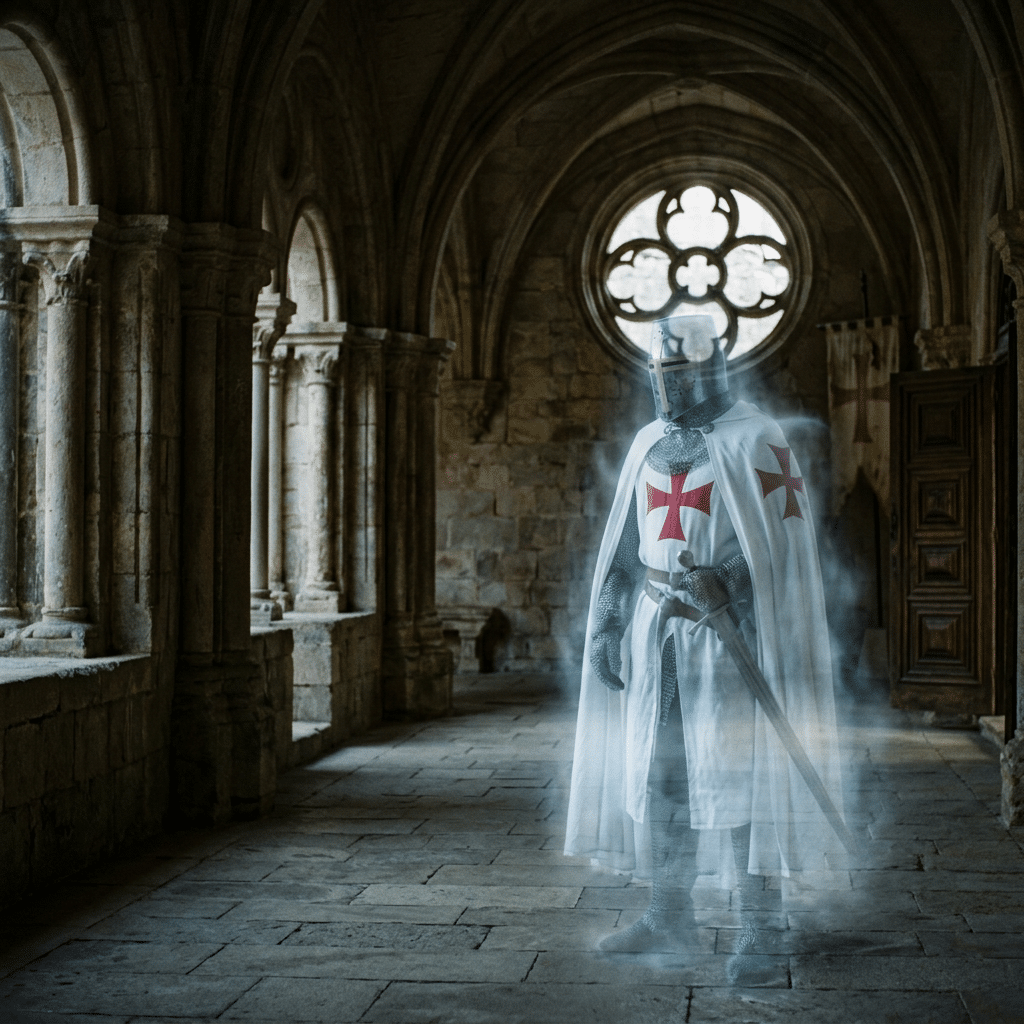
The most frequently reported ghost is that of founding Grand Master Gualdim Pais, whose white-robed figure is said to walk the Charola rotunda, accompanied by the sounds of Latin chanting and armored footsteps near the castle walls.
-
Other supernatural presences include a shadowy contemplative figure in the Manueline cloisters, a sorrowful female apparition, and reports from restoration workers of moved tools, unexplained sounds, and a persistent feeling of being watched.
-
Theories explaining the hauntings range from residual haunting, where centuries of intense devotion imprinted psychic energy into the stones, to psychological explanations involving the site’s unique architecture and lighting creating conditions for perceptual misinterpretation.
-
A third theory suggests the ghost stories were deliberately cultivated by the Order of Christ and local communities to maintain the site’s mystique and sense of sacred protection, giving the legends a practical social function alongside their supernatural dimension.

Introduction
Hidden amid a forested hill in central Portugal, the Castle of Tomar is one of the most historically charged sites in all of Europe. Its stone walls have soaked up centuries of devotion; conquest, ceremonial and secret; and it is probably no surprise that such a place has become one of fertile ground for stories of the supernatural. These traditions of knights’ ghosts haunting its hallways and courtyards are not just idle folklore but are tied to the castle’s extraordinary history as the center of the Knights Templar in Portugal. Before you can understand the phantom warriors supposed to haunt Tomar, you must understand the castle itself, the unusual order that created it, and the weight of history that seems to hang in the air of its ancient stones.
The Castle of Tomar and the Knights Templar
The Castle of Tomar (Portuguese: Castelo de Tomar) was established in the twelfth century and overlooks the picturesque town of the same name in the Santarém province of Portugal. The construction comprises not only a defensive castle but also the spectacular Convent of Christ, or Convento de Cristo, with a large complex of towers, cloisters, chapter rooms, and chapels. The most distinctive element of the building that reflects the deeply spiritual and crusading mentality of those who commissioned it is the Charola, a sixteen-sided rotunda erected in the Romanesque style and based after the Church of the Holy Sepulchre in Jerusalem. Over several centuries, the complex was extended by several Portuguese monarchs and military organizations, creating a layered architectural palimpsest that flows through Romanesque, Gothic, Manueline, and Renaissance styles. The complex is mostly hidden by the dense forest of the Mata Nacional dos Sete Montes, which lends an air of ancient seclusion to the whole place that has long inspired the imaginations of both visitors and local residents.
Around 1119 a Catholic military order, the Knights Templar, was created in Jerusalem to defend Christian pilgrims going to the Holy Land. They soon gained wealth, influence, and power throughout Europe. They became mighty financiers and fierce warriors. Their unique white mantles emblazoned with a crimson cross were a symbol feared and revered throughout the medieval world. They have been linked with Tomar since 1160, when Gualdim Pais, Grand Master of the order in Portugal, built the castle as the order’s headquarters in the Iberian Peninsula. The Templars were heavily involved in the Reconquista, the centuries-long fight to regain the Iberian Peninsula from the Moors, and Tomar was a castle and a military stronghold but also a spiritual center where the brothers held their ceremonies and prayers. The central Charola rotunda of the complex was the Templars’ own church and legend has it that on occasion the knights would hold their services on horseback, clattering around the circular nave in full armor as a symbol of their dual identity as soldiers and monks.
Templar Legacy and the Order of Christ
During the medieval period, the Templars erected a castle and defense fortification at Tomar, which was a fundamental deed in the creation of the urban settlement that would later be centered on the Convent of Christ. This basic point is expressly addressed as the Templar headquarters in medieval Tomar, where the castle served as the physical and symbolic focal point around which the early town formed (Marques, 2021). The same literature also states that Tomar’s castle is the center of the 12th-century growth of the town’s guarded precinct, paving the way for the later monastery complex of Christ to embrace and reconfigure the site (Monteiro, 2024). The architectural concept contains the key defensive component of the keep or donjon, a defining feature of Templar castle building in Iberia, adopted in the 12th century as part of their adaptation to frontier warfare and their experience in the Holy Land. The keep/donjon feature is usually linked to Tomar’s castle in wider surveys of Templar fortification in the region, indicating the shared medieval heritage that Tomar represents (Trindade & Carvalho, 2023).
The Knights Templar were suddenly and bloodily disbanded. In 1307 King Philip IV of France, who owed so much to the order, had thousands of Templars arrested throughout France on charges of heresy, blasphemy, and other crimes that many historians believe were largely invented. In 1312, at the Council of Vienne, Pope Clement V officially suppressed the order throughout Christendom. However, Portugal was something of an exception to the wholesale destruction of the Templars, as King Denis I of Portugal was able to negotiate with the papacy to re-constitute the order under the new name of the Order of Christ in 1319, allowing most of the Portuguese Templars to continue their activities under the new banner. The Castle of Tomar became the headquarters of this successor order and its Templar identity was never really erased but transmuted so that the spiritual and institutional legacies of the white-mantled knights remained embedded in the very fabric of the site. This continuity between the condemned Templars and their Portuguese successors means that Tomar has a unique place in the Templar story, as a place where the order did not end in fire and ruin but instead changed and endured, leaving a residue of identity never wholly dissipated.
Thus, a central issue of historiography is the transformation of the Templar castle and the Templar precinct into something new in the framework of the new political order after the Templar dissolution. The formal rearrangement of assets, with the castles and other assets of Tomar being transferred to the Order of Christ, is a defining moment in which the historic fortress of Tomar became the administrative and religious center of a reconstructed order. There are several sources that expressly explain the transfer of the former Templar assets to the Order of Christ after the papal authorization and the action of the king in Portugal (Vairo, 2017). The continuity and restructuring are subjects of controversy in the literature, with some publications outlining the sequence of transfer and legal-papal confirmations, while others highlight the larger political economy of the reform rather than a single point of turnover (Vairo, 2017; Costa & Lencart, 2023).

Spectral Traditions and Supernatural Reports
The most frequently alleged ghost at Tomar is that of Gualdim Pais himself, the Templar Grand Master who oversaw the construction of the fortress and who spent most of his life defending it. For ages, witnesses have reported seeing a tall figure in white robes stroll across the Charola rotunda in the late hours of the evening, often with a torch or light, engaging in some sort of meditative walk or prayer circuit. The local guides have long repeated the narrative that Gualdim Pais is bonded to the castle because he poured so much of his spiritual energy into its founding and that his ghost cannot leave a site so profoundly etched by his will and his beliefs. Other reports describe armored figures spotted near the castle’s old defended walls and towers, figures that disappear when approached and that are accompanied by the faint sound of metal or slow, methodical footsteps. Especially persistent is the story of chanting sounds heard in the early hours of the morning near the Charola, a low, rhythmic sound that some tourists thought was a recording or practice before they realized that there was no such source. These were collected not only in legend and oral tradition but also in the recorded descriptions of travelers to Tomar in the eighteenth and nineteenth centuries and therefore have a degree of documentary weight frequently absent from simply local folklore.
Besides the Templar knights themselves, the castle and monastery complex is rumored to hold additional mysterious beings tied to its long history after the Templars. The Order of Christ, which succeeded the Templars at Tomar, was central to the financing and inspiration of the Portuguese Age of Discovery in the fifteenth and sixteenth centuries and figures such as Prince Henry the Navigator, who was governor of the order, are closely associated with the castle. Some reports refer to a shadowy figure seen in the enormous cloisters created in this Manueline period, a contemplative presence that appears to study the elaborate brickwork before vanishing. Also reported is the presence of a woman in the earlier parts of the stronghold, variously identified as a lady associated with the household of Gualdim Pais or to the later administration of the Order of Christ, whose apparition is usually described as sorrowful rather than threatening. Throughout the restoration and maintenance of the convent complex, workers have sometimes reported tools being moved throughout the night, inexplicable sounds of movement in sealed rooms, and a constant feeling of being watched when working in the underground corridors and cellars. Alone, these stories may not appear very significant, but their convergence in one location and their similarity through different times and different kinds of witnesses imbue them with a cumulative force that is hard to completely brush aside.
Interpreting the Hauntings: Theories and Modern Legacy
There are several hypotheses about why Tomar has so many stories of supernatural activity. One of the most powerful attractions to the theory of residual hauntings is that locations absorb great emotional and psychological energy over time and recreate it in ways that living people may sometimes see. It would be difficult to find a site more filled with concentrated human intensity than Tomar. For generations men who thought themselves to be soldiers of God worked there, in activity of cosmic importance, including tremendous religious devotion, military training, and sacred ceremony. This hypothesis is advocated by those who claim that the Charola rotunda in particular, utilized for decades in daily prayer and ritual practice by the original Templars, would have been especially sensitive to this kind of psychic imprinting.
Another idea is based on the psychological effect of the site itself, proposing that Tomar’s peculiar mixture of military architecture, sacred space, and natural forest surroundings produces a context that predisposes visitors to enhanced perception and imaginative projection. The light quality of the rotunda, the acoustics of the cloisters, and the deep shadows of the surrounding woodlands can all add to perceptual ambiguity, making it easier for the mind to perceive regular sensory data as something special.
A third, more historical explanation is that the ghost stories of Tomar were deliberately nurtured and kept alive by the local communities and by the Order of Christ in an effort to maintain the mystique and sanctity of the place, to prevent intrusion, and to reinforce the feeling that the place was under supernatural protection. The ghost stories would have had a functional social purpose to accompany the supernatural dimension, common to many medieval ecclesiastical and military sites; this tradition of sacred guardianship; and the stories would have been passed down and enhanced with each generation.
The contemporary city has also reacted to its Templar history, with cultural events that strengthen its identity and attractiveness to visitors. The Festa Templária (Templar Festival) in Tomar is an example of such a situation and is analyzed as a long-term placemaking strategy linking the city’s event portfolio to its historic identity and the Tomar-Templar mythology. The case study illustrates how local authorities and stakeholders use historical narrative to revitalize tourism and placemaking activities in a way that respects local identity yet engages contemporary audiences (Sol et al., 2017).
Tomar’s urban and architectural memory has been framed within a larger context of reconfigurations of medieval fortifications and monastic ensembles in the modern period, including nineteenth- and twentieth-century interventions that reinterpreted or rehabilitated fortifications in Portugal’s historic towns. Research on urban space in Portuguese fortified cities addresses the mid- and late-19th/early-20th-century restorations that treated medieval fortifications as patrimonial monuments, a trend that indirectly impacted Tomar by defining how its Templar fortifications were perceived and conserved in modernity (Santos, 2016). Discussions of Tomar’s urban fabric in relation to the floodplains highlight the role of the Nabão River in the historic identity of the city and its continuing vulnerability to natural hazards, bridging heritage design with resilience considerations for a flood-prone historic core (Davis et al., 2023).
Conclusion
Ultimately, the phenomenon of Templar ghosts in Tomar Castle points to something more than superstition or entertainment of travelers. It is a testament to the extraordinary power that the Knights Templar and their heirs down the centuries have held over the human imagination. The power is grounded in the real drama and tragedy of their historical story, but it is strengthened by the extraordinary physical presence of the castle they built and loved. The stones of Tomar are more than architectural relics; they are witnesses of crusades and prayers, of political treachery and decades of faithful service, and the human mind automatically wants to people such monuments with the persons that once walked among them. Whether we view the ghost stories of Tomar as genuine paranormal testimony, as psychological phenomena, or as living folklore that preserves history in the present, they are important for connecting the modern visitor to the medieval world that shaped this remarkable place. Whether or not the ghost knights of Tomar wander the Charola at midnight, their presence in the myths people tell about the castle is as real and as persistent as the red crosses cut into its ancient rock.
References
Costa, P. and Lencart, J. (2023). Crusade: The Arising of a Concept Based on Portuguese Written Records of Three Military Campaigns (1147–1217). Religions, 14(2), 244. https://doi.org/10.3390/rel14020244
Davis, L., Larionova, T., Patel, D., Tse, D., Julià, P., Santos, P., … & Ferreira, T. (2023). Flood vulnerability and risk assessment of historic urban areas: Vulnerability evaluation, derivation of depth‐damage curves and cost–benefit analysis of flood adaptation measures applied to the historic city centre of Tomar, Portugal. Journal of Flood Risk Management, 16(3). https://doi.org/10.1111/jfr3.12908
Marques, C. (2021). The Development of Industrial Activity in Tomar: a Study on the Unpublished Document of Bernardo Daniel de Moraes Requirement. Gardens and Landscapes of Portugal, 7(1), 30-43. https://doi.org/10.2478/glp-2021-0004
Monteiro, P. (2024). Portuguese Medieval Wall Paintings. https://doi.org/10.3986/9789610508847_008
Santos, J. (2016). Reshaping the Urban Space in Portuguese Fortified Cities. Journal of Urban History, 43(1), 53-69. https://doi.org/10.1177/0096144214566960
Sol, H., Brito, M., Coelho, J., Figueira, L., Pratt, C., & Lopes, E. (2017). Rooting a new event in its place: the case of Festa Templária, Tomar, Portugal. International Journal of Event and Festival Management, 8(3), 324-345. https://doi.org/10.1108/ijefm-10-2016-0068
Trindade, L. and Carvalho, P. (2023). De Roma a Portugal, do Império ao Reino: uma viagem de 1500 anos pela região de Coimbra. https://doi.org/10.14195/978-989-26-2444-0
Vairo, G. (2017). The dissolution of the Order of the Temple and the creation of the Order of Christ in Portugal. Ordines Militares Colloquia Torunensia Historica, 21, 43. https://doi.org/10.12775/om.2016.003
Leave a Reply