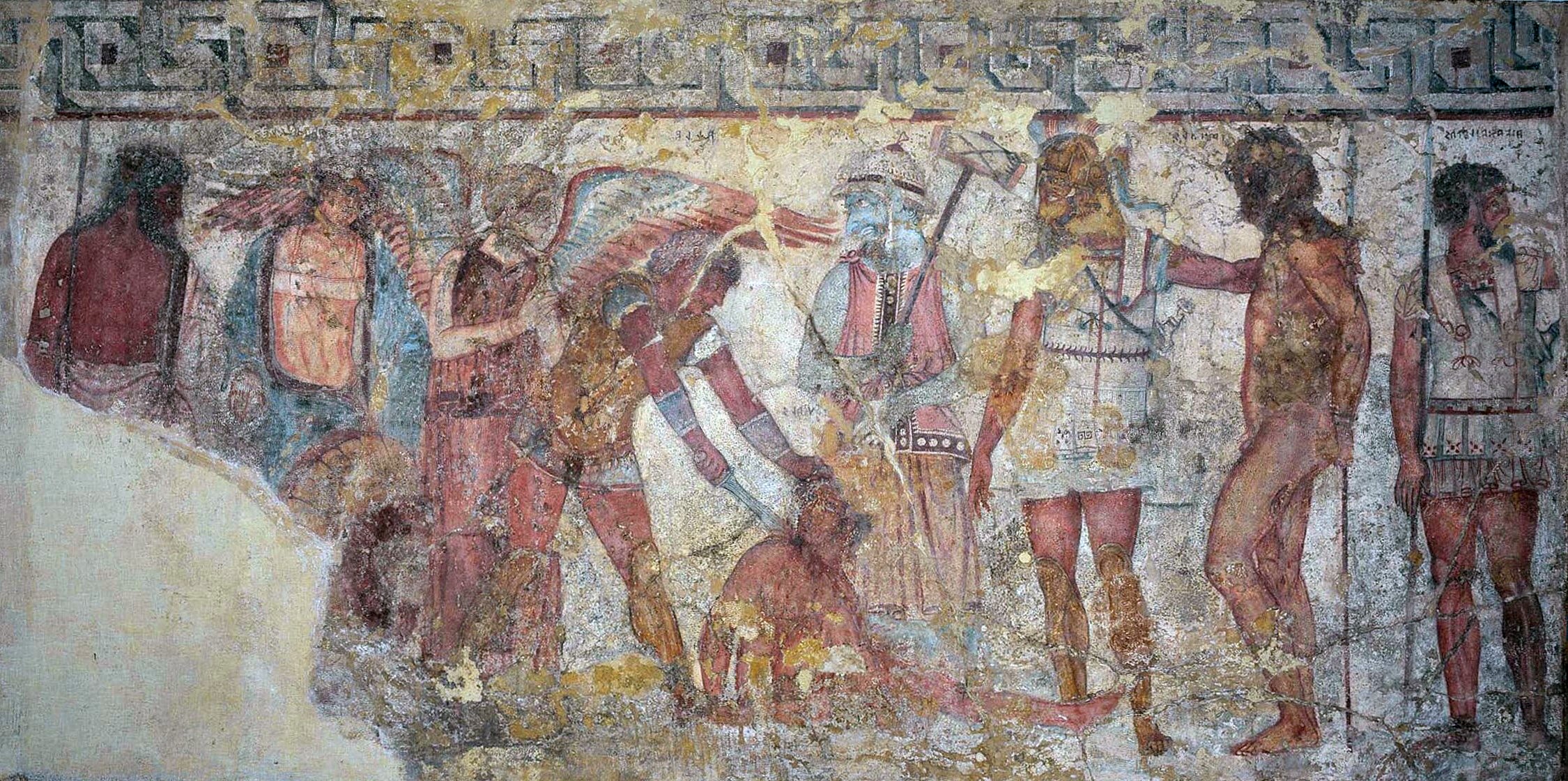
Greek Concept of Eidolon: Key Points
- The eidolon was a Greek phantom or ghostly double of the dead, retaining a person’s appearance but stripped of their living essence.
- In Homer’s Iliad and Odyssey, eidola appear as recognizable but unreachable shades, most memorably in Achilles’ encounter with the ghost of Patroclus.
- Greek tragedy extended the concept through the myth of a phantom Helen whose eidolon went to Troy in her place, questioning whether an image can substitute for a real person.
- Virgil and Dante both echo the Homeric eidolon, recreating the experience of reaching out to embrace a beloved shade and finding only empty air.
- Democritus, Epicurus, and Lucretius proposed that eidola were literal films of atoms shed by objects, making all visual perception a kind of encounter with material phantoms.
- Plato criticized art as a copy of a copy using eidolon logic, a line of thinking that influenced Baudrillard’s theory of simulacra and modern debates about the AI resurrection of the dead.
Introduction
The ancient Greeks had a rather rich lexicon for borders between the living and the dead and the unseen realm. The eidolon was perhaps one of their most philosophically complex and artistically fertile notions, a word that contained in itself a full cosmology of images, ghosts, and phantom doubles. To study the eidolon is to look into the Greek imagination at its most unsettled and its most yearning. It follows an idea that flowed restlessly through theology, philosophy, poetry, and the theory of human perception itself.

Etymology and Definition of the Eidolon
The Greek word “eidolon” stems from “eidos,” meaning form, shape, or outward appearance. It had a broad spectrum of meanings, which ancient writers used with a remarkable deal of versatility. At its most basic, an eidolon was a phantom or image, a representation of something rather than the thing itself, and this seemingly simple division between appearance and reality is what gave the term its philosophical weight. In its most popular meaning, the eidolon referred to the shade of a dead person, the ghostly double that went down to the underworld and stayed there as a type of hollowed-out replica of the person who had been alive. This shade was believed to maintain the recognizable appearance of the dead but to be emptied of the vital power that made a living person genuinely themselves, leaving something that was both familiar and utterly alien. The eidolon was not the soul in the sense of the animating life principle, which the Greeks called the “psyche,” but the visible, perceivable image of a person, the element of them that could be seen and recognized even after death had done its work. This terminological variation is key to understanding how Greeks conceived of images as icons, cult objects, and viewers at ritual times (and how those images could be considered independent agents or mediators of divine presence) (Bremmer, 2013).
The Eidolon in Ancient Greek Literature and Art
Greek literature has the most haunting and intellectually fraught experiences with eidola in all of world literature. In Homer’s Iliad, the sleeping Achilles is visited by the eidolon of his deceased buddy Patroclus, who appears to him as he was in life, with the same face, voice, and eyes. Patroclus begs Achilles to bury him as soon as possible so that his shade may pass through the gates of Hades, unable to cross until the necessary burial rites have been performed, and then he slinks away like smoke into the dirt when Achilles reaches out to embrace him. It is one of the most moving scenes in all ancient poetry, since the eidolon is so convincing yet so completely unattainable, a flawless depiction of what has been lost and unequivocal proof that it is lost forever. In Book Eleven of the Odyssey, Odysseus goes down to the edges of the underworld and finds himself facing a throng of shades that rush at the blood offering he has made, the eidola of the dead drinking deep so that they can recover for a moment the capacity for coherent speech and memory. These shades, including those of Achilles himself, are depicted as strengthless heads, hollow and without the force of life, proving that the eidolon is defined precisely by what it lacks and not by what it possesses.
The tradition of Helen of Troy is perhaps the most philosophically provocative use of the eidolon in Greek literature, and it produced one of the most shocking notions of antiquity. The lyric poet Stesichorus, in his renowned palinode, asserted that the genuine Helen never arrived in Troy at all, but that only a phantom, an eidolon, traveled with Paris, while the true Helen was carried away to Egypt to be faithful to Menelaus. Euripides took up this tradition in his tragedy Helen, in which a phantasm of Helen is constructed out of air and cloud to deceive Paris while the real Helen is stuck in Egypt, lamenting a reputation destroyed by a duplicate of herself that she never authorized. This version of the myth is philosophically rich in that it forces one to confront the question of what it is that makes a person truly himself: if the eidolon of Helen resembled her precisely and was treated as her by everyone who encountered it, then did the Trojan War really happen because of Helen, or because of an image? The tragedy shows how completely an eidolon may replace reality in the lives and actions of those who mistake the phantom for the person. Pindar also refers to the myth of phantom Helen and employs the eidolon more generally to reflect on the illusory quality of appearances, a concept that would resonate in Greek thinking for centuries to come.
Tangible pictures often visually communicate the dead, serving both communicative and remembrance functions. A remarkable Attic lekythos by the Achilles Painter (c. 440-435 BC) shows two adolescents visiting a grave, with a winged figure floating above the head of one youth. The scene and the presence of the winged figure force the viewer to read the image as more than a simple visit to a tomb: it calls for an interpretation of the deceased as present (in absentia) through a constellation of signs—the stele, the pointing gesture, the flying apparition, and a mortal figure—that mutually counterpoint the mourner and the deceased. The interpretation suggests that the “absent referent” (the dead) is indicated through multiple representations in the fictional world of the vase decoration, enabling a variegated commemorative program in which the dead are at once present in the form of the tomb’s referent and in the more “other” ways of representation (the winged figure). This scenario is emblematic of how vase painting mobilizes eidola and related markers to mediate memory of the dead (Jones, 2015).

The Eidolon in Later Literary Traditions
The notion of the eidolon did not stay isolated to Greek literature but passed into many other literary traditions, sometimes directly, sometimes by parallel intuition. Virgil’s Aeneid is heavily influenced by Homer, and we have a series of encounters with shades in the underworld that evoke the Odyssean eidola, most notably the scene where Aeneas attempts three times to embrace the shade of his dead father, Anchises, and each time his arms close on empty air. The scenario is an almost literal retelling of the Homeric formula, and the impossibility of physical touch with the dead is employed to similar emotional effect, lingering over the cruelty of a picture that seems like love but cannot be grasped. Dante’s Commedia, while rooted in the medieval Christian tradition, nevertheless reinvents the shades of the afterlife in ways that resonate strongly with the ancient Greek idea, especially in how the souls in Purgatorio and Inferno retain the form and semblance of who they were in life while being radically changed by their condition. Dante’s attempt to embrace the shade of Casella in Purgatorio is a case in point; the shade evades his grasp just as the Homeric eidolon does, demonstrating either that Dante was knowingly drawing on classical sources or that he was finding the same emotional logic independently. We are presented with a structurally similar problem in English Romantic poetry in Shelley’s Adonais and in Keats’s work on beauty and its relation to truth, where the eidolon problem arises: whether the beautiful image we see is a real connection to something real or just a phantom that recedes as we approach it.
Philosophical Interpretations of the Eidolon
Ancient philosophers seriously considered the idea of an eidolon, employing it to bolster some of their most fundamental arguments concerning perception, reality, and the relationship between images and that which they represent. The atomist philosophers Democritus and Epicurus devised a physical theory of eidola as thin films or shells of atoms that objects continually shed from their surfaces, which fly through the air to strike the sense organs and cause perception. Thus, we perceive only eidola, which are material images of the original objects, meaning that all perception is mediated by phantoms; therefore, the question of whether we ever see things directly is quite challenging to answer. This theory was applied to the explanation of dreams by Lucretius, the Roman poet who translated the Epicurean philosophy into Latin verse in his De Rerum Natura. He considered dreams to be the result of eidola floating through the air and entering the dreaming mind, which would mean that the dream apparitions of the dead that Homer describes were not supernatural at all but the physical remnant of a person who had once lived and was still circulating in the material world. This atomist theory of eidola is extraordinary in its ambition: what began as a poetic concept for the ghost of the dead becomes a general theory of visual perception that anticipates in fascinating ways later optical and psychological theorizing the relationship between images and reality.
This contemporary scholarly recomposition of the area highlights that the term “eidolon” is precisely an image or a phantom that might stand for or symbolize the dead or the divine, while “eidos” (idea or form) is typically used to denote the intelligible archetype behind the image. The term “eidōlon” in Plato’s debates of appearance versus reality is crucial to this difference between image and form, and it foregrounds how Greek thinkers interpret images as potentially deceiving or revealing, depending on philosophical attitude. This dichotomy, eidolon as image/appearance and eidos as the fundamental form, has been fruitfully explored in current interpretive work linking Plato, Plato-derived debates on vision, and the ethics of representation (Villa, 2020).
The link of eidolon to logos in ancient Greek thought offers fertile ground for understanding the interaction between language and representation, death and perception. The Sophist and its relatives teem with eidola legomena (pictures or sounds that spell out or accompany conversation) in Platonic contexts, indicating a continuing interest in the relationship between the spoken word, image, and truth. Prósperi traces a genealogy in which the term “eidola legomena” refers to “sound images” or “spoken images,” which are part of the discourse about images and language; the article links these notions to a more general claim that the logos, the system of language and meaning, can be entangled with, or haunted by, eidola as residual imagery. This work highlights that eidola legomena are not solely decorative but are involved in the semantics of myth and discourse and demonstrates how imagery and speech co-constitute the formation of meaning in Greek philosophy (Prósperi, 2021).
Plato’s philosophy approaches the eidolon in a different but equally important way, tying it into his larger theory of Forms and his fears about art and illusion, the threat that appearances pose to reality. Plato, in the Republic and the Sophist, utilizes the related idea of the simulacrum to characterize the activity of artists and poets. They are considered creators of eidola, making copies of copies of reality rather than dealing with the genuine Forms underlying the phenomenal world. Here the eidolon is a figure for a form of ontological poverty, an entity that is only an image of an image, two steps away from real being. This Platonic anxiety about images and doubles has had an enormous theoretical afterlife, most notably in the work of the French philosopher Jean Baudrillard. Baudrillard, in the twentieth century, developed his theory of simulacra and simulation partly in response to Platonic thought, arguing that contemporary culture has reached a condition in which signs and images have become completely detached from any original reality they might once have represented. Sigmund Freud’s concept of the uncanny, which he analyzed in his 1919 essay, describes the unsettling feeling that arises from encounters with doubles, ghosts, and animated images, and this psychological experience corresponds closely to the way Homer’s characters respond to the eidola of the dead, with a mixture of recognition, desire, and profound unease.
The concept of the eidolon has survived centuries of intellectual history with amazing tenacity, continuing to provoke fruitful thought whenever concerns are raised about the nature of images, the permanence of identity after death, or the relationship between originals and copies. The modern world is saturated in what might be called “technological eidola,” photographs, recordings, digital simulations, and deepfake images, all of which raise questions that the Greeks would have found entirely familiar about what it means to encounter an image of a person rather than the person themselves and whether such an encounter can be meaningful or even dangerous. It is an ancient idea: the eidolon has the semblance of the person but not their substance. It is expressed in modern debates about digital avatars, posthumous AI simulations of the dead, and the use of CGI to bring dead actors back to the screen, cases in which a recognizable image is created in the absence of the living original. The Greeks were not the only people to think seriously about ghosts and phantom doubles, but they were among the first to develop a sustained and multi-dimensional vocabulary for doing so, one that connected the emotional experience of loss to deep questions about perception, reality, and the nature of what makes a person real.
Conclusion
The eidolon is one of the most quietly fundamental concepts in ancient Greek thought, binding together poetry, religion, philosophy, and the theory of knowledge in one haunting figure. So, in summary: Eidolon has a flexible semantic niche. It may be (i) a cult image or statue (typically ritual in importance), (ii) a visible phantom or shade (the haunted image of the dead), or (iii) a figurative image in discourse (a kind of representation that is philosophically and literarily significant). It is this adaptability that underlies the art-historical and philosophical approaches to eidola in antiquity (Bremmer, 2013; Jurczyk, 2023; Villa, 2020). From the empty shades of Homer’s underworld to the phantom Helen of Euripides, from the atomic films of Epicurus to the deadly simulacra of Plato, the idea followed the restless concern of the Greek intellect with the gap between appearance and reality, between what is seen and what truly is. Its lengthy literary and philosophical afterlife, extending through Virgil, Dante, the Romantics, and into modern theories of representation and perception, attests to the depth with which the concerns it raises are rooted in human experience. Ultimately, to think about the eidolon is to think about what it means to identify someone you love, to realize that an image is never quite the thing it images, and to live with the awareness that the world we see is partly made of ghosts.
References
Alighieri, D. (ca. 1308–1320). The divine comedy.
Bremmer, J. Ν. (2013). The agency of Greek and Roman statues. From Homer to Constantine. Opuscula Annual of the Swedish Institutes at Athens and Rome, 6, 7–21. https://doi.org/10.30549/opathrom-06-02
Euripides. (412 BCE). Helen.
Homer. (ca. 800 BCE). Iliad.
Homer. (ca. 800 BCE). Odyssey.
Jones, N. B. (2015). Phantasms and Metonyms: The Limits of Representation in Fifth-Century Athens. Art History, 38(5), 814–837. https://doi.org/10.1111/1467-8365.12183
Jurczyk, T. (2023). The Meaning of agalma, eidôlon, and eikôn in Ancient Greek Texts: A Quantitative Approach Using Computer-Driven Methods and Tools. Entangled Religions, 14(5). https://doi.org/10.46586/er.14.2023.10442
Lucretius. (ca. 55 BCE). De rerum natura.
Plato. (ca. 375 BCE). Republic.
Plato. (ca. 360 BCE). Sophist.
Prósperi, G. O. (2021). Logos y Hades. El horror como causa ambivalente del lenguaje humano”. Logos Anales Del Seminario De Metafísica, 54(1), 153–174. https://doi.org/10.5209/asem.74711
Shelley, P. B. (1821). Adonais: An elegy on the death of John Keats.
Villa, R. M. (2020). Tókos. 61–63. https://doi.org/10.1515/9783035622164-007
Virgil. (ca. 19 BCE). Aeneid.




Leave a Reply