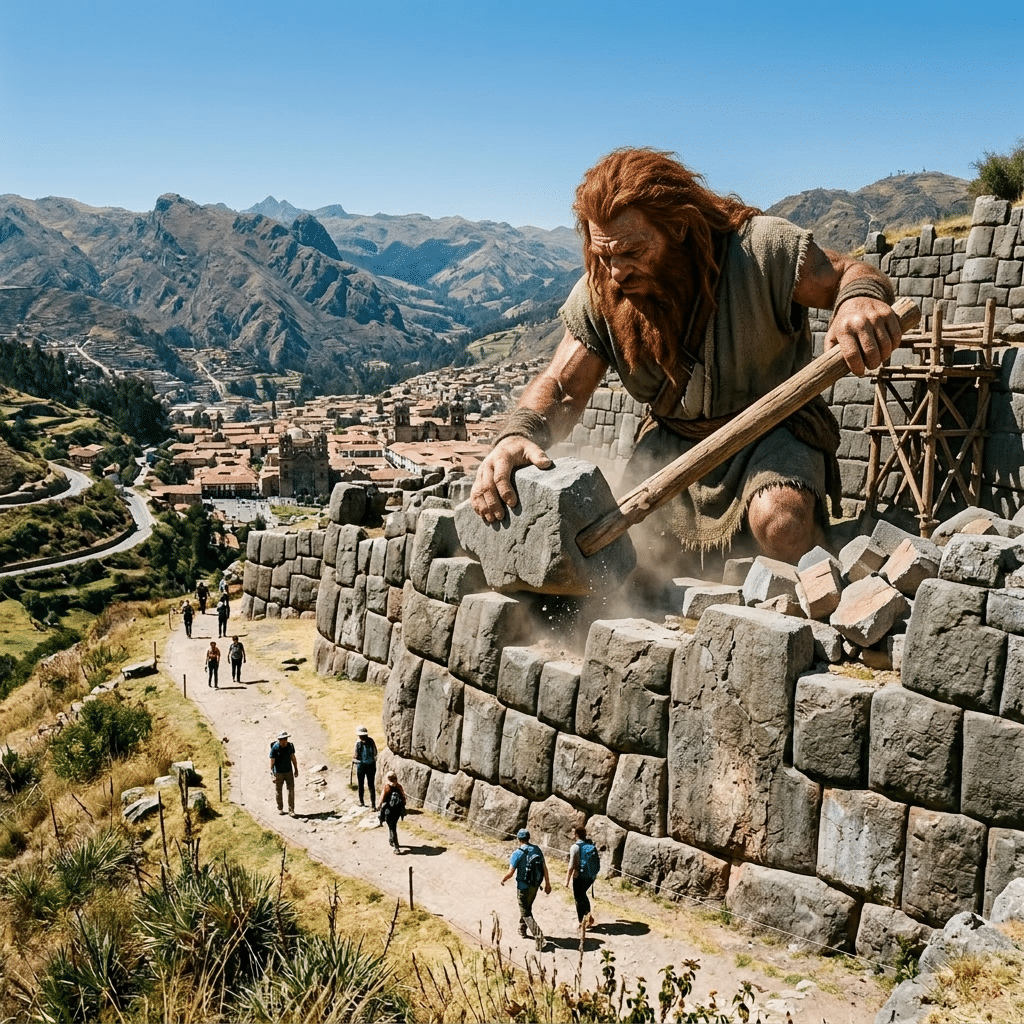
Sacsayhuamán and Giants: Key Points
-
Sacsayhuamán is a massive Inca fortress complex near Cusco, Peru, built from stones weighing up to 360 metric tons and fitted together with extraordinary precision, making it one of the most physically impressive ancient structures on Earth.
-
Historians attribute the site’s construction primarily to the Inca under Pachacuti in the fifteenth century, built using tens of thousands of mit’a laborers over several decades before being partially dismantled by Spanish colonizers.
-
Andean mythology contains ancient traditions of a race of giants who arrived by sea and possessed superhuman power and a related belief in primordial pre-human beings called gentiles who were thought responsible for inexplicable features of the landscape.
-
Local Quechua oral traditions long held that Sacsayhuamán was built by giants or supernatural beings, and Spanish colonial writers recorded that native Peruvians believed no ordinary human force could have assembled such a structure.
-
Modern alternative history movements have expanded these legends, arguing that the impossibly heavy stones and lack of wheeled vehicles or iron tools prove that conventional archaeology’s explanation of human labor is not sufficient.
-
Mainstream archaeology counters these theories with evidence of Inca quarrying tools, ramp systems, and large organized workforces, while the enduring giant folklore reflects both genuine human awe at the site and the cultural significance of mythologizing extraordinary achievements.

Introduction
Sacsayhuaman is one of the world’s most incredible and intriguing archaeological monuments, a tribute to either phenomenal human skill or, some say, something well beyond ordinary human capabilities. High in the Andes above the ancient Inca capital of Cusco, Peru, this immense fortress-like complex has fascinated explorers, historians, and storytellers for centuries. One of the most persistent legends about Sacsayhuaman is the belief, in various forms in Andean folklore and popular imagination, that the site was not built by ordinary men but by a race of giants whose superhuman strength alone could account for the otherwise inexplicable scale of the monument.
The Physical Structure and Architecture of Sacsayhuamán
Perhaps the most well known site highlighted in talks about mega-scale stone masonry in the Andes is Sacsayhuamán, near Cusco. The blocks at Sacsayhuamán are generally described as huge, precisely cut stones, fitted together without mortar in a dry-stone technique to construct vast, winding walls that step down the mountainside above Cusco. This configuration, of exceptionally large fitted blocks erected in interlocking drystone walls, is at the heart of the wider debate on “giant stone buildings” and Cyclopean/megalithic architecture, a debate that spans many civilizations and regions and raises questions about building techniques, labor organization, and historical dating (Šaravanja et al., 2023; Lipa et al., 2024; Lin, 2020).
Physically, Sacsayhuamán is an overwhelming structure, difficult to describe in words. Located on a steep hill that rises 3,701 meters above sea level with a view of Cusco, the site contains a large expanse of terraced walls and open plazas. Sacsayhuamán’s most recognizable feature is its enormous zigzagging exterior walls, constructed with giant limestone and andesite rocks so perfectly fitted that not even a sheet of paper could be inserted between them. These stones weigh as much as 100 to 300 metric tons. The single largest stone is said to weigh around 360 metric tons, one of the heaviest building blocks ever used in any structure on Earth. The walls are constructed in three levels to a height of around six meters in places and the total perimeter of the outer walls is some 400 meters. The entire complex also previously contained towers, cisterns, and interior chambers, much of which was torn down by Spanish colonial officials, who used the stones to build churches and government buildings in Cusco below.
Recent numerical and observational analyses have identified three main wall typologies in the Sacsayhuamán complex: typology 1, typology 2, and typology 3, distinguished by diverse block sizes (from ca. 0.2 to 8 m), dry joints, and irregular textures. These walls tend to serve as retaining structures on stepped terraces. The same analysis indicates that the walls were not finished at the moment of the Spanish conquest, a detail that makes evident the position of the site within the late Inca period and the sudden historical interruption that was generated by contact with Europeans (Lipa et al., 2024). In terms of typology, field accounts generally mention massive stone leaves with two or more faces, with uneven infill, which is characteristic of Peruvian dry-stone walling at a monumental scale (Lin, 2020). Quantitative characterizations of the blocks’ weight ranges, often cited in the megalithic literature, place many blocks in the tens of tons, with some claims approaching two-digit to near-hundred-ton classes. These mass figures fit into broader discussions of “giant stone buildings” and help explain the awe associated with Sacsayhuamán in both scholarly and popular contexts (Šaravanja et al., 2023).

Historical Origins and the Inca Legacy
The history of Sacsayhuamán is related to the emergence and collapse of the Inca Empire. Most historians and archaeologists attribute the construction of Sacsayhuamán mainly to the Inca, with large-scale building thought to have begun under the reign of Pachacuti Inca Yupanqui in the mid-fifteenth century and to have continued under successive rulers, possibly taking decades and the labor of tens of thousands of workers to complete. The Inca’s oral traditions and the accounts of the Spanish chroniclers speak of a huge workforce of mit’a laborers (a type of mandatory duty to the state) to quarry, transport, and set the big stones. In the sixteenth century, the Spanish chronicler Cieza de León described the location with evident awe, as if it were almost unthinkable that human hands alone could have fashioned such a place. The Spanish conquest of 1533 abruptly ended the Inca Empire, and within a generation, Sacsayhuamán was significantly destroyed, with its stones transported to Cusco to construct the Cathedral and other colonial monuments. Now it is listed as a UNESCO World Heritage site within the Historic Center of Cusco, and it attracts hundreds of thousands of visitors each year, who never cease to be amazed by the grandeur and accuracy of its construction.
Giant Mythology, Andean Folklore, and Alternative Theories
Peruvian mythology has a long heritage of giant stories, as does Andean mythology more generally. Numerous indigenous tribes throughout South America have preserved these traditions, which pre-date the Spanish conquest. One of the most curious stories is the legend that the chronicler Pedro Cieza de León narrates in his Chronicle of Peru, where he tells a story that the native Peruvians told him about a race of giants who came by sea on huge rafts and were so big that a normal man reached only to the knee of one of those beings. Legend has it that these giants were violent and ravenous, eating enormous quantities of food and fresh water and doing horrific atrocities against the local populace. The story closes with the giants being consumed by divine fire from heaven as retribution for their transgressions, a narrative framework that is highly reminiscent of flood and giant myths common to many civilizations of the world. Other Andean mythologies describe a primordial race, sometimes called the gentiles or ñaupas, ancient people of incredible power who inhabited the earth before the current era of humanity and who were believed to be responsible for many of the most dramatic and incomprehensible elements of the environment. They were considered to have been wiped out or driven underground when the sun first rose over the world, and their bones were sometimes identified as the fossilized remains that Andean people periodically found eroding from hillsides and cliffsides.
The link between giant mythology and Sacsayhuamán seems to be rooted deeply in the oral traditions of the Cusco region itself. For some time, some Quechua-speaking communities have believed that edifices such as Sacsayhuaman were built by a race of ancient giants or by a pre-human race of powerful beings who lived before the time of the Inca, and such traditions often describe these beings as having had magical powers or divine help that gave them the ability to move and place stones that no ordinary person could possibly move. When Spanish colonial writers saw the remains and heard these local traditions, they often noted the view of native Peruvians that no human power could have built such constructions and that some supernatural agency, whether giants or demons or gods, must have. This oral tradition fed directly into speculation of later centuries and was never fully suppressed even after Spanish missionaries imposed Christian worldviews on the Andean population, who sometimes in turn absorbed and reinterpreted these giant legends into biblical modes involving the Nephilim or antediluvian peoples.
The gigantic notion has been avidly taken up and advanced by modern popular folklore and alternative history organizations in connection with Sacsayhuamán. The impossibly large stones of Sacsayhuamán have been cited as evidence that some form of intelligence or power beyond ordinary human capability was at work by writers such as Erich von Däniken, who popularized the ancient astronaut hypothesis in the latter half of the twentieth century, and later researchers in the so-called alternative archaeology movement. Another belief is that the architects of Sacsayhuamán were members of a vanished society of giants, perhaps associated with the mythical continent of Atlantis or with antediluvian peoples mentioned in numerous religious books. These hypotheses generally mention the weight of the stones and the sheer difficulties of carrying them over mountainous terrain without wheeled vehicles or iron tools as the main reason why the explanation of ordinary human labor given by mainstream archaeology is not sufficient. Photographs and alleged reports of giant skeletal remains discovered in Peru and other parts of South America have further fueled the folklore tradition, even though archaeologists and physical anthropologists have consistently found that such remains are either misidentified ordinary human bones, deliberate hoaxes, or the result of digital photo manipulation.
Mainstream Archaeology, Cultural Significance, and the Persistence of Legend
Mainstream archaeology and engineering have quite different sets of beliefs, which, while not as dramatic as the enormous legends, have a lot of physical and documentary evidence to back them up. Experimental archaeology has shown that large groups of workers, using wooden sledges, earthen ramps, rope systems, and lever techniques, can move and position even extraordinarily heavy stones, provided they have adequate organization and time; replications of these techniques have been conducted successfully with multi-ton blocks. Archaeological evidence from several Inca quarry sites shows stone hammers, metal tools, and remains of earthen ramps that prove the Inca had sophisticated means of mining and moving huge boulders over challenging terrain. Research into Inca administrative records has shown that at any one moment tens of thousands of mit’a laborers were arranged at key state construction projects, providing the huge human manpower that such an endeavor would require. The Incas also seemed to have intimate, practical knowledge of Andean nature. They often used natural rock formations as starting locations and moved stones along paths taking advantage of existing slopes and waterways to minimize effort. Engineers and archaeologists have linked the perfection of the fitting of the stones, so often mentioned by the giant theorists as evidence of supernatural potential, to careful and highly skilled stone-dressing procedures honed by Inca craftsmen over many generations.
Sacsayhuamán is also involved in broader discussions concerning legacy, representation, and the politics of monumental memory in Peru, beyond technical concerns. Scholarly and public debate frames More than a technical conundrum, Sacsayhuamán was a cultural emblem, an anchor for ideas of Inca sovereignty in the Andean environment, a focal point for the modern heritage economy, and a site where narratives of indigeneity, modern nationhood, and tourism came together. Studies of heritage governance and representation reveal how sites like Sacsayhuamán operate in contemporary politics and how heritage is prospected, valued, and sometimes instrumentalized in support of national narratives or tourism economies. Research on the mobilization of heritage in Peru supports this, as it intersects with the politics of memory, the ethics of representation, and the ways in which sites such as Sacsayhuaman are used in public life and contemporary politics (Molinié, 2019; Hall, 2019; Huamantupa‐Chuquimaco et al., 2023). Other treatments of Inca architectural history place Sacsayhuamán in a broader consideration of the city’s environment, its stone architecture, and its contribution to cultural identity in Cusco (Esenarro et al., 2023; Sovero et al., 2021).
The survival of the giant mythology is in itself a remarkable cultural and psychological phenomenon that deserves significant attention. Sacsayhuaman is not the only ancient site to be the subject of such legends; many societies and historical periods have a tendency to attribute extraordinary feats of architecture to supernatural beings when the practical means of construction are not immediately obvious to outside observers. Specifically, the giant legend carries layers of cultural meaning in the Andean context in relation to the disruption of the Spanish conquest since stories of a powerful pre-human or superhuman past can be expressions of pride and cultural continuity in the face of colonial erasure and suppression of indigenous knowledge. The stories also speak to a very real and comprehensible human feeling of wonder at a structure that continues to baffle even contemporary engineers and architects who examine it intently, as the site indeed presents architectural problems that are not easily answered or universally accepted.
Conclusion
Sacsayhuamán is one of the outstanding architectural feats of the ancient world, a construction whose sheer physical enormity has inspired folklore about giants and supernatural builders from the time of the Inca to the current day. What the traditions of Andean giants and heavenly builders tell us is something true about the human condition: a profound urge to look for mythological explanations when faced with proof of accomplishments beyond what we assume ordinary humans can achieve. Mainstream archaeology and experimental engineering have given us compelling, evidence-based narratives of how the Inca built Sacsayhuamán through human labor, organization, and ingenuity. But the site’s folklore of giants persists because it captures some of the real wonder it inspires in all who encounter it. Whether it is a monument of Inca engineering genius or a building that speaks of lost prehistoric knowledge, the enormous stones of Sacsayhuaman still speak across the centuries in a voice that asks for explanation and invites the imagination to roam far beyond the mundane.
References
Cieza de León, P. de. (1864). The chronicle of Peru (C. R. Markham, Trans.). Hakluyt Society. (Original work published 1553)
Esenarro, D., Vásquez, P., Morales, W., & Raymundo, V. (2023). Interpretation Center for the Revaluation of Flora and Fauna in Cusco, Perú. Buildings, 13(9), 2345. https://doi.org/10.3390/buildings13092345
Hall, A. (2019). Heritage Prospecting and the Past as Future(s) in Peru. The Journal of Latin American and Caribbean Anthropology, 24(2), 331–350. https://doi.org/10.1111/jlca.12402
Huamantupa‐Chuquimaco, I., Trujillo, Y., & Ucamayta, E. (2023). Valuation of the Diversity of Native Plants and the Cultural-Archaeological Richness as an Integrative Approach for a Potential Use in Ecotourism in the Inter-Andean Valley of Cusco, Southern Peru. Diversity, 15(6), 760. https://doi.org/10.3390/d15060760
Lin, S. (2020). Machu Picchu-The Sublime Stone Citadel. Open Access Journal of Archaeology & Anthropology, 2(2). https://doi.org/10.33552/oajaa.2019.02.000531
Lipa, L., Tarque, N., Pelà, L., & Ruigómez, J. (2024). Seismic numerical analysis of an Inca stone wall in Sacsayhuaman using rigid body dynamics within a finite element framework. https://doi.org/10.2139/ssrn.4711361
Molinié, A. (2019). L’instrumentalisation des sites archéologiques incas. Questions d’éthique. Canadian Journal of Bioethics, 2(3), 57–65. https://doi.org/10.7202/1066463ar
Šaravanja, K., Oreč, F., & Kopilaš, V. (2023). Giant stone buildings (III) – Cyclopean and other buildings of more developed architecture. E-Zbornik, 13(26), 76–99. https://doi.org/10.47960/2232-9080.2023.26.13.76
Sovero, K., Tarque, N., Spacone, E., Mazzanti, C., Brando, G., & Alfaro, C. (2021). Historical and Typological Characterization of Churches in the Historical Centre of Cusco, Peru. https://doi.org/10.23967/sahc.2021.125


Leave a Reply