Oni Ogres: Key Points
- The oni is Japan’s archetypal ogre, but far stranger and older than its modern cartoon image, having served across fifteen centuries as plague-carrier, hell warden, mountain bandit, temple guardian, and comic figure.
- Physically it is a giant with horns, tusks, bulging eyes, brightly colored skin, a tiger-pelt loincloth, and an iron-studded kanabō club, features drawn from the ox-tiger zodiac position of the unlucky northeast “demon gate.”
- In behavior oni are raiders and man-eaters who hoard treasure, drink heavily, and abduct women, though some are dutiful hell-torturers and others, like ogre-faced roof tiles, are protective precisely because they look terrifying.
- The name originally referred to hidden, invisible causes of illness and misfortune; Buddhist yaksha and rakshasa imagery gave those forces bodies, and medieval war tales, Noh, and Edo publishing fixed the familiar ogre form.
- Oni possess immense strength, flight, storm-summoning, shapeshifting, regeneration, and magical items, yet fall to thrown soybeans at Setsubun, holly and sardine heads, sutras and sacred swords, and above all their own gluttony and gullibility.
- Famous tales include Shuten-dōji, Ibaraki, Momotarō, Issun-bōshi, and the transformed women behind the hannya mask, and theories read oni variously as disease, marginalized peoples, wandering metalworkers, imperial propaganda, projected rage, or embodied boundaries.
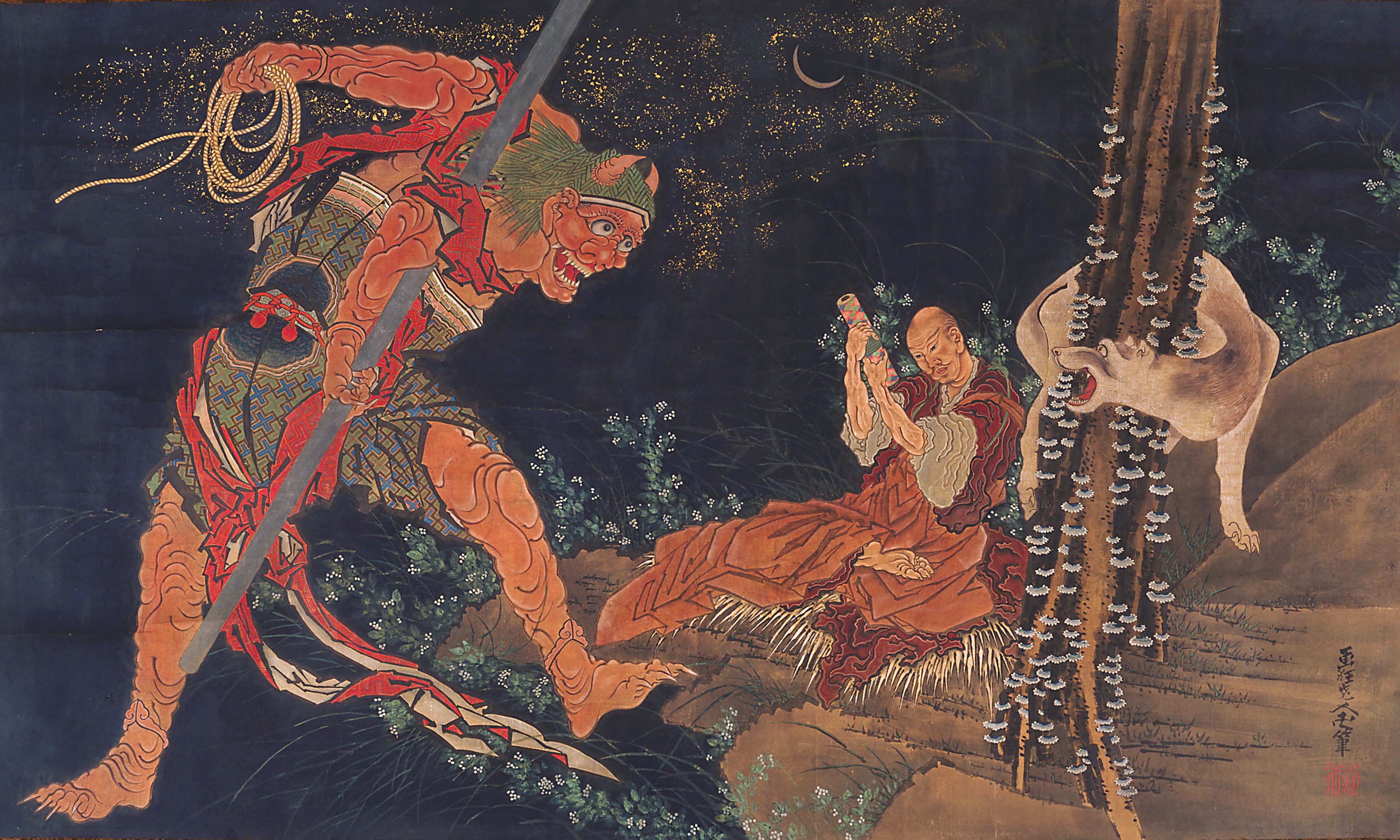
![By Soga Shōhaku (曾我蕭白) (1730–1781) - Artscape.ne.jp [1], originally from Keishoji temple, Mie prefecture, Public Domain, https://commons.wikimedia.org/w/index.php?curid=97844199](https://i0.wp.com/connectparanormal.net/wp-content/uploads/2026/07/Sessen-Doji-Offers-His-Life-Ogre-Oni-1764-Soga-Shohaku.png?resize=752%2C1024&quality=80&ssl=1)
Introduction
Among the vast Japanese supernatural landscape, the oni is one of the most readily recognizable beings. The oni, with horns and fangs and often painted in the garish primary colors of a festival mask, has become shorthand for monstrousness itself, the ogre that lives in the highlands beyond the last rice crop. However, the creature is much stranger and older than its cartoon silhouette suggests. The oni has been a carrier of plague (invisible), a jailer in the Buddhist hells, a mountain bandit, a guardian on a temple roof, a jealous woman transformed by fury, and a comedic foil in children’s stories throughout some fifteen centuries. To follow the oni is to follow the evolving Japanese idea of what lies beyond the human community and why it should be feared.
Oni are horned monsters or ogres in Japanese folklore, appearing in many mediums from classical myths and folktales to modern animation and literature. Oni serve as versatile symbols of social otherness, terror, and moral testing across sources, and are typically dialogically associated with human issues such as power, wealth, and social order. The cited works highlight the deep entrenchment of Oni in mythological and cultural landscapes of Japan, appearing in ancient narratives and constantly reimagined in contemporary media (Bak, 2014; Faraday, 2015; Sarkar, 2023; Yamaguchi et al., 2001).
Appearance, Behavior, and Iconography
The classic oni of the medieval and early modern imagination are meant to frighten. It is taller than a man, sometimes much taller, with a barrel chest, robust limbs, and skin tinted red, blue, green, black, or sickly yellow (Rosen, 2009). Sources describe the oni as having two horns and a mane of untamed hair. The mouth is overly big, filled with tusks, the eyes bulge, a third eye occurs in certain renditions, and extra fingers or a decreased count of three claws to a hand are prevalent. The traditional clothing is a tiger-pelt loincloth. The traditional media. The traditional weapon is the kanabō, a large iron-studded club that is closely associated with oni (2015). The expression “an oni with an iron club” still means a thing already strong made stronger. Much of this appearance is not accidental. In the Japanese translation of Chinese divination, Onmyōdō designated the northeast as the kimon or demon gate, the unlucky sector through which malefic forces entered. In the zodiacal compass, the northeast is between the ox and the tiger, and so the ogre of that gate got ox horns and tiger stripes. Cosmology followed iconography.
The oni is known for its raiding and eating habits. The village tales locate it in caves and mountain tops and on islands beyond the horizon, in ruined gates and abandoned halls. From these lairs, it descends to seize cattle, wealth, and especially people, particularly young women, who are taken away to be either captives or meals. Oni are thought to hoard loot, drink heavily, and feast in raucous groups, which is why so many stories conclude with a hero stumbling into a banquet rather than a solitary monster in the open. Some may be coarse and credulous, quick to laugh and cry, and their tears are notorious for suddenly breaking with hardness. Not all oni are hostile. Some are gokusotsu, Buddhist service hell wardens like the ox-headed Gozu and horse-headed Mezu, who torture sinners at the behest of the judge Enma, not because they are hungry. Others serve as defenders due to their frightening appearance. The onigawara, ogre-faced ridge tiles on temples and buildings, glare outward to scare off the evils they represent (Rosen, 2009).

Historical Origins and Etymology
The word itself implies something earlier and more ambiguous. Oni is often associated with the reading of a character that means to hide or conceal. In the oldest levels of the tradition, these were unseen presences, sources of illness, untimely death, and bad luck, rather than bodies with horns. Early chronicles and provincial gazetteers from the seventh century contain references to these murky figures, while the Izumo Fudoki presents a one-eyed oni devouring a farmer, marking one of the first recorded instances of a man-eating ogre. Buddhism furnished the bodies. Indian cosmology’s demon armies, the yaksha and rakshasa, came with scripture and temple art, their muscular, tusked shapes merging with native conceptions of the hidden and the destructive. By the Heian period, the court regarded oni seriously as a political and ritual concern, and exorcistic ceremonies like the tsuina rite were undertaken to banish them from the city at the turn of the year. Then medieval war stories, Noh drama, and drawn scrolls set the image in stone as the ogre we know. Edo publishing made the image of oni ubiquitous, ranging from Toriyama Sekien’s illustrated catalogues of monsters to inexpensive comic pamphlets that portray oni as more clownish than terrible. Modern manga and animation have inherited and continue to mine the full accumulated material. by modern manga and animation. Modern manga and animation continue to mine this material.
Powers, Weaknesses, and Exemplary Tales
Oni are said to possess great powers. Strength is the first power, which is strong enough to break blades, throw rocks, tear limbs from bodies, or fly; at the very least, it allows for inhuman speed and the ability to move limbs with a comb (Black, Storm, or Whirlwind, 2009). Shifting is common and hazardous because an oni that transforms into a beautiful woman, a monk, or a relative is far more difficult to defend against than an oni that comes screaming down the road. Some regrow severed parts, and a great oni’s severed head might still bite. Invisibility, a remnant of old etymology, remains in stories where the monster is sensed before it is seen. Magical objects are also of that type, including cloaks and caps that disguise the wearer and mallets that create what is desired. The vulnerabilities are equally specific. The roasted soybeans are hurled at the New Year in the Setsubun rite still performed with the shout, “Oni out, fortune in, come!” “O, drive them away,” as are the holly twigs and the pungent heads of grilled sardines placed at the entrance. They are kept at a distance by sutras, by divine names, by charms, and by gods and bodhisattvas intervening. Sacred or specifically made swords cut things that ordinary steel could not cut. Above all, they are their undoing, in their desires and in their poor judgment. They sip the wine, believe the disguise, take the wager, and lose.
Folklore provides unforgettable instances of the pattern. The greatest is Shuten-dōji, the drunken ogre of Mount Ōe, who terrorized the capital until Minamoto no Yorimitsu and his retainers disguised themselves as mountain ascetics, drank poisoned sake with him, and struck when he was drunk; it is said that even after death his flying head clung to the hero’s helmet. One of that band, Watanabe no Tsuna, is said to have cut off the arm of the oni Ibaraki at the Rashōmon Gate, only to have the creature return in the form of an old woman to retrieve it. Momotaro, the kid born from a peach, travels to Onigashima with a dog, a monkey, and a pheasant and makes the ogres give up their stolen wealth. The thumb-sized Issun-bōshi is eaten by an oni but stabs his way out with a needle and wins the wishing mallet as a reward. Elsewhere the horror is domestic and psychological. The witch of Adachigahara attracts travelers to a lonely cottage and kills them. In thwarted love Kiyohime becomes both serpent and demon and the hannya mask of the Noh theater with its horns and bitter grin cemented forever the image that a woman’s restrained rage could remake her into an oni. There are softer stories, too. The sobbing blue oni and the misunderstood red oni have been turned into symbols of friendship and prejudice by a cycle of modern children’s literature, for the story of the old man’s lump, where oni dance at night, is so taken by a stranger’s dancing that they reward him.
Oni in Contemporary Media and Scholarly Interpretation
In current Japanese anime and popular culture, oni are often cited within intertextual networks that reference traditional folktales and mythic tropes. Analyses emphasize the connection between anime and folklore, with Oni (and kindred yōkai themes) serving as a cultural reference point in modern productions, impacting audience engagement and perception of legendary content in a modern environment (Sarkar, 2023). In contemporary media, such as Dragon Ball (Toriyama, 1984–1995) and other anime texts, we can see how traditional folkloric references are resignified or subverted, such as Oni-like figures and other yokai-inspired beings, revealing intertextual dynamics between traditional Japanese folklore and modern entertainment (Mínguez-López, 2014). Scholarly discussions of yōkai in horror and contemporary series have focused on the mobilization of Oni and similar beings to express sociocultural anxieties in late modern Japan, highlighting the continuity and transformation of Oni imagery from traditional folklore to modern storytelling (Sarkar, 2023).
Folklore pioneers such as Yanagita Kunio began the systematic collection of rural tales and supported the mythic aspect of folktales, situating Oni within a long history of Japanese folklore and religious syncretism (Shinto and Buddhism) that influences many demon figures (including Oni) in both past and present contexts (Costanzo, 2020). Oni are inseparably intertwined with the mythic and social worlds of Japan, as reflected in their presence throughout a range of storytelling genres, from monogatari and setsuwa to picture literature, from classical to early modern times (Costanzo, 2020; Faraday, 2015). Later decades have seen academic treatments of Oni that have explored the context of premodern Buddhist and other religious practices, where Oni figures are woven into themes of wealth, morality, and ritual practice in storytelling and temple culture, attesting to the multilayered social functions of Oni in historical Japan (Rambelli, 2019).
There have been many explanations for all of this. One long-standing tradition interprets the oni as a personification of disease and tragedy, the invisible cause given a face so it might be named, punished, and ritually ejected. Instead, a euhemerist strain sees real persons behind the mask: mountain bandits and outlaws, defeated Emishi and other groups on the frontier of Yamato expansion, itinerant communities living outside the village order, or foreign sailors and traders whose unfamiliar coloring and speech made them monstrous in retelling, with the pirate haunts of the Inland Sea a plausible Onigashima. Another interesting variant connects oni to metalworkers, linking the red or blackened skin, the single eye, and the iron club to smiths and miners who had been scorched by furnaces and blinded on one side by staring into the flame, wandering specialists whose secret craft placed them on the margin of settled society. Political readings understand the oni-slaying as a myth of central authority pacifying a wayward province, noting that Shuten-dōji was destroyed by the agents of the Kyoto court. Psychological readings stress projection, the externalizing of fury, envy, and desire that the social order prohibited, explaining why women and the dispossessed so often become oni in the stories rather than simply being eaten by them. Structural approaches, finally, focus on the boundary itself. The oni is part of the gate, the mountain pass, the northeast corner, and the turning of the year; it is everything a society must retain on the far side of a line. None of these hypotheses excludes the others, and the oni’s durability may lie in its ability to absorb them all.
Conclusion
The oni thus resists any one definition, and that is the point. It started as a secret source of bad luck, evolved from imported demonology, became an ogre with horns and a club, and then radiated into ritual, theater, roof tiles, sweets, and screens. He embodies contradictions: both a villain and a jailer, an invader and a guardian, a cannibal and a comic dupe, serving as the figure onto which both anger and difference can be projected. It’s noteworthy for its physical excess, defeatable for its folly, and helpful for its shifting meanings. As long as there are borders to be drawn between inside and out and beans to be flung at the door in early February, the oni will continue to descend the mountain.
References
Bak, M. (2014). The folktale “Hokpuri Yongkam” and the visual representation of the Korean Dokkaebi. https://doi.org/10.5151/despro-icdhs2014-0028
Costanzo, W. V. (2020). Archetypes of comedy (pp. 55–68). https://doi.org/10.1093/oso/9780190924997.003.0004
Faraday, J. D. (2015). Noriko T. Reider. Seven demon stories from medieval Japan. (Boulder: 2016, University Press of Colorado. Pp. 292. ISBN: 978-1-60732-489-8.). Ethnologies, 37(2), 207. https://doi.org/10.7202/1041494ar
Izumo fudoki [Records of the customs and land of Izumo Province]. (1997). In M. Y. Aoki (Trans.), Records of wind and earth: A translation of Fudoki with introduction and commentaries. Association for Asian Studies. (Original work compiled 733)
Mínguez-López, X. (2014). Folktales and other references in Toriyama’s Dragon Ball. Animation, 9(1), 27–46. https://doi.org/10.1177/1746847713519386
Rambelli, F. (2019). The mystery of wealth and the role of divinities: The economy in pre-modern Japanese fiction and practice. Hualin International Journal of Buddhist Studies, 2(2), 163–201. https://doi.org/10.15239/hijbs.02.02.06
Rosen, B. (2009). The mythical creatures bible: The definitive guide to legendary beings. Union Square & Co.
Sarkar, A. (2023). Modern anxieties and traditional influence in horror anime. Humanities, 12(5), 118. https://doi.org/10.3390/h12050118
Toriyama, A. (1984–1995). Dragon Ball [Manga series]. Shueisha.
Yamaguchi, S., Murakami, T., & Inokuchi, H. (2001). Resistivity mapping using the VLF‐MT method around surface fault ruptures of the 1995 Hyogo‐ken Nanbu earthquake, Japan. Island Arc, 10(3–4), 296–305. https://doi.org/10.1111/j.1440-1738.2001.00328.x


Leave a Reply