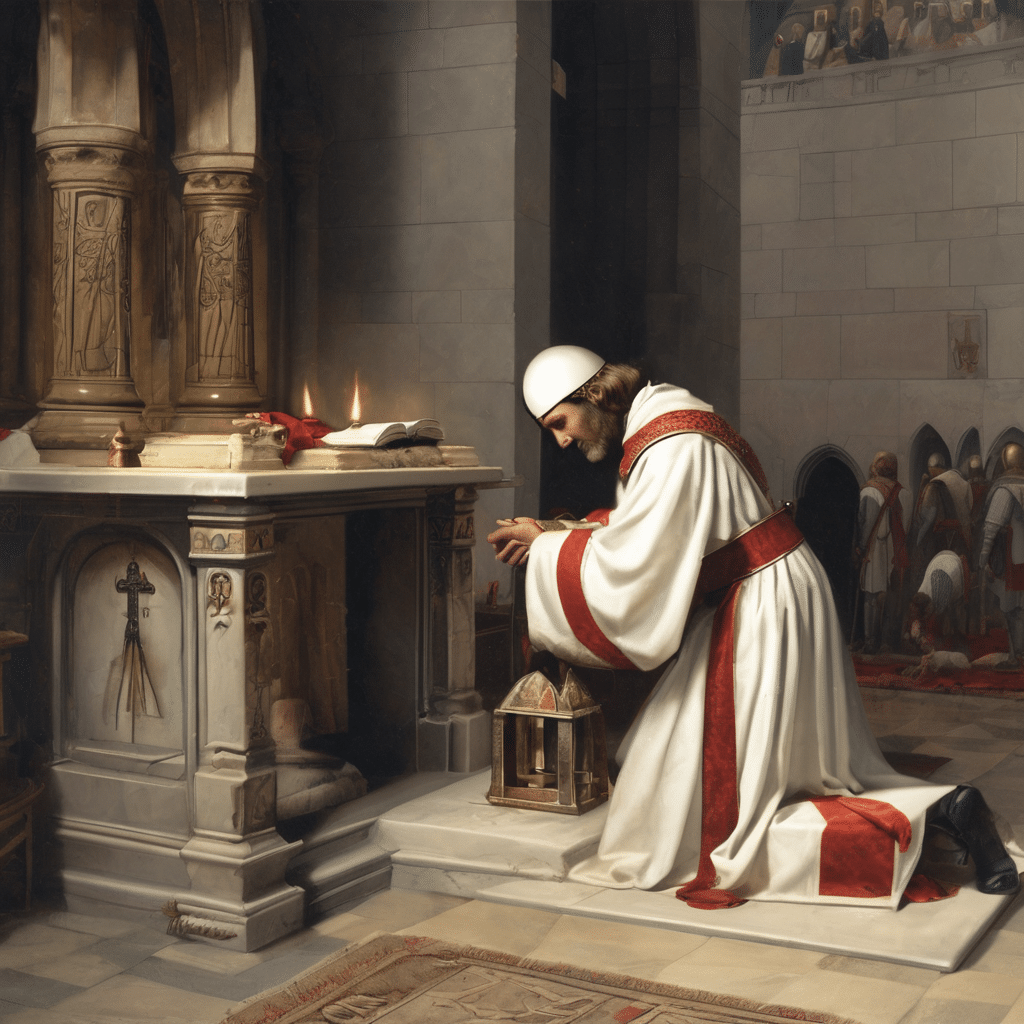
Did the Knights Templar worship the devil or was their reputation smeared to justify disbanding them?
For ages, there has been a fascination and fiction surrounding the Knights Templar, a Christian military organization from the Middle Ages. The claim that the Templars engaged in heretical activities and devil worship is one of the most persuasive and divisive of these myths. Popular culture, literature, and folklore have passed down this story, which originated in the events leading up to the Templars’ demise. For decades, people have asserted this claim, presenting numerous narratives and theories to unravel the enigma of these mysterious medieval knights.
Knights Templar
In 1119, the French knight Hugues de Payens and eight other knights established the Knights Templar, also known as the Poor Fellow-Soldiers of Christ and of the Temple of Solomon. The French knight Hugues de Payens and eight other knights established the order with the primary objective of defending Christian pilgrims en route to the Holy Land. The Templars were one of the wealthiest and most influential military orders of the Middle Ages, thanks to their rapid conversion to the favor of the Church and European kings, who granted them endowments and privileges. They participated in military operations throughout the Crusades, built a network of fortresses throughout Europe and the Middle East, and established the first banking system.
The Templars were distinct in that they were both formidable soldiers committed to defending the Christian kingdoms in the East, took monastic vows, and lived as monks. At their peak, they had between 15,000 and 20,000 members. The Templars amassed considerable riches and influence and built a thriving network of banks. The Muslim armies dreaded these expert fighters.
Rumors that the Templars were corrupt and had deviated from their initial goal started to spread as they gained wealth and influence. The Templars’ most well-known myth is that they worship a deity named Baphomet. The Templars’ heresy centers on this purported deity, portrayed in a variety of ways, most notably as a demonic figure or a disembodied head.
The Knights Templar order suffered a serious blow in their quest to defend the Holy Regions, despite their reputation as fearsome fighters. As time went on, it became clear that the tenacious advances of Muslim forces ultimately brought about the collapse of every Crusader state. This sad sequence of events not only inflicted a mortal blow on the Christian presence in these hallowed lands but also prompted doubts about the devotion and efficacy of the famous knights.
Particularly upsetting was the loss of Jerusalem, which had great spiritual significance for Christians throughout. Salah ad-Din’s army’s capture of the city in 1187 marked a turning point in history, sending shockwaves throughout Europe and shattering Western Christendom’s notion of invincibility. Observers began to question the necessity of the Knights Templar when other Crusaders lost battles in Palestine and Syria, including those at Hattin and Acre, as they had fallen short of their goal. The Templars moved to Cyprus, yet they managed to hold on to a large portion of their fortune through profitable banking ventures.
Conflicts over the Order’s banking activities with European kings, particularly King Phillip IV of France, had a lengthy history. When the Templars declined to lend Phillip money, he became extremely enraged and asked Pope Clement V to excommunicate them. Desperate to have his request granted, Phillip, on Friday, October 13, 1307, ordered the arrest and execution of hundreds of French Templars; this action brought about the dissolution of the order. Because of this tragedy, Friday, the 13th, became associated with superstition, with many believing it to be unlucky or cursed.
Under pressure from King Philip, Pope Clement V issued the papal bull Vox in excelso in 1312, rescinding the directive.

Devil Worship?
Narratives from the Templar trials, which are now known to have taken place under intense coercion and torture, include confessions from initiates that they were made to spit on the cross, deny Christ, and kiss indecently. These confessions frequently discuss the idol of Baphomet, which the Templars are said to have worshipped as a devil’s representation or as a source of prosperity and fertility.
Other allegations included cat worship and gay activities.
As these trials progressed, the public’s anger, fed by false information about the Templars’ alleged transgressions, intensified; nonetheless, it quickly became evident that their fate was predestined even before they appeared in court. After finding them guilty without a fair trial or due process, they brutally killed and burned at the stake alongside other offenders.
The Templar order officially dissolved in 1314 with the burning at the stake of Jacques de Molay, the last Grand Master. The Templars’ operations effectively ended when European rulers appropriated their property, assumed control of it, or combined it with other orders.
According to historical analysis, King Philip IV concocted the accusations of heresy and devil worship in order to weaken the Templars’ authority and settle his debts to them. The admissions obtained through torture lacked credibility and were inconsistent. Modern researchers argue that the trial was unfair because the king’s intention to destroy the Templars, as a powerful political and economic organization, dictated the verdict. These stories also spread because of the larger context of the period’s political and religious power struggles.
Even after the order’s dissolution, the Templars’ devil worship story persisted, entwined with numerous conspiracy theories and tales of lost wealth. Popular culture frequently portrays them as the guardians of esoteric and archaic knowledge, and they have established connections with numerous secret groups. Many occult groups have adopted Baphomet, and popular culture frequently mentions him. This curiosity is a reflection of the Templars’ continuing influence in popular culture.
Conclusion
People are still fascinated by the Templars’ spectacular fall from power. Fictional books like The Da Vinci Code and Ivanhoe perpetuate their fame. They are known for their enigmatic rites, deaths, and status as the epitome of warrior monks.
The tales that the Knights Templar practiced devil worship and worshipped Baphomet are a concoction of myth-making, misinformation, and propaganda from the Middle Ages. There is no firm historical foundation for these stories, but they have molded and enhanced the Templars’ mythos. The Templars’ reputation stands as a monument to the power of myth and the intricacy of history, notwithstanding these rumors.
References
Jonas, M. (2011). The Templar Spirit: The Esoteric Inspiration, Rituals and Beliefs of the Knights Templar. Temple Lodge Publishing.
Martin, S. (2004). The Knights Templar: The history and myths of the legendary military order. Basic Books.
Novotný, F. (2022). Harbinger of the Witches’ Sabbath? The Emergence of Devil Worship Imagery in the Trial of the Templars. Magic, Ritual, and Witchcraft, 17(3), 367-392.
Sanello, F. (2005). The Knights Templars: God’s warriors, the devil’s bankers. Rowman & Littlefield.
Wheet, C. T. (2009). THE CREATION AND DEMISE OF THE KNIGHTS TEMPLAR.

Leave a Reply