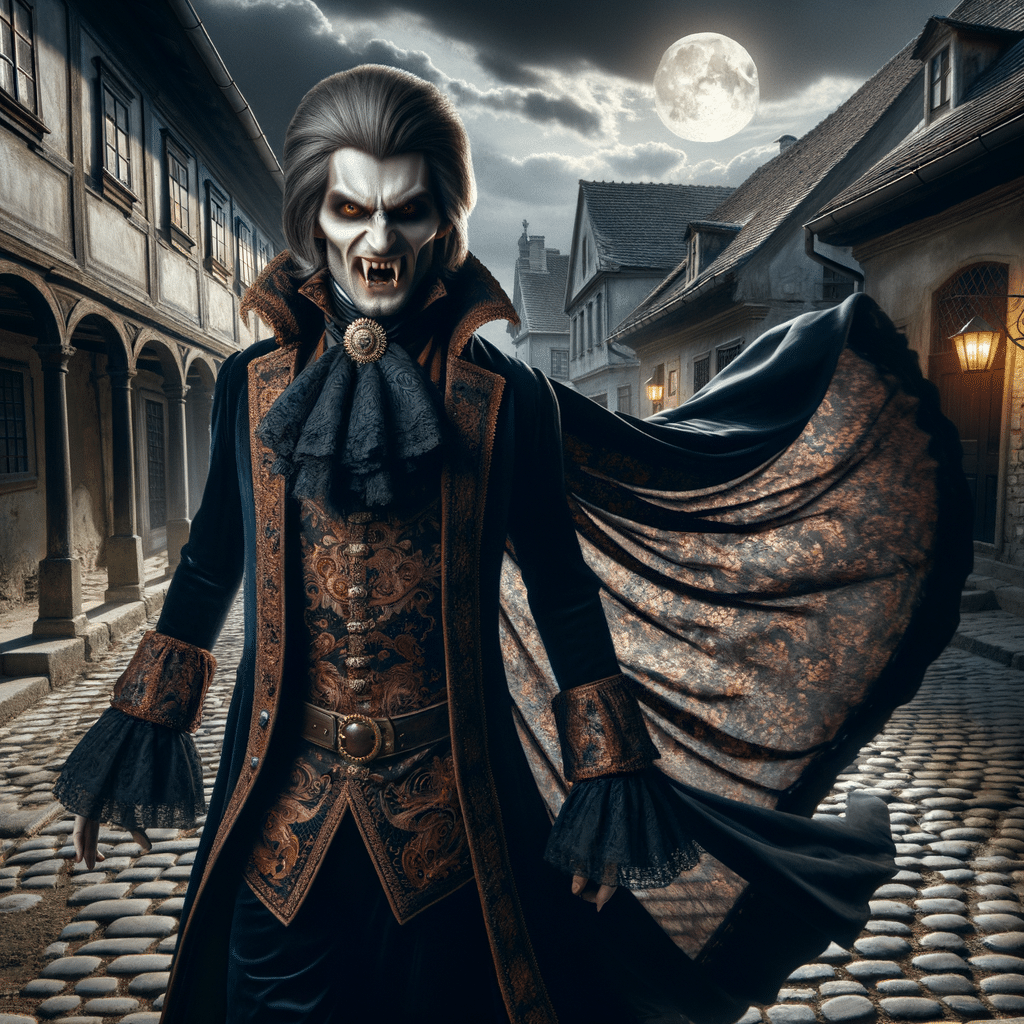
Arnold Paole is a name that strikes fear into the hearts of many who have heard of his story. He was an infamous figure from the 18th century who was believed to be a vampire. His story has become one of the most famous cases of vampirism in history, and it is still discussed and debated by scholars and enthusiasts alike as many think he may have started a vampire outbreak that claimed the lives of at least 17 people.
Vampires are supposedly mythical creatures that are believed to feed off the blood of humans in order to stay alive, often by draining them of their life force. Vampires are often depicted as undead creatures, although there have been many different interpretations of what they look like throughout time.

Paole Bio
Arnold Paole was born in the village of Medvegia in Serbia. He was a soldier in the Austrian army, and it was during his time in the military that he claimed to have been bitten by a vampire. According to conflicting sources, Paole was on a mission in Greece, Gossowa, or Kosovo when he was attacked by a vampire. He fought back and killed the vampire, but he was bitten in the process. Paole claimed that he didn’t think much of the bite at the time, but later he began to experience strange symptoms.
After leaving the military, Paole returned to his hometown in Serbia. It was there that he began to exhibit bizarre behavior. He would often be seen wandering around at night, and he would refuse to eat or drink anything that was offered to him. He also claimed to have vivid nightmares and would wake up screaming in terror.
Later, Paole fell off a hay wagon and shattered his neck, which led to his death.
Vampire Life
Three or four weeks after Paole’s passing, he was spotted out and about in the hamlet at night. Some claimed that he had assumed the appearance of a black hound and was prowling for prey. Also, he was charged with attacking calves and stealing their blood. Four people complained about being bothered by him, and all four of them passed away soon after.
A priest from the neighborhood church, two military officials, two army physicians, and Paole’s grave was uncovered ten days later. Paole’s body was uncomposed, his veins were bursting with blood, and his eyes, nose, mouth, and ears were covered in fresh blood. His body was red, his shirt, the covering, and the coffin were all covered in blood, his hands and feet had lost their old nails and skin but grown in new ones, and his hair and beard had grown back. The villagers stabbed Paole in the heart, believing him to be a vampire. The villagers burned Paole’s body after he shrieked as though he were still alive.
The villagers believed that this would put an end to the outbreak of vampirism, but they were wrong. The people in the village continued to report strange occurrences, and the rumors of vampirism persisted for many years.
Villagers who had consumed beef from cattle that the vampire had fed on were thought to be vampires themselves, despite the fact that the bodies of his human victims received the same treatment. In a period of three months, seventeen persons passed away, with their demise being attributed to Paole’s delayed work.
The Austrian government dispatched medical investigators under the direction of Johannes Fluckinger in December 1731 to investigate claims that bodies had been burned, mutilated, and staked in Meduegna. It was claimed that Paole was to blame for a number of these fatalities. 15 bodies, including two children, were excavated and examined by the medical examiners. It was discovered that eleven of these corpses were in a vampire state. Following the investigation, the local gipsies cut off the heads of the vampires, burned the bodies, and dumped the ashes into the river.
As Fluckinger reached Vienna, his discoveries created a stir, and copies were translated and disseminated all throughout Europe. Also, the press covered it extensively. In the year that followed Flückinger’s report in 1732, the topic was the subject of 12 books and 4 dissertations.

Impact
Before this, vampires stories were not generally publicized widely of in much of Europe, and Flückinger’s story had a significant impact on what would subsequently be referred to as the “vampire epidemic,” during which dozens of vampire attacks were documented and bodies were excavated. Hungary and the Balkans saw a sharp increase in the number of cases reported, which then extended to Germany, Italy, France, England, and Spain. Several people started researching the phenomenon, and writers and playwrights started investigating the vampire mythology.
Vampires were referred to as “fallacious fictions of human fantasy” by Pope Benedict XIV in 1749.
When Empress Maria Theresa of Austria ordered her physician, Gerhard van Swieten, to look into reports of vampires, the vampire plague came to an end. He said that there were no vampires. Witch and vampire hunts were forbidden by the Empress, and in 1768 a law was issued outlawing magical activities.
Conclusion
The story of Arnold Paole has become one of the most famous cases of vampirism in history. It has inspired countless books, movies, and TV shows, and it continues to be a topic of fascination for many people. While there is no scientific evidence to support the existence of vampires, the legend of Arnold Paole and other vampire stories continue to capture the imaginations of people around the world.
Arnold Paole was an 18th century figure who became famous for his alleged vampirism. His story has become a legend and continues to inspire fascination in people around the world. While the truth behind the story may never be known, the legend of Arnold Paole and other vampire stories will continue to be a part of popular culture for years to come.



Leave a Reply