Blue Dragons: Key Points
-
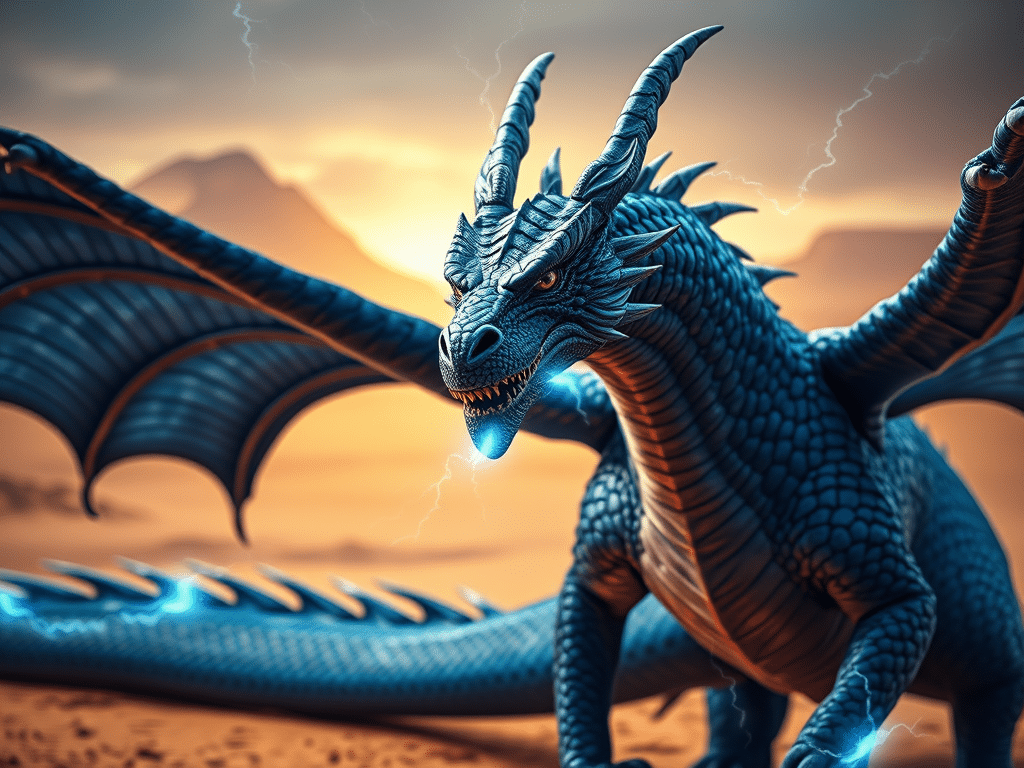
Blue dragons have shimmering azure to cobalt scales, swept-back lightning bolt horns, and wield devastating lightning breath weapons.
-
Blue dragons are intelligent desert predators who ambush prey from beneath the sand and rule over complex hierarchies of minions.
-
Their evil stems from overwhelming pride and belief in their own superiority, leading to cold, calculated cruelty.
-
Blue dragons appear in Dragonlance novels, Dungeons & Dragons: Honor Among Thieves, and McCaffrey’s Pern series in various forms.
-
In role-playing games, they serve as high-level tactical challenges with lightning attacks, high intelligence, and manipulative strategies.
-
Their enduring popularity comes from their visual appeal, tactical complexity, and classic villainous motivations of pride and dominion.

Introduction
The blue dragon is one of the most famous and scary monsters in fantasy literature and video games. It combines the beauty of a dragon with the power of lightning. These beautiful animals have inspired storytellers, artists, and game makers for decades, symbolizing desert power and proud rule. Blue dragons have made a name for themselves in the magical world, where they are both feared and respected, unlike their colored relatives, who hide in icy peaks or volcanoes. The presence of blue dragons in any story or campaign setting instantly heightens the tension, provoking battles filled with cunning tactics, devastating power, and a constant crackling of electricity in the atmosphere.
Physical Characteristics and Appearance
Blue dragons are some of the most beautiful to look at. Their scales shine in colors from bright azure to deep cobalt and sapphire. Compared to other dragon species, their bodies are very efficient, meaning they were made to fly quickly and maneuverably. Their horns are beautiful and swept back; they look like lightning bolts stuck in time. When lit from behind, the membranes of their wings often look almost clear, showing complex patterns of veins that look like they are pulsing with electricity. Their big horns and frilled ears may be their most distinguishing features. These features give the blue dragons an almost royal look that complements their haughty personality. When a blue dragon opens its mouth, you can see the crackling energy building up in its throat before it lets out its famous lightning breath. The smell of ozone around these creatures is a constant reminder of how dangerous they are.
Blue dragons have a life cycle that is similar to that of other real dragons, but with some differences. It takes about twenty months for blue dragon eggs to hatch. During the last fifteen months, the mother dragon carefully cared for the eggs in a specially made nest. A standard clutch has two to four eggs, and most of them hatch into healthy wyrmlings when things are normal. In their early years, blue dragons grow pretty quickly. After about seven years, they are the size and maturity of young adults. After that, though, their growth slows down a lot, and they don’t become fully grown until they are about 160 years old. Over the course of their long lives, blues keep getting stronger. They become adults after about a thousand years and become ancient around eighteen hundred years old. Legends say there are blue dragons that are even older than the oldest known death, which happened about 2,500 years ago.
Behavior, Intelligence, and Territory
When it comes to behavior, blue dragons are methodical hunters and territorial rulers who like to take control of large areas of dry or semi-dry land. They are patient hunters who often hide in the sands of the desert with only their horns and eyes showing, waiting for their prey to come within striking distance. The dragons in this group are very smart and usually act more on logic than emotion. They like to watch possible threats or targets for a long time before they act. Blue dragons set up complicated social structures in their lands. They may even make networks of servants and minions who serve them out of fear or mistaken loyalty. They’re thought to be very vain and proud of how they look and what they’ve done. They often collect treasures not just for their value but also for the status and stories that come with them.
Blue dragons build their homes in the most remote and hostile places, like barren deserts, storm-battered coasts, and places where bad weather is always present. They actually fuse sand into glass by using their lightning breath over and over again. This is how they make complex tunnel systems and caverns with walls made of crystallized, glassy material that shine with an eerie beauty. The dragons that built these lairs used both natural and artificial power to make them. Around the lair, thunderstorms happen all the time, and the whole underground complex is ventilated by a network of narrow shafts whose walls have been hardened by lightning hits. There are secret sinkholes on the paths that lead to the lair that can swallow up unwary intruders and drop them dozens or even hundreds of feet into dark pits.

Blue Dragon Defenses
It is very hard to hurt blue dragons with magical attacks or powers that weaken them. Their strong health and unbreakable will make them naturally resistant to spells, mental effects, and magic that changes things. They are very smart and can see details and danger that almost any other animal would miss. Even though they are very big, blue dragons can move very quietly when they want to. They often hide in the sands of the desert to catch their food by surprise. There is no danger at all for them from lightning; they can receive electricity without getting hurt and even get energy from it. They can speak both everyday language and the ancient language of dragons. Their senses can see through darkness as if it were daylight, and they can also feel what’s around them in ways that normal people can’t.
One of the most impressive things about blue dragons’ defenses is how strong they are. Because of their strong will and magical health, these dragons can sometimes beat effects that should normally make them weak. If the dragon decides it won’t give in, a spell that should freeze it, a poison that should weaken it, or a curse that should bind it can all fail. This skill makes it almost impossible to use magic to control or disable blue dragons, since they can choose not to be affected when it counts.
That blue dragons are bad comes mostly from their huge sense of pride and their firm belief that they are better than all other living things. These creatures believe that other creatures exist solely for their use as prey, servants, or as problems to solve. They have no qualms about destroying whole villages if it helps them. Blue dragons really enjoy tricking their enemies. When the chance comes up, they’d rather use complicated plans and psychological warfare than simple physical force. They are usually cold and planned in their cruelty, not angry or sadistic. They hurt others because they believe they have the right to, not because they are angry. These dragons feel entitled to everything, including hoarding. They think that the world’s best treasures belong to them and that anyone else who has them is just temporarily holding them until the dragon claims what is truly theirs.
Cultural Impact and Role in Fantasy Media
Blue dragons have made major appearances in literature and movies, showing off their unique traits and mythological importance. There is a huge blue dragon named Skie in the Dragonlance books by Margaret Weis and Tracy Hickman. She is the mount of the Dragon Highlord Kitiara. This shows that dragons are ready to work together to gain power and territory. In Dungeons & Dragons: Honor Among Thieves, a blue dragon shows up in an exciting arena scene, showing off its lightning-fast breath and intimidating size in a way that brings the board game to life in the movies. While Anne McCaffrey’s Pern story doesn’t have any traditional evil dragons, it does have blue dragons as one of the smaller fighting dragons. However, these dragons are reimagined as good creatures bonded to human riders, which is an interesting twist on the traditional blue dragon archetype. While Avatar: The Last Airbender is based on Eastern dragon mythology, it uses blue dragons as a spiritual symbol. These blue dragons are more like the good dragons from Eastern mythology than the bad dragons from Western mythology.
In role-playing games, especially Dungeons & Dragons, where they were first seen, blue dragons have come to represent mid- to high-level tasks that test both strategy and resource management. Blue dragons are often used by game masters as master manipulators who have spent years or even centuries building power bases with cults of personality, slave populations, and networks of spies and sources. They pose a complex tactical challenge because their lightning breath can destroy groups of people who are close together, they are very smart and won’t fall for easy tricks, and their natural armor and flight make them hard to pin down in battle. Blue dragons have been the main bad guys in many memorable campaigns. They survive the first fight and come back with well-thought-out counters to the party’s plans, building a rivalry that can last for multiple gaming sessions. Dragons live in the desert, which can be hard for game masters because of things like sandstorms that make it hard to see and the constant fear of the dragon rising from the sands at the worst possible time.
Even though they are dangerous, blue dragons can be the most calm of all the colored dragons if their pride and territory are respected. Their brutality isn’t as cruel and torturous as black dragons’. They don’t have the same intense hunger and need to rule that drives green and red dragons to constantly plan and grow their power. Some blue dragons even get along well with humanoid communities close by or, even less often, with dragons of other species. Blues sometimes hire humanoids as servants or spies because they enjoy being in charge (which shows they are better) and getting things done without having to do much themselves. It might be fun to have a blue dragon in the game as both a friend and an enemy.
Conclusion
The fact that blue dragons are still so popular in fantasy games shows how well they balance being beautiful to look at, challenging to play, and story-worthy. They are not mindless animals or aliens with minds that we can’t understand. Instead, they are highly believable bad guys whose drives—pride, greed, and the desire to rule—are familiar from classic stories. There is a common image of a blue dragon sitting on top of a ziggurat in the desert, its horns sparking with lightning as it observes its domain. This image makes people feel both fear and wonder. Believers in fantasy stories all over the world still find blue dragons fascinating, whether they are the main bad guy in a story or a natural force that needs to be handled with care. This shows that some monster ideas never lose their ability to inspire and scare.
References
D&D Beyond. (n.d.). Adult blue dragon. https://www.dndbeyond.com/monsters/16765-adult-blue-dragon
Dragons Wiki. (n.d.). Blue dragon (Dungeons & Dragons). https://dragons.fandom.com/wiki/Blue_Dragon_(Dungeons_%26_Dragons)
Forgotten Realms Wiki. (n.d.). Blue dragon. https://forgottenrealms.fandom.com/wiki/Blue_dragon
McCaffrey, A. (1968). Dragonflight. Ballantine Books.
Paramount Pictures. (2023). Dungeons & Dragons: Honor Among Thieves [Film]. Paramount Pictures.
Roll20 Compendium. (n.d.). Adult blue dragon. https://roll20.net/compendium/dnd5e/Adult%20Blue%20Dragon
Weis, M., & Hickman, T. (1984). Dragons of autumn twilight. TSR, Inc.

Leave a Reply