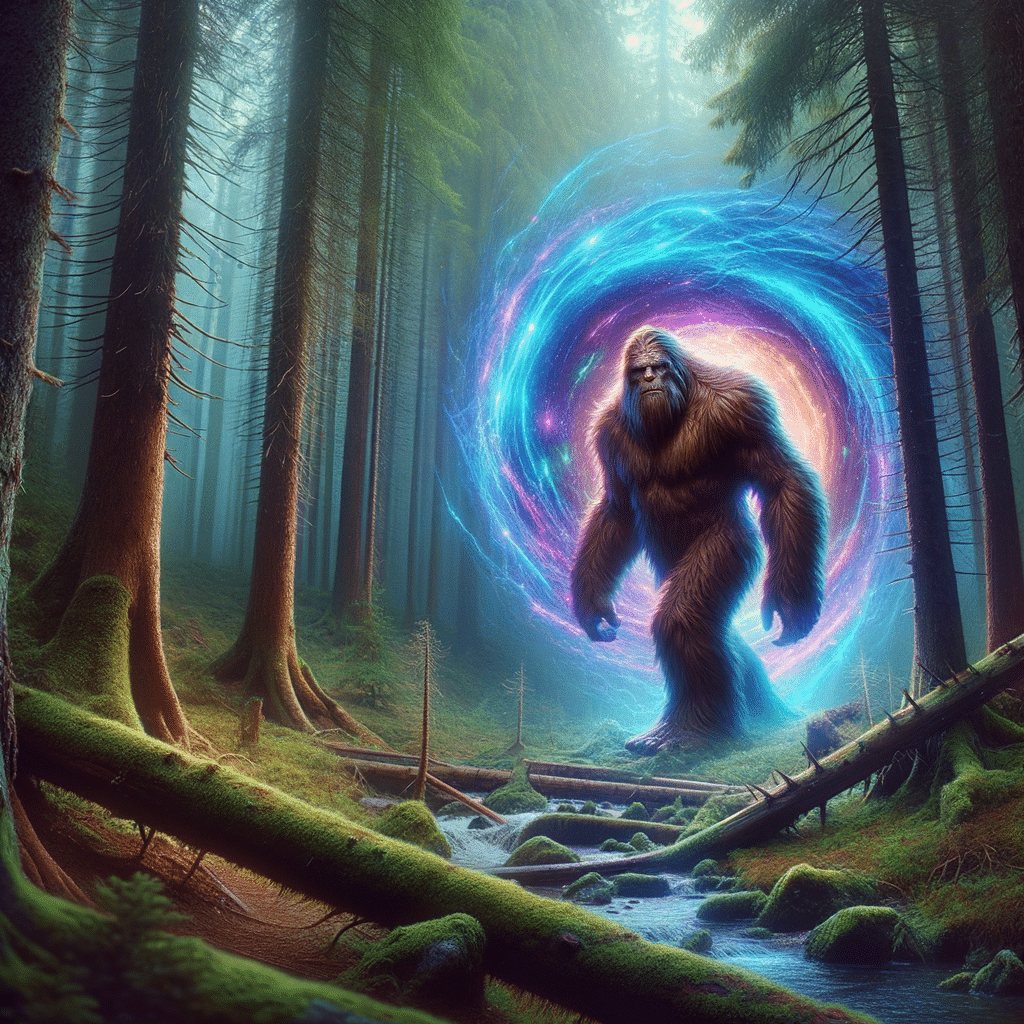
Is Bigfoot a fae creature? Would this account for Bigfoot’s disappearance?
For years, Bigfoot has been a part of North American folklore, captivating researchers and causing debate within the scientific community. Bigfoot has drawn a lot of attention due to its enigmatic nature and humanoid appearance, and its existence has been the subject of numerous theories. In contrast, fae creatures have their roots in European folklore. People frequently portray them as enchanted creatures with extraordinary abilities, like the capacity to vanish at will. This essay aims to explore the unexplored possibility of Bigfoot being a faerie by drawing comparisons between the two, highlighting their potential connections to portals and their swift disappearance.
Similarities
The primary similarity between Bigfoot and Fae is that they are both enigmatic and elusive. Both are creatures that avoid direct contact with humans and leave behind subtly cryptic signs of their presence. There are many stories about Bigfoot tracks that appear and then inexplicably disappear, and there are stories about the Fae that appear and then mysteriously disappear, usually with a shimmer or glimmer. These shared characteristics point to a possible relationship between the two.
Like Fae, Bigfoot is renowned for having a close relationship with nature. Similar to how Fae are represented as the protectors of waterways and woods, Bigfoot encounters are virtually solely limited to the outdoors. People regard them as secretive woodland protectors, just like their Fae cousins.
People often perceive both animals as playful due to their frequent pranks on unsuspecting individuals who cross their paths. Either by shifting objects or by simply vanishing into thin air, Bigfoot and the Fae appear to take pleasure in confusing humans while being elusive.
It is believed that bigfoot and the fae are present everywhere. However, depending on where you travel, they go by a variety of names, despite their widespread fame. For instance, some cultures refer to bigfoot as a sasquatch or yeti, while others refer to it as a skunk ape or yowie. Similar to this, there are many different names for the fae in different cultures: goblins, leprechauns, fairies, and more.
This variance in names is a reflection of both cultural disparities and the distinctive ways that these animals appear in regional folklore. For example, although some myths paint Bigfoot as a fearsome creature that hides deep within mountainsides and forests, others show him as a kind giant that guards wayward hikers and keeps wildlife safe.
In the same vein, representations of the fae differ greatly depending on region and culture. Fairies have a significant role in Celtic mythology in Scotland and Ireland, where people view them as kind, magical beings that assist those in need. However, other cultures view them with mistrust, if not fear, due to their reputation for cunning and mischief.
Bigfoot is elusive, and the Fae’s well-known capacity for disappearing and reappearing resonates well with this trait. Bigfoot sightings are frequently sporadic, with the monster disappearing almost as quickly as it appears. This has sparked a multitude of beliefs, including the possibility that Bigfoot, akin to the Fae, possesses the mystical ability to vanish at will.

Another interesting link is the idea of glamor in Fae legend, which enables them to manipulate human perception or become invisible. With this skill, Faeries can also confuse or delight people as they please. Putting this idea to use with Bigfoot offers an alternative viewpoint. Could Bigfoot employ a similar tactic to manipulate perceptions, surfacing when it desires attention and vanishing when it wishes to avoid disturbance?
Similar to fae encounters, bigfoot sightings often evoke an unexplained sensation that the creature’s presence distorts reality or inhabits an ethereal place. Witnesses describe a heavy, ominous atmosphere, and frequently there is an eerie silence in the surrounding forest, even with regard to animal motions and sounds. This may suggest that Bigfoot is essentially magical or metaphysical in nature, like other fae entities—a being that partially inhabits our natural world.
Witnesses to Bigfoot often describe experiencing zapping. This is the point at which Bigfoot paralyzes, confuses, and instills fear in humans. Does this faerie have a talent for glamour?
Portals
The idea of portals, or entryways to alternate realms, is one of the more ethereal aspects of Fae folklore. Natural features such as ponds, trees, and stones frequently connect these portals. They have the ability to fully vanish from the human world or swiftly travel enormous distances by stepping through these portals.
Witnesses to several Bigfoot encounters are perplexed by the creature’s mysterious and abrupt disappearance. Is it possible that similar gateways exist to explain this? Is it possible that Bigfoot, akin to the Fae, is utilizing these portals as a means of escape, an entrance into a realm beyond our reach, or both? This proposal could potentially provide a plausible explanation for the mysterious disappearances of Bigfoot, despite the need for further proof.
It defies logic to say that Bigfoot cannot be found in this instance. Why, given reports of bigfoot sightings worldwide, is it impossible to locate a specimen? Scientific research has made available hundreds of specimens of even the most elusive mammal in the world—the little wolverine. However, there is never evidence of an eight-foot-tall giant with a wide geographic range. If Bigfoot were a fae species, we could explain this issue.
Conclusion
The similarities between Bigfoot and Fae, their possible capacity to alter human perception, and the idea of portals make for an intriguing possibility, even if the relationship between them is still purely hypothetical. At the very least, investigating the possibility that Bigfoot is a Fae creature could transform our perception of this mythical creature and take folklore and cryptozoology to new and thrilling heights. But like these elusive beings, the truth remains hidden for the time being in the shadow of the unknown.
References
Alexander, S. (2014). Fairies: The Myths, Legends, & Lore. Simon and Schuster.
Briggs, K. M. (2002). The fairies in tradition and literature. Psychology Press.
Davenport, H. M. (2020). The changing face of folkloric transmission: bigfoot and the American psyche. Master of Arts in American Studies, Montana State University.
Fitch, M. E. (2013). Paranormal nation: Why America needs ghosts, UFOs, and bigfoot. Bloomsbury Publishing USA.
Sugg, R. (2018). Fairies: A dangerous history. Reaktion Books.



Leave a Reply