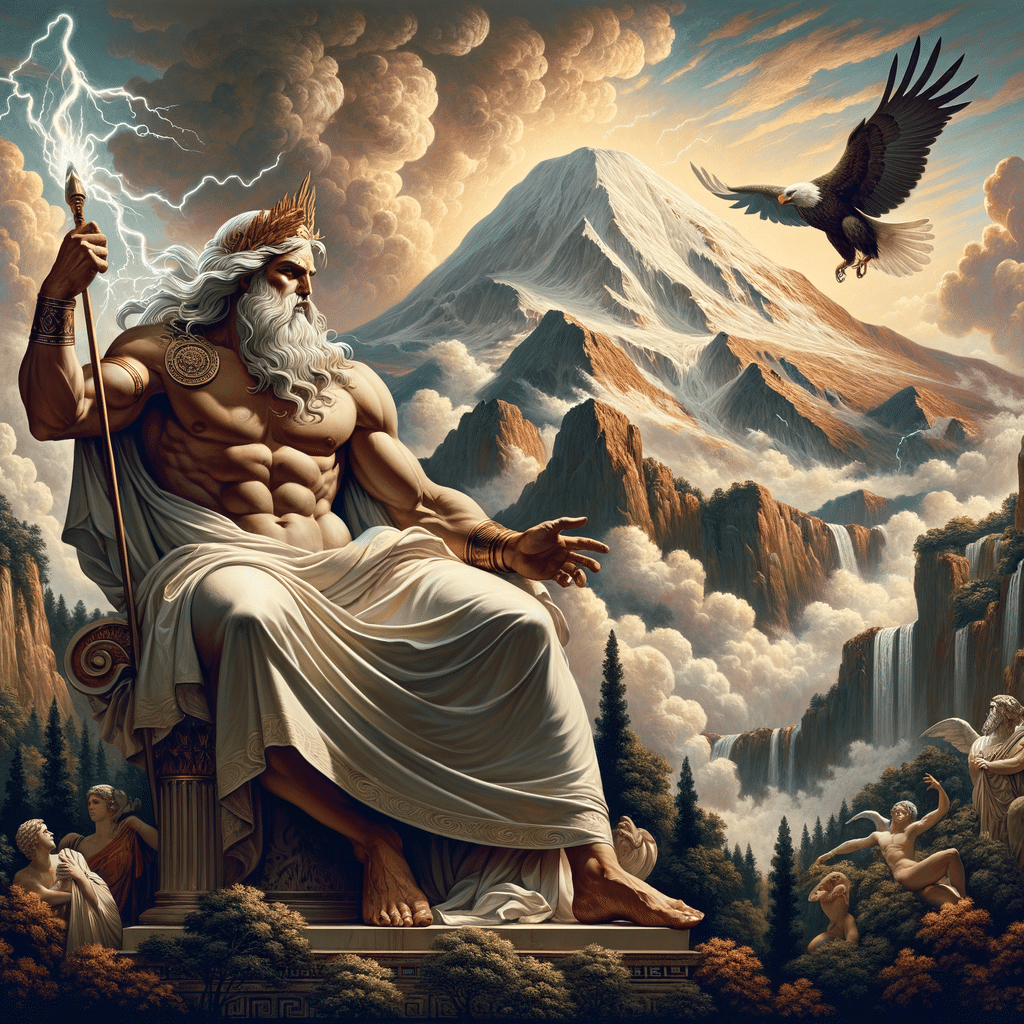
Long ago, in ancient Greece, men believed in mighty gods. Some people still believe in these deities and worship them in modern times.
The mythology of ancient Greece paints a vivid picture of a world governed by divine forces, each with distinct personalities and domains. At the center of this cosmic drama stands the pantheon of the twelve Olympians, a group of deities whose narratives have shaped the values, art, and literature of Western civilization. This video delves into the vibrant tableau of these gods, exploring their origins, characteristics, and the roles they played in both the divine and mortal worlds.
The Olympian pantheon represents the most influential deities in Greek mythology, residing on the mythical Mount Olympus.

Before the Pantheon
The Titanomachy stands as a pivotal event in Greek mythology, encapsulating the fierce battle between the younger Olympian gods and their predecessors, the mighty Titans. This legendary conflict sparked an era of transformation and power shift within the divine realm, ultimately resulting in the overthrow of the older deities by their ambitious descendants.
According to ancient accounts, this epic struggle originated from a deep-rooted tension between Zeus, leader of the Olympian gods, and Cronus, one of the Titans who ruled over Mount Othrys. Fueled by his insatiable hunger for dominion and his desire to prevent any potential threats to his reign, Cronus resorted to devouring each of his children upon birth.
However, fate had other plans in store. Aided by Gaia (Mother Earth) and Uranus (Father Sky), Rhea – Cronus’ wife – managed to save her sixth child from this gruesome fate. Named Zeus, he was hidden away on Crete until he reached maturity under Gaia’s watchful eye.
As Zeus grew stronger and more determined to challenge his tyrannical father’s rule, he gathered allies among both fellow Titans who were dissatisfied with Cronus’ oppressive regime and powerful beings such as Cyclopes and Hecatonchires imprisoned beneath Tartarus. United against a common enemy known for their immense strength but also arrogance towards mortals like Prometheus or Epimetheus , they formed a formidable coalition that brought Cronus down and brought the Olympian Gods to power.
Each Olympian wielded control over specific aspects of human life and the natural world, their personalities as varied as their domains. Collectively, they formed a divine council that presided over the cosmos, interweaving their wills with the fate of humanity.
Mount Olympus, the fabled abode of the gods, stood tall and proud as a symbol of divine authority and serenity. This majestic mountain, reaching towards the heavens and shrouded in clouds and mystery, possessed an ethereal beauty that captivated all who beheld it. It was whispered among mortals that this sacred peak was impervious to the whims of weather, perpetually enveloped in a gentle spring-like climate that provided a harmonious sanctuary for the gods to dwell in eternal peace.
However, Olympus transcended mere physicality; it existed not only as a tangible space but also as an intangible realm where abstract ideals converged. Within its celestial summit resided concepts of power, justice, and beauty – inseparable entities that intertwined with one another like threads woven through a tapestry. Here at Mount Olympus, these lofty principles found their ultimate expression.
Zeus
Originating from the union of the Titans Cronus and Rhea, Zeus is a central figure in Greek mythology. As the king of the gods, he holds immense power and authority over all other deities. His dominion extends to the skies, where he reigns as the supreme ruler. Representing justice and law, Zeus embodies moral order and ensures that it is upheld throughout both divine realms and mortal existence.
Zeus’s ascent to power was not without struggle. He led a revolt against his tyrannical father, Cronus, who had swallowed his siblings at birth to maintain sole control over the universe. With cunning strategy and sheer strength, Zeus successfully overthrew Cronus, liberating his fellow Titans from their oppressive rule.
Following this victorious uprising, Zeus took on the formidable task of dividing up the vast expanse of creation among his siblings. In an act of fairness befitting his role as arbiter of justice, he apportioned different domains to each god or goddess while reserving for himself dominion over heavens – symbolizing his lofty position in celestial hierarchy.
However awe-inspiring Zeus may be as a divine being; he possesses a multi-faceted personality shaped by wisdom mingled with occasional flaws. While renowned for upholding justice with unwavering resolve on Mount Olympus’ grand stage, he has also been entangled in various romantic affairs outside of wedlock – both with immortals and mortals alike – resulting in numerous offspring who would go on to become legendary figures.
Hera
Hera, the queen of the Olympians and wife of Zeus, held a prominent position in Greek mythology as both a daughter of Cronus and Rhea. Revered as the goddess of marriage and childbirth, she embodied the sacred bond between spouses and upheld the sanctity of family life. Known for her maternal qualities, Hera’s personality was not without its darker side, characterized by jealousy and an inclination towards vengeance, especially when it came to Zeus’s numerous paramours and their offspring.
One cannot overlook Hera’s significant role in shaping ancient legends through her involvement in key events such as the Trojan War. During this epic conflict that consumed Greece for years on end, Hera stood firmly beside her fellow Greeks, offering unwavering support to their cause against Troy. Her strategic guidance proved invaluable to both mortal warriors and divine allies alike.
Moreover, beyond her influence on major battles like Troy, Hera also played a crucial part in championing legendary heroes throughout Greek mythology. One notable figure who benefited from her patronage was Jason—the renowned leader of the Argonauts. As he embarked on his perilous quest for the Golden Fleece alongside his crewmates aboard the Argo ship, it was under Hera’s watchful eye that they navigated treacherous waters with relative safety.
Poseidon
Poseidon, the mighty brother of Zeus and Hera, ascended to become the revered deity of vast seas, tumultuous storms, devastating earthquakes, and majestic horses following the downfall of the formidable Titans. Known for his fierce temperament and ardent rivalry with Athena over dominion of Athens, Poseidon commanded immense reverence from seafarers and bustling cities dependent on maritime commerce. His indelible mark on Greek mythology is exemplified by two remarkable contributions: his pivotal role in bestowing mankind with the awe-inspiring creature known as horse and his integral involvement in the epic saga of Odysseus.
As god of the seas, Poseidon’s domain encompassed not only its tranquil depths but also its unforgiving tempests that could unleash unparalleled fury upon anyone who dared to challenge them. Sailors looked up to him as their protector during treacherous voyages, invoking his name for safe passage amidst turbulent waters. Cities situated along coastlines sought solace in Poseidon’s benevolence as they thrived on trade routes traversing these expansive bodies of water.
Demeter
Demeter, known as the goddess of agriculture and the harvest, is not only a sibling of Zeus but also possesses a gentle and nurturing personality. However, her serene nature is often eclipsed by overwhelming grief caused by the abduction of her beloved daughter Persephone by Hades, god of the Underworld. This heart-wrenching event serves as the catalyst for the cyclical changes in seasons that Earth experiences each year.
The profound connection between Demeter’s emotions and nature’s cycles lies at the core of Greek mythology. As Persephone departs for the Underworld during winter months, Demeter mourns her absence with an indescribable sorrow that blankets every corner of Earth. The desolation she feels leads to barren fields and lifelessness across vast landscapes.
Conversely, when Persephone returns from her time in Hades’ realm during springtime, Demeter is consumed with unbridled joy. Her genuine happiness erupts into bursts of vibrant blossoms and thriving crops that blanket our surroundings in vivid colors.
Athena
Athena, the powerful goddess of wisdom, war, and crafts, has a fascinating origin story. As one of the Twelve Olympians, she emerged fully grown and armored from the head of her father Zeus. Unlike her reckless and impulsive half-brother Ares, Athena’s approach to warfare is strategic and defensive in nature.
Renowned for her unparalleled wisdom and rationality, Athena symbolizes intellect and reason among the gods. She holds a special place as the patroness of Athens, bestowing upon it an invaluable gift—the sacred olive tree. This city became synonymous with knowledge, learning, and civilization under her watchful eye.
Throughout Greek mythology, Athena played an integral role in shaping heroic tales. Her benevolent influence can be seen through numerous instances where she aided legendary heroes such as Perseus on their perilous quests.
Apollo
Apollo, the son of Zeus and Leto, is a multifaceted deity in Greek mythology. Revered as the god of the sun, music, prophecy, and healing, Apollo’s influence extends to various domains that encompass both light and darkness. Known for his radiant persona reminiscent of artistic brilliance, he also embodies the somber aspects associated with plague and retribution.
As a patron god of music and poetry, Apollo not only inspires musicians but also presides over harmonious melodies that resonate within human souls. Through his musical prowess and enchanting lyre playing skills – an instrument he cherished dearly – he instills joy while simultaneously evoking profound emotions among listeners.
Furthermore, as a healer god who possesses immense restorative powers attributed to medicine and medical knowledge.
Artemis
Artemis, the formidable twin sister of Apollo, is not only known for her role as the goddess of the hunt, but also as a guardian of the wilderness and childbirth in ancient Greek mythology. Her unwavering dedication to protecting the young and upholding virtues like chastity and independence make her a revered figure among mortals and deities alike. With a fierce and untamed spirit that reflects the wild yet liberating facets of nature itself, Artemis embodies both strength and grace.
One prime example of Artemis’s relentless punishment can be seen in Actaeon’s tale—a story that warns mortals about challenging the boundaries set by gods. Actaeon was an unfortunate hunter who inadvertently stumbled upon Artemis while she bathed in a secluded pool with her nymphs. Enraged by his audacity, Artemis transformed him into a stag as punishment for witnessing such an intimate moment without permission.

Ares
Ares, the son of Zeus and Hera, truly embodies the raw and savage essence of warfare. Unlike Athena, who approaches battles with discipline and careful planning, Ares revels in the chaos that ensues on the battlefield. His unyielding personality is drawn to the exhilaration found amidst bloodshed and destruction.
However, it is important to note that Ares’ actions often lack strategic thinking, leading him down a path of unnecessary conflict.
Moreover, Ares frequently finds himself entangled in confrontations with Hercules – clashes that exemplify his impulsive nature. These encounters serve as reminders of his inclination towards aggression rather than employing clever tactics or considering long-term consequences.
Ares thrives on disorder and combat without much thought for what lies ahead.
Aphrodite
Aphrodite, the mesmerizing goddess of love, beauty, and procreation, emerges from the enchanting sea foam that arose when Cronus ruthlessly separated Uranus from his genitals. With an ever-changing temperament that embodies the paradoxical essence of love – gentle yet capable of wreaking havoc – Aphrodite captivates all who encounter her presence.
Although she is renowned for a myriad of accomplishments, none surpasses the timeless tale of her pivotal role in the fateful Judgement of Paris. This momentous event set into motion a chain reaction that ultimately ignited the infamous Trojan War, forever altering the course of history. Notorious for her relentless pursuit of desire and pleasure, Aphrodite’s allure proves irresistible to both gods and mortals alike.
Hephaestus
Hephaestus, the son of Hera and possibly conceived without a father, is a prominent figure in Greek mythology. Revered as the god of fire, metallurgy, and craftsmanship, he possesses an extraordinary talent for creating intricate works of art. Despite his physical imperfections, Hephaestus’s personality shines through with his remarkable creativity and exceptional craftsmanship.
One of Hephaestus’s most notable accomplishments lies in his mastery of forging weapons for the gods. With unmatched skill and precision, he crafts powerful weapons that are essential to their divine battles and conflicts. The gods rely on him to provide them with these mighty tools that ensure victory in their epic struggles.
Beyond weapon-making, Hephaestus is renowned for constructing marvelous automata or self-operating machines. These wondrous creations captivate all who witness them with their intricacy and lifelike movements. From golden servants to animated statues that imitate human behavior flawlessly, Hephaestus’s automata showcase not only his technical expertise but also his boundless imagination.
Hermes
Hermes, the son of Zeus and the nymph Maia, is not only known as the fleet-footed messenger of the gods and guide of souls to the underworld but also possesses a captivating personality that is often described as clever, mischievous, and resourceful. His cunning nature allows him to partake in various ventures that have shaped Greek mythology.
One notable accomplishment attributed to Hermes is his invention of the lyre, an instrument with strings stretched over a tortoise shell. This creation revolutionized music during ancient times and continues to inspire musicians across generations.
Dionysus
Dionysus, the son of Zeus and the mortal Semele, holds a prominent position among the Twelve Olympians as the god of wine, ecstasy, and theater. His complex character embodies a unique duality – he is both a source of joy and an instigator of madness. This dichotomy mirrors the captivating power that Dionysus exudes over mortals and immortals alike.
One cannot fully comprehend Dionysus without acknowledging his significant contributions to ancient Greek society. Among his numerous accomplishments, two stand out prominently: spreading the cultivation of vines and establishing the sacred rituals known as the Dionysian Mysteries.
By introducing vine cultivation to mankind, Dionysus forever altered their relationship with nature. Through this gift, he bestowed upon humanity not only an intoxicating beverage but also a symbol of fertility and abundance.
However, it was through the establishment of the enigmatic Dionysian Mysteries that Dionysus truly showcased his divine influence on human existence. These secret ceremonies celebrated liberation from societal constraints by embracing ecstatic experiences linked to wine consumption and ritualistic performances in honor of their god.
Conclusion
The twelve Olympians represent archetypal qualities and human conditions, from the authority of Zeus to the artisan skill of Hephaestus. Their interactions, conflicts, and narratives served to explain the natural phenomena, social institutions, and psychological drives observed by the ancient Greeks. The Olympians’ stories were not only religious texts but also moral and didactic tales that provided guidance and reflection for individuals and the community.
The twelve Olympians remain an indelible part of Western cultural heritage. Their tales of power, passion, and consequence continue to resonate, reflecting the complexities of the human condition. The Olympian gods, with their distinct personalities and spheres of influence, served as both embodiments of natural laws and mirrors of human society. Their myths, preserved through literature and art, provide a timeless window into the ancient Greek understanding of the world, reminding us of our place within a universe replete with both divine order and capricious whimsy.




Leave a Reply