Dark Pixies: Key Points
-
Dark pixies are malevolent variants of traditional pixies that actively seek to cause genuine harm and suffering rather than engaging in playful pranks.
-
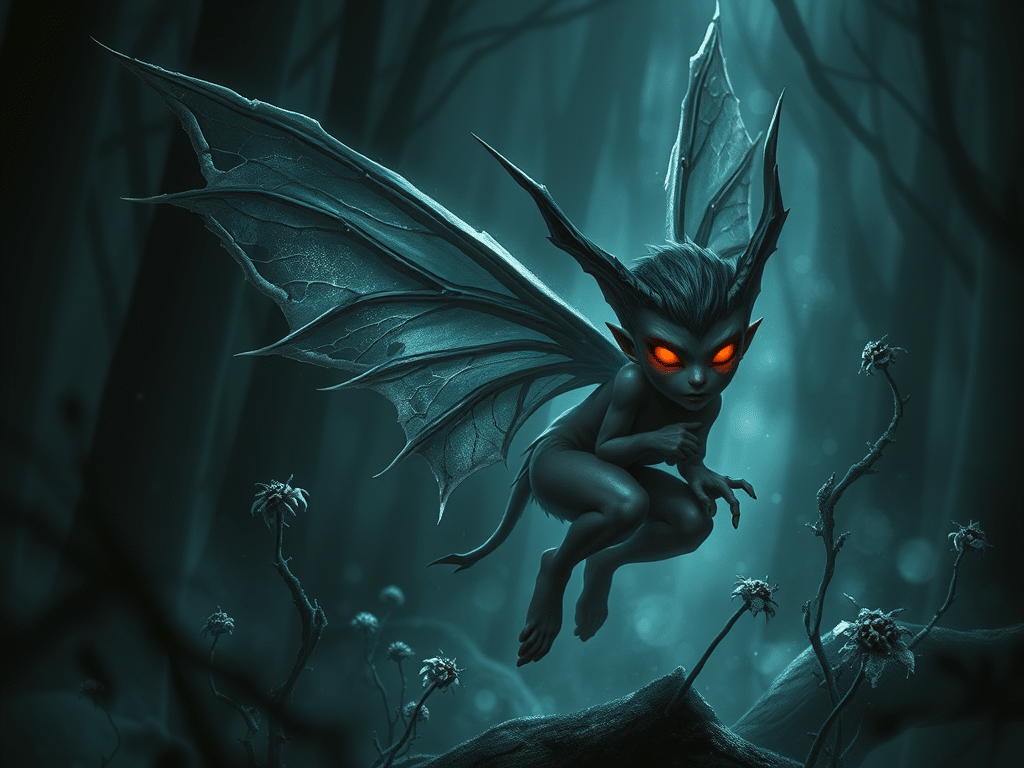
Physically, dark pixies have ashen skin, glowing red or green eyes, tattered bat-like wings, and their presence causes coldness and dimming light.
-
Dark pixies poison food, blight crops, form alliances with other malevolent fae, and gain strength from human suffering and negative emotions.
-
Traditional protections include iron objects, salt barriers, avoiding their territory at night, never accepting their gifts, and maintaining calm without showing fear.
-
Scholars interpret dark pixies as projections of human fears about nature, cautionary moral figures, or representations of shadow aspects within the human psyche.
-
Dark pixie folklore has influenced cultural attitudes throughout history and continues to evolve in modern contexts as metaphors for environmental themes and personal shadow work.

Introduction
There are many mysterious beings in the world of faerie folklore, but dark pixies are the most misunderstood and possibly dangerous. People have been fascinated by their more friendly cousins, the pixies, through stories of mischief and small spells. But dark pixies are a darker side of pixie nature that has been a part of myth for hundreds of years. These shadowy beings are a warning that the faerie world has its own set of rules, and in the blink of an eye, it can go from being fun to being dangerous. To understand what dark pixies are like, you must first look at pixie mythology as a whole and then look at the specific traits that make these darker versions of their kind different.
Pixies have their roots in English folklore, where they were often connected to the fey or fairy worlds and were thought to be both good and bad (Altiok, 2024; Masson, 2016). Folklore stories about them stress how they are connected to nature, which makes it seem like they have magical powers that can change people’s lives. So, the difference between light and dark pixies can be seen as a metaphor for the human experience, which is made up of both happiness and sadness, creation and destruction (Starrs, 2014; Masson, 2016).
Traditional Pixies Versus Dark Pixies: Physical and Behavioral Distinctions
In classic fairy tales, pixies are small supernatural beings that live in the countryside, especially in Celtic areas like Cornwall, Devon, and parts of Ireland and Scotland. Most of the time, these creatures are shown to be between a few inches and a foot tall, with delicate, airy features and natural materials like flower petals, leaves, and spider silk used to decorate them. Regular pixies are known for being unpredictable. They play harmless jokes on humans by directing tourists astray, tying horses’ manes up in complicated knots at night, or moving things around in people’s homes to make them confused. Even though traditional pixies like to get into trouble, they are not seen as evil. Instead, they act based on their own whims and are usually placated by giving them small gifts like milk, honey, or shiny things. Their magic is mostly fake and small. It can make dancing lights in the forest, cause small amounts of confusion, or give small gifts to people who treat it nicely.
Dark pixies, on the other hand, are a twisted or corrupted version of a normal pixie. Folklore experts disagree on whether dark pixies are really changed regular pixies or a whole different species. These things are different because they don’t follow the normal pixie code of harmless mischief. Instead, they have really bad goals toward people and other animals. Lighter pixies might lead a traveler on a confusing but ultimately safe side trip. Dark pixies, on the other hand, are known to lead people into really dangerous places like bogs, cliff edges, or the homes of more dangerous fairies. In folklore, dark pixies often show up in stories about broken vows, betrayal, or the destruction of natural areas. This suggests that their darkness may come from being harmed by bad people or from choosing to be evil. According to some beliefs, dark pixies are made when normal pixies are severely insulted, exposed to iron for a long time, or see their sacred groves and homes destroyed.
The differences in appearance between light and dark pixies are noticeable and serve as warnings to people who come across them. People usually say that dark pixies have pale, grayish, or midnight-blue skin instead of the healthy, glowing skin of normal pixies. Their eyes also often glow a disturbing red, purple, or sickly green. When you can see their wings, they don’t look like the tiny dragonfly or butterfly wings that you usually see with pixies. Instead, their wings look like they’ve been torn or eaten by moths. Dark pixies don’t like the bright natural decorations that their friendly cousins wear. Instead, they like to wear worn-out clothes that are made from dead plants, dark mosses, or even what looks like shadow itself. Some stories say they have sharper features, like teeth that stick out and nails that look like claws. But it’s unclear if this is their natural look or a manifestation of their evil energy. People say that when dark pixies are around, the air gets cold and stuffy, and natural light seems to dim. This appearance is different from regular pixies, who are thought to be connected with the magical glow of twilight and moonbeams.
Dark pixies are not just mean; they act differently than other pixies. Dark pixies are said to poison food sources, ruin crops, and make animals sick and kill them as a joke. Regular pixies might steal a loaf of bread as a joke. Instead of just being mischievous, their relationship with humans is basically hostile; they enjoy causing fear, pain, and misfortune more than just confusion or mild inconvenience. Dark pixies are known to make evil deals with other dark fae creatures and can be found with redcaps, boggarts, or Unseelie Court members. On the other hand, regular pixies tend to be more social and only hang out with other normal pixies. They are most active when the moon is at its darkest. It is said that they get stronger when people suffer, when feelings run high, and when natural areas are harmed. When you try to deal with or appease normal pixies, you can use courteous manners and gifts. But dark pixies don’t respect these things and might even see them as chances to do more harm.

John Bauer’s illustration of Alfred Smedberg’s “The Seven Wishes” in Among Pixies and Trolls.
Protective Measures and Strategies for Dealing with Dark Pixies
Several traditional ways to stay safe have been passed down through folklore for people who find themselves in dark pixie land or think they have drawn the attention of these evil beings. Most people still say that iron is the best defense because dark pixies are vulnerable to it, though some stories say they have developed a slightly higher tolerance than other fairies. To protect yourself, you can carry an iron nail in your pocket or hang iron horseshoes above doorways. People also think that salt rings and lines work as barriers because dark pixies and most fae can’t cross pure salt. Sprinkling salt on doorways and window sills may also keep them out of homes. Different traditions have different ideas about how well religious symbols and prayers work. Some say that dark pixies are harder to protect against these things than normal fae, but true faith still has power. Most importantly, you should never accept gifts from dark pixies, eat or drink anything they offer, or make any kind of deal or agreement with them. This is because their deals are meant to keep humans in slavery or worse.
To deal with dark pixies more effectively, one must also understand how they act and stay away from scenarios where they could easily affect one. At night, especially during the new moon, travelers shouldn’t take shortcuts through woods or meadows. They should also avoid following strange lights or sounds that call from the dark, as these are often dark pixie traps. People who think they are being led wrong by dark pixies have been known to turn their coat inside out to break their glamour and confusion magic, though such actions may make them even more angry. Dark pixies are more interested in people who are confused and scared, so if you are polite but strong, say your name and what you’re there for, and stress that you are being protected, they might lose interest. If someone is really stuck or surrounded, they might be able to get help by calling on stronger, more friendly fae, their ancestors, or even normal pixies, since even mischievous pixies don’t always agree with their darker cousins’ behavior. It’s important to stay cool and not show fear, because dark pixies feed on it and get stronger when they’re around it.
Scholarly Interpretations and Contemporary Relevance of Dark Pixie Folklore
In the larger setting of faerie mythology, scholars and folklorists have come up with different ideas about what dark pixies are like and whether or not they exist. One popular theory says that dark pixies are the subconscious projections of people’s fears about nature’s dangerous parts. They are thought to represent the real threats that wilderness posed to historical communities that relied on safe travel and reliable crops. In a different view, dark pixies are used as warning characters in moral tales to show what happens when people disrespect nature, break promises, or let bad feelings like anger and cruelty take over their lives. Some researchers believe that dark pixies first appeared in folklore during times of social and environmental change, as a sign of how nature reacted to people trying to take over and abuse it. From a Jungian perspective, dark pixies might reflect the shadow sides of the human mind, the darker urges and destructive tendencies that live alongside our ability to be happy and creative. Such an interpretation would make them more like psychological archetypes than real people. Newer ideas about dark pixies have looked at them through the lens of dualistic worldviews, saying that they help to keep moral limits by showing clearly evil supernatural beings in contrast to good or neutral ones.
Dark pixies have made their way into modern society through books, movies, and video games, among other things. These updated versions often focus on the darker parts, exploring ideas of power, independence, and identity. For example, the characters in witches and magical realism works often show the conflict between the magical and the everyday, as well as the problems that come with empowering women (Davies, 2016; Wang & Huang, 2024). We can see how pixie folklore is changing over time in feminist discussions and in modern versions of fairy tales, where female characters who are usually portrayed as victims are changed into strong and complicated women. These new readings question the old stories and look at how people can have control in magical but dangerous worlds (Connor, 2023; Masson, 2016). So, dark pixies can represent taking back control, and their mischievous nature can be rethought in light of current feminist ideas.
Over time, the folklore surrounding dark pixies has significantly influenced people’s perceptions of the supernatural, nature, and morality. In the Middle Ages and Early Modern Periods, believing in dark pixies made people really afraid to travel at night and brought people together through shared routines and practices for safety. Their beliefs influenced the way people farmed. Farmers would make offerings and perform rituals to attract good spirits for assistance and to keep bad spirits, such as dark pixies, away from their fields. In some places, people who were accused of witchcraft were sometimes charged with having relationships with dark fae animals or changing into them. These developments meant that dark pixie myths and witch trials were linked. The stories were important for society because they taught kids to stay away from dangerous areas, stay home after dark, and respect nature. They also helped people understand terrible things that happened in their community, like crops failing, sudden illnesses, or accidents. Dark pixies have been the inspiration for many works of literature and art, from Gothic fairy tales to modern dark fantasy. They were meant to be different from the more wholesome fairy images that came about in the Victorian era.
These days, the idea of dark pixies keeps changing and becoming important in modern society and thought. Dark pixies have been used as bad guys or complicated anti-heroes in urban fantasy and paranormal fiction, which often deal with themes of corruption, salvation, and how the lines between good and evil aren’t always clear. Some environmental groups have used dark pixie images to show how nature can fight back against human damage, but this use is still controversial and not widely used. In therapy and self-help, facing your “dark pixies” is seen as a metaphor for dealing with harmful patterns and urges. This psychological view of dark pixies as symbols of your shadow self and repressed negativity has found traction. Dark pixie mythology has a complicated relationship with neo-pagan and modern witches. Some practitioners try to work with or please these beings, while others only focus on protecting themselves from them. Dark pixie stories have taken on new forms in the digital age thanks to online communities, role-playing games, and collaborative storytelling. The idea keeps changing to reflect modern fears and interests in the areas between nature and society, as well as between good and evil.
Several works show how pixie folklore can be darker. Authors often change the plots of traditional stories to explore psychological themes by putting characters in situations that aren’t always clear-cut. These characters’ exploration of gothic aspects makes us think deeply about social norms and human psychology (Piatti-Farnell, 2017; Ez-zahouani et al., 2022). For instance, stories with dark pixies often show a society that is struggling with power, independence, and justice, with a focus on the results of inaction or unfair treatment. The darker parts of pixie tales are also present in video games and other digital media. Modern video games, like the Bayonetta series, show how historical and mythical themes interact with each other in complicated ways, giving traditional stories more than one ending (Davies, 2016; Wang & Huang, 2024). These images keep players interested by challenging their ideas of what is right and wrong and encouraging them to explore themes that blur the lines between right and wrong, which is typical of dark pixies who are both magical and dangerous.
Conclusion
Dark pixies have been around for a long time in folklore. They represent people’s need to understand and organize the physical and mental threats that exist in the world around them. These shadowy beings are a warning that not all supernatural beings are good or even neutral, and the faerie realm has both wonderful and dangerous things to see. Dark pixies continue to fascinate our imaginations because they represent the darker sides of magic and the real risks of working with forces that are beyond our control. This conclusion is true whether we see them as real spiritual beings, psychological projections, or cultural symbols. As long as people are thinking about right and wrong, the power of nature, and the shadows that live in the world and within us, dark pixie folklore will be relevant. It will always warn of the dangers between the mundane and the magical, but it will change with each generation’s fears and interests.
References
Altiok, R. (2024). Unveiling Ken. M/C Journal, 27(3). https://doi.org/10.5204/mcj.3067
Connor, W. (2023). Making It Magical. M/C Journal, 26(5). https://doi.org/10.5204/mcj.3006
Davies, E. (2016). <em>Bayonetta</em>: A Journey through Time and Space. M/C Journal, 19(5). https://doi.org/10.5204/mcj.1147
Ez-zahouani, B., EL Kharki, O., Kanga Idé, S., & Zouiten, M. (2023). Determination of Segmentation Parameters for Object-Based Remote Sensing Image Analysis from Conventional to Recent Approaches: A Review. International Journal of Geoinformatics, 19(1), 23–42. https://doi.org/10.52939/ijg.v19i1.2497
Masson, S. (2016). Fairy Tale Transformation: The Pied Piper Theme in Australian Fiction. M/C Journal, 19(4). https://doi.org/10.5204/mcj.1116
Piatti‐Farnell, L. (2017). “The Blood Never Stops Flowing and the Party Never Ends”: The Originals and the Afterlife of New Orleans as a Vampire City. M/C Journal, 20(5). https://doi.org/10.5204/mcj.1314
Starrs, B. (2014). Writing Indigenous Vampires: Aboriginal Gothic or Aboriginal Fantastic?. M/C Journal, 17(4). https://doi.org/10.5204/mcj.834
Wang, C. and Huang, Q. (2024). Design of a Technology-Based Magic Show System with Virtual User Interfacing to Enhance the Entertainment Effects. Applied Sciences, 14(13), 5535. https://doi.org/10.3390/app14135535
Leave a Reply