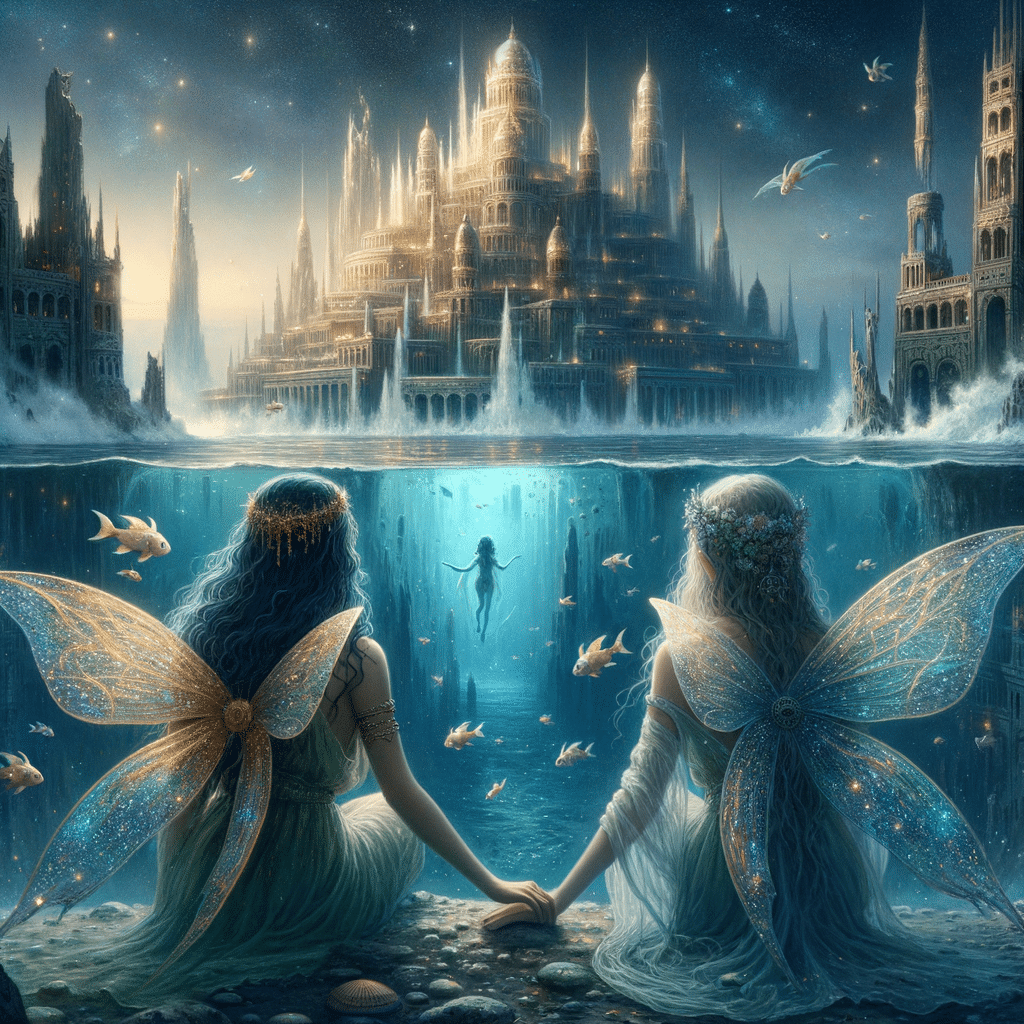
For thousands of years, scholars, mystics, and entertainers have been interested in the stories of faeries and the fall of Atlantis and Lemuria. People assert the existence of these imaginary countries in the past, frequently depicting them as advanced societies that ultimately collapsed. Faeries, believed to have played significant roles both before and after the destruction of these places, form the basis of some of these stories. This essay looks at the link between faerie stories and the mythical cities of Atlantis and Lemuria. It depicts their rise and fall, as well as the faeries’ constant presence in these old stories.

Atlantis
Plato, an ancient Greek philosopher, said that Atlantis was a strong and technologically advanced society that lay beyond the Pillars of Hercules, which are now the Strait of Gibraltar. Legend has it that Atlantis was a perfect society with amazing feats in building, engineering, and running the government. However, spiritual decay and arrogance led to its downfall. Because the Atlanteans were so proud, the gods supposedly sent terrible earthquakes and floods that flooded the island and sank it into the water (Plato, 2008).
People in Atlantis believed that faeries took care of nature and kept it peaceful. People praised these spiritual beings, often referred to as elementals in this context, for their wisdom and magical powers. They were very important to keep the balance between the natural world and Atlantean society. People used to think of faeries as go-betweens between the real world and the heavenly world. They assisted in cultivating plants, purifying water, and maintaining stable weather patterns. Atlantis saw their presence as essential to its health and wealth (Steiner, 1997).
People thought that after the disaster that destroyed Atlantis, the faeries went to live in secret places to mourn the loss of the once-great society they had helped build. According to some myths, they continued to exert a subtle yet significant influence on nature, ensuring that those with good intentions could access the remnants of Atlantean knowledge (Leadbeater, 2023). Several spiritual traditions support this idea, which says that faeries, or nature spirits, work on a frequency that most people are not tuned into, so they do their work alone and in secret.

Lemuria
Another mythical land thought to have lived in the Pacific Ocean is Lemuria, which is also known as Mu. Usually depicted as a more peaceful and spiritual society, Lemuria stands in contrast to Atlantis. According to Churchward (2007), the people who lived there possessed advanced skills in telepathy, healing, and other psychic abilities, and were highly in tune with the Earth’s forces. Many natural disasters, including erupting volcanoes and massive earthquakes, are believed to have destroyed Lemuria. Because of these disasters, the land slowly sank beneath the waves of the ocean, leaving behind only traces of its culture and knowledge (Blavatsky, 1888).
Faeries were closely linked to the spiritual routines and daily lives of the Lemurians. People thought of them as good spirits that helped with healing, connecting with nature, and developing stronger psychic skills. Lemurian people believed that faeries, often depicted as glowing beings with tiny wings, could guide and protect them. Before the destruction, faeries were an important part of life on Lemuria. The Lemurians sent them to communicate with the higher spiritual worlds and used them in rituals to grow sacred plants. It was clear from their appearance that people and nature got along well in Lemuria (Stewart, 1999).
People thought that faeries had gone into hiding in the Earth’s hidden realms after Lemuria fell, just like their Atlantean peers did. But they kept having an effect on nature and the spiritual paths of those who stayed in touch with Lemurian knowledge. According to folklore, the faeries’ advice lived on in subtle ways, helping people keep the spiritual ideas and practices of Lemuria alive (Blavatsky, 1888). For instance, some modern spiritual groups say they can access Lemurian wisdom by talking to these faerie beings. This suggests that there is a line of magical knowledge that goes back thousands of years.
Analysis
The stories about faeries in Atlantis and Lemuria show how people have always believed in magical beings that exist beyond the real world. These stories show how important it is to live in peace with nature, to be spiritually wise, and to understand what happens when people are too proud. Fairies, like the ones in these stories, remind us of how fragile the balance is between people and nature. The fact that they played important roles before and after the destruction of Atlantis and Lemuria supports the idea that ancient civilizations’ wisdom can live on through the subtle influences of the supernatural and the unseen.
Experts examine these legends, uncovering deeper symbolic meanings. Richard Southall (2003) says that faeries are the spiritual forces of nature that people in the past worshiped. The collapse of these societies shows that people have lost touch with spiritual and natural forces, which leads to undesirable things happening. Some people, like Southall, say that the fact that fairy tales have been around for so long shows us how important it is to live in harmony with nature and the spiritual world.
Similarly, W. Y. Evans-Wentz (2003) asserts that faerie tales hold the knowledge of native and ancient cultures, who understood the interconnectedness of all living things. Evans-Wentz’s research shows that faeries are not just made-up creatures; they are representations of natural laws and cosmic laws that people in ancient civilizations like Atlantis and Lemuria knew and honored. So, the loss of these societies is a metaphor for the loss of deep knowledge.
Conclusion
Ultimately, the tales of fairies and the fall of Atlantis and Lemuria provide valuable insights into these enchanted societies. These stories about supernatural beings who watched over and helped ancient societies teach us that harmony, respect for nature, and spiritual knowledge are always important. The inclusion of expert analysis and examples makes the meaning of faeries even clearer, not just as mythical creatures but also as deep representations of nature’s spiritual forces and the lost knowledge that people need to find again.
References
Blavatsky, H. P., & De Zirkoff, B. (1888). The secret doctrine (Vol. 2). Theosophy Company.
Churchward, J. (2007). The Lost Continent of Mu. Adventures Unlimited Press.
Evans-Wentz, W. Y. (2003). The Fairy Faith in Celtic Countries: The Classic Study of Leprechauns, Pixies, and Other Fairy Spirits. Citadel Press.
Leadbeater, C. W. (2023). The hidden side of things. BoD-Books on Demand.
Plato. (2008). Timaeus and Critias. Penguin Classics.
Southall, R. (2003). How to Be a Ghost Hunter. Llewellyn Publications.
Steiner, R. (1997). Atlantis and Lemuria. Health Research Books.
Stewart, R. J. (1999). The living world of Faery. Mercury Pub.

Leave a Reply