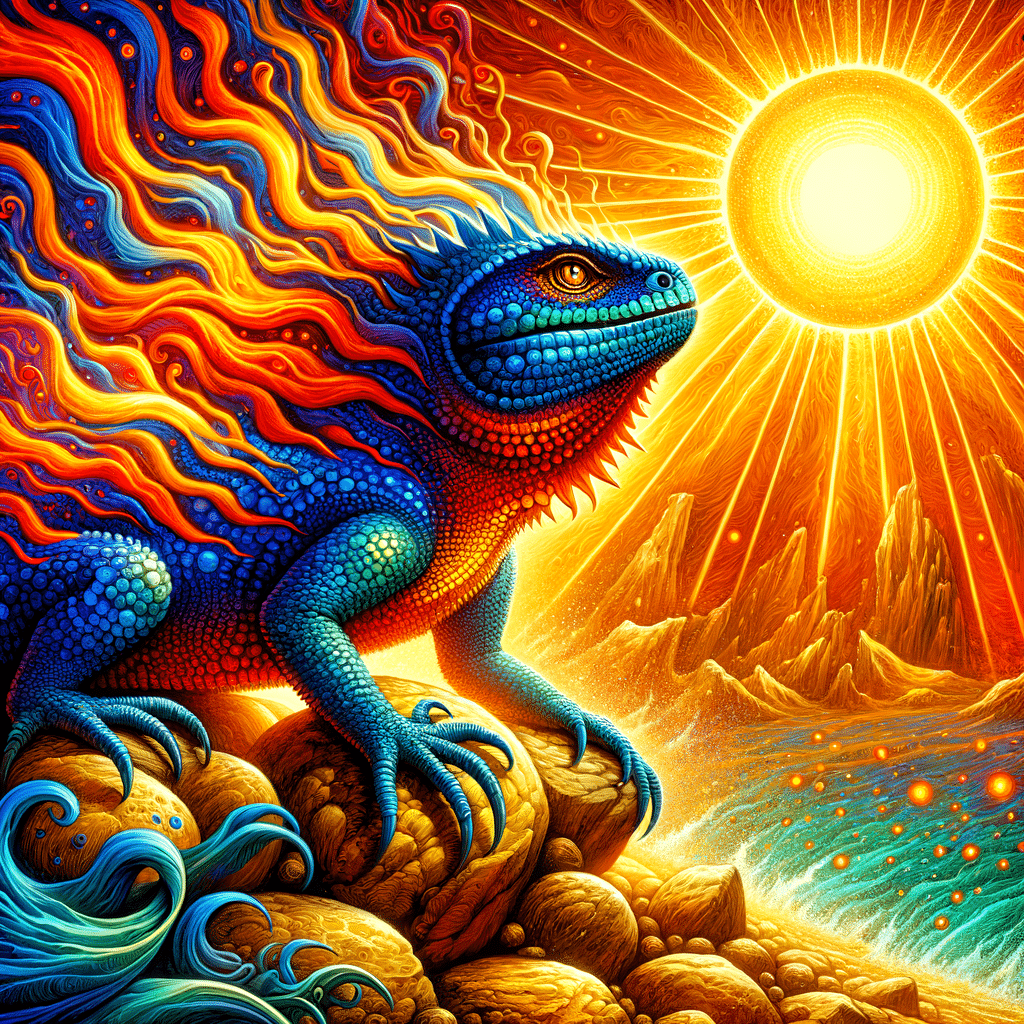
In various historical periods and cultural contexts, lizards have held great symbolic value. In mythology, both old and new, lizards have been connected to kindness, well-being, regrowth, and a host of other things. These ostensibly modest creatures have been assigned positions ranging from guardians to gods. This paper investigates the continued significance of lizards in contemporary interpretations and their complex symbolism in a variety of cultural mythologies.
Narrative of Lizard Symbolism
Many cultures view lizards as enigmatic, silent animals of the moon that feed on the fragile nighttime dew. They are associated with ideas of brightness and enlightenment due to their tendency to enjoy the sun. In an attempt to receive eternal light, the ancient Greeks interpreted the lizard’s sun-seeking habit as an offering to Apollo. According to Egyptian mythology, lizards were symbols of fertility, heat, and heavenly wisdom. Since lizards hibernated over the winter and their emergence was associated with rebirth, the Roman interpretation added dimensions of death and resurrection.
In Australian Aboriginal mythology, the lizard Tarrotarro is a cultural hero and the creator of human society; in African mythology, on the other hand, the lizard is a representation of ancestor spirits. According to Japanese folklore, the lizard changes into a malevolent spirit possessing otherworldly qualities.
In addition, in contrast to the Iranian plant of life, the lizard is considered a creature of darkness in the ancient Persian religion of Mazadaism, which Zoroaster founded.

Indigenous and Global Perspectives
According to Aboriginal Australian mythology, lizards are spiritual representations of ancestors and the land. The Egyptians considered lizards to be knowledgeable and protective creatures that could survive in harsh conditions. Lizards were associated with luck and the cyclical nature of life and death in Greco-Roman mythology.
The Plains tribes’ customs and the Hopi people’s veneration for the Dreamtime symbolism of the lizard demonstrate how important the animal is to Native American traditions as a totem of healing, perception, and spiritual guidance. Asian viewpoints frequently see lizards—like geckos—as lucky charms; the Japanese even believe that they guard dwellings.
Diverse African societies perceive lizards in different ways; some see them as foreboding cunning or bad luck, while others see them as clever omens. Particularly renowned for its versatility and changeability is the chameleon. The Bura tribe of Nigeria has the myth of Agadzagadza. A video version of this tale is embedded at the top of this article and can also be found at Youtube as Agadzagadza, a Bura Myth Story.

Analysis
The global myth surrounding lizard iconography demonstrates a fascinating pattern of respect for and affiliation with the four most fundamental aspects of life—creation, protection, knowledge, and renewal. Because of the cultural narratives and beliefs that have been built around their biological traits—such as skin-shedding and hibernation—lizards have been given a complex and multifaceted meaning. These reptiles act as a mirror, reflecting the health, strength, and pursuit of spiritual enlightenment that are among human concerns and goals.
Conclusion
As a creature of many habitats, lizards have also found a position of diversity in human awareness. Lizards have been immortalized in mythology and cultural symbolism, from the ancient Egyptian deserts to the sacred regions of Indigenous Australia, from the houses of the Greco-Romans to the Native American tribes. They still hold our attention in the modern world, serving as a constant reminder of their significance as ecological indicators and as representations of flexibility and resiliency. In all of its figurative forms, the lizard invites us to reflect on the deep relationships that exist between culture, the environment, and the resilient human spirit.
Further Reading
Cirlot, J. E. (1971). A Dictionary of Symbols. New York: Dover Publications.
Cirlot’s A Dictionary of Symbols is an essential resource for anyone interested in the symbolism of various creatures, including lizards. This comprehensive work delves into the symbolic meanings attributed to lizards in different cultures and contexts. Its inclusion of cross-referenced symbols from art, literature, and folklore makes it an invaluable tool for understanding the complex web of symbolic meanings in human culture.
Cooper, J. C. (1992). Symbolic and Mythological Animals. London: Aquarian Press.
Selected for its focused examination of animals in myth and symbolism, Cooper’s Symbolic and Mythological Animals provides a detailed look at the place of lizards in the world’s mythologies. This book is especially helpful for readers who want a deeper understanding of how different cultures throughout history have interpreted lizards and their place in various belief systems.
Andrews, T. (1994). Animal-Speak: The Spiritual & Magical Powers of Creatures Great & Small. St. Paul, MN: Llewellyn Publications.
Andrews’ Animal-Speak offers insight into not just the historical and mythological aspects of animal symbolism, but also its contemporary spiritual significance. The book is chosen for its blend of folklore and modern interpretive thought, making it a comprehensive guide for those looking to understand the significance of lizards and other animals in daily life as totems and spiritual guides.



Leave a Reply