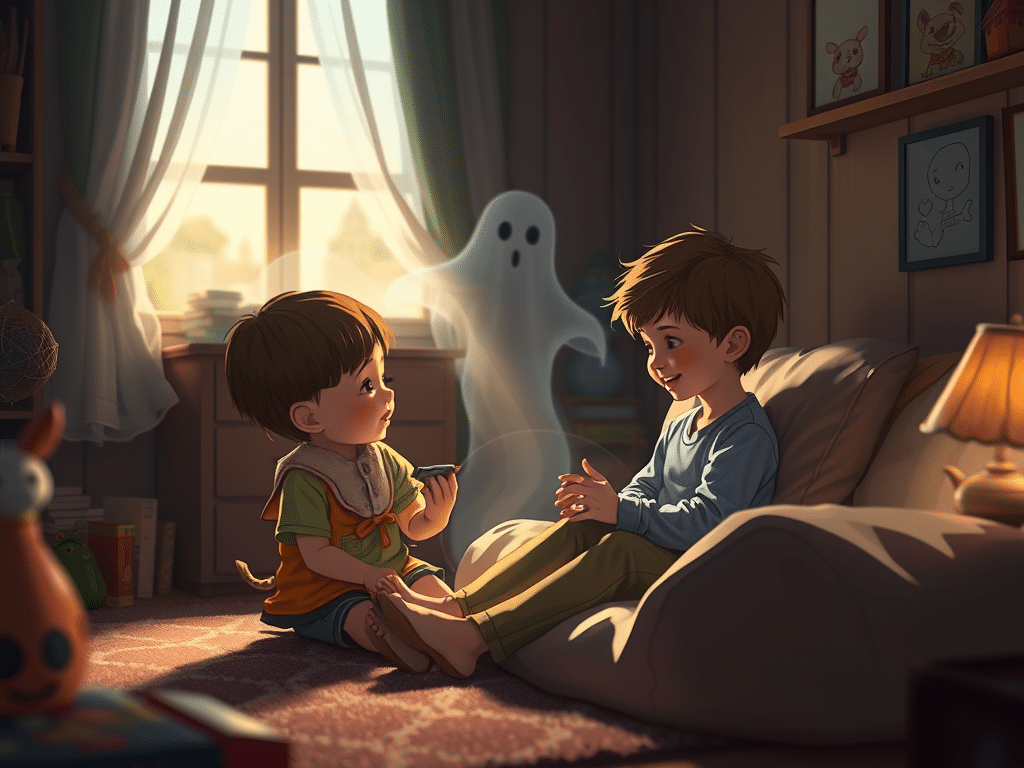
Imaginary Friend or Ghost?: Key Points
-
Imaginary friends are invisible companions typically created by young children that help with social and emotional development.
-
Both imaginary friends and ghosts involve perceived interactions with invisible entities using similar psychological mechanisms like visualization and personification.
-
Imaginary friends are intentionally created and evolve, while ghost encounters are unexpected, involuntary, and often inspire fear.
-
Ghost sightings align with cultural narratives and may involve multiple witnesses, whereas imaginary friends reflect personal experiences without external validation.
-
Imaginary friends fade with childhood maturity, while ghost encounters occur across all ages during periods of stress or emotional vulnerability.
-
Both phenomena reveal the mind’s capacity to create meaningful experiences with unseen entities, serving important psychological and emotional functions.

Introduction
Imaginary friends have long been intriguing to psychologists, parents, and kids alike. Similarly, ghosts and other supernatural events continue to interest believers and doubters from all over the world. At first look, these two events may not seem to have anything to do with each other. One is a known part of childhood development, and the other is a matter of paranormal belief. However, it can be challenging to tell the difference between imaginary friends and ghostly presences. This topic brings up intriguing questions about how we see and remember things and the mental processes that make unknown friends appear in our lives.
Imaginary Friends
Kids (and sometimes adults) create imaginary friends with personalities, likes, and dislikes. These friends usually appear when a child is three to seven, when their minds are at their fullest and their ability to tell the difference between fantasy and reality is still growing. According to research, making up imagined friends is a normal and even beneficial part of growing up. It provides kids a chance to practice their social skills, confront their feelings, and see things from different points of view in a safe and controlled setting. Invisible friends can be humanoid figures, animals, or even inanimate items that have personalities. Kids often provide their invisible friends detailed descriptions of their looks, habits, and past lives.
Studies have repeatedly demonstrated that imaginary friends significantly contribute to a child’s development during early years. Akpakır (2021) says that kids who make up imaginary friends might be different from their peers in ways like age, gender, birth order, and how they grow. These friends help kids develop their social skills, learn how to control their emotions, and feel like they can do things. One important thing about them is that they help with brain growth. For example, kids who have imaginary friends have better theory of mind skills when they are young (Akpakır, 2021).
Bouldin’s doctoral study in 1998, which looked at kids between the ages of three and nine, found that kids who have imaginary friends are more likely to be highly imaginative, be more likely to believe in fantasy stories, and have internal anxiety than kids who don’t have imaginary friends. Instead of showing that they are worried about their mental health, kids seem to use these imaginary friends in a healthy way to practice independence, improve their language and social skills, play pretend, and work through their fears. Bouldin (1998) says that the imagined friend helps the child learn how to cope with new things.
Newcomb’s (2009) stories make you question whether all of your “imaginary” childhood friends are really imaginary. He suggests that some of them may be real, invisible friends. The book has stories like the one about a child who thinks she has a ghost friend named George. Adults can’t see George, but the child can see him in different places. Newcomb (2009) makes people contemplate whether kids’ “invisible friends” are sometimes guardian angels, spiritual guides, or dead relatives, or if they are just made up by the kids.

Imaginary Friends and Ghosts
The link between imaginary friends and ghosts is especially intriguing when we consider how both involve seeing or hearing things that other people can’t see or confirm. Children who claim to see or talk to imaginary friends often exhibit similar speech and behavior patterns to those who report seeing ghosts or spirits of deceased individuals. In both cases, the person having the experience talks to an unseen presence, may report physical sensations that are connected to the entity, and often provides detailed descriptions of the being’s look and personality. People of all ages can see ghosts and have other supernatural experiences because the same psychological and neurological processes help them make up and believe in imaginary friends. These processes include visualization, personification, and the suspension of disbelief.
Traditionally, developmental psychology has seen imaginary friends as harmless results of kids’ creativity. But a new study has started to look into more complex ways to explain these things. Laythe et al. (2021) did a content analysis of online stories about childhood imaginary friends with “creepy or spooky” traits. They suggested that some of the stories might be about ghostly encounters or episodes that people have forgotten about. Their research indicated that people who thought their imaginary friends were ghosts did better on the Survey of Strange Events, which measures strange events that happen around ghosts. In addition, the characteristics of ghostly imaginary partner experiences were strongly linked to the symptoms of both natural and artificial hauntings that had been studied before (Laythe et al., 2021).
This line of research challenges the common belief that all invisible friends are imaginary. Adams et al. (2022) argue for a new way of contemplating imaginary friends that crosses over into other fields. They argue that anthropology, religious studies, and other fields may all be discussing the same phenomenon: typically involving interactions with a person that others do not usually see. This view goes against the common psychology view that seeing invisible friends is just pretend play. It’s important to note that Adams et al. (2022) say that an adult’s story of a ghost is only similar to a child’s imaginary friend if the adult thinks the ghost is just a fantasy. They also discuss cases like a child who said her imaginary friend was the ghost of her dead grandma. This study shows that the way people perceive invisible figures is similar across different frameworks (Adams et al., 2022).
According to Wigger (2019), there may be similarities between how kids have imaginary friends and how adults have relationships with ghosts, spirits, angels, and gods. Wigger looks at the religious meaning of having relationships with invisible people by talking to kids from five different countries about their imaginary friends. The study examines how religious imagination enables individuals to perceive beyond superficial appearances, linking this capacity to the cognitive processes that facilitate the existence of unseen companions (Wigger, 2019).
Telling the Difference
There are a lot of things that need to be carefully thought through to tell the difference between an imaginary friend and what could be interpreted as a ghostly meeting. People often create imaginary friends on purpose, controlling when they appear, what they say, and how they act. On the other hand, ghost encounters are usually described as sudden, unplanned events that the witness has little control over. It’s also important that the experience is consistent. Imaginary friends change over time to adapt to the child’s changing interests and developmental needs, while recorded ghost sightings usually involve seeing the same person or thing over and over again. Also, imaginary friends don’t usually make people scared; they usually make people feel better and provide them company. On the other hand, seeing a ghost often makes people feel uneasy, scared, or like something is fundamentally wrong or missing.
Another important way to tell them apart is to look at the social and cultural context in which they happen. When kids make up imaginary friends, they don’t usually receive much help from stories in the media about ghosts. Instead, their friends tend to reflect on their real-life friends and experiences, rather than follow traditional ghost models. On the other hand, ghost sightings often fit with cultural norms and local legends, with witnesses describing things that sound like stories about haunted places or historical people. External validation also plays a part. For example, no one else can really interact with an imaginary friend, but multiple witnesses report similar experiences with ghosts. There may also be physical evidence, like unexplained sounds or movements, or phenomena that can be recorded on equipment, though there is still a lot of disagreement about what this evidence means.
Other things that help tell them apart are the experiencer’s age and mental state. Imaginary friends are most common when a child is young. As a child grows older and their cognitive skills improve, they are better able to tell the difference between dream and reality, and their imaginary friends tend to fade. However, people of all ages have reported seeing ghosts, and they often happen when they are stressed, sad, not getting enough sleep, or feeling emotionally weak. This suggests that changes in their mental states may play a big role in these events. Furthermore, people who say they see ghosts usually already believe in the supernatural or have been influenced by stories about a certain place being haunted. On the other hand, kids make up imaginary friends without having to believe in ghosts or other supernatural beings first.
Conclusion
Immensely intriguing things happen when imaginary friends and ghosts come together. This shows how the mind can create meaningful experiences with things that only live in our minds. Depending on our worldview, cultural background, and personal views, these events can be considered products of our imagination, psychological needs, neurological processes, or real encounters with beings from other worlds. Skeptics might say that all ghost sightings are just grown-up versions of imaginary friends made up by people who are looking for comfort, explanation, or meaning in confusing experiences. But believers say that real paranormal encounters are very different from the imaginative play of childhood. It’s clear that both imaginary friends and ghost sightings are important parts of human life. For example, imaginary friends help kids learn social and emotional skills, and ghost sightings provide adults a sense of connection to something beyond the material world. Figuring out the similarities and differences between these two things can help us understand how our minds create reality.
References
Adams, K., Stanford, E., & Singh, H. (2022). Reconceptualizing imaginary friends: Interdisciplinary approaches for understanding invisible companions. Journal of Childhood Studies, 47(2), 32-49.
Akpakır, Z. (2021). Imaginary companionships in childhood and their impacts on child development. Psikiyatride Guncel Yaklasimlar, 13(4), 820-830.
Bouldin, P. M. (1998). Imaginary companions: Their role in childhood development [Doctoral dissertation, University of Tasmania].
Laythe, B., Houran, J., & Little, C. (2021). The ghostly character of childhood imaginary companions: An empirical study of online accounts. The Journal of Parapsychology, 85(1), 54-74.
Newcomb, J. (2009). Angel kids. Hay House, Inc.
Wigger, J. B. (2019). Invisible companions: Encounters with imaginary friends, gods, ancestors, and angels. Stanford University Press.


Leave a Reply