Mold and Haunted Houses: Key Points
-
Haunted houses are typically old, neglected, and deteriorating structures where people commonly report shadowy figures, strange sounds, temperature drops, and overwhelming feelings of dread and anxiety.
-
Environmental factors like infrasound, electromagnetic fields, and carbon monoxide poisoning can produce hallucinations, paranoia, and sensory distortions that closely mimic supernatural experiences.
-
Mold, especially toxic species like black mold, thrives in the exact conditions found in stereotypically haunted houses and produces mycotoxins that can cause hallucinations, fear, and altered perception.
-
Mycotoxins can cross the blood-brain barrier and disrupt neurotransmitter function, and documented cases show patients experiencing paranormal-like symptoms that disappeared entirely once they left the contaminated environment.
-
Researcher Shane Rogers formally proposed that many famous haunted locations could be explained by fungal contamination, noting a strong correlation between mold-friendly conditions and reported hauntings.
-
The Victorian era’s mold-prone architecture and widespread spiritualism may be linked, suggesting that history’s most famous ghost stories could partly be the result of people living in chronically contaminated buildings.

Introduction
People have been fascinated by haunted houses for a long time, thinking that ghosts or other supernatural beings live in old, rotting structures and make weird noises, sights, and feelings of fear. People from practically every culture in the world have told stories, written books, made movies, and even been horrified by these unusual locales. But today’s science has begun to offer an entirely different explanation for many of these things. This hypothesis is based on biology and environmental chemistry, not on the supernatural. One of the most likely explanations is that mold, a common but powerful organism, could be behind a lot more ghost sightings than people imagined.
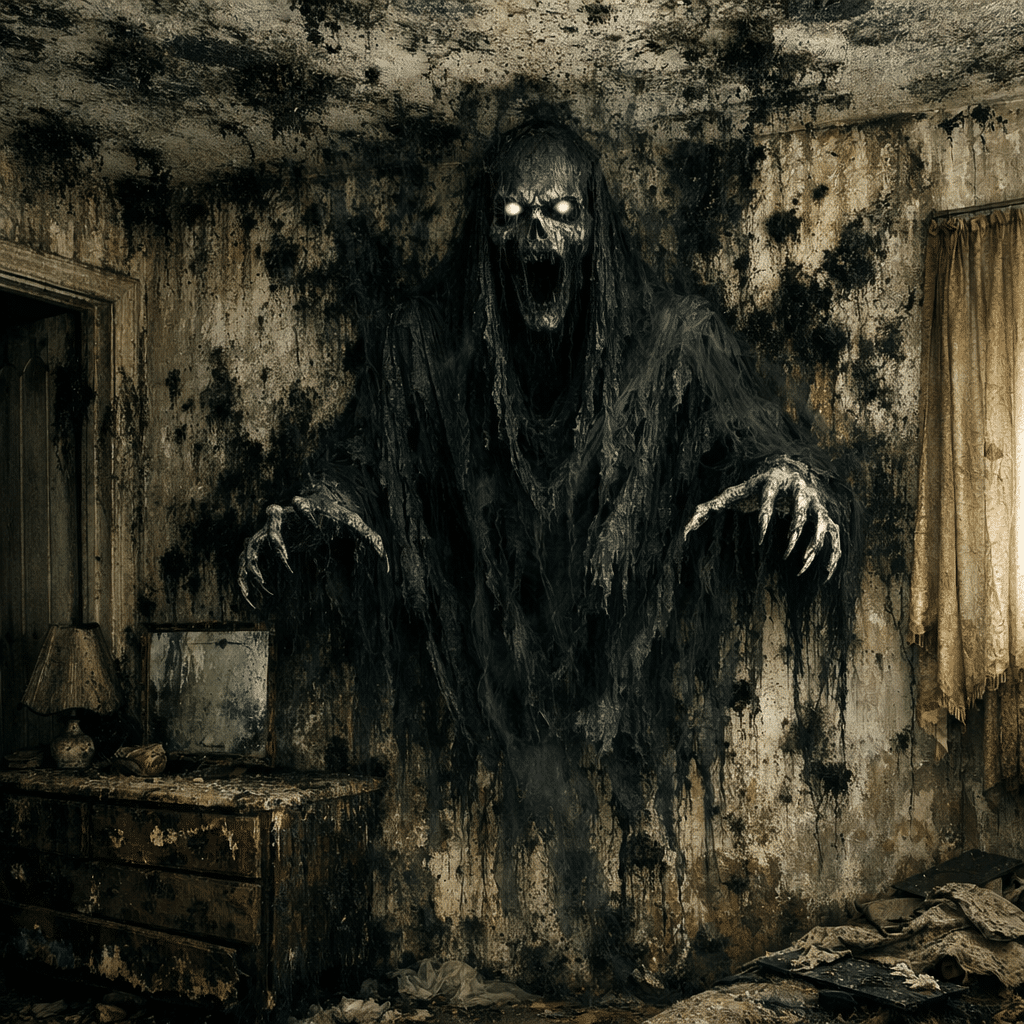
People frequently visualize haunted houses with a certain set of features in their minds. Usually, they are old, not well cared for, and falling apart. The wallpaper is peeling, the windows are broken, the floors are creaking, and the whole place feels neglected. People who think they have seen ghosts at these places usually discuss a succession of strange things that happen, like strange noises, shadowy figures at the edge of their vision, sudden drops in temperature, a strong feeling of being watched, and deep feelings of fear or dread. People have believed for a long time that these stories are proof that something truly otherworldly is going on because they originate from different cultures, times, and places.
Environmental Explanations for Supernatural Experiences
But it’s crucial to remember that many of the sensory and psychological impacts individuals encounter in haunted houses can be explained by typical things in the surroundings that have nothing to do with ghosts or spirits. Infrasound is a sound that is too low for people to hear. It could be because of malfunctioning ventilation systems, industrial machinery next door, or even the way old buildings were built. Vic Tandy and other experts completed studies in the late 1990s that indicated that infrasound at roughly 18 to 19 hertz can make individuals feel nervous, confused, and even like someone is in the room. Some research has demonstrated that some electromagnetic field (EMF) frequencies can directly affect the temporal lobes of the brain, making people see things that aren’t there and feel paranoid. This phenomenon is like how aged electrical wires can produce EMF fields.
People have also reported a connection between haunted houses and past carbon monoxide poisoning. In the early 1900s, a well-documented case involved a family that said they were having more and more terrifying supernatural experiences in their home, like seeing ghosts, hearing voices, and feeling like they were going crazy. All of these things stopped completely when they fixed a broken furnace and stopped the carbon monoxide leak. Even in small doses, the gas can cause headaches, confusion, hallucinations of sound and sight, and mental anguish. It has no color or smell. People who think they’ve seen ghosts often believe they have these same symptoms. This instance and others like it are noteworthy because they indicate that pollution may make things look like they are happening in a supernatural way.
Mold as a Biological Factor in Paranormal Experiences
Mold, on the other hand, may be the most frequent and least detected of all these environmental influences. Mold thrives best in locations that people commonly think are haunted, such as old buildings with bad air movement, water damage, high humidity, and organic building materials like wood and plaster that are great for fungi to grow on. Some kinds of dangerous mold, such as Stachybotrys chartarum, also called black mold, make mycotoxins that can be highly hazardous for the brain and body. Exposure to these mycotoxins has been demonstrated to elicit a variety of symptoms, including fatigue, confusion, amnesia, mood fluctuations, and, at elevated concentrations, hallucinations and profound dread.
An additional corpus of research concentrating on mold and indoor air quality (IAQ), apart from the primary ghost literature, offers essential convergent insights for comprehending haunted situations. Lorentzen et al. investigate the compounds responsible for mold odor in indoor settings—chloroanisoles (CAs)—and demonstrate that unpleasant odors frequently accompany damp structures, potentially indicating concealed mold growth and eliciting psychobiological effects associated with odor perception and health symptoms; their research emphasizes that mold-related odors serve as significant indicators of moisture, influencing occupants’ well-being, even when measured mold concentrations are not overtly elevated (Lorentzen et al., 2015). Fu et al. further link IAQ to Sick Building Syndrome (SBS) symptoms in adults, demonstrating that perceived indoor environment quality, housing conditions, and ventilation affect SBS risk; their extensive cross-sectional study highlights that IAQ and moisture indicators interact with lifestyle and building characteristics to influence health outcomes, a finding with direct relevance to haunted-house environments that frequently feature older or inadequately ventilated structures (Fu et al., 2022).
The neurological consequences of mold exposure are especially relevant to comprehending encounters in haunted homes. Mycotoxins can cross the blood-brain barrier and interfere with normal neurotransmitter function, hence quantifiably altering an individual’s perception of reality. Researchers and medics have discovered that persons who were around mold for a long time experienced paranoid thoughts, sensory hallucinations, and a continual sense that something horrible was happening around them. The symptoms disappeared immediately when the victims were relocated away from the contaminated area. The fact that these symptoms start and stop in particular places is really crucial since it is like the classic haunted house narrative where certain places look terrifying and others don’t.
There are now a lot of theories that aim to explain how mold and ghostly experiences are connected. One of the most famous people who has worked on this is Shane Rogers, a researcher at Clarkson University. He said that fungal infections could explain a lot of famous haunted places (National Post Staff, 2015). Rogers added that the conditions that cause mold to grow and those that cause people to see ghosts are quite similar. He also said that some molds make mycotoxins that can chemically induce the same kinds of hallucinations that people have said they saw ghosts. His idea doesn’t dismiss the real and often scary experiences of people who think they’ve seen something supernatural; instead, it puts these experiences in a new light by saying they are biological rather than philosophical.
Public health assessments indicate that mold and moisture are major factors that affect indoor air quality, which is known to have an impact on health outcomes. Nonetheless, the causal link between indoor air quality and the feeling of “haunting” is still unclear; it probably works through comfort, discomfort, or health problems instead of a direct paranormal mechanism (Hu & Roberts, 2020). Mold and moisture are important factors that affect indoor air quality in buildings that are thought to be haunted. However, the evidence does not support a clear, universal link between mold exposure and experiences of haunting. Mold and IAQ (indoor air quality)-related elements can affect comfort, health symptoms, and perceptual state, which could change how people report or understand haunt-type experiences.

Scientific Research and the Environmental Study of Haunting
Some of the most important environmental factors that haunt-related research has looked at are embedded cues, light, air quality, temperature, infrasound, and electromagnetic fields. Dagnall et al. summarize that these six variables have sometimes produced null or weak associations with haunt-type reports, and they stress the infancy of this research area and the need for designs that precisely measure discrete environmental factors and consider holistic person-environment interactions and individual perceptual sensitivities (Dagnall et al., 2020). Simmonds-Moore et al. discuss “spooky settings and structures” and identify six environmental elements that can alter the perception of ghosts: embedded cues, lighting, air quality, temperature, infrasound, and electromagnetic fields. This study is part of a larger, systems-based study of haunt phenomena (Simmonds-Moore, 2023). Houran et al. apply this focus to the tourism sector, noting that paranormal experiences are influenced by contextual environmental factors and that media representations of haunted sites can shape actual experiences through expectancy and social context; they call for a nuanced understanding of the relationship between environment and experience, rather than a simplistic causal claim (Houran et al., 2020). These sources jointly underline a methodological imperative: properly quantifying ambient elements while considering perceptual and social contexts is vital for advancing the study of haunt phenomena.
Another theoretical viewpoint investigates the psychological effects of mold in relation to suggestion and prior ideas. Apophenia, the human tendency to identify patterns in confusing stimuli, can make even slight cognitive impairment or sensory distortion caused by mold much worse if someone already thinks a house is haunted or has heard stories about its past. A small visual distortion caused by mycotoxins messing with the nervous system turns into an apparition for someone who is ready to see it, but an unexplained sound is heard as the footstep of a spirit. This interplay between environmental contamination and psychological anticipation creates a feedback loop that can render even minimal mold exposure akin to a genuine supernatural occurrence.
Cultural, Literary, and Historical Dimensions
For example, Keetley’s chapter on black mold in Haunted Nature (2021) talks about how pictures of mold transform the way we think about death and extinction in a way that is both racialized and ecocritical. This demonstrates how mold can serve as a potent metaphor in literature and media concerning hauntings. It also shows how mold can be a cultural and narrative force that influences how we think about hauntings in more than simply physical terms (Fitzpatrick, 2023). In Australian Gothic contexts, a related conversation emphasizes the house as a site where mold and decay manifest as physical symbols that link architecture, corporeality, and memory, thereby associating haunting with social and environmental histories, exemplified by images of mold infiltrating homes (Jeffery & Doolan, 2020). These literatures suggest that mold in haunted-house discourse serves both as a potential biological etiological factor and as a symbolic device that shapes meanings associated with hauntings, fear, and social critique.
The historical record offers considerable circumstantial support for these views. Many of the most well-known haunted locales, like some Victorian-era mansions and asylum buildings, were built with materials and procedures that made it basic for moisture to get in and mold to grow (Keetley, 2021). People liked heavy wallpaper, thick plasterwork, and not much air flow in buildings in the 1800s. These characteristics make the insides of buildings practically perfect for growing mushrooms. People were particularly interested in ghosts, seances, and spiritualism throughout the Victorian era, which is probably not a coincidence. This cultural fixation may have been at least partly caused by the fact that many people lived and worked in buildings that were always moldy.
Conclusion
The connection between haunted houses and mold is one of the most intriguing ways that science and myth come together in modern research. Ghost stories nevertheless have a lot of force and cultural meaning, even though they don’t take away from such things. They address basic human needs for dealing with death and the unknown. But it does give us a good, evidence-based technique to figure out why some regions always have stories of unusual and terrifying things happening. As environmental science and neurology advance, it seems increasingly likely that the apparitions linked to several notable historical locations were not spirits, but rather the undetectable manifestations of a pervasive entity multiplying within the structures. In this way, the haunted house is less a way to access the supernatural and more a reminder of how profoundly the mind can be affected by the actual environment.
References
Dagnall, N., Drinkwater, K., O’Keeffe, C., Ventola, A., Laythe, B., Jawer, M., … & Houran, J. (2020). Things That Go Bump in the Literature: An Environmental Appraisal of “Haunted Houses.” Frontiers in Psychology, 11. https://doi.org/10.3389/fpsyg.2020.01328
Fitzpatrick, T. (2023). Haunted Nature: Entanglements of the Human and Nonhuman. Edited by Sladja Blazan. Gothic Studies, 25(2), 217–221. https://doi.org/10.3366/gothic.2023.0165
Fu, P., Zhao, Z., Norbäck, D., Zhang, X., & Yung, K. (2022). Associations between indoor environment and lifestyles and sick building syndrome symptoms among adults in Taiyuan and Urumqi of China. Indoor Air, 32(7). https://doi.org/10.1111/ina.13081
Houran, J., Hill, S., Haynes, E., & Bielski, U. (2020). Paranormal Tourism: Market Study of a Novel and Interactive Approach to Space Activation and Monetization. Cornell Hospitality Quarterly, 61(3), 287–311. https://doi.org/10.1177/1938965520909094
Hu, M. and Roberts, J. (2020). Connections and Divergence between Public Health and Built Environment—A Scoping Review. Urban Science, 4(1), 12. https://doi.org/10.3390/urbansci4010012
Jeffery, E. and Doolan, E. (2020). “The house will come to you”: Domestic Architecture in Contemporary Australian Literature and Film. Antipodes, 34(2), 277–295. https://doi.org/10.1353/apo.2020.0045
Keetley, D. (2021). Black Mold, White Extinction: I Am the Pretty Thing That Lives in the House, The Haunting of Hill House, “Gray Matter,” and HP Lovecraft’s “The Shunned House.” In Haunted Nature: Entanglements of the Human and the Nonhuman (pp. 43–66). Cham: Springer International Publishing.
Lorentzen, J., Juran, S., Nilsson, M., Nordin, S., & Johanson, G. (2015). Chloroanisoles may explain mold odor and represent a major indoor environment problem in Sweden. Indoor Air, 26(2), 207–218. https://doi.org/10.1111/ina.12207
National Post Staff. (2015, April 7). The truth behind ‘haunted’ houses? Toxic moulds can cause severe psychosis and hallucinations, researchers say. National Post. https://nationalpost.com/news/world/the-truth-behind-haunted-houses-toxic-moulds-can-cause-severe-psychosis-and-hallucinations-researchers-say
Simmonds-Moore, C. (2023). Ghosted! Exploring the Haunting Reality of Paranormal Encounters. Journal of Scientific Exploration, 37(4), 705–713. https://doi.org/10.31275/20233259

Leave a Reply