New Slains Castle: Key Points
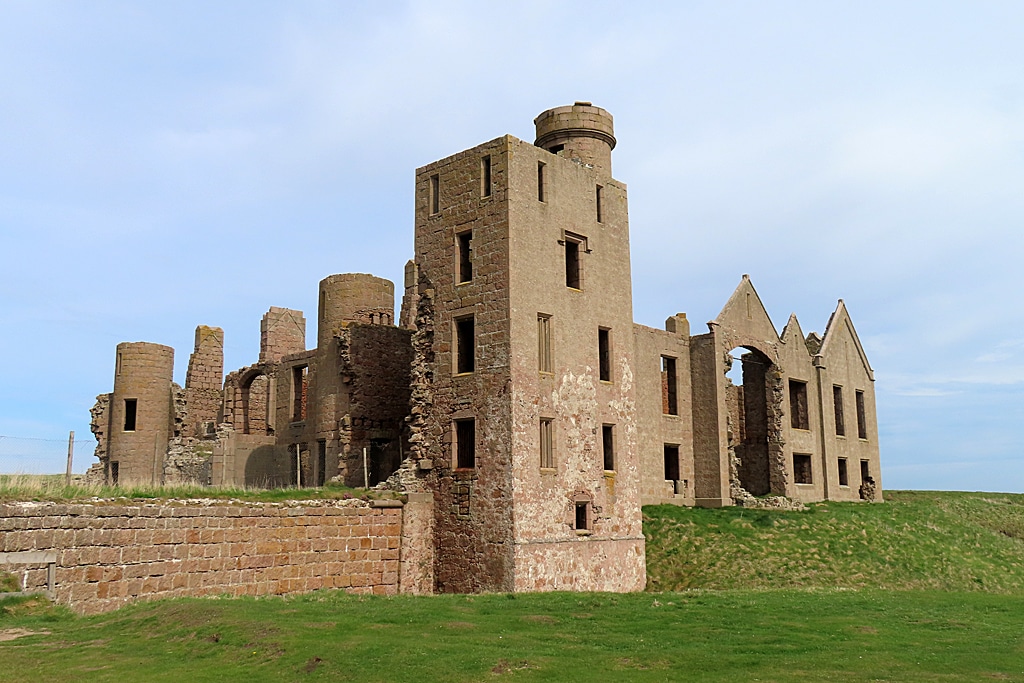
- New Slains Castle is a dramatic clifftop ruin near Cruden Bay in Aberdeenshire, Scotland, with weathered granite walls, roofless chambers, and empty windows overlooking the North Sea. Its exposed setting gives it a bleak and haunting atmosphere, especially in sea mist.
- Built by the Earls of Erroll from the Hay family after Old Slains was destroyed in 1594, the castle was expanded and refaced over the centuries before its roof was removed in 1916 to avoid taxation, leading to its ruin.
- The author of Dracula, Bram Stoker, stayed in Cruden Bay several times, and many believe the brooding castle, including its octagonal room, helped inspire the atmosphere of Count Dracula’s home, though this link remains debated.
- The castle is tied to the legend of the baobhan sith, a beautiful vampire-like spirit of Highland folklore who lures and preys on young men, a tradition that thrives in such isolated landscapes.
- Visitors report cold spots, feelings of being watched, shadowy figures, strange sounds, and unexplained lights, all amplified by the ruin’s exposed and often foggy surroundings.
- Believers attribute the reputation to the site’s long and tragic history leaving a lingering imprint, while sceptics point to natural sounds, isolation, and the priming effect of the Dracula connection shaping visitors’ perceptions.

Introduction
One of the most frightening remains in the country, New Slains Castle sits on the craggy cliffs of Aberdeenshire in northeast Scotland. Near the settlement of Cruden Bay, overlooking the frigid North Sea, its aged stone walls nonetheless draw notice even in their dilapidated state. Visitors who brave the windswept walk to its edge typically report a feeling that’s difficult to name, somewhere between awe and unease. The castle is more than a lovely ruin. It is steeped in centuries of history, literary legend, folklore, and persistent tales of the uncanny that still beckon the curious to its decaying doors.
A Ruin on the Cliffs: Architecture and Physical Presence
Slains Castle has long been a landmark in the North-East of Scotland, its tower-house and adjacent palace complex epitomizing the feudal and late medieval to early modern architecture of the region. Davidson and Walker analyze Catholic material culture in the north-east and point to the importance of Erroll’s and Slains Castle within Catholic networks and its architectural representations as part of regional power dynamics (Davidson & Walker, 2021). Davidson and Walker also cite Slains as the home of the Erroll family, with the building of a double-height library in the mid-nineteenth century, and therefore place Slains within a culture of gentry libraries and households of learning (Reid, 2019).
New Slains is a dramatic physical presence. The ruin is perched on a stunning clifftop, sprawling across an uneven terrain with tall sections of wall, vacant window frames, and roofless chambers open to the sky. For millennia, sea spray and salt wind have gnawed at the granite, leaving it grey and mottled. Below, the waves break on craggy rocks, the sound rising through broken rooms. On a fine day, the castle might seem almost beautiful, but when the fog starts rolling in from the sea, it becomes something much more gloomy. You can still sense its past glory in the layout, with the ghosts of magnificent rooms and the bow portion that formerly stared triumphantly out to sea.
The physical condition of Slains, its abandonment, and its cliff-edge location have helped create its liminal and evocative narrative in the online and offline imaginaries of rural Scotland. Ironside and Reid examine the importance of abandoned places, such as Slains, in digital placemaking in rural hinterlands and how pictures, narratives, and user-generated content can reconfigure views of landscape and history (Ironside & Reid, 2024). The paper presents a case study of the rural hinterland reconfigured through interactive digital material that challenges urban-centric conceptions of place, using the example of Slains Castle.

A History of Aristocracy and Faith
The history of the castle is complex and difficult for outsiders. It is dubbed New Slains to differentiate it from Old Slains Castle, an earlier castle a few miles to the south. The Hay family, notably the Earls of Erroll, was essential to its story. The first Slains was destroyed in 1594 by order of King James VI after a rebellion, and the ninth Earl of Erroll developed a new mansion on the present site. During the following centuries, the house was extended, rebuilt, and refined, most notably in the early nineteenth century when it was refaced in granite and given a more fashionable aspect. The castle stayed in the family until financial difficulties forced them to sell it. In 1916, the roof was removed, a usual practice at the time to avoid taxation on usable buildings, and from then on, the structure gradually sank into ruin.
The castle’s place in the Jesuit mission network of the 17th century and its links with the Erroll family’s patronage of Catholicism are part of a wider pattern of northern houses supporting Catholic worship and culture in Scotland following the Reformation. This is consistent with the examination in Scottish Catholic material culture that notes how northern noble households, like Slains, kept up or re-used religious symbols and spaces even while wider Protestant consolidation was taking place (Davidson & Walker, 2021). The literature also suggests that Slains’ architectural development (e.g., the installation of a library in the mid-19th century) is indicative of the gentry’s investment in places of knowledge and status, linking Slains to wider library culture in Aberdeenshire and beyond (Reid, 2019).
Literary Legend: Stoker and Dracula
New Slains has gained most of its present prominence through its association with the writer Bram Stoker. Dracula’s creator spent time in Cruden Bay on a few occasions and is known to have visited the area when developing his ideas. Many enthusiasts feel that the dark, cliff-edge castle helped set the mood for Count Dracula’s abode, and some even point to an octagonal room inside Slains as the likely basis for a similar chamber in the novel. It is still argued whether Stoker intentionally chose the castle as his model, as Dracula is also located in Transylvania and has other references as well. Still, the connection is strong. It is easy to envision a writer roaming these lonely cliffs, looking down at the sea churning below, and finding the seed of a gothic nightmare.
Local memory and the language of literary tourism sustain the story of Slains, particularly its connections to popular culture and Bram Stoker’s Dracula. Senf’s examination of Dracula origins considers Cruden Bay and Slains as locations of cultural storytelling and local involvement with Stoker’s lore, showing how literary linkages contribute to modern placemaking and tourism narratives in the region (Senf, 2019).
Folklore and the Supernatural
The castle is also linked to a darker stream of Scottish tradition, the baobhan sith. This creature is a feature of Highland folklore and is generally portrayed as a beautiful female spirit or vampire, preying on unsuspecting travelers, in particular young males. She is green and nocturnal and invites her victims to dance before drinking their blood. Naturally, such a legend is linked to a desolate, sea-battered ruin, for these stories do thrive in just the kind of isolated setting that surrounds Slains. The baobhan sith tradition is loosely associated with the vampire ideas that pervade Stoker’s legacy, intertwining folklore and literature into a singular creepy tapestry surrounding the castle.
For years, stories of paranormal activity have been associated with New Slains. Visitors and ghost hunters report cold spots, unexpected feelings of being watched, and strange sounds that seem to come from vacant rooms. Some have claimed to see shadowy figures in the ruins, while others have reported strange lights and a feeling of being followed on the cliff walk. The very environment of the place, open and often fog-bound, must surely intensify these feelings. Some allege that photographs taken at the location reveal strange shapes or mists, but interpretation always plays a role in these claims.
There are several theories as to why this castle has this notoriety. The dramatic and sometimes terrible lengthy human history of the place, believers say, has left a lingering impact that sensitive visitors can detect. Sceptics offer a more pragmatic explanation. They claim that the whistling of the wind through the shattered stone, the crashing of waves, and the remoteness of the ruin create experiences that the mind interprets as supernatural. The literary link to Dracula might also condition visitors to expect something frightening before they ever arrive, altering what they think they feel and see. A clear truth lies between these perspectives. New Slains is a place that circumstance has shaped to be disturbing, and it does its task well.
Conclusion
New Slains Castle is a memorial to so many things at once. It is a history of Scottish aristocracy, a possible inspiration for one of literature’s greatest horror books, and a magnet for folklore and spooky tales. The ruined walls have not one narrative but many to tell, intertwined, each adding to the ambiance that hangs over the cliffs above Cruden Bay. Whether you visit as a historian, a literary pilgrim, or a seeker of the supernatural, the castle has plenty to nourish the imagination. It is surprisingly alive in its solitude and decay, and that silent force is precisely the reason why people keep coming back.
References
Davidson, P., & Walker, D. W. (2021). Scottish Catholic Material Culture. 303–338. https://doi.org/10.1163/9789004335981_012
Ironside, R., & Reid, P. H. (2024). Reimagining the Rural Hinterland: an investigation of participatory digital placemaking in rural communities. Culture Unbound Journal of Current Cultural Research, 16(1), 60–85. https://doi.org/10.3384/cu.4287
Reid, P. H. (2019). Patriots and Rogues: Some Scottish Lairds and Their Libraries. Library & Information History, 35(1), 1–20. https://doi.org/10.1080/17583489.2019.1589724
Senf, C. (2019). review When Brave Men Shudder: The Scottish Origins of Dracula by Mike Shepherd. Victorian Popular Fictions Journal, 124–126. https://doi.org/10.46911/ddpf9943
Stoker, B. (1897). Dracula.
Leave a Reply