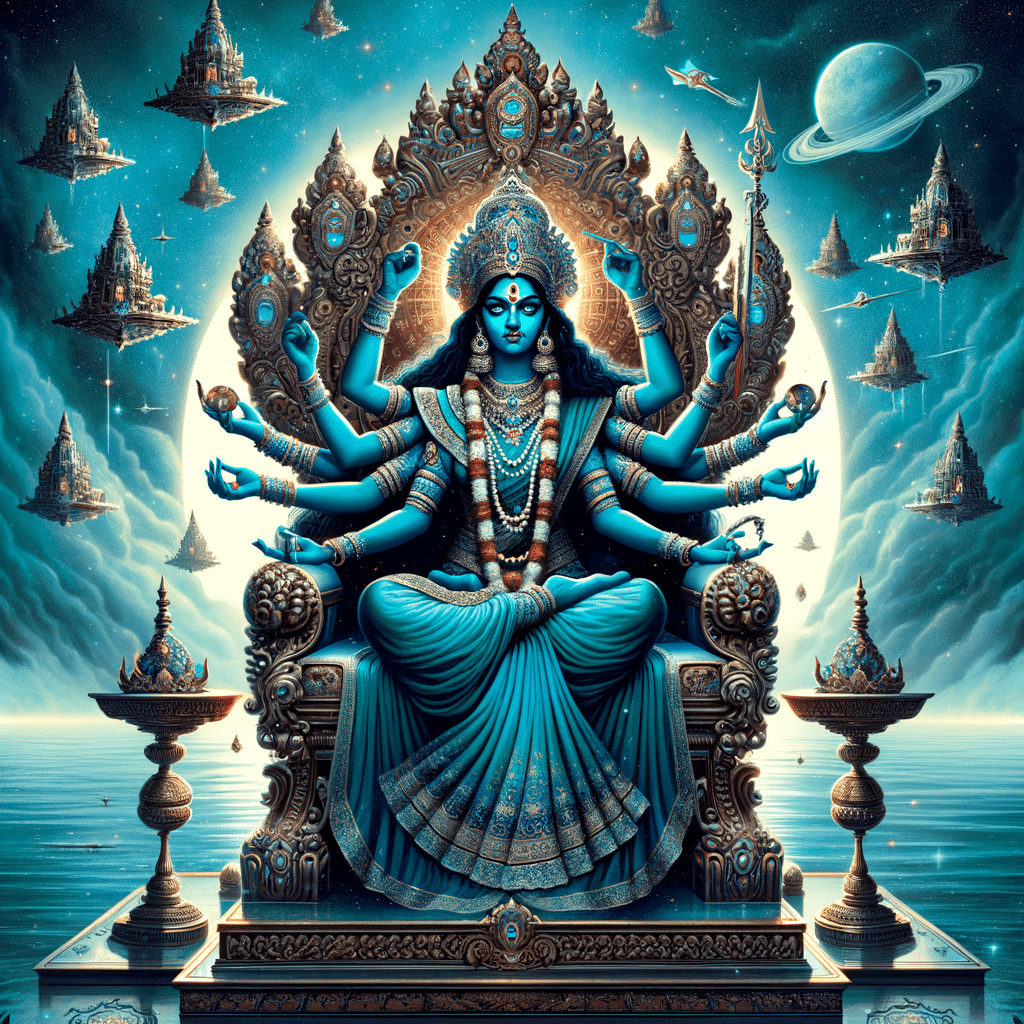
Within the Hindu pantheon, Kali, the Goddess of Time, is frequently misinterpreted and misrepresented, particularly when considering her in the context of Western civilization. In the rich fabric of Hindu mythology, Kali manifests as a complex deity representing time, change, and metamorphosis rather than just as a forerunner of death and devastation. This essay aims to explore Kali’s multifaceted character by dissecting the oversimplifications that have obscured her actual nature and examining how she has been viewed and portrayed in the West.
The word Kali, which means “the dark one,” has often been misinterpreted in the West as a demonic force. This misconception may have originated from historical reports of the Thuggee cult, which is said to have worshipped Kali by killing and robbing people. In fact, the English word “thug,” which implies violence and criminality, comes from this gang, which solidifies Kali’s reputation for evil activities. But this picture of Black Mother Time is a glaring oversimplification.

According to Hinduism, the divine feminine, or Devi, takes on different forms, each with unique functions and characteristics, yet they are all aspects of the same ultimate reality. One such facet of Devi is Kali, who is most appropriately portrayed as the goddess ruling over the unstoppable force of time, change, and the unrelenting march toward metamorphosis. Her depiction as dancing the dance of death represents life’s cyclical cycle, in which passing away is only a transition to another form of existence.
In the hearts of her adherents in India, Kali is far from being merely a tool of destruction. She is the destroyer, but only of things that stand in the way of progress, such as ignorance, sins, fears, or demons. She is a symbol of both genesis and destruction because it is thanks to her destructive abilities that rebirth, and creation are made possible. Her relationship with Lord Shiva further explains Kali’s part in the cosmic dance of creation and destruction. Even though Shiva is frequently referred to as the destroyer, Kali is the one who gives him the ability to do so because she is Shakti, or divine force. Shiva would be powerless without her, as she is the primeval force.
In a more symbolic sense, Kali would continue to remain as the eternal, formless nothingness, like a black hole that harbors boundless possibilities for creation. Her unmatched demon-slaying ferocity represents her ability to destroy everything corrupt and make room for the new.

Such intricate stories have long been a source of difficulty for Western society, which usually distorts Kali’s image to that of an exotic, sinister, and terrifying “Other.” As a result, there is a distorted perception of Kali’s qualities and significance, and images of her dancing in cemeteries and brandishing skulls fuel sensational and exotic interpretations. In addition to ignoring Kali’s rich philosophical and spiritual elements, these representations fail to acknowledge Kali as a symbol of empowerment and freedom from illusion and fear.
Given that Kundalini energy is associated with Kali, it enhances her position as a liberator by symbolizing the spiritual force that, when awakened, frees souls from the bonds of material existence. For those who follow her, calling on Kali is an appeal for courage to face illusions and fears rather than a means of calling forth devastation. The appeal to Kali is a cry for bravery to confront and overcome the darkest fears that immobilize the human soul.
In conclusion, the Western perception of Kali as a violent deity grossly misrepresents her fundamental position in Hinduism as a force of time, change, and transition. The essential core of Kali, as her adherents understand it, is not blind anger and sadness, but love, courage, and the ability to rise above the confines of the material world. In order to dispel the myths surrounding Kali, one must have a greater understanding of the deep symbolism and lessons of Hindu mythology and acknowledge her as a potent representation of the vitality of life and the possibility for human rejuvenation.
Further Reading
Kinsley, D. R. (1986). Kali: Goddess of death and destruction. Delhi: Motilal Banarsidass.
David Kinsley’s work offers a comprehensive examination of Kali, exploring her origins, her role in Indian religion, her rituals, and her iconography. Kinsley is known for his scholarly approach to Hindu goddesses, and this book is selected for its in-depth analysis of Kali within the broader spectrum of Hindu mythology. It is an essential read for those looking to understand the historical and religious context of Kali’s worship.
McDermott, R. A., & Kripal, J. J. (Eds.). (2003). Encountering Kālī: In the margins, at the center, in the West. University of California Press.
This edited volume is a valuable collection of essays that examines Kali’s presence from multiple perspectives, including her historical development, her cultural impact in India, and her interpretation in the West. The diversity of views presented in this book makes it an excellent resource for readers interested in the multifaceted ways Kali has been understood and represented across different cultures and times.
Harding, E. (1993). Kali: The black goddess of Dakshineswar. Motilal Banarsidass.
Elizabeth Harding’s book provides an intimate look at the worship of Kali at the Dakshineswar Kali Temple, where the famous mystic Ramakrishna served as a priest. Harding’s narrative is both a personal journey and a scholarly endeavor, making this book a compelling read for those who wish to explore Kali’s worship practices and her profound impact on the lives of her devotees. It is particularly valuable for its blend of ethnographic detail and religious scholarship.



Leave a Reply