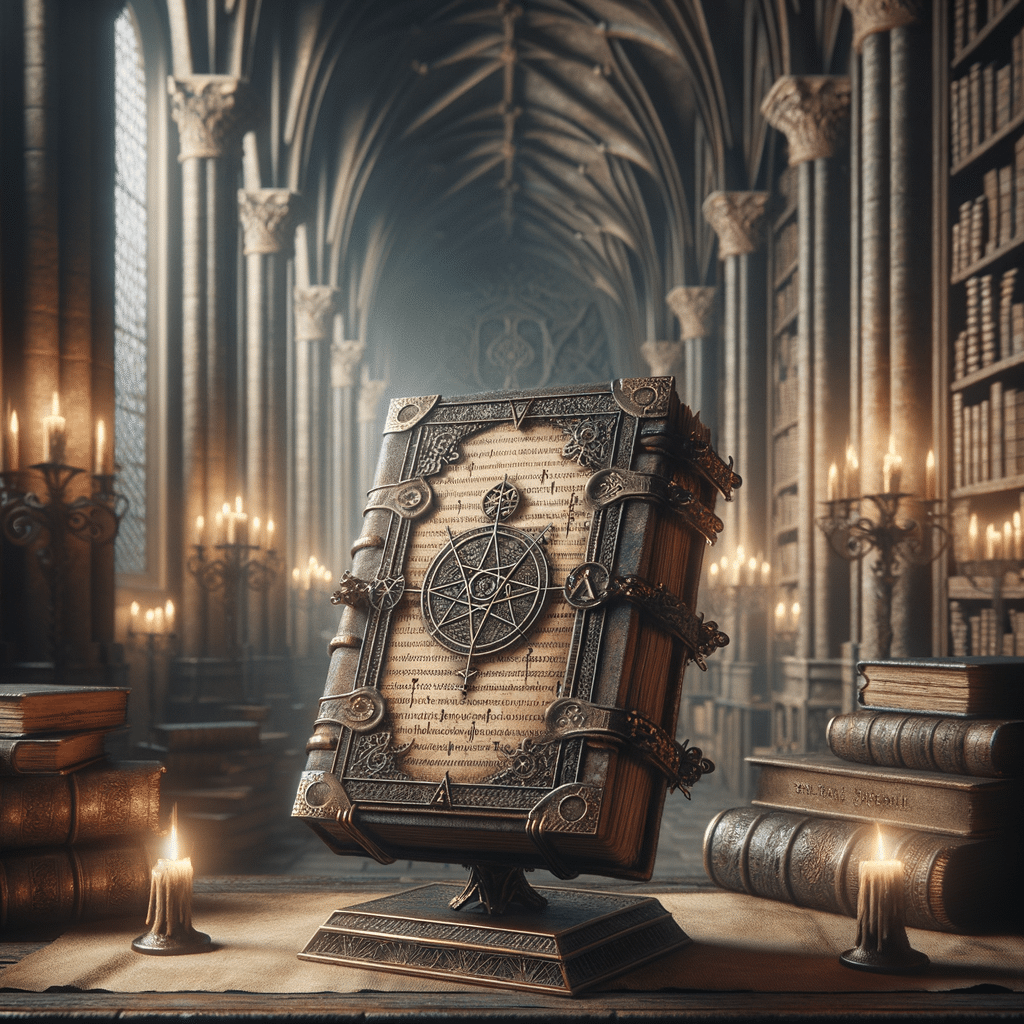
Grimoires, or magical textbooks, have long piqued the interest of scholars and non-academics alike due to their mysterious nature. These antiquated books are stores of magical knowledge; they provide guidance on how to make enchanted artifacts, cast spells, do divinations, and call on angels, spirits, and demons, among other supernatural beings. The word ‘grammaire,’ which originally applied to any Latin-written documents, is where the word ‘grimoire’ got its etymology. Over time, however, it evolved to be linked only with magical manuals.
The Key of Solomon (Clavicula Salomonis), a book credited to the fabled King Solomon himself, is arguably the most well-known grimoire. This book is an encyclopedia of information about creating magical objects and calling spirits. A companion work, The Lesser Key of Solomon, explores the complexities of demons, offering comprehensive explanations and strategies for calling forth and subduing these powerful entities. In 1889, The Key of Solomon was translated from old manuscripts for a wider English audience. Its contents certainly had an impact on notable personalities in the English magical tradition, including the polymath Dr. John Dee.

Book of Abramelin, an important grimoire canonical work that comes from a German-Egyptian heritage, is another important book. The main ritual of the grimoire promises practitioners that by learning the ‘Knowledge and Conversation’ of their guardian angel, they will be able to command different spirits, which is the ultimate objective. Samuel Liddell MacGregor Mathers, a founding member of the Hermetic Order of the Golden Dawn, translated this treatise into English, which is largely to blame for its popularity in the Anglophone world.
One of the earliest grimoires is thought to be the English Sworn Book of Honorius (Liber Juratus Honorii), which was written in the 13th and 14th centuries. It is stated that this ancient book has the wisdom needed to call forth the Seven Great Princes of Spirits. Its continued popularity over the ages is evidence of the occult’s ongoing appeal.
Condensed and credited to Peter de Abano, the Heptameron offers particular instructions for calling angels every day of the week. The Heptameron found a willing audience in England despite its Continental roots, highlighting the interdependence of European magical traditions.
It is impossible to overestimate Dr. John Dee’s contributions to the field of magical literature. The foundation of English magical practice is still Dee, a 16th-century luminary whose vast work in angelology and creation of Enochian magic—a system based on an angelic language supposedly revealed to him and his seer, Edward Kelley—remain.

The inclusion of the Pseudomonarchia Daemonum, an addendum to Johann Weyer’s well-known compendium of demons De praestigiis daemonum, further demonstrates the ongoing concern with grimoires. This literature goes beyond the infernal realms that many grimoires delve into, presenting a hierarchy of demonic spirits along with names and descriptions.
These grimoires have a supposed potency that has frequently resulted in their suppression—only to be covertly duplicated and circulated again—due to their syncretic fusion of Pagan rituals, Kabbalistic teachings, Christian prayers, and occult symbols. Even though many grimoires date back to the Middle Ages, their impact is still present in Renaissance art and is still present in modern occult rituals. Grimoires continue to be a source of fascination and conjecture due to the aura of forbidden knowledge encapsulated in their pages, providing a glimpse into a realm where the supernatural and the corporeal merge.
Further Reading
Davies, O. (2009). Grimoires: A History of Magic Books. Oxford University Press.
Davies’ comprehensive work explores the history of grimoires and their role across different cultures. The depth of research and accessible narrative provide an excellent introduction to the subject, making it a foundational text for anyone interested in the historical context and impact of magical books. Selected for its scholarly yet engaging approach, this book serves as a bridge between academic research and the broader public interest in the occult.
Kieckhefer, R. (1997). Forbidden Rites: A Necromancer’s Manual of the Fifteenth Century. Pennsylvania State University Press.
Richard Kieckhefer’s Forbidden Rites analyzes a fifteenth-century manuscript that serves as an instruction manual for necromancers. His meticulous translation and commentary on the text offer a fascinating glimpse into medieval magical practice and belief systems. This book was chosen for its unique blend of primary source material and scholarly interpretation, providing an in-depth look at the specifics of one particular grimoire and the broader implications for medieval society.
Betz, H. D. (Ed.). (1996). The Greek Magical Papyri in Translation: Including the Demotic Spells. University of Chicago Press.
This is a collection of magical spells and formulas, hymns, and rituals from Greco-Roman Egypt, dating from the second century B.C. to the fifth century A.D. Betz’s translation is the most comprehensive English version of this critical source material for understanding ancient Western magic. This volume was selected because it provides direct insights into the spells and incantations that influenced later Western magical traditions and grimoires.



Leave a Reply