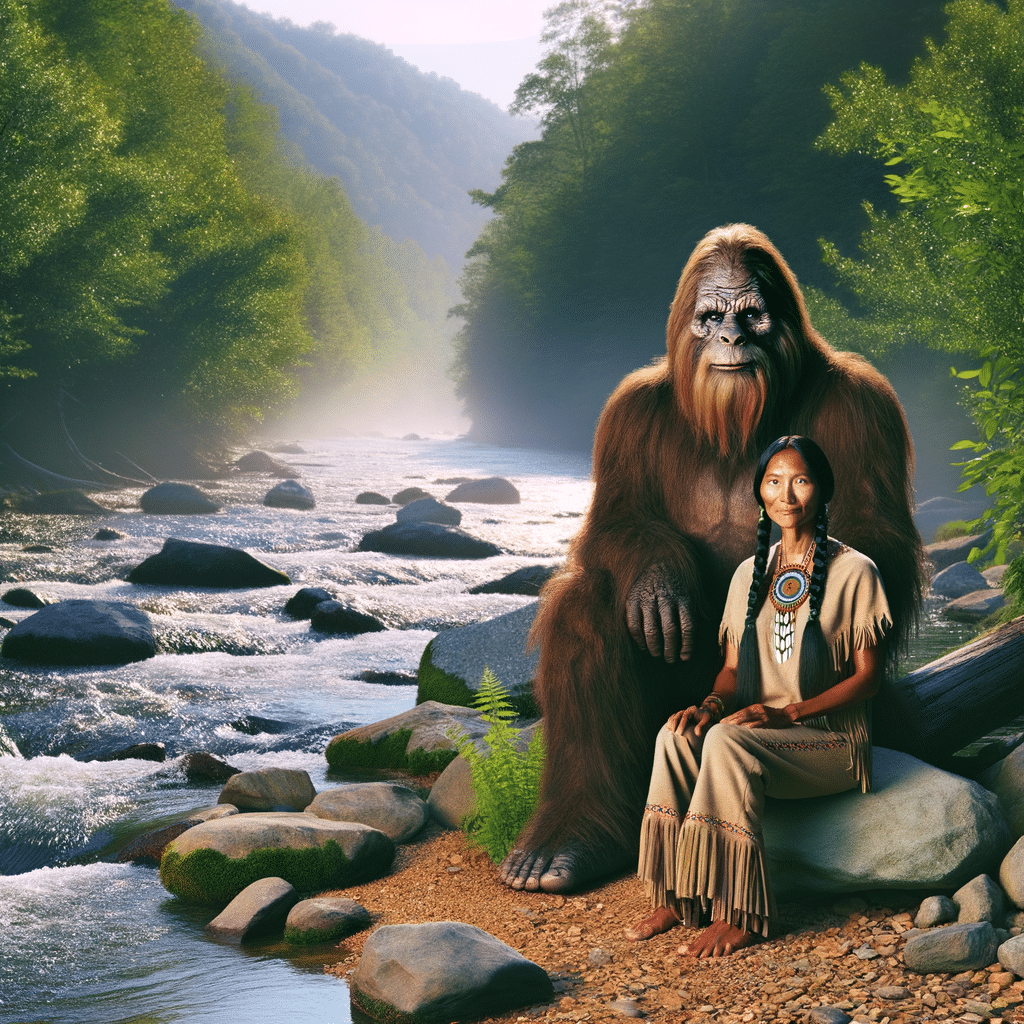
Giant tales are a common thread that runs through the history of human storytelling. They may be found in the epics of ancient Greece and Norse mythology, the Bible’s spiritual stories, and the Hindu Ramayana. These enormous beings are now more than just fictional characters; they are powerful symbols that teach moral education and social values. However, in the present day, although logic frequently consigns these creatures to the category of myth, there is one enormous figure that defies the final verdict of fiction: Bigfoot, or Sasquatch, as it is known in some Native American tribes.
This essay explores the mysterious Bigfoot mythology, going back to the beginning of the myth and looking at the modern sightings that sustain the tale. We’ll look at what Bigfoot really is, how important it is to Native American mythology, and address the age-old mystery of its existence.
Unraveling the Mystery of Bigfoot
The monster known by most as Bigfoot is thought to be an elusive giant that only leaves enormous footprints behind as proof of its presence. Despite having a unique name, Bigfoot is implied to wander all throughout North America, as sightings have been documented in all states but Hawaii. Particularly, the Pacific Northwest is a hotspot, with about one-third of all sightings occurring there.
According to descriptions, Bigfoot weighed an astonishing 800 pounds and stood eight to nine feet tall. Footprints up to 24 inches long and 8 inches wide are often used to deduce the existence of the species. Bigfoot stands out for his thick covering of dark hair, upright bipedal gait, and existence somewhere between an ape and a human. Because of this, some have theorized that Bigfoot might be a “missing link” in the evolutionary tree.

Bigfoot in Native American Lore
There are more than sixty different names for Bigfoot in Native American culture, where the myth originated. The word Sasquatch itself comes from the word Sesquac, which means “wild man” in the Halkomelem language of the Coast Salish Indians. Other tribes provide alternative names; two examples are “Oh-Mah” from the Hoopa and “Kecleh-Kudleh” from the Cherokee. The Okanogan refer to the monster as “Sne Nah,” or “Owl Woman,” while the Tillamook call it “Xi’lgo,” which translates to “wild woman.”
Though there are differences in terminology, local accounts of the beast are quite consistent: it is a large, wild creature that is completely covered in hair and lies halfway between a human and a beast. It is possible to construe this widespread Native American belief as a group affirmation of Bigfoot’s existence; however, this interpretation is not without controversy.
In their creation tale, the Yokuts of the Tule River Indian Reservation in California, for example, have old pictographs of the Hairy Man, a spiritual gatekeeper. The Hairy Man was a death omen, much like the Grim Reaper, who was a menacing character. Similar characters, such as the Me-Wuk tribe’s child-stealing Hairy Man, functioned as warning tales in other tribal traditions to discourage kids from going off on their own.
These stories probably originated as personifications of the natural threats that exist in the wilderness, acting as a cultural safeguard against facing the unknown with caution.

Conclusion: The Bigfoot Enigma
Therefore, the Bigfoot story is more than just a mysterious riddle that has to be answered; it’s a story line that connects contemporary interest with age-old knowledge. Although there is still much doubt about the creature’s existence, there is no denying the Bigfoot legend’s influence on people’s minds, especially in Native American cultures. Regardless of whether Bigfoot is a real creature or a mythical figure, it captures our innate desire for mystery and our tendency to humanize the wildness around us. We are constantly reminded of the power of myth and its enduring role in our collective consciousness as we struggle to determine whether Bigfoot is genuine.
Further Reading
Meldrum, J. (2006). Sasquatch: Legend Meets Science. Forge Books.
Dr. Jeff Meldrum, a professor of anatomy and anthropology, provides a rigorous scientific perspective on the Bigfoot phenomenon. In this book, Meldrum examines the available evidence for the existence of Bigfoot, from footprint analyses to eyewitness accounts, through the lens of a skeptical scientist. This book was selected for its scientific approach, which offers a credible examination of the legend and its potential realities.
Bindernagel, J. A. (1998). North America’s Great Ape: The Sasquatch. Beachcomber Books.
Wildlife biologist Dr. John Bindernagel presents his argument for the existence of Sasquatch as a North American great ape in this compelling book. Bindernagel meticulously compiles biological data, including sightings and physical evidence like footprints, suggesting that sasquatch could be a genuine species awaiting formal recognition. This work was chosen because it provides an insightful biological perspective on the Bigfoot debate, grounded in the author’s professional expertise.
Napier, J. (1973). Bigfoot: The Yeti and Sasquatch in Myth and Reality. E. P. Dutton.
With a foreword by famed anthropologist Dr. Richard Leakey, primatologist John Napier’s book explores the cross-cultural phenomenon of Bigfoot, including the Yeti of Asia, offering a comparative analysis of these creatures in myth and potential reality. Napier’s scholarly yet accessible writing style makes this book a classic in the field of cryptozoology. This work was selected for its historical and cultural context, which helps readers understand the broader implications of Bigfoot legends around the world.



Leave a Reply