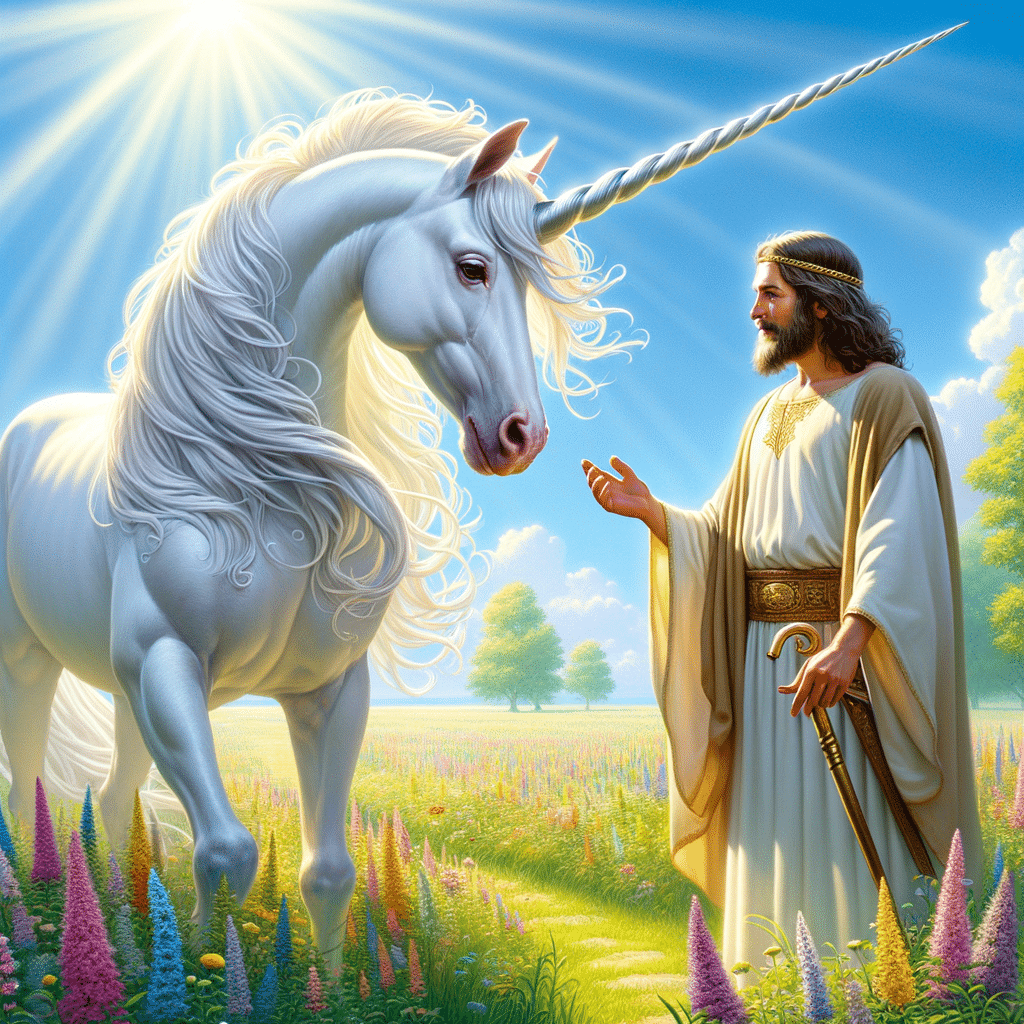
Are sea serpents, unicorns, and dragons real? The Bible says that they might be.
The Bible mentions many mythological animals that were common in prehistoric Middle Eastern folklore and tradition. The Bible names some of these creatures clearly, while it describes others in less detail. Analyzing these mythological characters helps us understand the myths and ideas that biblical societies held.
Unicorns
The Bible references the unicorn, one of the most well-known legendary creatures. The King James Version of the Bible makes multiple references to unicorns, depicting them as strong, untamed creatures with a single horn sticking out of their foreheads. Researchers speculate that the unicorn may actually be alluding to the extinct aurochs, a big creature that resembled cattle and had two horns, although from a profile view, it might only appear to have one. Ancient writers portrayed the strength and majesty of God’s natural creation through descriptions of unicorns as uncontrollably strong.
The Bible portrays the unicorn as a fierce, wild animal. Job 39:9–12 suggests that taming a unicorn is impossible.
The text says, “Will the unicorn obey your crib or be willing to serve you? Is it possible for you to tie the unicorn’s band to the groove? Or is he going to harrow the valleys in your wake? Will you trust him because of his immense strength? Or are you planning to delegate your labor to him? When he says he will carry your seed home and store it in your barn, will you trust him?
Numbers 23:22 and 24:8 describe unicorns as having considerable strength, along with other creatures like lions and bulls.
According to Isaiah 34:7, unicorns will also perish, along with the kingdom of Edom’s punishment.
Psalm 22:21 describes the unicorn’s horn as having immense strength, indicating that people thought unicorns were supernatural beings.
It reads, “Save me from the lion’s mouth, for thou hast heard me from the horns of the unicorns.”
Despite the frequent replacement of unicorns with other nouns in subsequent Bible translations, these texts nonetheless provide fascinating insights into the biblical people’s perceptions of legendary creatures found in the natural world.

Dragons
The Bible also mentions dragons, another common element of myth and folklore. People typically associate these animals with chaos and evil. The books of Psalms, Isaiah, and Jeremiah use dragons to symbolize desolation and locations that God has abandoned.
The Book of Revelation, however, contains the most dramatic illustration of a dragon in the entire Bible. In Revelation 12:3–4, a large red dragon with seven heads is described as representing Satan, who is threatening the lady dressed in the sun and her child.
The passage says, “And there was another marvel in heaven; and see, a big red dragon with ten horns, seven heads, and seven crowns on his heads.” The dragon approached the woman, who was about to give birth, with the intention of devouring her unborn child. The dragon’s tail then grabbed the third of the stars in the sky and hurled them towards Earth.
The dragon represents forces and beings that work against God and His redemptive mission. It is a potent metaphor for all that opposes God’s established order, including sinful and rebellious human tendencies, as well as supernatural beings like Satan.
Dragons also played a significant role in the literature and folklore of Egypt and Mesopotamia, two nearby societies. Popular myths and stories about ferocious serpents and draconic monsters vanquished by heroes and gods inspired the references to dragons in the Bible. Dragons were potent symbols of defeated foes and spiritual dangers because they represented chaos and wickedness.
Sea Monsters
The Bible also mentions sea monsters and serpents, such as Rahab and Leviathan. These animals, which frequently stand in for the wild elements of nature that only God can control or subdue, are symbols of chaos and disaster.
According to Job 41, Leviathan is an enormous, unconquerable monster that is impossible for people to subdue or defeat. It highlights the enormous gap between human potential and heavenly power. The creature serves as a metaphor for the enormous obstacles and hardships that, in our weakness as humans, we are unable to conquer without the help of God.
Chapter 41 begins with the following 10 verses: “Can you pull out the leviathan with a hook?” Could you please insert a hook into his nose? Could you please insert a hook into his nose? Maybe use a thorn to pierce his jaw. Will he come to you with numerous prayers? Will he talk to you in a gentle manner? Is he going to make a covenant with you? Will you consider him to be your permanent servant? Will you play with him like a bird? Or are you going to tie him to your maidens? Should his friends host a feast for him? Shall they divide him up among the traders? Can’t you put barbed irons all over his skin? Could you also stab him with fish spears? Place your hand on him, reflect on the battle, and come to a stop. Observe that his hope is in vain. Will someone not give up even at his sight?
In contrast, the books of Psalms and Isaiah use Rahab, a sea monster, as a metaphor for Egypt. Rahab’s loss reinforces the idea of God’s ability to save and free His people from seemingly insurmountable difficulties, symbolizing God’s release of the Israelites from their slavery in Egypt.
These references connect ancient Near Eastern mythology to biblical tales. Sea serpents are associated with chaos and primeval peril because of their relationship to the ocean. Sea serpents represent the uncharted aquatic environment’s strength and mystique because they are menacing entities that emerge from the ocean’s depths. God’s victory over these legendary beings symbolizes his tyranny over the universe’s and nature’s strong, chaotic elements. The sea serpents mentioned in the Bible highlight the enigmatic threats that lie in the seas and aquatic environments that surround the biblical landscape, whether they are genuine animals like crocodiles or symbolic monsters.

Other Mythological Creatures
The Bible describes a number of additional mythological animals in addition to unicorns, dragons, and sea serpents, including the Behemoth, Nephilim, and Satyrs. Similar to the Leviathan, the Behemoth symbolizes an uncontrollable natural force, a symbol of God’s creation that defies human comprehension or control. Genesis refers to the Nephilim as giants or “sons of God,” symbolizing the depravity of humankind that led God to decide to bring about the Great Flood.
Allusions to satyrs, or human-goat hybrids, are a reflection of popular Greek and Roman mythology. Through these kinds of mythological references, Biblical texts incorporated notions about magical animals that surrounding civilizations believed existed in remote regions of the known world.
According to Isaiah 13:21, “But wild beasts of the desert shall lie there; and their houses shall be full of doleful creatures; and owls shall dwell there, and satyrs shall dance there.”
A lot of people will argue that verses about sea serpents, dragons, and unicorns are all mistranslated or merely meant metaphorically. That might be the case. However, people regard other passages in the Bible with greater seriousness than dragons or unicorns. Given the inability to accept many Bible verses at face value, how can we take any of them seriously? This is the major task for biblical scholars who study biblical hermeneutics.
Conclusion
The rich cultural context that surrounds the writings of the Bible includes mythical animals like sea serpents, dragons, and unicorns. Middle Eastern customs, storytelling, and symbols influenced biblical portrayals of the natural world, as evidenced by the inclusion of these mythical monsters, despite their limited mention in the texts. The biblical authors used mythical creatures as rhetorical devices, symbolic imagery, and components of prophetic visions, drawing inspiration from stories and folklore. These amazing creatures continue to captivate the imagination of the general public, bringing to life the fantasy world of monsters, heroes, and wonders that surrounded the biblical environment.
References
Godbey, A. H. (1939). The unicorn in the Old Testament. The American Journal of Semitic Languages and Literatures, 56(3), 256-296.
Macumber, H. (2024). Disappointing Dragons: The Powerless Monster of the Hebrew Bible. Premodern Monsters: A Varied Compilation of Pre-modern Judeo-Christian and Japanese Buddhist Monstrous Discourses, 1.
Miller, R. D. (2019). Dragon myths and biblical theology. Theological Studies, 80(1), 37-56.
Sorensen, R. (2018). Unicorn Atheism. Noûs, 52(2), 373-388.
Weitbrecht, J. (2018). ” Thou hast heard me from the horns of the unicorns:” The Biblical Unicorn in Late Medieval Religious Interpretation. Interfaces: A Journal of Medieval European Literatures, (5), 49-64.




Leave a Reply