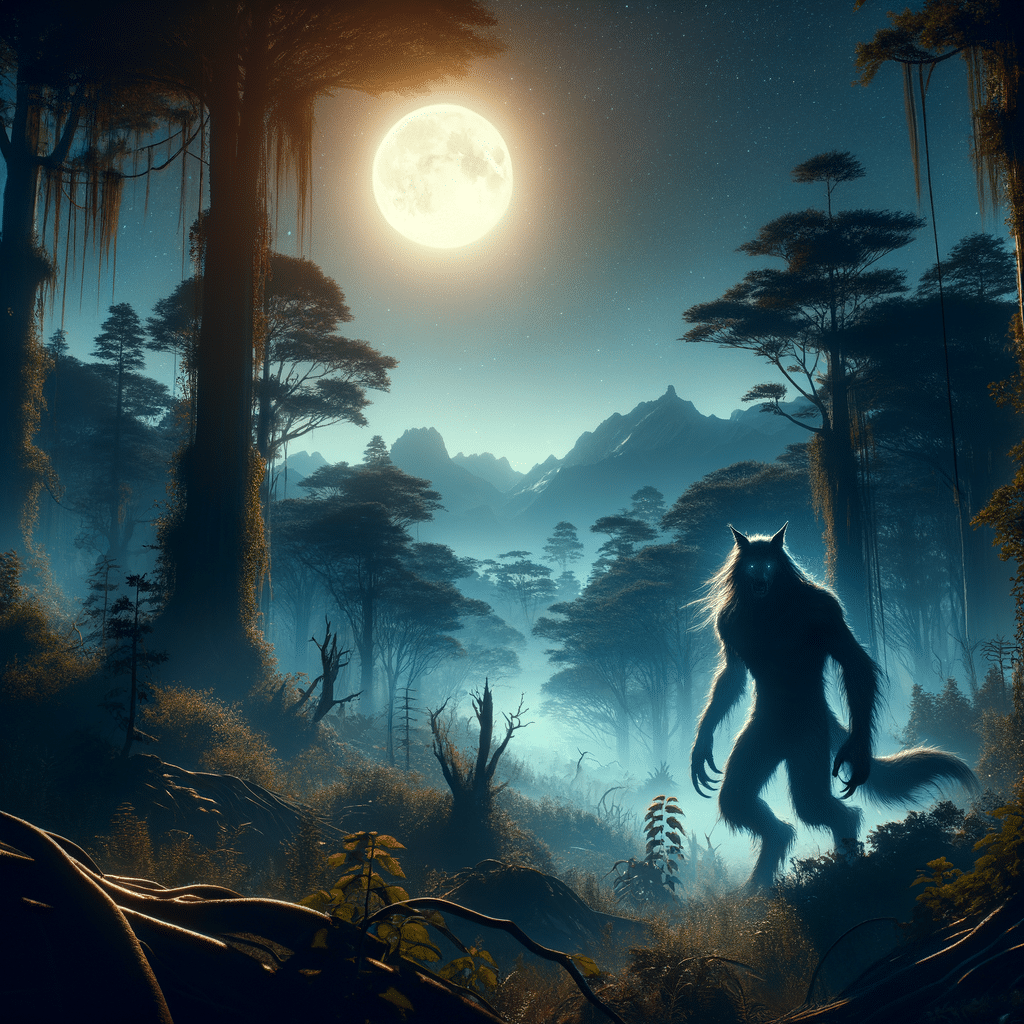
Many believe werewolves roam the hidden places of Argentina and other South American nations.
El Lobizón, also known as the Lobisón or Luisón, is a creature deeply rooted in the folklore of Argentina, as well as in other parts of South America such as Paraguay and southern Brazil. This mythical being is often described as a type of werewolf or a similar shapeshifting entity. Spanish and Portuguese colonizers are most likely responsible for bringing European werewolf tales to South America, where they combined them to create the legend of El Lobizón. While sharing similarities with its European counterpart, El Lobizon possesses unique characteristics and origins that set it apart.
There has long been conjecture that Portuguese settlers brought El Lobizon to South America. However, historical accounts state that the Lobizon originally appeared in the early 1900s, and current reports suggest that the beast is still seen. There is no way to be sure where the legend originally started.
Origins and Description
The Lobizón is typically said to be the seventh son in a family of all boys. According to the legend, this seventh son is cursed to transform into a creature that resembles a large dog or wolf on every full moon night, starting with his thirteenth birthday. The creature is often depicted with features that are a mix between a human and a wolf, possessing enormous strength and ferocious appetites. Its appearance is often described as having glowing red eyes, sharp fangs, and a generally grotesque and fearsome visage. Some stories claim that the Lobizón retains some level of human intelligence, while others suggest that it becomes a completely feral and savage beast during its transformations.
While often portrayed as a predator of livestock and even humans, some tales depict El Lobizon as a victim of circumstance, forced to endure the curse and its consequences. Unlike the purely malevolent werewolf, El Lobizon’s character can be more nuanced, sometimes eliciting sympathy as a victim of fate. Certain stories suggest the possibility of breaking the curse, often involving religious rituals or acts of selflessness. This curse is often attributed to divine punishment for the sins of the family or community, adding a layer of moral complexity to the myth. The creature is also believed to be able to spread its curse to those it bites, similar to the werewolves of European lore.
This legend prompted some people to abandon — or kill — their seventh-born sons. In response to this legend, there is an interesting cultural tradition in Argentina: the President of the country is sometimes asked to become the godfather of a seventh consecutive son to ward off the curse of becoming a Lobizón. So Argentina passed a law in 1974 that gave the seventh son presidential protection along with a gold medal and a scholarship until his 21st birthday.

Behavior and Sightings
The Lobizón is said to lurk in the rural areas, forests, and near rivers. It preys on livestock and possibly humans, though accounts of actual attacks are rare. Hundreds of eyewitnesses have reported seeing El Lobizon. The beast has been sighted in villages and small cities in addition to rural regions (such as farmlands) in certain cases. These witnesses vouch for having seen a werewolf-like creature in the flesh.
Sightings and stories of the Lobizón continue to be reported in modern times, particularly in small communities where such legends are often passed down through generations. While many consider the Lobizón to be a mere superstition, others treat its existence with a degree of seriousness, avoiding certain areas at night and taking precautions during full moons.
There are various methods said to protect oneself from the Lobizón or to ward it off. Some stories suggest that religious symbols, such as a crucifix or rosary, can deter the creature, while others claim that the use of certain herbs or plants can offer protection. In some accounts, it is believed that the Lobizón’s power can be neutralized by making it count the seeds of a specific fruit, such as a melon or a pumpkin, which it becomes compelled to do, thus distracting it from its intended prey.
In terms of truly dispatching the beast, silver bullets or a dedicated weapon are not necessary for the task. The Lobizon can be killed with cold steel and fire, just like any other animal. Swords and long spears are suggested weapons. Despite its small, the Lobizon moves incredibly quickly and with great strength. It’s usually a good idea to try to penetrate important organs from a somewhat safe distance. A strong, sharp instrument such as an axe or sword should be used to decapitate the beast even if it appears to be dead. It may take several hours to burn the body to ashes, after which the ashes should be thrown to the winds or thrown into flowing water. El Lobizon will not be able to regenerate and come back to life thanks to these precautions.
Although the Argentinean people are terrified, they don’t seem to be as afraid of the beast as they are of some of the more horrific creatures that lurk in the shadows of the night. This may be because the Lobizon loves the flavor of raw meat, since the majority of this particular werebeast’s prey consists of agricultural animals (such as cows and chickens). Reliable stories of this beast killing and consuming humans are scarce, if any. Maybe the beast thinks people are too dangerous to eat. Even though there isn’t much fear of the beast eating them, the idea of El Lobizon’s curse falling on their lowly relatives still terrifies the populace.
The Lobizón has roots in Guarani mythology, where similar creatures known as “Luisõ” exist. These beings are said to be spirits or demons of the night. The Guarani are an indigenous people from the region that now comprises Paraguay, southern Brazil, northeastern Argentina, and parts of Uruguay and Bolivia. The European werewolf myth likely merged with indigenous beliefs about these night creatures during the colonial period, creating the modern Lobizón legend.
While the basic premise of the Lobizón being the seventh son transformed into a werewolf-like creature is consistent, there are regional variations in the story:
In Paraguay, the creature is often referred to as Luisõ and is considered more demonic, associated with death and misfortune. It is feared for its supernatural powers rather than just its physical strength.
In southern Brazil, particularly in areas with a high concentration of Guarani people, similar legends exist but may have different names and attributes, reflecting the local adaptation of the myth.

Cultural Impact
Folklore like that of the Lobizón often serves deeper psychological and social purposes. In the case of the Lobizón, the transformation can be seen as a metaphor for the onset of puberty or other significant life transitions. The fear of the seventh son might also reflect historical anxieties about inheritance and family legacy, particularly in rural communities where resources could be scarce.
Furthermore, the myth of the Lobizón could be interpreted as a way of instilling social conformity. By attributing monstrous transformations to those who differ from the norm (in this case, being the seventh son), the folklore reinforces standard social structures and discourages deviation. The legend of El Lobizón also serves as a means of explaining the unexplainable, such as mysterious deaths, disappearances, or strange occurrences in rural areas.
The legend of El Lobizón has had a significant impact on the cultural heritage of the regions where it is believed to exist. It is a common subject in local stories, movies, and literature, often serving as a symbol of the unknown and the mystical aspects of nature. The story also reflects deeper themes, such as the fear of the other and the transformation of the self.
In popular culture, the Lobizón has been featured in various forms of media, contributing to the global fascination with creatures of the night. It also plays a role in discussions about the supernatural in Argentine folklore, alongside other mythical beings like La Llorona and El Chupacabra.
For instance, it appears in comics, films, and literature, sometimes portrayed with a horror slant, while other times it’s approached more humorously or with a focus on cultural identity.
In some communities, the legend of the Lobizón is celebrated during festivals, particularly around Halloween or local equivalent celebrations, where stories are told, costumes are worn, and the cultural heritage is passed down through generations.
Argentine and Paraguayan media sometimes use the Lobizón as a character or reference point in discussions about folklore and national identity. This creature is particularly appealing for horror and fantasy genres.
Conclusion
El Lobizón remains a fascinating aspect of South American folklore. Whether as a cautionary tale to instill fear and enforce social norms, or as a thrilling story told around the fire, the legend of the werewolf-like creature continues to captivate imaginations. As is often the case with folklore, the Lobizón serves not only to entertain but also to convey cultural values and explore the complexities of human nature and the unknown.


Leave a Reply