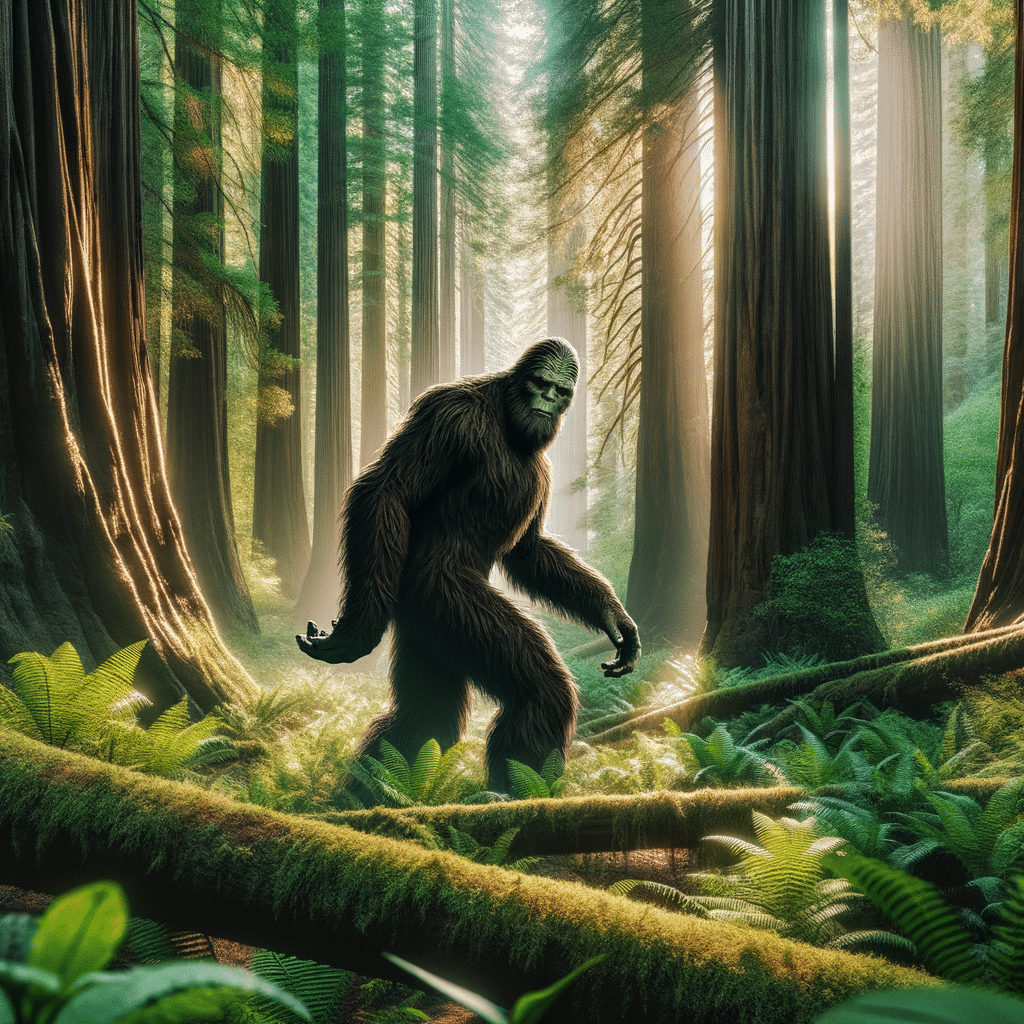
A fascinating section of American legend, the Bigfoot phenomenon is representative of a larger human obsession with the enigmatic and inexplicable. The modern story of Bigfoot did not become ingrained in the American consciousness until the late 1950s, despite sightings and stories dating back to Native American legends and early settler accounts. This was due to a confluence of events and a growing media landscape that was hungry for dramatic tales.
The serene forests of Northern California became the focal point of a growing legend in October 1958. A shocking headline from the local newspaper, The Humboldt Times, read, “Giant footprints puzzle residents.” Journalist Andrew Genzoli’s story described how a road construction crew at Bluff Creek, a remote location that would later become associated with Bigfoot legend, discovered massive, apelike footprints. Crew leader Jerry Crew took the initiative to make a plaster cast of these enormous prints, which are eighteen inches long and seven inches wide, and then brought this “proof” to the newsroom. The story and the big plaster footprint’s striking visual impact piqued the public’s interest.
Not only did Genzoli’s story document an abnormality, but it also gave rise to the nickname “Bigfoot,” which would go on to become a commonplace term in both American and international popular culture. This branding was not accidental; rather, it was a masterful media influence tactic that distilled the mystery’s essence into a single, potent phrase that piqued the interest of a nation that was enamored with the notion that unknown species might be hiding in its vast wildernesses.
This tale is similar to the Loch Ness Monster. It makes sense to draw a parallel between the Loch Ness Monster, Bigfoot, human behavior, and media consumption. These tales demonstrate a fundamental human inclination to be lured to the implausible and the unknown. It is impossible to overestimate the influence of the media on this fixation; it serves as a catalyst, drawing hordes of tourists, scientists, and monster hunters to regions like Humboldt County and Loch Ness in the hopes of coming across a fabled beast.

Hoax Revealed
But the underbelly of the Bigfoot mythology exposes a more depressing reality about the power of the media and the credulity of the populace. Many years after the initial thrill, it was discovered that Ray Wallace, a prankish team member of Jerry Crew, had stage-managed the entire affair. Wallace unintentionally started one of the largest wild goose chases in modern history when he carved the enormous footprints out of wood. His 2002 confession, which his family made public after his passing, showed how what had initially been a simple joke among coworkers had developed into a significant part of modern mythology.
This discovery raises questions about the nature of belief and the influence of the media. The Bigfoot hoax serves as a reminder of how quickly a made-up tale can become a legend when it draws on preexisting myths and receives consistent media support. In addition to being a tale about a legendary creature, Bigfoot’s story also explores the human need for mystery and adventure, as well as the function of the media in creating stories that offer an escape from everyday life.
Just because this incident was hoaxed does not mean Bigfoot doesn’t exist. Wallace may well have been hoaxing an actual local monster unknown to science. He selected Bigfoot tracks because there were stories of a Bigfoot creature in local legends. However, it certainly takes away from the credibility of Bigfoot overall.
Bigfoot is more than simply a monster; it’s a cultural phenomenon that provides important insights on media influence, human psychology, and the creation of contemporary myth. It reminds us of our never-ending search for wonder and the extent we will go to in order to support or refute the fanciful. The Bigfoot story serves as a warning about the need to confirm facts and the public’s vulnerability to concocted riddles as we continue to navigate an era of information overload.
Further Reading
Buhs, J. B. (2009). Bigfoot: The life and times of a legend. University of Chicago Press.
This book by Joshua Blu Buhs offers a comprehensive look at the Bigfoot legend, tracing its origins and examining its development over time. Buhs not only explores the specific incidents that contributed to the Bigfoot myth but also situates the story within the larger context of American folklore and the societal need for monsters and myths. The detailed research and engaging narrative make this an essential read for anyone interested in understanding the cultural significance of Bigfoot.
Coleman, L., & Clark, J. (1999). Cryptozoology A to Z: The encyclopedia of loch monsters, Sasquatch, Chupacabras, and other authentic mysteries of nature. Simon & Schuster.
This encyclopedia, which Loren Coleman and Jerome Clark wrote, is a goldmine of knowledge on cryptozoological creatures like Bigfoot. The authors provide a detailed catalogue of various mythical and unproven creatures reported across the world, offering insights into the folklore surrounding each. This book is particularly useful for those interested in the broader field of cryptozoology and how Bigfoot compares to other legendary creatures.
Napier, J. (1973). Bigfoot: The yeti and Sasquatch in myth and reality. Dutton.
John Napier’s book provides a scientific perspective on the Bigfoot phenomenon, analyzing physical evidence and eyewitness accounts through the lens of a primatologist. While Napier maintains a skeptical approach, his analysis is thorough and balanced, offering readers a scientific framework for considering reports of Bigfoot and other similar creatures. This book is recommended for those who are interested in a more rigorous, scientific examination of the evidence surrounding Bigfoot myths.




Leave a Reply