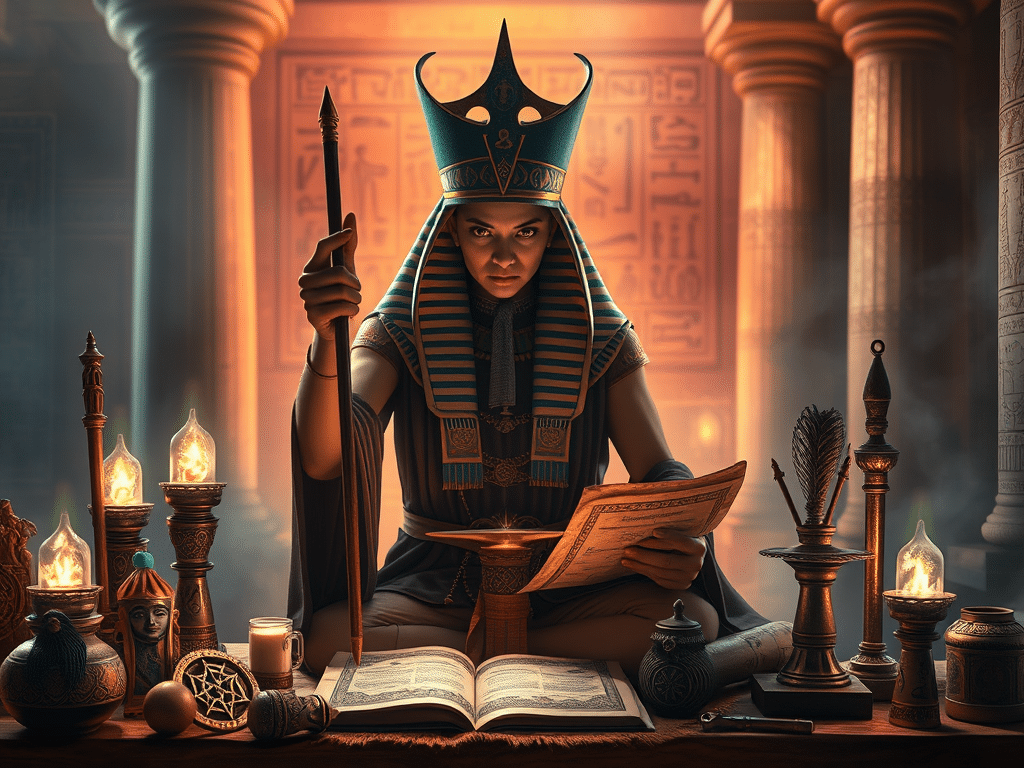
Witchcraft and Magic in Ancient Egypt: Key Points
-
Ancient Egyptian witchcraft was integrated into mainstream society, with magical practitioners respected as professionals, unlike later Western traditions that feared and persecuted witches.
-
Magic was initially controlled by priests but eventually spread to magicians, midwives, and wise women who served community needs.
-
Egyptian magical practitioners required mastery of alchemy, astrology, astronomy, herbal medicine, and religious devotion, drawing power from connections to specific gods.
-
Egyptian magic utilized sophisticated tools, including spells from the Book of the Dead, decorated wands, protective amulets, and secret names for protection.
-
Magic served both individual needs, like healing, and state purposes, like cursing enemies through elaborate rituals with figurines and written spells.
-
Magic’s integration into Egyptian society reflected a worldview where supernatural forces constantly interacted, making magic a valuable tool rather than a forbidden practice.

Introduction
People used witchcraft and magic in the past to attempt to control nature and fate. The Egyptian period was one of the first times that people tried to do this. Ancient civilizations incorporated magical practices into their religious and social systems, in contrast to the contemporary Western view of witchcraft as a nefarious and illicit art. Of all the ancient cultures, Egypt is the only one that accepted magic and saw it as a divine gift, a way to protect oneself, and a way to keep the universe in order. The ancient Egyptians engaged in witchcraft with what has been characterized as “mathematical precision,” regarding individuals who possessed magical abilities not with trepidation but with profound reverence (Schoppert, 2017). This essay investigates the characteristics of witchcraft in ancient Egypt, analyzing the functions of Egyptian witches and magicians, the techniques and resources they utilized, and the notable distinctions between ancient Egyptian magical traditions and contemporary interpretations of witchcraft.
Overview
In the past, witchcraft was closely linked to religion, medicine, and how people understood natural events. In the past, people didn’t think of science, religion, and magic as separate things like we do today. Rather, these domains significantly overlapped, with practitioners of magic acting as intermediaries between the human and divine realms. Pollard (2008) observes that Roman literature and art frequently depicted witchcraft through gendered perspectives, portraying female practitioners as perilous and deviant individuals who operated beyond societal conventions. However, this portrayal varied significantly across different ancient cultures. In many ancient cultures, people who practiced magic were important members of the community who offered important services, such as healing the sick and protecting against evil forces. People in the past considered magic to be a real source of knowledge and power that could be used for good or bad, depending on the practitioner’s skill and intentions.
Witchcraft held a distinctive and esteemed status in ancient Egyptian society, contrasting sharply with its depiction in numerous other ancient cultures. In her research on how Victorians thought about Egyptian practices, Dobson shows that the Victorian era’s interest in Egyptian magic was a sign of how advanced and complicated it was. The Egyptians thought that magic, or “heka,” was a gift from the gods to people to help them avoid adverse luck. At first, only priests in Pharaonic Egypt could control magic. They were “the guardians of the knowledge bestowed upon humans by the Gods” (Schoppert, 2017). These religious figures had different ranks. Lector priests had the most magical power because they could read ancient magical texts. By the first millennium BCE, though, magical knowledge had spread beyond priests to include magicians, midwives, nurses, and wise women who could be called upon for help with different things. The democratization of magical practice in Egypt indicates a society that regarded magic as a vital instrument for overcoming life’s difficulties rather than as an entity to be feared or repressed (Ritner, 1987).
People who practiced magic in ancient Egypt, who we might call witches today, were very skilled and got their power from a mix of special knowledge and a connection to the divine. These magical practitioners had to be skilled at many things, such as “alchemy, astrology, astronomy, animal concoctions, and herbal medicines,” as well as being religious and having a personal relationship with a god (Schoppert, 2017). Egyptian magicians got their power from their ties to certain gods, who gave them power and were the focus of their magic work. Literacy was essential for magic because written spells were especially powerful because so few Egyptians could read or write. People would carefully keep these written spells and pass them down from generation to generation, making them very valuable sources of power. Women who worked as midwives or wise women were thought to have magical powers that made them especially adept at dealing with childbirth, illness, and problems caused by ghosts or gods. This acceptance of women who practiced magic is very different from later times when women who were thought to be witches were killed and persecuted.
The techniques and instruments utilized by ancient Egyptian witches and magicians were both varied and highly specialized, demonstrating an advanced comprehension of the manipulation of supernatural forces. Nagel’s (2019) study of stories about magical power shows how ancient practitioners used different objects and rituals to direct and channel magical energy. Egyptian magicians used spells and amulets a lot, and each one had a very specific purpose. The well-known Book of the Dead had many spells that were thought to be able to change fate and ensure a safe journey to the afterlife. People used highly prized, intricately decorated magic wands to call magical creatures and make them do what they wanted. People thought that semi-circular ivory wands from around the second millennium BCE could make protective circles around people who were weak, like sick people or women giving birth. Amulets made by skilled men or women could be worn for protection or used in spells. One intriguing thing about Egyptian magic was that magicians thought they could only cast spells against someone if they knew that person’s true, private name, which only their mother knew. Because of this belief, most Egyptians had both a public name and a private name to protect themselves from evil magic.

Analysis
Magic in ancient Egypt was used for more than just personal needs; it was also used for the benefit of the state and to keep the universe in order. This shows how important magic was to Egyptian society and government. The state used what we would now call “black magic” or curse magic against enemies and threats to the divine order. Priests would write enemies’ names on pots, tablets, or figurines, tie them together, and burn or bury them to weaken them. More elaborate ceremonies involved making pictures of enemies on papyrus or modeling them in clay. Then, the pictures would be “trampled, burned, and stabbed, and the pieces would be dissolved in urine” (Schoppert, 2017). These rituals could be used against both supernatural enemies, like the chaos serpent Apophis, who threatened the sun god, and people who were enemies of the Pharaoh. During the reign of Ramesses III, there was a famous historical event in which priests, harem girls, and courtiers plotted against the king using a book of harmful spells. The conspirators got hair from the king to make their spells stronger on figurines, but the plan failed, and everyone involved was sentenced to death. This event shows that the Egyptians believed in the real power of magic and that they thought it couldn’t work against rulers who were chosen by God.
There are big differences between how ancient Egyptians thought about witchcraft and how people in the West view it today. These differences show how cultural contexts shape our understanding of magical practices. Contemporary witchcraft, especially in its portrayals within popular culture, is frequently linked to solitary practitioners who function outside or in opposition to established religious institutions, often with malevolent motives. The Salem witch trials and Halloween pictures have linked witches to negative things like fear and persecution. In contrast, ancient Egyptian magic was a normal part of religion and society. People who practiced magic were important members of their communities and had the support of the government and religious leaders. Modern witchcraft is often secretive and looked down upon, but Egyptian magic was well-known and respected. The gender dynamics are also entirely unique. For example, later European witch hunts mostly targeted women, but ancient Egypt recognized both male and female magical practitioners. Women’s magical abilities held special value in certain areas, such as childbirth and healing. The Egyptian belief that harmful magic was mainly the work of foreigners is very different from later times when people were afraid of witchcraft coming from their own groups (Hutton, 2017).
There are a few theories that help us understand why ancient Egyptian witchcraft was so different from later Western traditions. One theory posits that the incorporation of magic into Egyptian religion signifies the culture’s core worldview, perceiving the universe as a realm where divine, natural, and supernatural forces are perpetually engaged with one another. In this cosmology, magic was just another way to control these forces, and it was no better or worse than other knowledge. Another theory says that Egypt’s relative stability and strong central government kept magical practices under institutional control, which stopped the kind of fear and persecution that happened during later times of social upheaval. The focus on literacy and specialized knowledge in Egyptian magic may also show how the culture as a whole valued education and expertise, with magical power being considered a professional skill rather than a scary and mysterious ability. The link between magic and medicine in ancient Egypt also suggests that magical practices may have grown up with early scientific knowledge, with successful treatments making people believe in the power of magic even more. The transition of magic from a priestly monopoly to a more widespread practice during the first millennium BCE may indicate broader societal transformations, including heightened literacy and the decentralization of religious authority.
Conclusion
The examination of ancient Egyptian witchcraft provides significant understanding of how human societies have comprehended and attempted to influence supernatural forces throughout history. Ancient Egyptians viewed magic as a divine gift and revered those who practiced it as experts. This outlook is very different from the fearful and persecutory view of witchcraft that developed later. Egyptian witches and magicians were highly trained professionals who used their knowledge of many different fields, along with their religious faith and connection to the divine, to help their communities with everything from healing the sick to protecting them from both human and supernatural enemies. The complex ways they used magic, such as spells, amulets, wands, and long rituals, show that they knew a lot about how to use magical power well. The differences between how ancient Egyptians and modern Westerners thought about witchcraft show us that our ideas about magic are heavily influenced by culture, religion, and social structures. The ancient Egyptians viewed witchcraft with respect and utility, demonstrating an alternative approach to incorporating the supernatural into daily life. They saw magic as a useful tool instead of a dangerous crime. Studying these old customs helps us understand the past and question what we think we know about the lines between the natural and the supernatural, the sacred and the profane, and what is okay and what is not.
References
Dobson, E. (n.d.). Victorian alchemy: Science, magic and ancient Egypt. UCL Press.
Hutton, R. (2017). The witch: A history of fear, from ancient times to the present (Vol. 88). Yale University Press.
Nagel, A. (2019). Narrations of magical power. Magic, Ritual, and Witchcraft, 14(1).
Pollard, E. A. (2008). Witchcrafting in Roman literature and art. Mediterranean Review, 3(2).
Ritner, R. K. (1987). The Mechanics of Ancient Egyptian Magical Practices (Doctoral dissertation, The University of Chicago).
Schoppert, S. (2017, March 22). Ancient witchcraft: How magic was used in ancient Egypt. History Collection. https://historycollection.com/truth-witchcraft-ancient-egypt/
Leave a Reply