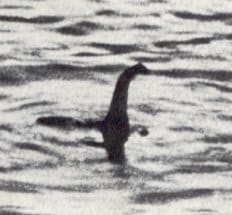
The most well-known picture of the Loch Ness Monster from 1934 is a hoax. But it is quite the story.
One of the most well-known and persistent myths about the legendary creature believed to inhabit Loch Ness in Scotland is the 1934 Loch Ness Monster hoax. The hoax revolves around a photograph, commonly known as the Surgeon’s Photograph, purported to offer visual proof of the Loch Ness Monster.
Loch Ness is a vast, deep freshwater loch in the Scottish Highlands. It is home to the legend of a creature known as the Loch Ness Monster, or Nessie for short. The folklore surrounding this beast is one of the world’s most well-known and persistent cryptozoological riddles.
Loch Ness Monster Legend
Legends suggest that Scottish rivers and lochs are home to water horses, also known as kelpies. These stories have long been a part of local tradition. These tales frequently speak of shape-shifting creatures that can entice humans to their deaths in the ocean by pretending to be gorgeous horses. These stories, however unrelated to the Loch Ness Monster, are a reflection of Scottish culture’s long-standing fascination with enigmatic aquatic monsters.
Adomnán wrote The Life of Saint Columba in the seventh century, and it contains one of the oldest and most well-known narratives. The narrative claims that in the year 565 AD, Irish missionary Saint Columba came across a huge aquatic beast in the River Ness. According to legend, Columba called out God’s name to order the beast to back off as it approached a swimmer. Amazingly, the animal complied and swam off, sparing the swimmer no harm.
Hector Boece’s Chronicles of the Kings of Scotland describe big fish and slithering aquatic animals that live in Scottish waters, such as Loch Ness. Even though these stories don’t mention the Loch Ness Monster specifically, they add to the local folklore around enigmatic water monsters.
On August 27, 1868, the Inverness Courier reported the sighting of a “fish-like” creature in Loch Ness. The description of the creature included a head resembling a horse and a long, serpentine body. This report contains one of the first media reports of an enigmatic creature in the Loch.
Early in the 20th century, the current Loch Ness Monster tale started to take shape. When they built a road by the loch in 1933, more people drove by and reported more sightings. In the same year, George Spicer and his spouse claimed to have seen a big, long-necked animal cross the road in front of their automobile and head toward the lake.
Over the years, thousands of people have reported seeing the Loch Ness Monster. Though descriptions vary, they typically depict the monster as enormous, with a long neck and one or more humps sticking out of the water.
Numerous scientific studies have used sonar and other technologies to find anomalies underwater. Although there have been some interesting sonar interactions, they have not shown that a large species exists. In 2018, a thorough DNA survey on Loch Ness revealed a significant amount of eel DNA, suggesting that huge eels could be the cause of some sightings but no evidence of large mammals.

The Hoax
The British tabloid Daily Mail released a picture in April 1934 that showed what looked to be a long-necked, serpentine creature rising out of Loch Ness. The original report attributed the photo to London doctor Robert Kenneth Wilson, who wished to remain anonymous. Because of his line of work, the picture became known as the “Surgeon’s Photograph.”
The picture shows a black object with a small head and a long neck sticking out of the water, causing ripples to surround it. This image piqued the public’s interest, which improved the legend. This photo was considered the best proof of Nessie’s existence for many years.
In 1994, sixty years after the photo’s capture, researchers discovered the fraud. Christian Spurling admitted on his deathbed that the picture was a fabrication. Big-game hunter Marmaduke Wetherell, whom the Daily Mail had disproved in his past attempts to track down Nessie, masterminded the prank. Wetherell recruited his stepson, Spurling, to assist in building a model of the monster out of a desire for retribution.
Christian Spurling was an accomplished model builder. Spurling’s creation of the Loch Ness Monster model was a key component of the hoax. Spurling said in 1994 that he had built a small, intricate model with a toy submarine as the base and putty-and-wood for a head and neck. He intended for the model to resemble a creature emerging from the ocean.
Ian Wetherell, Marmaduke Wetherell’s son, was also involved in the scam. He was part of the real photo shoot setup at Loch Ness. After Ian submerged the model in the water, he and his father took the pictures that Wilson would publish.
They carefully followed the strategy to ensure the picture appeared real. They placed the little model in Loch Ness and captured it in a low-angle photo to give the impression that it was bigger and farther away. They intended the water ripples surrounding the figure to intensify the impression of a large animal swimming through the loch.

Alternate Theories
Just because this picture was a hoax doesn’t mean that the Loch Ness Monster isn’t real. Many people have hoaxed real animals before. However, it does hurt the credibility of the Loch Ness Monster story.
Numerous theories put forth contend that reports of sightings of the Loch Ness Monster are actually misidentifications of regular animals such as big fish, otters, or seals. Natural occurrences like waves, floating logs, and other phenomena can also produce large-looking illusions.
According to a widely held belief, Nessie might be a living example of a plesiosaur, a kind of marine reptile from the Mesozoic epoch. However, the absence of fossil evidence in the loch and the possibility of a breeding population remaining undetected for millions of years present serious obstacles to this proposal.
Theories suggesting Nessie is real are unlikely to be true, leaving only misidentification and a very real hoax to explain the Loch Ness Monster legend.
Conclusion
The image, albeit disproved, had a long-lasting effect on the Loch Ness Monster belief. It was essential in making the mythology more widely known and has served as the impetus for countless studies, documentaries, and trips to Loch Ness. The tale of the “Surgeon’s Photograph” serves as a helpful reminder of the ease with which myths can spread and the importance of exercising skepticism when confronted with exceptional claims.

Leave a Reply