
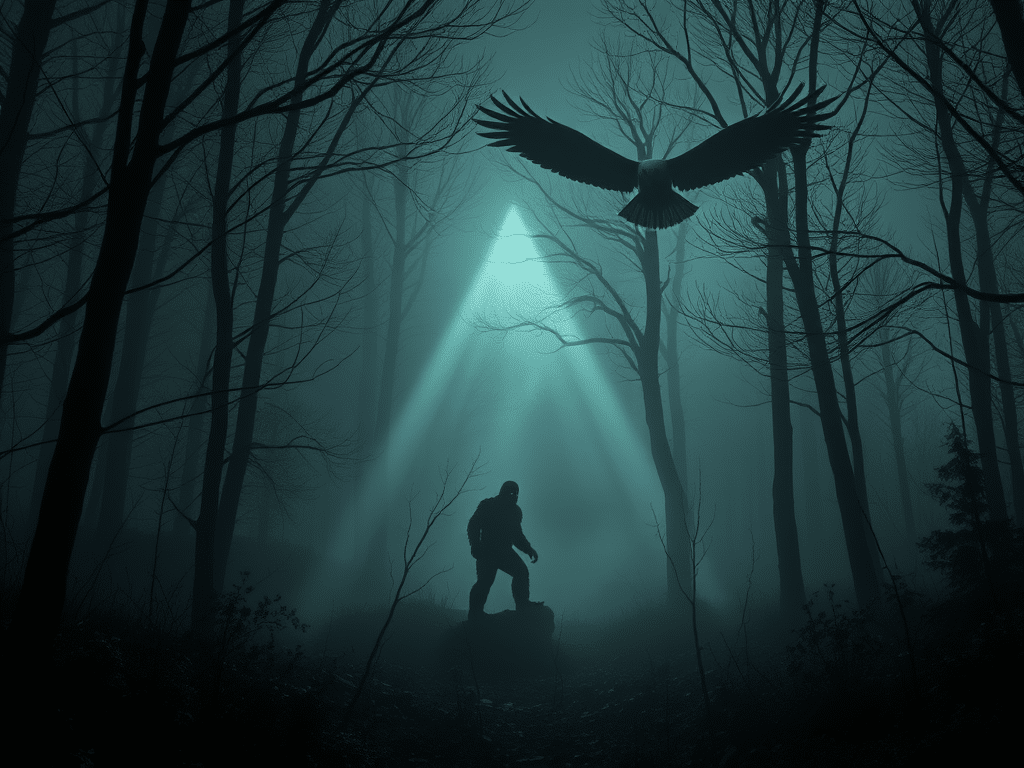
Why is it that so many paranormal photos are blurry? Why do we need to put a red circle around Bigfoot to find him in a picture?
For a variety of reasons, photos depicting paranormal phenomena—such as ghosts, UFOs, and Bigfoot—are frequently blurry. We can broadly divide these explanations into four categories: physical nature, psychological aspects, environmental influences, and technical restrictions.
Technical, Environmental, and Psychological Reasons
One major factor contributing to blurry pictures is the caliber of the used camera. Witnesses typically use whatever camera they have on hand, which is typically a smartphone with limited capabilities, leading to many unexpected occurrences of paranormal events. When used at high zoom levels or in poor light, these devices may produce fuzzy images. Moreover, motion blur is a frequent problem. Many times, paranormal encounters are brief occurrences, and witnesses may have mishandled their cameras out of excitement or terror. This causes motion blur, particularly in dimly lit environments where the shutter speed of the camera is slower. Problems with focus are another technical factor. The strange forms and motions of supernatural beings may be difficult for automatic focus systems to handle. Out-of-focus photos can occur when a subject is moving quickly, is far away, or is not well defined. Cameras may have trouble locking onto these types of subjects.
The environment also plays a significant role. Nighttime or poorly lit settings are the settings for many of the documented paranormal occurrences. Longer exposure periods or higher ISO settings are necessary in low light, and both can increase noise and blurriness in photos. In addition, weather-related factors like mist, rain, or fog can distort the subject and cause hazy photos. Places where reports of paranormal sightings are common often experience these circumstances, adding another degree of distortion.
Psychological considerations are another important component to consider. Tension or heightened emotions frequently experienced by paranormal phenomenon witnesses can compromise photographic clarity. Adrenaline, shaking hands, and fast breathing can all lead to subpar pictures. People can also see and capture images of what they expect to see. Looking back at their pictures, individuals’ expectations may lead them to perceive hazy figures or nebulous objects as paranormal, despite normal circumstances causing the blurriness.

Confirmation Biases and Hoaxes
Some people might purposefully produce blurry photos in order to pull off a prank. They might employ a variety of methods, like motion blur, out-of-focus photos, or artificially enhancing blurriness in post-processing. The idea is to conceal information that might expose the deception while creating an image that appears enigmatic or indicative of paranormal activity.
Sometimes blurriness causes photographers to unwittingly capture everyday things or events in a way that makes them seem intriguing. For instance, one could mistake a grainy picture of an insect or bird for a UFO, or mistake a particle of dust or a reflection for a ghost. The blurriness introduces uncertainty, making these misunderstandings possible.
The psychological phenomenon known as pareidolia describes the inclination to identify well-known faces, patterns, or shapes in seemingly random or confusing visual data. When viewing hazy paranormal photos, people may perceive human features, alien faces, or other identifiable forms as essentially visual noise or distortion. Pareidolia may lead to the perception that a fuzzy image depicts something supernatural.
People who have a strong belief in the presence of paranormal events are more inclined to see blurry photos as proof of their theories. Confirmation bias can cause people to ignore contradictory explanations or discrepancies and concentrate only on aspects of the image that match their preconceptions.
Photoshopped images of purported paranormal activity are increasingly popular on social media and in sensationalized news articles. The photos’ blurriness might heighten their mystique and make them more captivating to share. Even though the initial context or goal of these photographs was misleading, their virality could misrepresent them as real proof.

Paranormal Reasons
Some theories suggest that paranormal entities could produce or alter electromagnetic fields. If this were the case, their presence might cause electronic devices—including cameras—to malfunction. This influence may cause noise, distortions, or glitches in the resulting photos. It’s crucial to remember, though, that commonplace elements like defective equipment or unfavorable ambient circumstances may also contribute to these distortions.
People frequently describe the movements and forms of paranormal entities as peculiar or unpredictable, defying recognition. These features could make it difficult for cameras to get good pictures of them. For example, autofocus systems may find it difficult to lock onto subjects that move irregularly or have soft edges. As a result, photos may be grainy or out of focus.
If paranormal entities have certain characteristics that influence how they interact with light, the way they appear in photos may change. For instance, an object may appear translucent, distorted, or unusually bright in photos if it absorbs or reflects light differently from actual objects. However, reflections, aberrant lighting, or photography artifacts may produce similar appearances.
According to certain paranormal hypotheses, things like ghosts and UFOs may exist in dimensions that are outside of our usual senses. If this were the case, it would be difficult to photograph them because the equipment is designed to record three-dimensional, tangible reality. Photographing events outside of these dimensions may produce distorted, incomplete, or fuzzy photographs.
Another theory is that certain supernatural beings might be able to manipulate their appearance or level of visibility. If they have the ability to select when and how to manifest, they may only show up momentarily or partially, which would make it challenging to take sharp pictures of them. Nevertheless, this theory is predicated on unproven assumptions regarding the characteristics and powers of paranormal entities.
Conclusion
Photographs purporting to capture UFOs, ghosts, or Bigfoot are frequently fuzzy due to a mix of technical issues, ambient circumstances, human psychology, and the elusiveness of the phenomenon itself. These elements do not necessarily rule out the existence of paranormal beings, but they do draw attention to the difficulties in obtaining unambiguous, photographic proof of such occurrences.
Leave a Reply