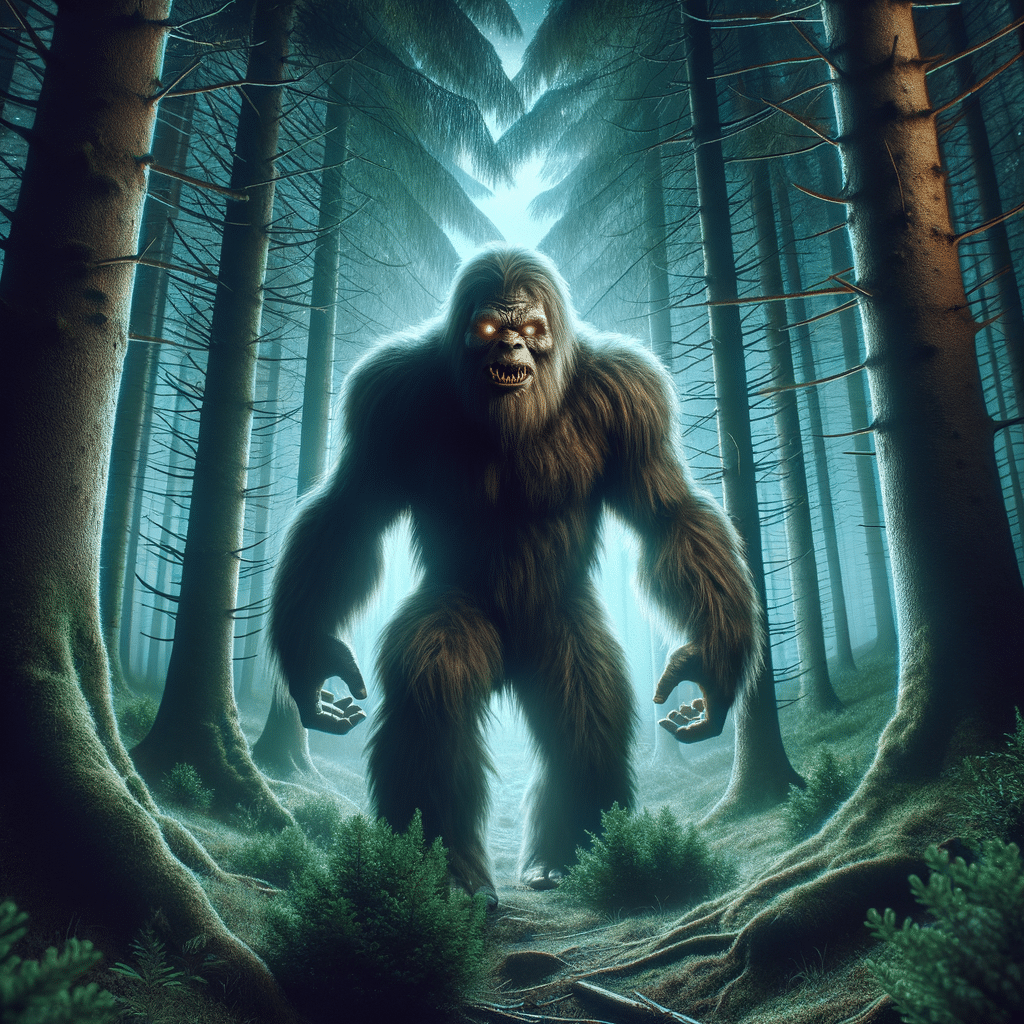
Bigfoot is a mysterious creature that has captured the imagination of people in North America for decades. Stories of giant, hairy, ape-like beasts roaming the woods have persisted for hundreds of years among Native American tribes. In the 20th century, Bigfoot really captured the public’s attention and became a fixture in American folklore and pop culture. There are many well-known stories and alleged Bigfoot encounters throughout the United States and Canada. Despite the lack of solid scientific evidence, numerous eyewitness accounts, footprint casts, and blurry photographs have sustained Bigfoot lore for centuries. Here are five of the most famous and compelling Bigfoot stories from North America.
The Patterson-Gimlin Film
In 1967, Roger Patterson and Robert Gimlin claimed to have captured the most famous Bigfoot footage ever taken. While riding on horseback near Bluff Creek in California, the pair came across a large, hairy bipedal creature walking along a creek bed. Patterson quickly jumped off his horse and managed to film the creature for about a minute with his 16mm camera before it walked away into the woods.
This footage purportedly captures an encounter with a female Bigfoot dubbed Patty. Although Patty is visible for less than a minute in total during the film’s duration, it is one specific frame that has solidified her image as the universal representation of Sasquatch. That particular frame, widely recognized as Frame 352 within cryptozoological circles, depicts Patty mid-stride with her arms swinging rhythmically. In this freeze-frame moment captured on 16mm film stock, Patty appears to display distinct physical characteristics associated with traditional descriptions of Bigfoot — towering height, muscular build, long arms dangling down her sides. Her pronounced brow ridge and cone-shaped head only add to her mysterious allure.
The significance of Frame 352 lies not only in its visual impact but also in its lasting influence on popular culture’s perception of Sasquatch. This single snapshot has emerged as an enduring symbol representing all that is fascinating about these legendary creatures lurking deep within remote forests around the world.
The controversial footage captured over 50 years ago continues to intrigue both believers and skeptics alike, as experts have yet to conclusively disprove its authenticity. For ardent Bigfoot enthusiasts, this enigmatic video is seen as irrefutable evidence supporting the existence of the elusive creature. Analysts closely scrutinize the film’s anatomical details, highlighting them as compelling indications that it could not be a mere man donning an elaborate costume.
Nonetheless, in the ongoing discourse surrounding this iconic footage, the burden of proof squarely rests on those who assert its veracity rather than on skeptical individuals seeking to debunk it. Over several decades, impassioned debates have ensued regarding whether or not this remarkable piece of visual documentation can truly be deemed genuine. Despite these fervent discussions and extensive scrutiny from countless angles, one undeniable fact remains – this particular film stands out as the most renowned and meticulously analyzed artifact within Bigfoot lore.
The 1924 Ape Canyon Attack
The Ape Canyon Bigfoot attack, an intriguing and widely debated incident, has captivated the imaginations of people for decades. This alleged encounter took place in a remote area of Washington state, near Mount St. Helens, in 1924. A group of miners found themselves at the center of a bizarre and terrifying ordeal when they claimed to have come face-to-face with several Bigfoots.
According to their chilling account, earlier that day, the miners had encountered one of these elusive creatures and fired shots at it in self-defense. The creature appeared to be wounded before disappearing into the wilderness. Little did they know that this act would set off a series of events that would forever change their lives.
As darkness shrouded their campsite that night, chaos ensued. The miners found themselves under siege as rocks rained down upon their cabin from all directions. With each thunderous impact against the wooden walls, fear gripped them tighter. Incredibly brave or perhaps desperate for survival, these ape-men relentlessly attempted to break into their sanctuary.
With dawn breaking on what must have felt like an eternal night filled with terror and uncertainty, the survivors ventured outside only to discover massive footprints surrounding their campsite—undeniable evidence that something extraordinary had transpired during those harrowing hours.
It became one of the first widely publicized Bigfoot stories in American history and sparked a wave of Bigfoot fever in the Pacific Northwest. The event is locally known as the Ape Canyon Incident and has become a staple of Bigfoot lore.

The Albert Ostman Kidnapping
While camping in British Columbia in 1924, a Canadian prospector by the name of Albert Ostman claimed that a Bigfoot family had actually kidnapped him.
Albert Ostman had always been intrigued by logging and construction work. He once spent over a year on a construction job and decided that a good vacation was in order.
Ostman, who had never heard of Sasquatch before, learned from his guide that they were supposed to be large, hairy creatures that lived in the mountains.
Despite the fascinating tales, Ostman dismissed the Sasquatch stories as mere folklore. He set up camp at the head of the inlet and spent the following days prospecting and exploring the mountains. He was fully equipped with a Winchester rifle, a homemade prospecting pick, an axe, and other essential gear.
After setting up camp in a new location, Ostman awoke one morning to find a large creature carrying him away in his sleeping bag. Realizing he had been kidnapped by a Sasquatch, he was taken deep into the mountains and left in a small, secluded valley. There, he found himself in the company of a family of four Sasquatches — an older male and female, and two younger ones.
For days, Ostman observed the Sasquatch family, noting their human-like qualities, their vegetarian diet, and their agility and strength. Despite being in a perilous situation, he was fascinated by the simplicity of their life and how they seemed to thrive in the wilderness.
All the while, Ostman was planning his escape. He hatched a plan to incapacitate the elder Sasquatch using snuff, hoping to make his escape during the resulting confusion. His plan worked and he managed to escape, making his way back to civilization. Once back in society, he chose to keep his extraordinary experience a secret, ending his story with a speculation about the possible existence of these creatures in the modern world.
His remarkable tale of being held hostage by Bigfoots became famous after he gave an interview in 1957. It remains one of the most bizarre and sensational Bigfoot stories ever told.
The Jerry Crew Footprints
Jerry Crew, a construction worker, stumbled upon an extraordinary discovery during his time at a worksite near Bluff Creek in California. In the year 1958, while going about his daily routine, Crew encountered remarkably large footprints that left him bewildered and intrigued. These prints were unlike anything he had ever seen before—enormous and unexplainable.
Jerry Crew made the decision to keep the evidence for further investigation because of this perplexing find. He meticulously crafted plaster casts of these gigantic footprints, capturing their intricate details with precision. When measured later on, these casts revealed astonishing dimensions: a staggering 16 inches in length.
The significance of this incredible event soon reverberated beyond the confines of that remote worksite. As news outlets across the nation caught wind of Jerry Crew’s remarkable discovery, public fascination grew exponentially. The mysterious creature responsible for leaving such massive footprints was dubbed Bigfoot, cementing its place in American vernacular.
With national news coverage spreading like wildfire, Bigfoot became firmly entrenched within popular culture from that point forward.
In 2002, the story appeared to suffer a damaging blow when Ray Wallace, a member of Crew’s work squad and an inveterate prankster, died at 84. His family then revealed a secret: The whole thing was a hoax. Wallace had made the oversized footprints with a set of carved wooden feet.
Decades later, echoes of Jerry Crew’s astonishing encounter continue to resonate throughout society as people remain enthralled by tales and sightings associated with Bigfoot. While skeptics question the authenticity and reality behind these claims, there is no denying that Jerry Crew’s fateful discovery helped to create the Bigfoot legend.

The Theodore Roosevelt Bigfoot Account
Before he became president, Theodore Roosevelt published a book in 1893 describing his frontier adventures in the Dakota Territory.
In The Wilderness Hunter, Teddy Roosevelt recounts a chilling tale he heard from a seasoned mountain hunter named Bauman. Bauman and a companion had set up a trapping expedition on a remote, reputedly evil trail near Montana’s Wisdom River. This was the same location where another trapper had been found half-eaten.
During their expedition, they had a terrifying encounter with a mysterious creature that destroyed their campsite. Bauman was awakened one night by a foul smell and the sight of a large, shadowy figure. He fired a shot at the creature, which then retreated into the darkness. The two men, shaken by the encounter, noticed that the creature’s tracks were unlike any human or bear.
Eventually, they decided to abandon their trapping expedition due to lack of success. When Bauman returned to their camp, he was met with a horrific sight — his friend was dead, his neck snapped with four fang marks visible.
Bauman fled, leaving nothing behind but his rifle because he thought they had been dealing with a hybrid human-demon creature. He rode through the night to safety, far beyond the reach of whatever creature had terrorized them.
The description was considered by some cryptozoologists to be an early Bigfoot account from Roosevelt. The former president later denied having ever seen Bigfoot himself, but his strange report from the frontier helped cement the legend of the hairy wildmen in the woods.
Summary
These stories represent some of the most famous and widely discussed Bigfoot encounters reported in North America. Several themes emerge in these accounts. Bigfoot is consistently described as large, hairy, bipedal creatures, closely resembling primates or prehistoric hominids. They are highly elusive and tend to avoid direct close contact and confrontation with humans. Most sightings occur in remote wilderness areas, with Bigfoot seeming to retreat deeper into the forests when encountered. These stories fueled mass curiosity, fascination and scientific debate about the existence and nature of Bigfoot that continues to this day.
Stories of Bigfoot have loomed large in the folklore and culture of North America for more than a century. Encounters like the ones discussed here imbued the legend with an air of authenticity and mystery that captivated the public imagination and made Bigfoot the enduring icon it remains today. These stories represent just a sample from the hundreds of alleged Bigfoot experiences that have reinforced the beast’s status as a true American legend. While most sightings remain shrouded in mystery and subject to interpretation, one thing is clear – the allure of Bigfoot will no doubt continue to capture our collective curiosity.
References
Bindernagel, J. A. (1998). North America’s great ape: The Sasquatch. Beachcomber Books.
Green, J. W. (1968). On the track of the Sasquatch. Hancock House.
Green, J. W. (1970). Year of the Sasquatch. Hancock House.
Hunter, D., & Dahinden, R. (1973). Sasquatch/Bigfoot: The search for North America’s incredible creature. Firefly Books.
Napier, J. R. (1972). Bigfoot: The Yeti and Sasquatch in myth and reality. Jonathan Cape. E. P. Dutton.
Wasson, B. (1979). Sasquatch apparitions: A critique on the Pacific Northwest hominoid. [Self-published].



Leave a Reply