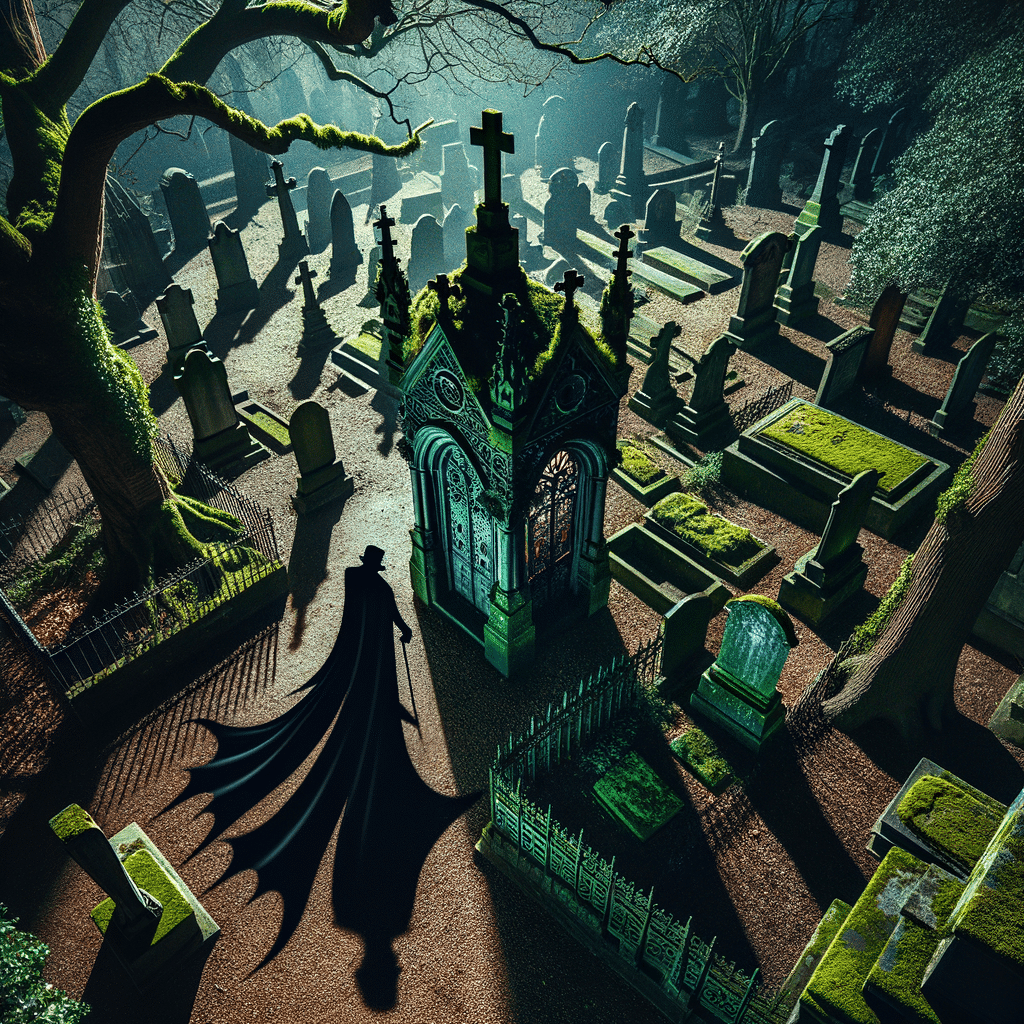
The creepy and mysterious Highgate Cemetery in London gave rise to a story known as The Highgate Vampire in the late 1960s and early 1970s. People first said they saw a tall, dark figure moving through the graves and tombstones. People described the figure as possessing hypnotic red eyes and an intimidating presence. These reports quickly captivated people, blending urban legends with Gothic horror and appealing to their deepest fears of the supernatural.
Highgate Cemetery is one of London’s most famous Victorian cemeteries. It opened in 1839 and is known for its wild beauty and historical importance. The cemetery was part of a campaign to create park-like burial grounds outside of the bustling city. Architect Stephen Geary designed it. By the middle of the 20th century, it was in terrible shape, making it a wonderful place for ghost stories and other strange stories. The cemetery’s mood, with crumbling tombs, vine-covered paths, iron gates, and ornate Gothic architecture, made the story of the Highgate Vampire feel even scarier. Famous people like Karl Marx found their resting places in the graveyard, making it an already mysterious and interesting place. The vampire story added even more mystery.

Vampire Tale
In February 1970, the Hampstead and Highgate Express printed letters from readers who said they had seen the vampire. This brought the story a lot of attention. The stories varied but they shared commonalities such as a menacing presence and peculiar incidents, such as the discovery of dead animals with severed necks. Local news outlets made the story even more shocking, which sparked more public interest and even led to organized hunts for the vampire. People who liked scary things and amateur ghost hunters flocked to the graveyard in hopes of seeing the mysterious figure.
To understand the Highgate Vampire myth, you need to know a lot about its history. In the late 1960s and early 1970s, people in Britain became interested in the magical and supernatural again. Ramsland wrote that a lot of people were watching and reading scary movies and TV shows during this time, which made the culture ready for such a story. During that period, a multitude of social unrest and countercultural groups fueled interest in strange beliefs and the supernatural.
Among the chaos, David Farrant and Sean Manchester stood out as two important people. The two men claimed to have seen the vampire and competed to find it. Manchester led the British Occult Society and later wrote a book about it. Thanks to their fights and public performances, the legend lived on. Both men performed rituals and watched the cemetery for an undead creature. In a dramatic ritual, Manchester claimed to have exorcised and killed the vampire, while Farrant found himself trapped in the graveyard with a crucifix and a wooden stake.

Analysis
Even though many people tried to find the vampire, no solid proof ever came up. Guiley wrote that ever since then, skeptics and experts have suggested that various factors, including people’s overactive imaginations, local wildlife, or even jokes, could have caused the sightings and strange events. Some people have thought that the figure might have been a homeless person or a very complex hoax. Even so, the Highgate Vampire is still an intriguing piece of modern folklore that shows how fear, mystery, and the timeless appeal of the supernatural can fuel urban tales and make them last.
Over the years that followed, the story of the Highgate Vampire kept coming up in pop culture. It became the focus of books, films, and even fiction, solidifying its place in the history of urban legends. The competition between Farrant and Manchester, with their dramatic and often staged fights, made the story more captivating by adding a human touch.
Experts have different ideas about the Highgate Vampire. Radford noted that some psychologists and folklorists say that the story shows a case of group delusion or mass hysteria, which happens when social and environmental factors cause a lot of people to believe in supernatural things. Ellis thought that the story of the Highgate Vampire is a form of modern folklore that helps individuals make sense of their fears and the unknown.
Case studies of similar urban legends and supernatural reports help us understand the Highgate Vampire better. For instance, the stories about the Mothman’s sightings in Point Pleasant, West Virginia during the 1960s bear similarities to those about the Highgate Vampire. Keel noted that both feature strange, humanoid figures seen in borderlands, like cemeteries or empty areas, and they both got a lot of attention from the public and the media.
Conclusion
Today, people still come to Highgate Cemetery because of its historical importance and its link to the scary story. The Highgate Vampire has become an important part of the cemetery’s mystery. It’s a story that blurs the line between myth and fact, showing how people have always been interested in the unknown. The peaceful but spooky, graveyard is a reminder of the power of folklore and how people tend to look for and make up stories that explain things that can’t be explained.
Urban myths like the Highgate Vampire Legend have been around for a long time and have the power to catch people’s imaginations. It’s an intriguing example of how folklore can grow, spread, and live on, even in current times. Because of its mix of fear, competition, and mystery, the story of the Highgate Vampire will continue to fascinate and inspire people for many years to come.
References
Ellis, B. (2000). Raising the Devil: Satanism, New Religions, and the Media. University Press of Kentucky.
Guiley, R. (2007). The Encyclopedia of Ghosts and Spirits. Checkmark Books.
Keel, J. A. (1991). The Mothman Prophecies. Illuminet Press.
Manchester, S. (1985). The Highgate Vampire: The Infernal World of the Undead Unearthed at London’s Famous Highgate Cemetery and Environs. British Occult Society.
Radford, B. (2011). Tracking the Chupacabra: The Vampire Beast in Fact, Fiction, and Folklore. University of New Mexico Press.
Ramsland, K. (2002). The Science of Vampires. Berkley Books.



Leave a Reply