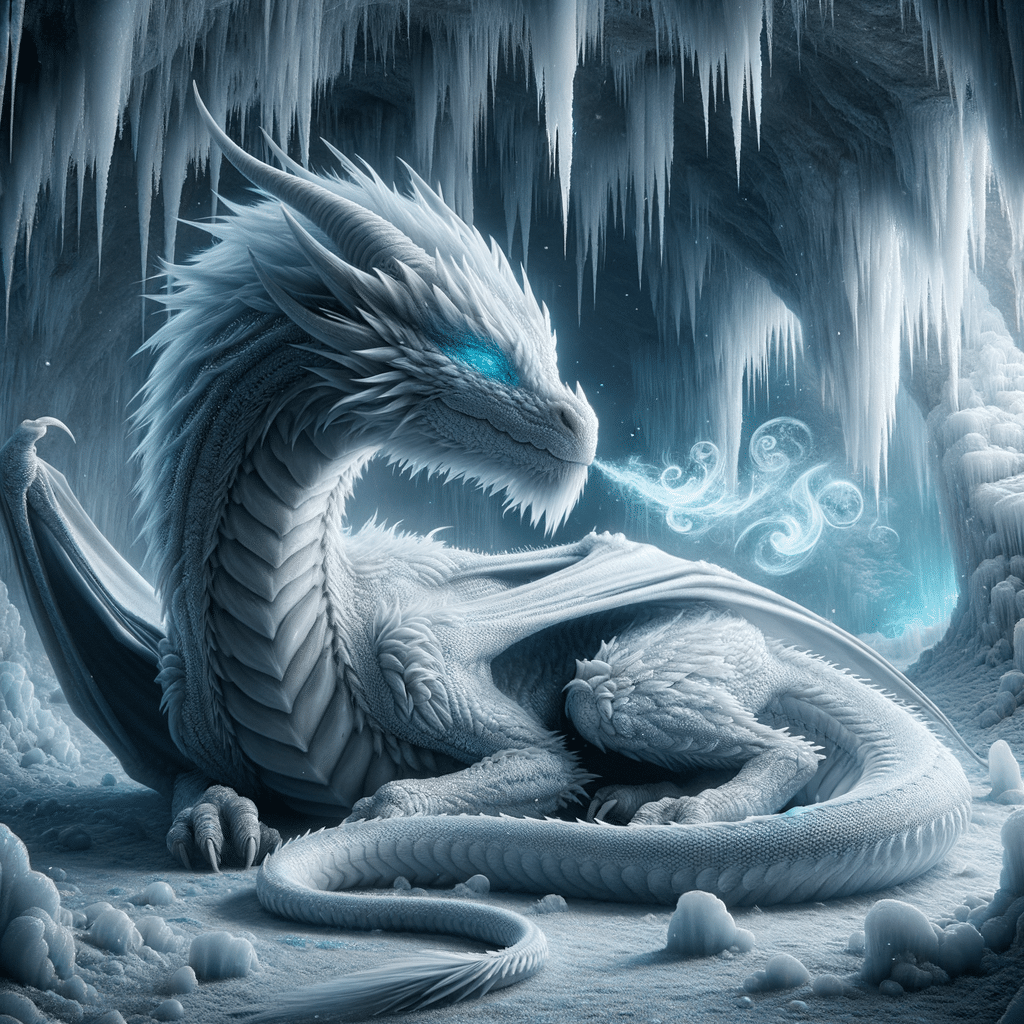
White dragons are a common feature in fantasy literature, role-playing games, and legendary folklore. They are also known as frost or ice dragons. These creatures, distinguished from other varieties of dragons by their distinct skills, mannerisms, and habitats, are known for their ice breath and cold-hearted disposition. Usually shown with scales that glitter like snow or ice, white dragons are able to blend in perfectly with their cold surroundings. People often describe their eyes as penetrating, almost hypnotic, and either pale blue or white. Despite being the tiniest chromatic dragons, these creatures are just as lethal.

Description
White dragons use a cone of ice and freezing air as their breath weapons. This breath has the power to immobilize its victims, reducing them to frozen statues that the dragon can eat whenever it pleases. They frequently hide in frigid caverns or on top of frozen mountains, where the weather is too cold for most other animals to survive. Books such as Christopher Paolini’s Inheritance Cycle and C.S. Lewis’s The Silver Chair, where the Lady of the Green Kirtle transforms into a large white serpent, frequently mention white dragons.
White dragons are known for being lonesome and possessive. Although they lack the intelligence of other dragon types, they are crafty and vicious by nature. Their main concern is survival, which makes them voracious hunters and food hoarders rather than treasure seekers. On the other hand, the temperaments and actions of different types of dragons vary. Red dragons, for instance, are renowned for their enormous size and fiery breath, which represent avarice and haughtiness. They are very smart and crafty, and they hoard valuables, especially money and gems. People portray red dragons as the strongest and most despotic of all chromatic dragons, with a preference for volcanic or mountainous environments. Smaug is a classic red dragon from J.R.R. Tolkien’s The Hobbit, emulating these characteristics with his enormous gold hoard and devastating fire breath.
Contrasts
Because of their lightning breath and desert lairs, blue dragons are military and strategic. They frequently rule over hordes of lesser creatures because they value hierarchy and order. They are formidable opponents because of their obsession with domination and control. Conversely, green dragons are experts at trickery and subterfuge. Living in woodlands and jungles, green dragons are armed with a breath weapon that releases toxic gas. They are cunning, planting dissension, and taking advantage of other species with their cleverness. Swamp dragons, sometimes known as black dragons, are symbols of rot and evil. Usually found in ruins or foul-smelling bogs, their acid breath dissolves everything it touches. They take great pleasure in the misery of others, and they are vile and vicious.
A number of significant distinctions between white dragons and other sorts of dragons become apparent. Unlike red dragons, which love volcanic regions, or blue dragons, which live in deserts, white dragons flourish in cold, frigid environs. This impacts their hunting strategies and the kinds of prey they hunt. In comparison to the crafty red and green dragons, white dragons are less sophisticated and more primitive. Survival instincts drive their actions more than intricate plans or lofty goals. Though they are all fierce creatures, white dragons tend to be smaller and nimbler. This is in contrast to the svelte, serpentine form of blue dragons or the enormous, imposing presence of red dragons.
One key differentiator is the breath weapon component. Red dragons utilize fire, blue dragons use lightning, green dragons use poison, black dragons use acid, and white dragons use ice. Every breath weapon has different effects and combat applications. Whereas blue and green dragons may participate in more intricate social systems or hierarchies, white dragons live alone. Red dragons occasionally hoard or govern creatures out of sheer dominance, but they usually regard themselves as lone kings.

White Dragon Society
White dragons have trouble cooperating with other white dragons except for mating. Even these are fierce affairs that end quickly. White dragons are known to be hostile and lonely creatures; therefore, their lack of collaboration goes beyond mating. White dragons prefer independent strategies to alliances and cooperation. Their interactions with hatchlings, left to fend for themselves immediately after birth, reflect this intense independence. Young white dragons must navigate their icy home’s dangerous landscape and avoid confrontations with possibly hostile family members in order to survive until adulthood.
The social systems of other dragon species are often more cohesive than those of white dragon society, which contrasts sharply with them. Red dragons are all about strength and control; blue dragons are about wisdom and strategy; green dragons are about trickery and slyness; black dragons are about hate and cruelty; and white dragons are about being heartless and living alone. Stories of bravery, danger, and intrigue among these beautiful beasts captivate storytellers and adventurers alike. The distinct blend of dread and majesty that each species of dragon provides adds layers of depth to the fantasy world.
The role-playing game Dungeons & Dragons (D&D) has greatly influenced the modern conception of the white dragon, having formalized many aspects of dragon lore. D&D categorizes white dragons as chromatic dragons, distinguishing them by their elemental breath weapon and evil alignment. The aforementioned classification has facilitated the standardization of white dragon traits in diverse media, guaranteeing a uniform representation. Dungeons & Dragons has been critical in shaping the contemporary portrayal of dragons, offering a structure that writers and game developers frequently follow. The white dragon is a perfect illustration of this effect, with its frigid breath and arctic home.
Conclusion
In the world of dragons, white dragons have a unique and terrifying presence due to their frigid breath and heartless disposition. The striking contrast between the fiery red dragons, cunning blue dragons, cunning green dragons, and cunning black dragons highlights the wide range of dragon legends. Each variety of dragon adds a unique blend of fear and majesty to the fantasy fabric, enthralling storytellers and adventurers alike.
References
Lewis, C. S. (1953). The Silver Chair. Geoffrey Bles.
Paolini, C. (2005). Eldest. Alfred A. Knopf.
Tolkien, J. R. R. (1937). The Hobbit. George Allen & Unwin.
Gygax, G., & Arneson, D. (1974). Dungeons & Dragons. TSR, Inc.



Leave a Reply