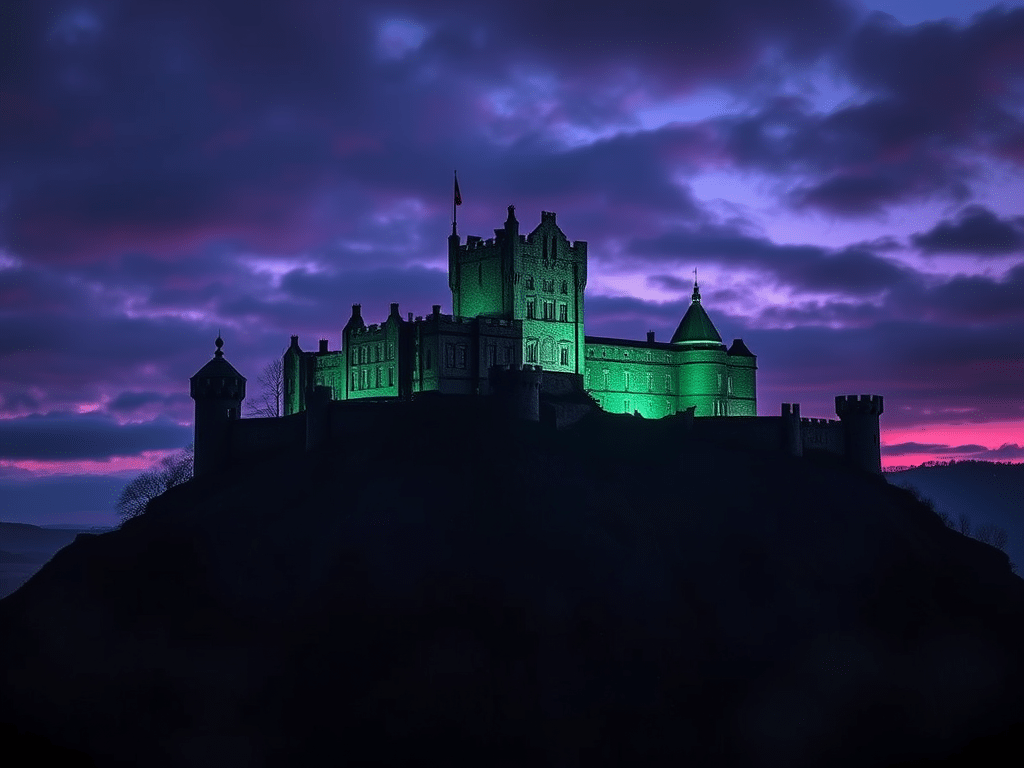
Haunted Stirling Castle: Key Points
-
Stirling Castle is a historically significant Scottish fortress on a volcanic crag that has become one of Scotland’s most haunted locations with centuries of paranormal reports.
-
The most famous ghosts include the “Pink Lady” in royal apartments and the “Green Lady,” believed to have saved Mary, Queen of Scots, along with spectral soldiers and unexplained sounds throughout the castle.
-
Skeptics believe that people’s experiences can be explained by factors such as the power of suggestion, environmental issues like drafts and sounds, and scientific effects like
-
The paranormal reputation has significantly increased tourism and revenue for preservation while providing an accessible entry point into Scottish history through books and documentaries.
-
The ghost stories create educational opportunities for critical consideration of historical sources and evidence while emotionally connecting people to the past.
-
Whether supernatural or not, these stories have become integral to the castle’s identity and ensure it continues captivating visitors across generations.
![By John Slezer - This image is available from the National Library of ScotlandFrom John Slezer's THeatrum Scotiae [1], Public Domain, https://commons.wikimedia.org/w/index.php?curid=6028462](https://i0.wp.com/connectparanormal.net/wp-content/uploads/2025/12/Stirling_Castle_John_Slezer.jpg?resize=300%2C167&quality=89&ssl=1)
Introduction
Stirling Castle, a key player in Scotland’s history, looms over the landscape from its commanding position on a volcanic rock in the heart of the country. This grand edifice has stood for ages, a silent observer of wars, coronations, and the political maneuvering that ultimately determined the country’s fate. Beyond its well-established historical significance, Stirling Castle has also become quite famous for its supposed hauntings. Ghost stories have fascinated castle visitors and researchers for centuries.
Stirling Castle
The castle’s silhouette dominates the horizon, visible from a considerable distance. It perches roughly 250 feet above the land on Castle Hill, a remnant of a long-extinct volcano, which offered built-in protection. The fortification’s layout includes several structures built at different times. These include the Great Hall, built by James IV; the Royal Palace, renovated by James V; and the Chapel Royal, built for Prince Henry’s baptism in 1594 (Hanke, 2004). The architectural splendor of the castle reveals its rich history as a preferred residence for Scottish kings and queens. Intricate Renaissance facades, elaborate carved stonework, and vast courtyards all hint at the building’s past magnificence. Stirling Castle, perched at the crucial juncture between the Scottish Highlands and Lowlands, was a coveted stronghold. Its formidable walls and elevated vantage point allowed it to endure countless sieges, a testament to its resilience over the centuries.
Stirling Castle’s history is a key part of Scottish nationalism and royal power struggles. The castle changed hands many times during the Wars of Scottish Independence, which lasted from the late 1200s to the early 1300s. William Wallace’s celebrated win at the Battle of Stirling Bridge in 1297 gave the Scots a brief hold on the castle. Robert the Bruce, however, wrested it back in 1314, after his success at Bannockburn. The castle was where Mary, Queen of Scots, spent her early years. She was crowned there, in the Chapel Royal, in 1543, a mere nine months after her birth. During the reigns of James IV and James V, Stirling Castle became a center of Renaissance culture, going beyond its military purpose. These monarchs transformed the medieval castle into a magnificent palace, reflecting Scotland’s royal status (Stair-Kerr, 1928).
The castle’s significance waned following the Union of the Crowns in 1603. For centuries, it then took on military duties. Eventually, the public gained access to it, transforming it into a historic site. The 1855 fire that destroyed the Douglas Room and the subsequent efforts to preserve its history highlight the lasting interest in and respect for its past (Stuart & Roger, 1858). The rich history of the area sets the stage perfectly for stories of the supernatural.
Haunted Castle
Stirling Castle’s ghostly reputation hinges on a series of persistent sightings and odd occurrences. Castle staff, visitors, and researchers have reported these sightings. The “Pink Lady” is the most commonly reported ghost. She’s often described as a woman in a pink dress, and witnesses have seen her drifting through the castle’s hallways. Sightings are especially frequent near the royal apartments and the chapel. Those who’ve seen her often describe a crushing wave of sorrow or unease. Some investigators of the unexplained have theorized that she could be linked to a woman who died in a blaze, desperately looking for her husband during one of the castle’s numerous attacks. Another well-known spectral presence is the “Green Lady.” Some believe she was a servant to Mary, Queen of Scots. According to legend, she warned the young queen of an impending fire, thus saving her life. Most people have seen the apparition, a green-clad woman, near Mary’s home. Sudden temperature drops and the smell of burning wood often precede her visits. Her presence symbolizes grief and loss, making her a poignant reminder of the emotional ties to the castle’s history (Lang, 2011). The history of the castle, particularly in areas impacted by tragedy and conflict, contributes to its reputation as a haunted place (Fleischhack & Schenkel, 2016).
Beyond the well-known specters, countless other strange occurrences have been reported within the castle’s many rooms and corridors over time. Castle staff, abandoned after the gates close, have recounted unsettling experiences. They’ve heard footsteps reverberating through the deserted hallways, the strains of music from a bygone era wafting from unoccupied chambers, and witnessed doors swinging open and shut without a soul to touch them. The Great Hall, a marvel of medieval design, has long been the setting for tales of mysterious figures. These apparitions, witnesses claim, watch from the minstrels’ gallery, only to disappear when someone draws near. Whispers, disembodied footsteps echoing through deserted corridors, and the unsettling sensation of unseen eyes—these are the experiences shared by both visitors and staff. These activities highlight the emotional impact of the castle’s spaces, creating a kind of “haunted infrastructure.” This infrastructure suggests that past events continue to exist and affect the present (Dagnall et al., 2020).
Reports from some visitors describe a ghostly Highland soldier. This apparition, attired in period-appropriate garb, including a tartan and weaponry, is said to patrol the battlements. The soldier vanishes when approached or when a photograph is attempted. Reports describe encounters with ghostly soldiers, thought to be the souls of those who perished in the numerous conflicts that raged around the castle. These sightings often occur during significant anniversaries of historical events, which strengthens the connection between the past and the present (Fleischhack & Schenkel, 2016). The castle’s dungeons and the lower levels, once the grim confines of prisoners, have become the focus of unsettling reports. Whispers of disembodied voices, piercing screams, and an atmosphere so heavy they can be unbearable for the more sensitive have emerged.
Historical records and accounts from earlier centuries provide some evidence of unusual events at Stirling Castle. However, the way these events are interpreted differs significantly from modern paranormal views. Victorian castle staff documented peculiar sounds and unexplainable occurrences in their writings. These accounts, however, were frequently chalked up to natural phenomena or simply brushed aside as the fanciful creations of minds stirred by the era’s Gothic novels. During the castle’s military occupation in the 1700s and 1800s, soldiers penned letters and kept diaries, and some of them described strange occurrences. They wrote about seeing figures that didn’t seem to belong to the living garrison. In the early 1900s, tourist accounts began to include more detailed descriptions of ghostly experiences. This shift reflected a broader cultural interest in spiritualism and the supernatural, which was growing in Britain and America at the time.

Theories
Skeptics have offered various alternative explanations for the paranormal events reported at Stirling Castle, suggesting that psychological, environmental, and cultural factors might account for these experiences. The power of suggestion is significant. Having already heard ghost stories, visitors to the castle may interpret unclear sensory experiences as paranormal. The castle’s age-old design lends itself to all sorts of misunderstandings when it comes to the natural world. Cold drafts can be mistaken for something more sinister, while the building’s unique acoustics can amplify and twist sounds in ways that are downright eerie. The uneven stone and narrow windows cast shadows that deceive the mind. The emotional environment, shaped by the castle’s past of violence, along with the dim lighting in certain areas and the feeling of isolation in less-visited parts, can trigger psychological reactions. These reactions often appear as feelings of being watched or the sensation of a presence.
Several scientific theories have been proposed to point out certain types of paranormal experiences reported at historic sites, such as Stirling Castle, without using supernatural explanations. Research on infrasound, which encompasses sound waves beneath the human auditory threshold, indicates that specific frequencies can induce sensations of discomfort, anxiety, and even visual disruptions. These disturbances might be misinterpreted as ghostly experiences. The castle’s stone structure, along with its spaces, could potentially create or amplify these frequencies, depending on the specific conditions. Studies have suggested that environmental factors, like electromagnetic fields, which can be created by geological formations such as the volcanic rock the castle is built on, might affect how people perceive things. These factors could lead to experiences that are similar to what people often describe as paranormal. Additionally, pareidolia, a psychological phenomenon where the brain recognizes familiar patterns like faces or figures in random visual data, might explain some reports of apparitions in places with complex shadows and architectural details.
The cultural and historical context also helps us understand how and why ghost stories, like those connected to Stirling Castle, continue to exist and change over time. Scotland’s deep-rooted folklore and the belief in the supernatural have woven a cultural tapestry where ghost stories are almost a given. This circumstance is especially true at locations marked by dramatic pasts—places where violence, tragedy, and death have left their mark. The growth of paranormal tourism has created economic benefits that encourage the preservation and promotion of ghost stories. These tales attract visitors who might not otherwise be interested in historical sites. The evolution of ghost stories, marked by changes, additions, and embellishments over time, shows how paranormal stories can become independent from their original sources through repeated retellings. Some researchers suggest that these stories serve important psychological and social functions. They help people process historical trauma, maintain connections to the past, and discover meaning in places that might otherwise seem like simple collections of old stones.
The ongoing fascination with the ghost stories associated with Stirling Castle underscores the relationship between historical reality and folklore. These narratives serve a dual purpose, functioning as both sources of amusement and vehicles for conveying cultural memories and identities, employing a perspective that intertwines the mundane with the fantastical (Samigorganroodi, 2015). The castle’s ghostly stories contribute to Scotland’s cultural identity, making it a place for remembering and reflecting on broader themes of loss and remembrance found in national narratives (Scholar, 2019). These narratives reveal how locations remain haunted by the echoes of their histories, even when the defining moments are long gone.
Impact
The ghostly reputation of Stirling Castle goes beyond just being a fun story; it greatly affects tourism, the preservation of cultural heritage, and how the public engages with Scottish history. The castle’s ghost stories have undeniably increased visitor interest, attracting people who might not usually visit historical sites. This phenomenon has provided an accessible way to engage with Scotland’s complex history. The surge in visitors brings in funds, which in turn fuels the continuous upkeep and conservation of the castle. This financial support is vital to keep this significant part of Scotland’s history accessible for those who come after us. These paranormal stories have also inspired creative works, including books, documentaries, and plays. As a result, they have increased public interest in the castle and its broader place in Scottish history.
From an educational perspective, the connection between history and paranormal claims at Stirling Castle offers unique opportunities for critical thinking and historical investigation. To understand ghost stories, students and visitors must examine primary historical sources, architectural evidence, and eyewitness accounts. Students and visitors should also take into account the reliability, potential biases, and interpretation of these accounts. This method mirrors the work of professional historians, which helps us understand how we know what we know about the past in a more nuanced way. Accounts of the paranormal, regardless of their acceptance as proof of supernatural occurrences, offer insights into the anxieties, convictions, and lived experiences of individuals from diverse historical epochs who either resided in or traveled to the castle.
The psychological and emotional effects on people who report paranormal experiences at Stirling Castle are worth studying, regardless of whether these experiences are truly caused by supernatural forces. For those who believe they’ve had experiences that go beyond what we can explain, these events often become very memorable and sometimes change their lives. These experiences then affect how they see the world and what they believe about consciousness and existence. Even for those who are skeptical, the castle’s atmosphere and historical importance can create strong emotional reactions. These reactions can connect people to the past in ways that traditional museum displays might not be able to. These personal experiences, while subjective, enhance the castle’s enduring cultural significance and its capacity to evoke wonder and reflection regarding human history and our role within it.
Conclusion
Stirling Castle, a silent witness to Scotland’s storied history, holds within its weathered walls the echoes of centuries filled with both triumph and tragedy. People continue to debate the nature of the paranormal events reported in the location. They could be real encounters with spirits, misunderstandings of natural events, or cultural ideas that serve important psychological purposes, depending on personal beliefs. Undeniably, these ghost stories have become a key part of the castle’s identity. They enhance the visitor experience and help this important historical site stay fascinating. This also ensures that essential aspects of Scottish heritage are preserved for future generations to explore and understand.
References
Dagnall, N., Drinkwater, K., O’Keeffe, C., Ventola, A., Laythe, B., Jawer, M., … & Houran, J. (2020). Things that go bump in the literature: an environmental appraisal of “haunted houses”. Frontiers in Psychology, 11. https://doi.org/10.3389/fpsyg.2020.01328
Fleischhack, M., & Schenkel, E. (Eds.). (2016). Ghosts – or the (Nearly) Invisible: Spectral Phenomena in Literature and the Media. Peter Lang. https://doi.org/10.3726/978-3-653-05962-5
Hanke, T. (2004). Stirling Castle Palace. Archaeological and Historical Research, 2008.
Lang, A. (2011). Cock Lane and common-sense. Cambridge University Press. https://doi.org/10.1017/CBO9780511974663 (Original work published 1894)
Samigorganroodi, G. (2015). Destruction of landscape by the forces of commercial industrialism in maxwell anderson’s play, high tor. International Journal of Comparative Literature and Translation Studies, 3(1). https://doi.org/10.7575/aiac.ijclts.v.3n.1p.34
Scholar, H. (2019). The ghost of the ‘y’: paternal dna, haunting and genealogy. Genealogy, 4(1), 3. https://doi.org/10.3390/genealogy4010003
Stair-Kerr, E. (1928). Stirling castle: its place in Scottish history. Eneas Mackay.
Stuart, J. and Roger, C. (1858). Extract of a letter referring to the destruction of the ‘douglas room,’ stirling castle, from the rev. charles rogers, communicated by john stuart. Proceedings of the Society of Antiquaries of Scotland, 2, 186-187. https://doi.org/10.9750/psas.002.186.187
Leave a Reply