Are there living dinosaurs in the world today and would their existence disprove evolution?
The study of cryptozoology has long piqued people’s interest because it is frequently linked to the hunt for unidentified or concealed creatures. The hunt for extant dinosaurs is one of its most fascinating missions. This is not just a pointless undertaking; for certain creationists, in particular, who want to use any new findings to refute evolutionary theory, it crosses important cultural, scientific, and ideological boundaries.
Dinosaur Cryptids
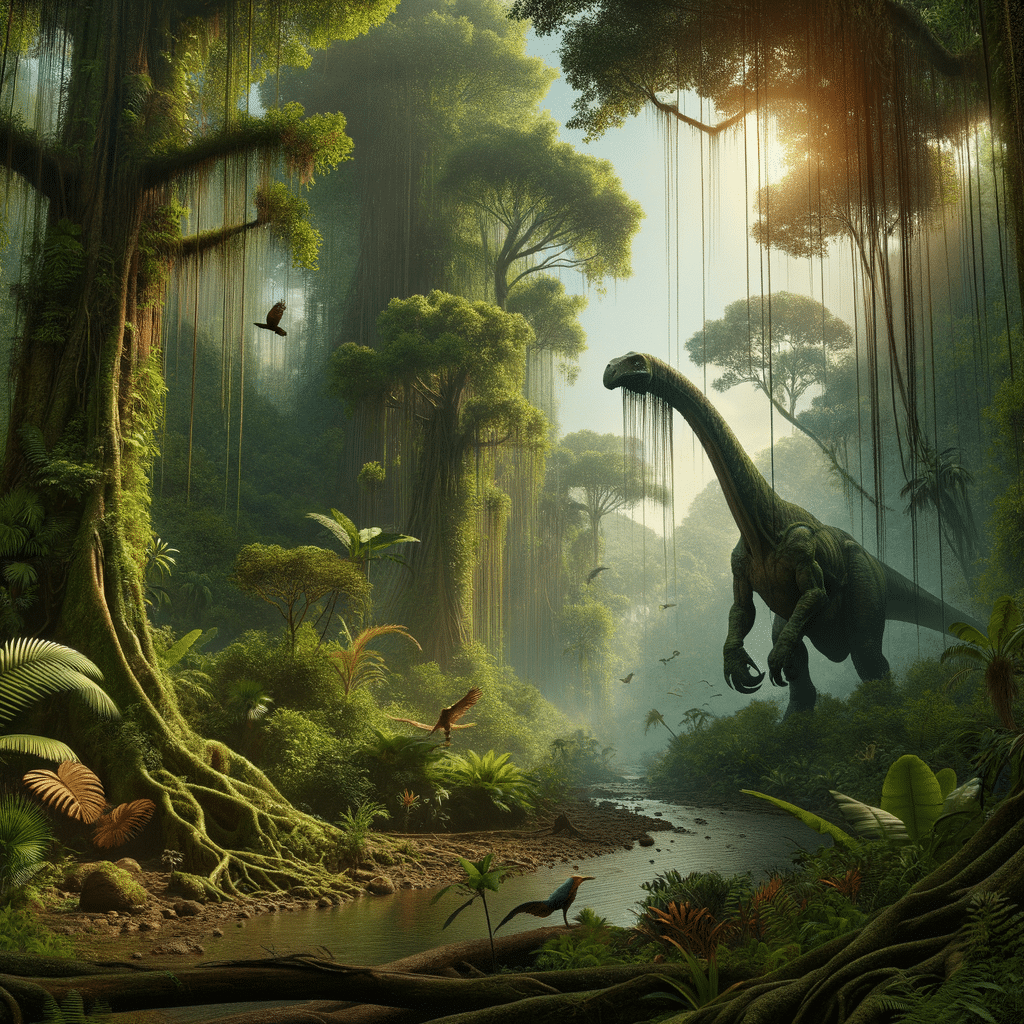
Said to live in the isolated marshes of the Congo Basin, the Mokele-Mbembe is one of the most well-known extinct dinosaurs. Different descriptions commonly depict this creature as a huge, herbivorous mammal with a long neck and tail resembling a sauropod dinosaur. Local legends and occasional eyewitness reports have motivated expeditions into Africa’s deep forests, but none have produced conclusive evidence of their existence. The myth of Mokele-Mbembe embodies the fascination with the uncharted and the idea that prehistoric animals may still exist on Earth and elude contemporary research.
Dr. Roy P. Mackal of the University of Chicago conducted one of the most prominent efforts to prove the existence of Mokele-Mbembe in 1980. James Powell and Mackal entered the Congo Basin to look into claims of a gigantic, dinosaur-like creature. Despite not finding any concrete evidence, their conversations with local residents and the compilation of anecdotal experiences supported the likelihood of living dinosaurs. A living dinosaur? In Search of Mokele-Mbembe, written by Mackal, summarizes their conclusions and reasoning.

The Ropen is a flying monster that has piqued the interest of creationists and cryptozoologists in Papua New Guinea. Scientists describe the Ropen as a gigantic, bat-like creature with a wingspan of up to 20 feet. People frequently compare it to a pterosaur, a species of flying reptile from the Mesozoic era. Witness reports of bioluminescent features lend an unsettling element to the sightings. Despite multiple trips and anecdotal evidence, no solid material evidence has confirmed the claims of a living pterosaur.
Carl Baugh, the creator of the Creation Evidence Museum in Texas and a creationist, has led multiple missions to Papua New Guinea to seek the Ropen. Baugh and associates, such as creationist adventurer David Woetzel, recorded oral histories from the area and reported seeing the monster. They contend that the Ropen, a pterosaur-like, bioluminescent creature, lends credence to the idea that humans and dinosaurs coexisted. Documentaries and publications supporting creationism have featured their findings.

Conversations about living dinosaurs frequently mention the Loch Ness Monster, also known as Nessie, a famous specimen from Scotland. People frequently portray Nessie, who first gained international notoriety in the 1930s, as a dinosaur-like creature with flippers and a long neck. The enigmatic surroundings of Loch Ness’s deep, murky waters provide for intriguing sightings and grainy photos. Numerous studies conducted over the years, such as sonar expeditions and underwater photography, have been unable to yield conclusive proof of the existence of this species. However, Nessie continues to be a powerful emblem in the field of cryptozoology.
At least one creationist textbook in 2012 argued that the Loch Ness Monster existing would disprove evolution. It noted, “Are dinosaurs alive today? Scientists are becoming more convinced of their existence. Have you heard of the ‘Loch Ness Monster’ in Scotland? ‘Nessie’ for short has been recorded on sonar from a small submarine, described by eyewitnesses, and photographed by others. Nessie appears to be a plesiosaur.”
Why Dinosaurs?
Creationists have a strong interest in these cryptid dinosaurs, especially those who support the young Earth hypothesis. They argue that the discovery of extant dinosaurs would validate their reading of the Bible, implying that humans and dinosaurs coexisted very recently. They argue that this would support their theory that the Earth is only thousands of years old and undercut the accepted scientific timeline, which places the extinction of non-avian dinosaurs about 65 million years ago.
Because the Bible was written long before dinosaurs were discovered in the 19th century, it does not specifically describe dinosaurs as we know them today. Nevertheless, creationists interpret several biblical texts as alluding to dinosaurs or creatures similar to dinosaurs.
Job 40:15–24 in the Book of Job mentions the “Behemoth” as one of the most frequently quoted cases. Job portrays the Behemoth as a robust, grass-eating monster with bronze-like bones and powerful muscles. According to some creationists, this description would fit a huge herbivorous dinosaur like a sauropod. This is the relevant passage:
“Look at Behemoth, which I made along with you and which feeds on grass like an ox. What strength it has in its loins, what power in the muscles of its belly! Its tail sways like a cedar; the sinews of its thighs are close-knit. Its bones are tubes of bronze, its limbs like rods of iron.” (Job 40:15-18, NIV)
Some creationists also associate the biblical creature “Leviathan” with dinosaurs, citing its mention in Job 41, Psalms 74:14, and Isaiah 27:1. The image of Leviathan is that of a massive, seafaring monster with terrifying looks and incredible strength. According to some, this alludes to a giant sea reptile, such as a mosasaur or plesiosaur.
Analysis
Despite the intriguing nature of these interpretations, neither science nor orthodox biblical research supports the idea that these texts describe dinosaurs. Rather, a number of scholars believe that the ancient writers probably modeled Behemoth and Leviathan on familiar large animals like crocodiles, elephants, or hippopotamuses before adding mythological details.
The lack of overt references to dinosaurs in the Bible is consistent with its writing in a pre-scientific era, long before the discovery of dinosaur fossils and the advancement of paleontology. Therefore, the Bible does not give a scientific explanation of dinosaurs, even if it has several vivid and symbolic descriptions of animals and fantastical beings.
Even though it appears astonishing, the discovery of living dinosaurs does not refute evolution. A substantial body of evidence from several fields, including genetics, paleontology, and comparative anatomy, supports evolutionary theory. Natural selection, genetic drift, and mutation are some of the mechanisms by which evolution explains the diversity of life. Even though the continued existence of a small population of dinosaurs would be an unexpected aberration, the overwhelming evidence supporting evolution would still stand. It would only imply that certain lineages that were previously believed to be extinct were able to thrive in remote areas.
Furthermore, the uniformitarianism principle in geology and biology postulates that the same natural processes observed today have existed throughout Earth’s history. A large portion of our knowledge about evolutionary processes is based on this idea. One might view the existence of a “living fossil” or a species that has survived over millions of years as an example of an organism that has experienced minimal morphological change, not as evidence against evolution but rather as proof of the stability of particular ecological niches.
Conclusion
Cryptozoology’s search for extant dinosaurs overlaps with profound human curiosities and important ideological conflicts. Though proponents of creationism anticipate that the discovery of a live dinosaur would cast doubt on evolutionary theory, the sound foundation of evolution would endure. Instead of contradicting widely accepted theories of evolution, such a discovery would represent a great addition to our understanding of life on Earth, demonstrating life’s adaptability and resilience.



Leave a Reply