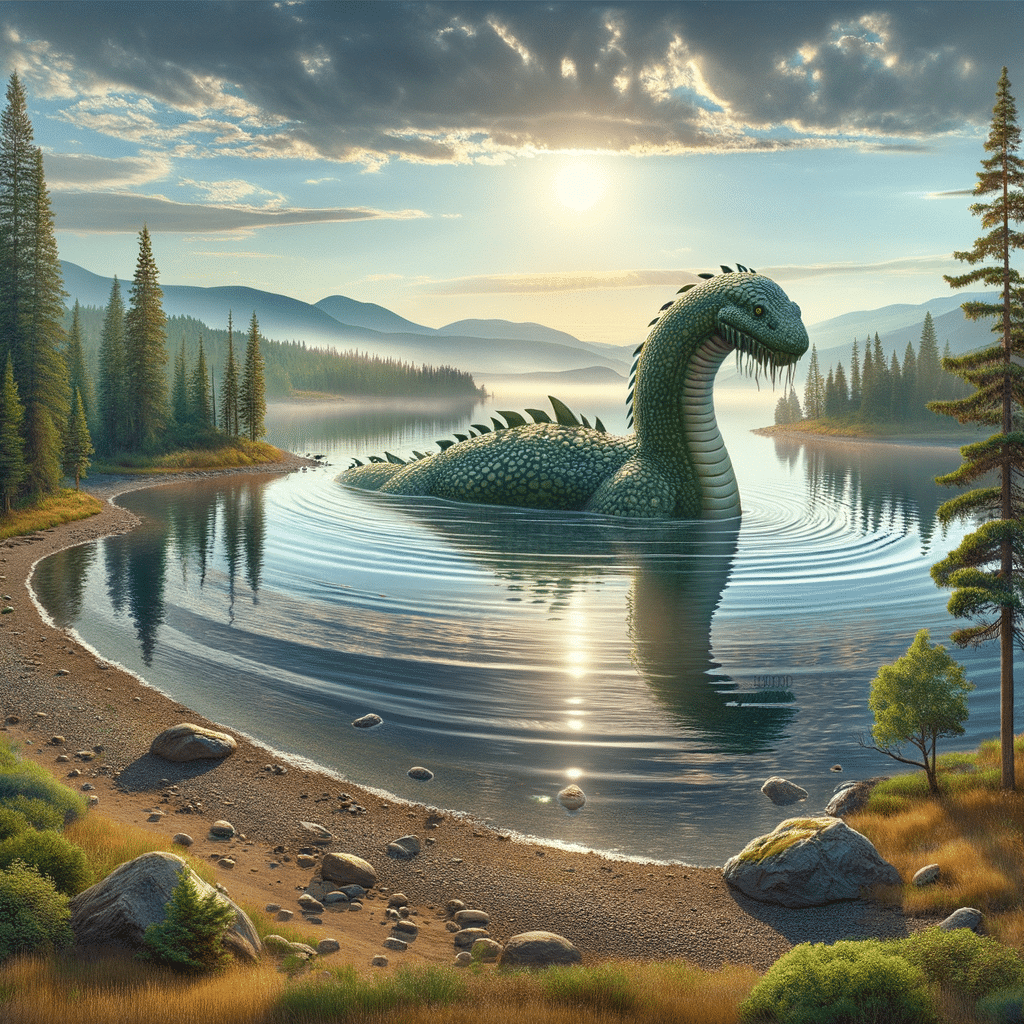
Okanagan Lake in British Columbia, Canada is home to the fabled Ogopogo Lake Monster. Descriptions of Ogopogo vary, but it is often depicted as a serpentine creature with a long, undulating body. Some accounts suggest it resembles a large snake or a prehistoric plesiosaur, with dark, smooth skin and the capacity to move swiftly through water. Local folklore describes its length as between 15 and 50 feet, endowing it with a formidable presence.
Okanagan Lake, spanning 84 miles and reaching a maximum depth of 761 feet, is home to Ogopogo. It is a long, narrow body of water encircled by the gorgeous Okanagan Valley scenery, an area renowned for its orchards, vineyards, and unspoiled beauty. The vastness and profundity of the lake, together with its intricate system of submerged caverns and tunnels, make it the perfect place for the enigmatic creature to avoid detection and continue to remain in mystery.

Folklore
The legend surrounding Ogopogo is rich and intricately entwined with the cultural past of the Okanagan Indigenous peoples. The mythology of the Syilx (Okanagan) First Nations describes the monster, called N’ha-a-itk, which translates as “lake demon” or “water god”. According to these legends, N’ha-a-itk is the lake’s guardian spirit, who requests homage and gifts from anyone hoping to cross its waters safely. Early European immigrants modified these stories by renaming N’ha-a-itk Ogopogo, a name that gained popularity in the early 20th century.
There have been reports of Ogopogo sightings for more than a century, varying in detail and veracity. Susan Allison reported seeing a strange creature in the lake in 1872, which is the earliest known sighting by European residents. Numerous sightings have been recorded since then, most of which describe a big, snake-like monster swimming just below the surface of the water. There have occasionally been photos and videos released, but they are frequently grainy or unconvincing. Even in the absence of conclusive proof, the public’s fascination with these sightings and tourists’ attraction to the region persist.

Theories
A few hypotheses attempt to explain the Ogopogo phenomenon. There are a number of optical tricks in Okanagan Lake that may be responsible for Ogopogo sightings. The influence of water and light on perception is a frequent occurrence. Ripples, waves, and reflections can distort objects, making them appear larger or more serpentine than they actually are.
Temperature variations between water and air can also produce illusions through mirages. When warm air layers bend light, they give the appearance of misplaced or distorted objects. These effects can lead to the mistaken identification of logs, floating debris, or groups of animals, such as otters, swimming in a line as a single huge species.
Pareidolia, the brain’s propensity to identify known patterns in seemingly random inputs, can also cause observers to interpret patterns on the water’s surface as monster-like shapes. When combined, these environmental and cognitive elements can produce deceptive but compelling perceptions of a lake monster.
On the other hand, some aficionados think Ogopogo might be a living fossil from the dinosaur era, similar to Scotland’s Loch Ness Monster. Though intriguing, this notion is still theoretical and devoid of scientific support. North America’s topography has changed since the time of the dinosaurs. How could a dinosaur species endure isolation on a moving lake?
To explain the Ogopogo’s presence in Okanagan Lake, some enthusiasts have put up wild theories, including portals and time travel. This theory suggests that some places on Earth may have naturally occurring portals that periodically open to connect various locations and eras. This might make it possible for extinct animals like dinosaurs to unintentionally arrive in the present day.
In this scenario, Ogopogo could be a dinosaur-era creature that entered the lake via one of these portals. The depths and enigma of Okanagan Lake are ideal for such a notion, as the creature may remain hidden and elusive, only occasionally rising to the surface to astonish onlookers.
These theories capture the imagination of people who like to mix science fiction with regional legend, even though they are entirely theoretical and unsupported by empirical data. They also provide an intriguing and inventive touch to the ongoing enigma of Ogopogo.
Professional examination frequently explores the cultural and psychological facets of these enigmatic myths. Radford (2011) posits that both eyewitness reports and people’s tendency to seek patterns in confusing inputs contribute to the perpetuation of these stories. Pareidolia is a condition that causes people to see shapes and forms—like monsters—in random patterns on the water surface. In a similar vein, Campbell (2008) highlights how cultural storytelling contributes to the continuation of these myths and proposes that communities use them to establish connections with their past and surroundings.
Ogopogo shares some parallels with the Loch Ness Monster and other lake cryptids from throughout the world, but it also has some distinct characteristics. Similar to Ogopogo, the Loch Ness Monster has generated discussion and fascination for many years due to its frequent description as a gigantic aquatic creature (Mackal, 1980). Though most people connect Nessie with Scotland, lake monsters are a worldwide phenomenon. There have been reports of similar species in Lake Tianchi in China and Lake Champlain in North America. Despite the unique cultural and historical backgrounds of each cryptid, mystery and intrigue are universal qualities that unify them all (Coleman, 2003).
Conclusion
In summary, the Ogopogo mythology is an enthralling fusion of local culture, mystery, and myth. Whether viewed as a guardian spirit, a mysterious curiosity, or just a trick of the eye, Ogopogo is nevertheless an iconic image of the Okanagan, enhancing its cultural environment and igniting the interest of those who hear its story.
References
Campbell, J. (2008). The hero with a thousand faces (Vol. 17). New World Library.
Coleman, L. (2003). Field Guide to Lake Monsters, Sea Serpents, and Other Mystery Denizens of the Deep. Penguin.
Gaal, A. (1986). Ogopogo: The true story of the Okanagan Lake million dollar monster. Hancock House.
Mackal, R. P. (1980). The monsters of loch ness. Swallow Press.
Radford, B. (2011). Tracking the chupacabra: the vampire beast in fact, fiction, and folklore. UNM Press.

Leave a Reply