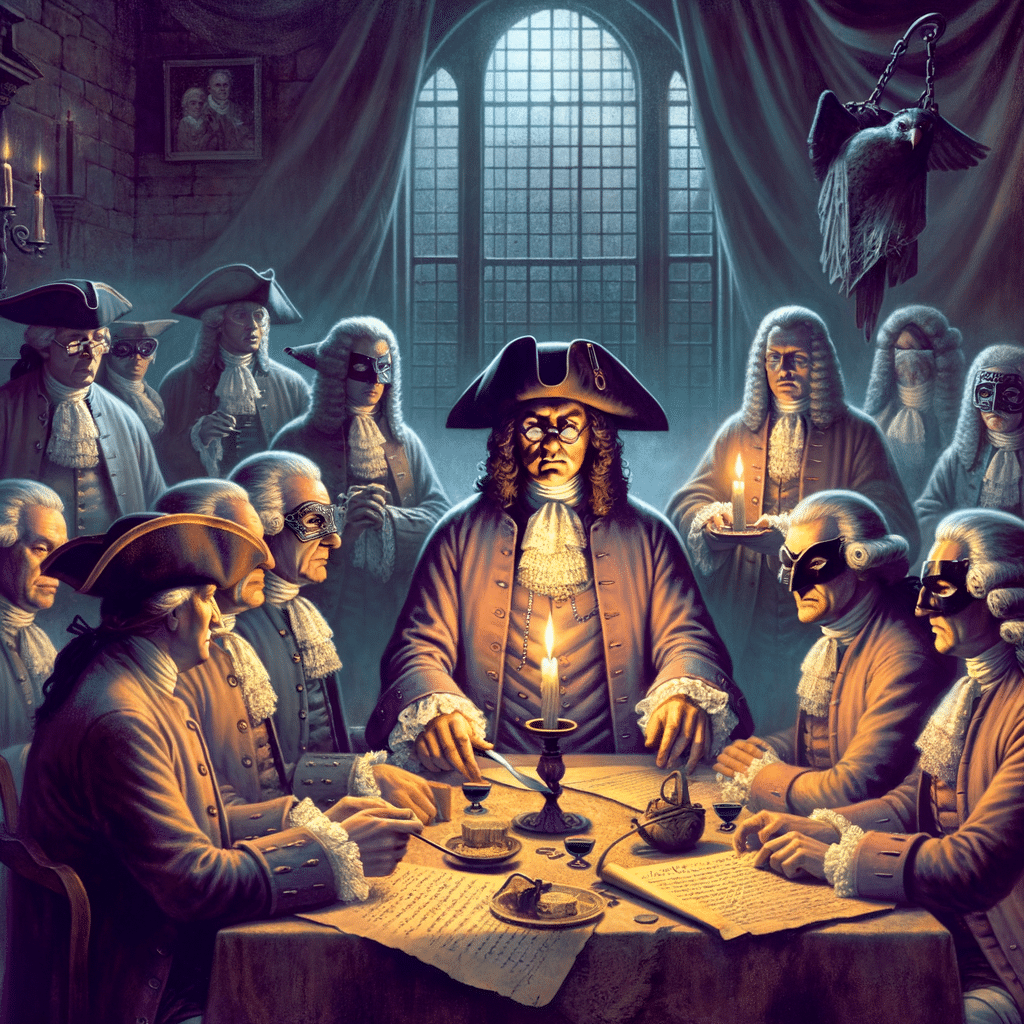
One of the best-known founding fathers of the United States, Benjamin Franklin, is well known for his contributions to literature, politics, and science. His participation with occult and paranormal societies, however, is an intriguing and little-known facet of his identity that lies beneath the surface of his well-documented public life. This essay will discuss Benjamin Franklin and secret societies, his encounters with the paranormal, and the enigmatic finds made at his London home. They will also examine how these events shaped Franklin’s worldview and contemporary thought.

Ben Franklin in Secret Societies
Benjamin Franklin was a polymath who was born in Boston in 1706 and achieved success in many different professions during his lifetime. He achieved success as a writer, printer, scientist, inventor, statesman, and diplomat. Because of his intellectual curiosity, Franklin ventured into the esoteric and mystical spheres in addition to the logical world of science. The establishment met his curiosity and quest for knowledge in the closed-off realm of esoteric groups.
Franklin began his involvement in secret groups after receiving his Freemasonry induction in 1731. He quickly rose through the ranks, earning the title of Grand Master in 1734. With their symbolism, rituals, and quest for secret knowledge, the Freemasons gave Franklin a forum to interact with other intellectually curious people who shared his curiosity. Throughout his life, he remained actively involved in Masonic activities, even when serving as a diplomat in France (Paterson, 1956). His membership is highlighted at The Masonic Hall of Fame: Extraordinary Freemasons in American History.
Franklin was a member of several other exclusive organizations in addition to Freemasonry, such as the Hellfire Club. Known for its purported occult rituals and hedonistic behaviors, Franklin was a member of this notorious club while he was living in England. Although the specifics of the club’s operations are still unknown, Franklin’s participation points to a willingness to investigate novel concepts and encounters (Bunker, 2019).
When Franklin’s previous London home on Craven Street was undergoing repairs in 1998, one of the most fascinating and gruesome aspects of his paranormal connections became apparent. Beneath the house, workers found a pit full of animal and human bones. A forensic investigation revealed that the bones belonged to Franklin’s 1750s home. It was eventually discovered that the bones were probably the product of William Hewson’s anatomy school, which used the property with Franklin’s consent, despite some conjecture about possible occult practices (Hillson et al, 2012).

Occult and Science
Franklin’s participation in occult societies and encounters with the paranormal may have had a profound impact on how he saw the universe. His exposure to nonconformist ideas and arcane information may have shaped the way he saw politics, philosophy, and science. The Masonic traditions’ emphasis on symbolism and hidden meanings may have influenced Franklin’s love of metaphor and his deft use of language in his writings. Furthermore, Franklin’s democratic beliefs and his endeavors to advance social progress are in line with the fraternity and equality that many secret organizations embrace.
Franklin’s interests in the occult and his scientific endeavors intertwined in a number of fascinating ways that reflect the rich intellectual environment of the eighteenth century. During this period, it was often difficult to distinguish between modern pseudoscience, occult rituals, and science.
Some of Franklin’s contemporaries thought his experiments with electricity, for which he is probably best known scientifically, contained elements that verged on the paranormal. Some saw his famous kite experiment—in which he showed lightning to be electrical—as a near-magical demonstration of his control over the laws of nature. At the time, the lack of understanding of electricity and its frequent association with mystical or vital powers contributed to this impression (Tucker, 2005).
Franz Mesmer created the therapeutic art of Mesmerism, which purported to use animal magnetism—an unseen natural force—and his interest in it illustrates another intersection. Franklin’s willingness to look into such phenomena shows his open-mindedness toward theories that straddle the border between science and the occult, even though he ultimately assisted in disproving Mesmer’s precise claims (Rockliff, 2015).
One could consider Franklin’s contributions to optics and his development of bifocal lenses as an extension of his alchemical efforts to achieve perfect perception and vision. In the framework of esoteric traditions, developing one’s vision was frequently associated with a more profound spiritual understanding.
Given the primitive knowledge of ocean currents and worldwide weather patterns at the time, some of his contemporaries may have considered the elements of his meteorological research and his mapping of the Gulf Stream to be verging on the magical.
It’s crucial to remember that Franklin approached these topics with a scientific attitude, looking for logical justifications and verifiable facts. Nonetheless, he was able to connect these seemingly unrelated domains because of his openness to investigating novel concepts and his affiliation with organizations that respected both esoteric and scientific knowledge.
Franklin’s method embodied the Enlightenment ideal of challenging received wisdom and pursuing truth via investigation and experimentation. Franklin employed this method in both his scientific investigations and his research into concepts currently classified as occult or paranormal.
Franklin’s study of both science and occultism essentially mirrored the intellectual milieu of his day, when the lines separating these fields were less clear than they are now. His ability to juggle two worlds shaped his reputation as a polymath and may have also enhanced his capacity for creative thought across a range of domains.
Conclusion
Franklin’s occult experiences continue to impact contemporary culture, spawning several conspiracy theories and alternate historical accounts. Some contend that his participation in covert organizations had a significant influence on the development of the US Constitution. Some contend that the symbolism of American iconography, such as the Great Seal, demonstrates the influence of esoteric ideas on the country’s founding fathers. Even though many of these allegations remain theoretical, they underscore the ongoing fascination with Franklin’s perceived paranormal connection.
Engaging in occult societies and experiencing paranormal events further enhances Benjamin Franklin’s already impressive reputation. Franklin’s memberships in the Hellfire Club and Freemasonry are proof of his unbridled curiosity and receptivity, which is evident in his pursuit of occult knowledge. The discovery of human remains at his London home has stoked more conjecture about his actions. While the extent to which these events shaped Franklin’s perspective remains a matter of debate, their impact on the contemporary perception of his life and contributions is undeniable. His paranormal links serve as a reminder of the depth and complexity of one of America’s most mysterious founding fathers, even as we continue to examine Benjamin Franklin and secret societies.
References
Bunker, N. (2019). Young Benjamin Franklin: The Birth of Ingenuity. Vintage.
Hillson, S., Waldron, T., Owen-Smith, B., & Martin, L. (2012). Benjamin Franklin, William Hewson and the craven street bones. Archaeology International, 2(1).
Paterson, W. J. (1956). Benjamin Franklin, the freemason. Franklin Institute.
Rockliff, M. (2015). Mesmerized: How Ben Franklin solved a mystery that baffled all of France. Candlewick.
Tucker, T. (2005). Bolt of Fate: Benjamin Franklin and His Fabulous Kite. Public Affairs.




Leave a Reply