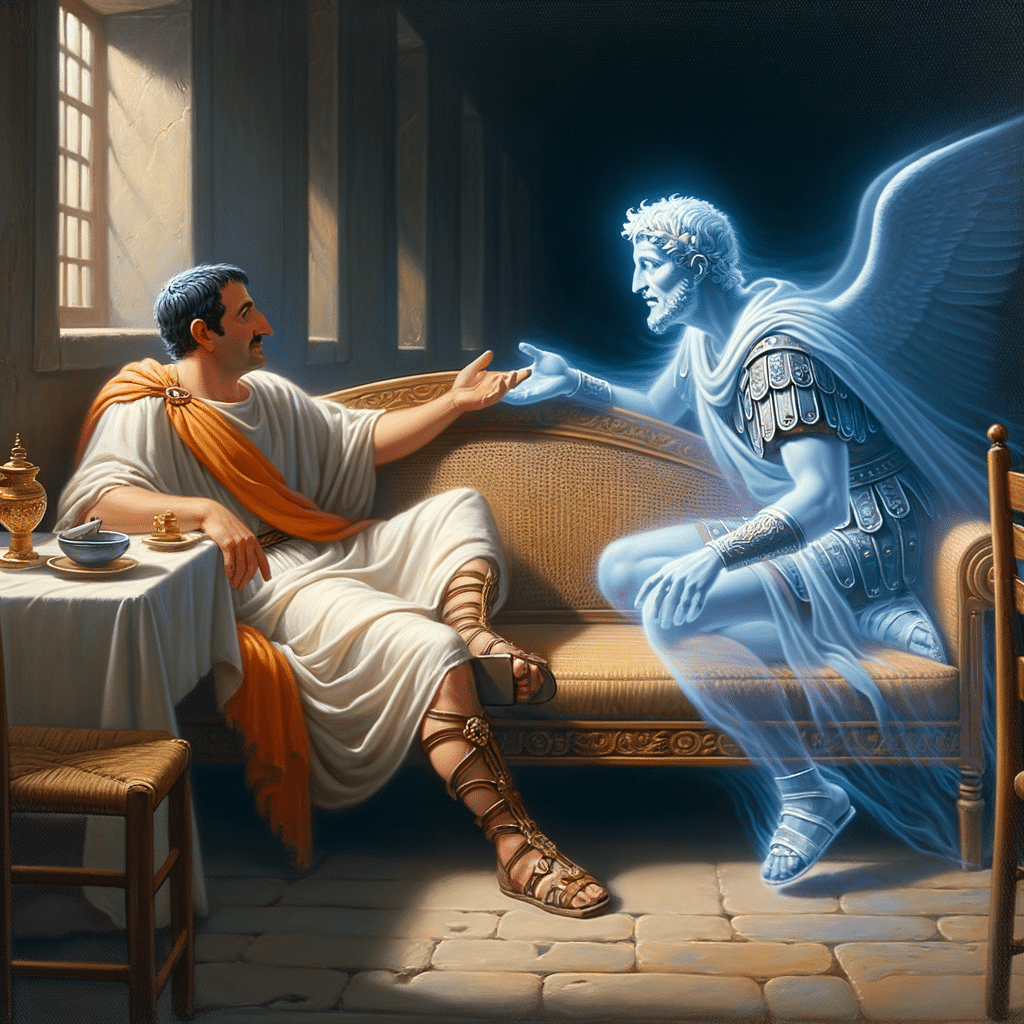
Few people in history have had as much of an influence on the field of ghost stories and paranormal research as Pliny the Younger. This essay examines the life of this outstanding author and statesman from Rome. It accomplishes this by exploring his contributions to our knowledge of the beliefs held by the Romans regarding ghosts, his significant writings on paranormal events, and the lasting influence of his work on contemporary ghost hunting and popular culture.

Pliny the Younger and Ghosts
A well-known person in ancient Roman society, Pliny the Younger was born Gaius Plinius Caecilius Secundus in Comum (modern-day Como, Italy) in 61 AD. In addition to being an author and lawyer, he was an imperial magistrate under Emperor Trajan. After his father passed away, Pliny the Elder, his uncle, took in the affluent family member. He had a first-rate education, studying rhetoric under Quintilian before going on to study law. Throughout his life, Pliny the Younger performed a number of significant roles, such as governor of Bithynia-Pontus in 110–112 AD and consul in 100 AD. His writings, which offer insightful accounts of early imperial Roman politics, culture, and daily life, are what made him most famous (Winsbury, 2013).
There were strong beliefs about ghosts and the paranormal in ancient Roman society. Romans believed in a variety of spirits, such as manes (good spirits of ancestors), larvae (spirits of the wicked dead), and lemures (malevolent ghosts of the dead). Ghosts were believed to be part of the living, frequently making appearances to carry messages, exact revenge, or just to haunt the locations they used to visit. The Romans employed a variety of rites to placate or fend off these demons. One such rite was the exorcism of evil spirits from dwellings, performed by family heads during the Lemuria festival.
Of special interest is Pliny the Younger’s contribution to the field of ghosts and ghost hunting. Letters contain ghost stories that have become genre classics. The story of the haunted home in Athens, which he recounts in Book 7, Letter 27 of his collected letters, is among the most well-known. Pliny narrates the tale of a large, spacious mansion, purportedly haunted by the sound of rattling chains and the appearance of an elderly man clad in shackles and sporting a long beard. At night, the ghost would materialize, frightening the occupants and making the house uninhabitable. Pliny continues by telling how Athenodorus, a philosopher, rented the house with the intention of looking into the haunting. When Athenodorus saw the ghost, he trailed it to a site in the courtyard and marked it. Once he had the site excavated, the haunting ceased. The following day, Athenodorus ordered the excavation of the remains. After burying them in a respectable manner, the haunting stopped (Neger, 2018).
This ghost story is notable not only for its detailed depiction but also for its method of ghost hunting. Pliny provides a logical and methodical approach to investigating reported hauntings, emphasizing the search for physical evidence, documentation, and observation. This kind of ghost hunting differs from more ritualistic or superstitious approaches that were common in his era.
Pliny wrote more about spirits than just this one story. He talks about the views of the Romans concerning numerous supernatural happenings in previous letters. He frequently approaches these tales with a blend of skepticism and open-mindedness, which captures the nuanced understanding the Romans had of the paranormal. Pliny’s methodical, methodical, and rationalist approach to narrating these experiences established a standard for subsequent ghost stories and paranormal research.

Historical Impact
Pliny the Younger’s ghost stories and method of looking into allegations of supernatural phenomena have had a lasting impact that extends far beyond ancient Rome into the present era. Numerous people have repeated and rewritten his story of the haunted home in Athens, often recognizing it as one of the first ghost stories in Western literature. Many ghost stories and paranormal investigation narratives have adopted the story’s framework, which centers on a skeptic investigator, a rigorous approach to discovering the truth, and a logical explanation for the haunting.
Pliny the Younger had a profound impact on other philosophers and writers throughout history with his theories on ghosts and his method of studying paranormal occurrences. His investigative and logical methods, along with his engaging storytelling, established a standard that lasted for decades. Pliny the Younger showed that ghosts and ghost hunting are ancient and not new (González-Rivas Fernández, 2016).
Throughout the Middle Ages, academics and theologians frequently read and referenced Pliny’s ghost stories. His work influenced medieval authors like Gregory the Great, who used ghost stories similar to his own in his Dialogues. These tales influenced Christian conceptions of purgatory and the afterlife in the Middle Ages.
The Renaissance saw a resurgence of interest in Pliny’s writings. Humanist scholars studied his letters and ghost stories as illustrations of ancient Latin literature. Renaissance authors like Giordano Bruno and Marsilio Ficino, who explored ghosts and the paranormal, reflected his influence in their writings.
During the Age of Enlightenment, philosophers who aimed to rationally explain supernatural events found Pliny’s logical response to ghost stories appealing. In his philosophical writings, Voltaire, for example, cited Pliny’s ghost stories as a springboard for talks on superstition and reason. Pliny had a significant influence on literature. Pliny’s evocative accounts of hauntings significantly influenced the Gothic literary genre of the 18th and 19th centuries. Ghost stories by authors like Horace Walpole, Ann Radcliffe, and M.R. James included elements reminiscent of Pliny’s fables (Felton, 1998).
The 19th-century discipline of psychical inquiry frequently recognized Pliny’s thorough investigation of hauntings as an early example of scientific ghost hunting. Scholars such as Harry Price and Sir William Crookes employed comparable techniques for recording and observing claimed extraterrestrial events. Both the public and academic domains continue to feel Pliny’s influence today. Scholars studying the history of the paranormal and classical studies often analyze his reports. Since then, many ghost hunters have adopted a methodical approach to acquiring evidence, further influencing contemporary paranormal investigative approaches.
Pliny’s methodical approach, which is neither wholly suspicious nor quite credulous, has served as a model for people looking for explanations for unexplained phenomena throughout history. His writings show that it is possible to approach these subjects with a critical eye and an open mind at the same time, a viewpoint that still impacts writers and thinkers today. Essentially, Pliny’s theories on ghosts have influenced how we approach, study, and write about ghostly occurrences for ages, acting as a benchmark for centuries of philosophical and literary interaction with the paranormal. His continuing impact highlights the eternal allure of ghost stories and the human need to make sense of the unknowable.
Pliny’s approach has shaped modern methods of investigation in the fields of parapsychology and ghost hunting. His focus on gathering tangible proof and recording experiences is in line with modern methods of paranormal inquiry, which frequently entail using technology to capture and examine possible spectral activity. Contemporary paranormal investigators and ghost hunters often cite Pliny’s story as an early example of scientific ghost hunting.
Additionally, Pliny’s ghost stories have had a big influence on popular culture and literature. His stories have influenced many writers, including contemporary horror novelists and Shakespeare, who may have drawn inspiration for the ghost in Hamlet from Pliny. Pliny’s detailed account of the Athenian mansion is largely responsible for the literary cliche known as the haunted house.
Conclusion
Academics that specialize in the paranormal, classicists, and historians continue to study Pliny’s works on ghosts. His writings shed important light on Roman views on the afterlife, the paranormal, and the ways in which prehistoric cultures dealt with unexplained occurrences. Pliny’s logical approach to these issues also provides an intriguing refutation of the more superstitious ideas prevalent in his day, highlighting the nuanced nature of Roman perspectives on the paranormal (Hajduk, 2018).
In summary, Pliny the Younger made significant contributions to the study of ghost stories and paranormal research, which have had a lasting impact on Western society. His thorough investigations and in-depth tales of hauntings set a benchmark for the study of paranormal claims and the telling of ghost stories. Pliny’s influence is evident in scholarly research, popular culture, literature, and paranormal studies. He represents the persistent human curiosity with the idea of life after death and acts as a vital link between traditional beliefs and contemporary perspectives on the paranormal. We owe a debt of appreciation to this Roman statesman whose works inspire, intrigue, and inform our understanding of ghosts and the supernatural even as we continue to investigate the secrets of the paranormal in the twenty-first century.
References
Felton, D. (1998). Haunted Greece and Rome: Ghost stories from classical antiquity. University of Texas Press.
Gibson, R. K., & Morello, R. (2012). Reading the letters of Pliny the Younger: an introduction. Cambridge University Press.
González-Rivas Fernández, A. (2016). The Haunted and the Haunters; or the House and the Brain, by Edward Bulwer-Lytton: a Victorian Literary Updating of Pliny the Younger’s Ghost Story (Plin. Ep. 7, 27, 5–11). English Studies, 97(8), 837-858.
Hajduk, J. (2018). Pliny the Younger and the Art of Narration. Classica Cracoviensia, (21), 55-70.
Neger, M. (2018). Telling Tales of Wonder: Mirabilia in the Letters of Pliny the Younger. Maria Gerolemou (editora). Recognizing Miracles in Antiquity and Beyond. Berlin-Boston: De Gruyter, 179-204.
Winsbury, R. (2013). Pliny the Younger: a life in Roman letters. A&C Black.




Leave a Reply