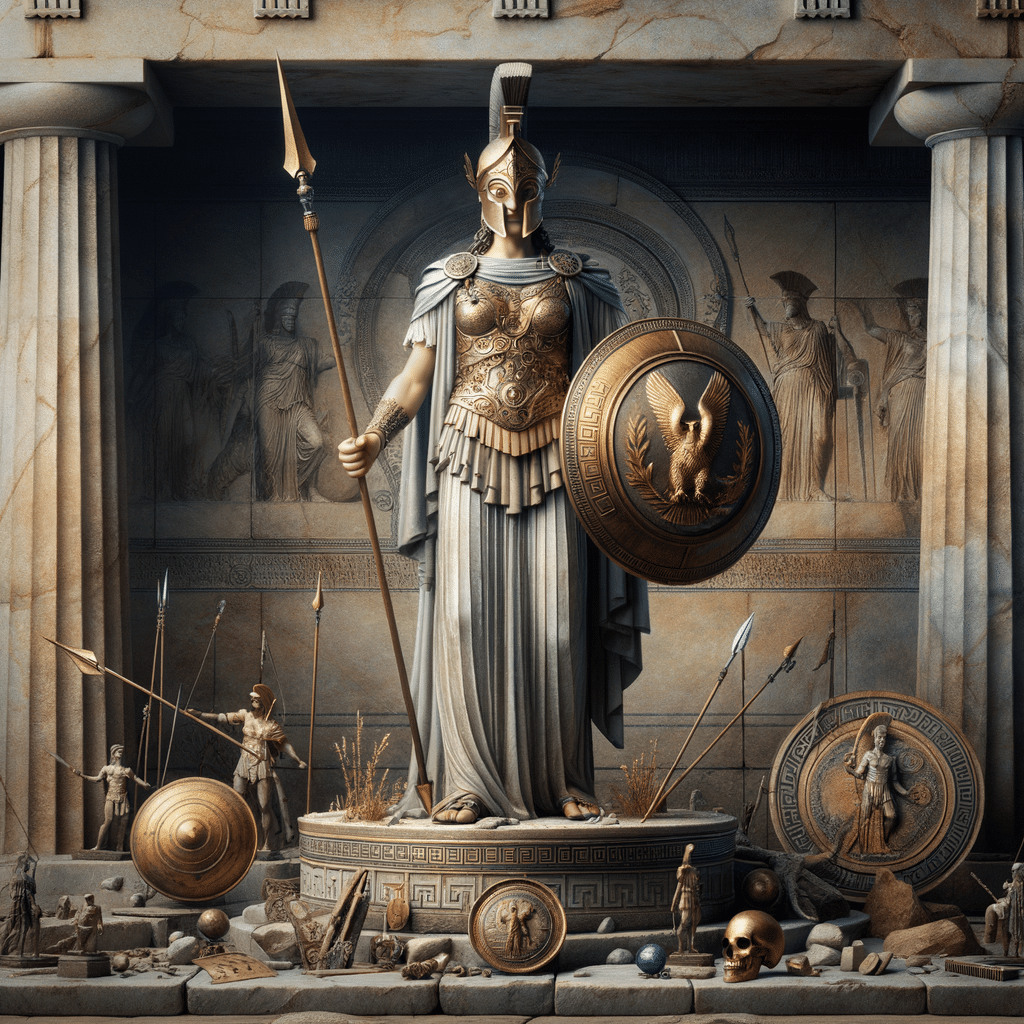
Ancient Athens’ worship of Athena, deeply ingrained in the city’s social, political, and cultural life, was one of the most significant religious customs in classical antiquity. From the early Mycenaean period to the height of classical Athens and into the Roman era, the goddess and her city have had a relationship that stretches over a thousand years. Athena was the heart of Athens.

Athena and Athens
Athenian legend states that Athena defeated Poseidon to become the city’s patron deity. Athena’s gift was an olive tree, which represented peace and wealth, whereas Poseidon used his trident to strike the Acropolis, creating a salt spring. This mythological competition mirrored the Athenians’ perception of themselves as a culture that prioritized knowledge and education over brute force (Deacy, 2008).
Athena herself possessed a special set of qualities that were highly compatible with Athens’ ideals. She was the goddess of justice, crafts, strategic warfare, and wisdom. Athena embodied military strategy and provided justification for defense, in contrast to Ares, who stood for the mayhem and brutality of war. She also embodied skillful workmanship, practical insight, and technological ingenuity. Greek culture depicted her as a warrior goddess, adorned with a helmet, shield, and spear, who maintained her femininity while defying male expectations.
The sacred fortress of Athens, the Acropolis, was the focal point of Athena devotion. The Parthenon, completed in 438 BC, represented the apex of Athens’ devotion to their patron goddess. Phidias crafted the approximately 40-foot-tall gold and ivory chryselephantine statue of Athena Parthenos in this beautiful temple. The statue symbolized Athens’ wealth and power in its heyday as well as religious devotion.
Worship in Athens
The Panathenaia, the most significant religious event in Athens, commemorated Athena’s birthday. Every four years, the Greater Panathenaia included poetry recitations, musical performances, and athletic contests. The Panathenaic parade served as the event’s climax, where Athenian citizens and allies presented Athena with a new peplos, a specially woven garment, as a symbol of their renewed protection and devotion (Develin, 1984).
Through its many elements and structure, the Panathenaia festival brilliantly expressed Athens’ values and self-image. Athens’ fundamental values of democracy, excellence, cultural sophistication, and military power were all on display throughout the festival. Plus, it was a time for relaxation and enjoyment.
The parade itself exemplified Athens’ democratic openness and social order. Participants came from all social strata, including citizens, metics (resident foreigners), and even liberated slaves, while upholding hierarchical divisions. The roles assigned to both males and females, young and old, reflected the Athenians’ conviction in communal civic engagement.
Athletic competitions best represented the Greek concept of arete (excellence) in physical accomplishment. The Panathenaic games placed a strong emphasis on Athenian prowess, in contrast to the Pan-Hellenic Olympics. Winners received specially made Panathenaic amphorae filled with sacred olive oil to connect athletic success with Athena’s divine gift to the city.
The cultural contests in poetry, music, and rhapsodic Homer recitation mirrored Athens’ perception of itself as the intellectual and cultural hub of Greece. These incidents showed that intellectual accomplishment was just as important to Athenians as athletic skill. Military performances such as the horse parades and pyrrhic dancing demonstrated Athens’ military prowess and preparedness. Young warriors’ involvement demonstrated the city’s dedication to upholding democracy and educating the next generation of citizens.
The ceremonial presentation of the peplos to Athena showcased Athens’ wealth, craftsmanship, and dedication. The young, aristocratic women who made the garment demonstrated how civic responsibility and conventional gender roles might coexist. Women had roles that Athena demanded be respected (Luyster, 1965).

Contrast With Other Greek Goddesses
In terms of both personality and social significance, Athena’s worship was very different from that of other Greek goddesses (Higginson, 2007). Athena’s cult was more municipal in nature than Demeter’s, whose worship focused on agricultural fertility and the Eleusinian Mysteries. Athena’s celebrations, especially the Panathenaia, centered on civic pride and collective identity, whereas Demeter’s festivals prioritized individual redemption and agricultural cycles.
Hera’s devotion, primarily focused on marriage and feminine purity, was very different from Athena’s. Athena was a virgin goddess; thus, her devotion had nothing to do with conventional female duties. Athena’s sanctuaries honored military triumph, civic accomplishment, and craftsmanship, whereas Hera’s temples, like the Heraion of Samos, served as locations for marriage ceremonies.
Athena and another virgin goddess, Artemis, were somewhat alike, although their adoration was very different. Artemis’s worship revolved around hunting, the outdoors, and safeguarding young women, often involving coming-of-age ceremonies and rural sanctuaries. Conversely, people primarily worshipped Athena in urban and civic settings.
The reverence for Aphrodite, known for her beauty, sensuality, and love, contrasted sharply with that of Athena. Athena’s sanctuaries were centers of creative and intellectual endeavor, whereas Aphrodite’s temples frequently included fertility rituals and holy prostitution. The virgin goddess Athena was worshipped very differently from Aphrodite.
Over time, the goddess’s function in Athens changed. She was mostly considered a defender of the citadel and a protector deity throughout the ancient era. Athena became more closely linked to civic virtues and imperial aspirations during the classical era as Athens became a democratic power. The goddess became a symbol of Athens’ cultural and intellectual accomplishments as well as its military prowess, reflecting the city’s self-perception as the Greek world’s seat of education.
The character of devotion evolved during the Hellenistic and Roman eras, even if the ceremonial elements of Athena’s worship persisted. Rather than being an active supernatural power, the goddess came to symbolize Athens’ rich cultural legacy and magnificent past. Despite the conversion to a Christian church in the fifth century AD, the Parthenon remained a site of devotion, highlighting the significance of the goddess to Athenian identity (Frantz, 1965).
Conclusion
From politics and education to art and architecture, the worship of Athena impacted many facets of Athens’ existence. Athena’s olive tree established a robust agricultural economy, her owl appeared on Athenian coins, and her principles of justice and wisdom influenced the development of democratic institutions and philosophical schools.
Beyond religious practice, Athena’s worship in Athens has left a lasting influence. It embodies the distinctive blend of religious devotion, cultural accomplishment, and civic pride that defined classical Athens. The goddess personified her city’s goals and ideals: the development of both practical and intellectual talents, the preference for wisdom over power, and the justification of defense over aggression. The Parthenon stands as a witness to the deep bond between the goddess and the community that honored her, recalling a time when civic morality and heavenly wisdom were considered inseparable ideals.
References
Deacy, S. (2008). Athena. Routledge.
Develin, R. (1984). From Panathenaia to Panathenaia. Zeitschrift für Papyrologie und Epigraphik, 133-138.
Frantz, A. (1965). From paganism to Christianity in the temples of Athens. Dumbarton Oaks Papers, 19, 185-205.
Higginson, T. W. (2007). The Greek Goddesses. New England Review (1990-), 28(4), 194-207.
Luyster, R. (1965). Symbolic elements in the cult of Athena. History of Religions, 5(1), 133-163.


Leave a Reply