One of the most complicated and contradictory characters in ancient mythology is Pazuzu, the demon king of the wind from Mesopotamia. Although this strong being was mainly feared as an evil force, it was sometimes called upon for protection, especially from other demons and supernatural dangers. Pazuzu was a unique figure in antiquity because of his dual nature, which still impacts popular culture today.

Description
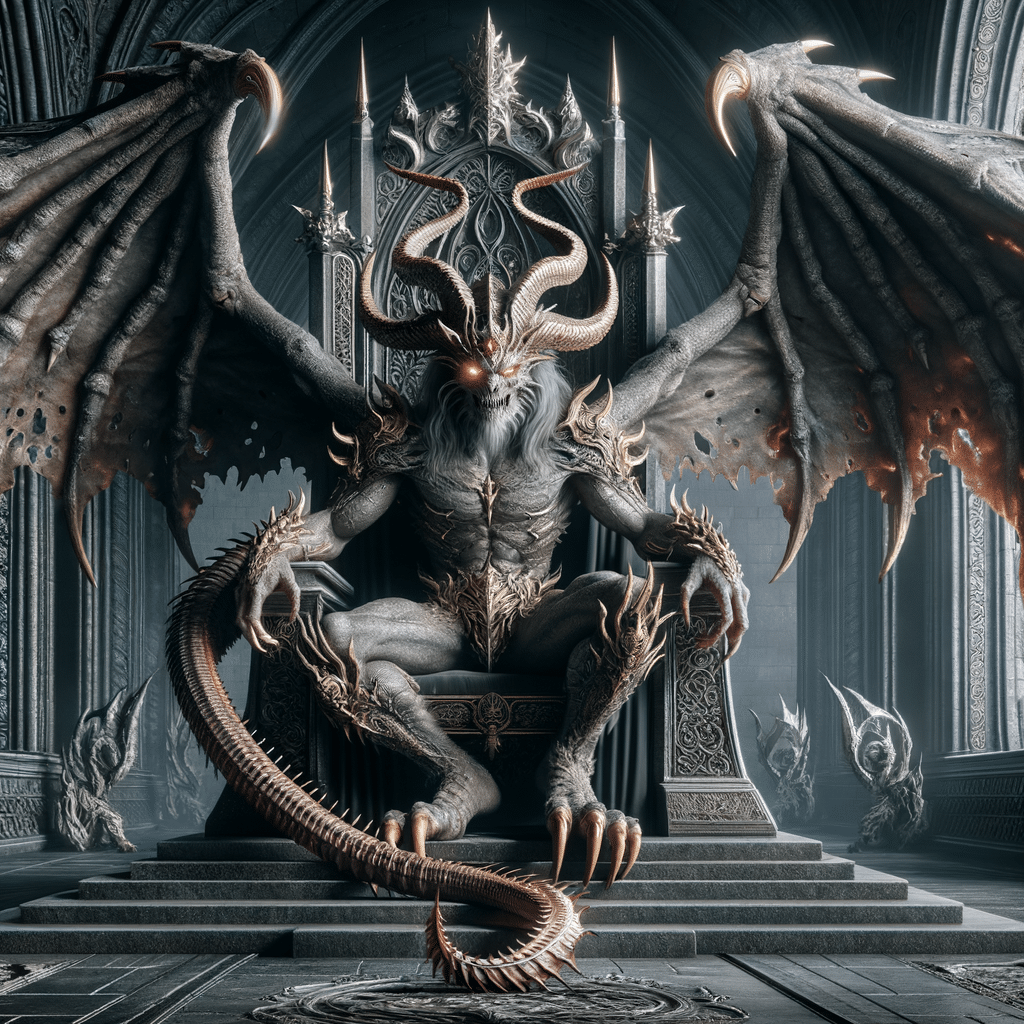
The demon’s appearance is a horrifying mashup of many animals. Usually portrayed with a humanoid figure, Pazuzu has four wings, a ferocious dog or lion’s head, sharp horns, and talons for feet. He frequently has a scorpion’s tail and raises his right hand upward while pointing his left hand downward. His face is most notable for its scales, protruding eyes, and a grimacing expression that displays pointed teeth. In certain renditions, the presence of a second face on his midsection further enhances his alien aspect.
Pazuzu was believed to control the west and southwest winds during the dry season, which brought locusts, storms, and drought. Pazuzu was particularly associated with the scorching winds that brought diseases and plagues. However, people also saw his strength and ferocity as useful in warding off other supernatural dangers, particularly the demon Lamashtu, who posed a threat to unborn children and expectant mothers (Heeßel, 2011).
Pazuzu occupied a special place in the Mesopotamian pantheon as a strong demon who was not part of the main divine hierarchy. Compared to major deities who received regular worship and had temples, Pazuzu operated in a more liminal realm. Despite ruling over the wind demons and other malevolent spirits of the sky, he had a complicated and frequently hostile relationship with the larger gods.
Pazuzu worship was clearly utilitarian rather than religious. People usually used apotropaic magic, which includes protective rites and talismans, to interact with Pazuzu rather than upholding temples or frequent offerings. Children and pregnant women frequently wore small amulets with his image on them as a form of protection against Lamashtu. These amulets frequently had inscriptions that invoked his ability to repel evil forces (Maiden, 2018).

Historical Development
Pazuzu’s role and perception changed dramatically throughout time. In the Neo-Assyrian era (911-612 BC), he was a prominent being in the field of magic. Pazuzu’s renown grew as Mesopotamian culture impacted neighboring areas, but his function shifted away from his more destructive qualities and toward protective magic. The development of monotheistic religions progressively forgot or demonized Pazuzu, like many ancient deities and demons (Frahm, 2018).
In the late Babylonian and Assyrian eras, Pazuzu maintained his multifaceted position as both a demon and a defender, despite the growing standardization of amulets’ designs and applications, particularly in his defenses against Lamashtu. Greek demon imagery started to blend with Pazuzu’s imagery during the Hellenistic era, creating hybrid depictions that combined aspects of the two traditions. His affinity with winds reflected similar Greek ideas of wind spirits.
Early Christian and Jewish faiths typically recast Pazuzu, like other Mesopotamian demons, as a completely evil force. Scholars classified him as a fallen angel or a desert demon, largely stripping him of his protective qualities. In Islamic tradition, he bore a resemblance to similar wind demons, but they did not receive the official name Pazuzu. However, most depictions of these beings portrayed them as merely destructive forces, lacking any protective attributes.
Despite his Mesopotamian roots, medieval European demonology occasionally included Pazuzu-like beings in their demon hierarchies. He was often associated with wind and illness. Medieval European demonology, using Christian theological frameworks and miasma theory, mostly explained Pazuzu’s sickness links. Because they thought demons could contaminate the air and spread epidemics, they linked his wind-demon characteristics to the medieval idea of “corrupt air,” or miasma. This was a distortion of Pazuzu’s original connection between scorching desert winds and the transmission of illness, and it aligned with the prevalent medical belief at the time that diseases were spread by foul winds (Lynn, 2019).
Demonologists typically classified him as a plague demon, often grouping him with entities such as Beelzebub, associated with flies and decay. This classification eliminated the ancient Mesopotamian notion of Pazuzu as both a disease avoider and a disease bringer. The medieval perspective reframed his disease-causing abilities as divine vengeance and curse rather than natural causes, emphasizing his role in God’s punishment of sinners. According to certain sources, he worked under the direction of superior demons who were in charge of different plagues. Church authorities cautioned that seeking protection from one demon against others was a hazardous heresy, reinterpreting Pazuzu’s disease-preventive properties as demonic trickery.
With the demon playing a major hostile part in William Peter Blatty’s novel The Exorcist and its film adaptation, Pazuzu has seen a remarkable rebirth in popular culture in modern times. Despite being very different from the original Mesopotamian idea, this depiction has made Pazuzu one of the most well-known ancient demons in modern media. Numerous books, video games, and movies feature Pazuzu, often altering his real-life persona significantly. Ancient Pazuzu statues and amulets are on display in museums all around the world, providing physical reminders of the intricate interaction between humans and otherworldly forces (Barentsen, 2012).
According to the universe of Dungeon & Dragons, Pazuzu is the ruler of all malevolent flying creatures and the Prince of the Lower Aerial Kingdoms. Although he is officially a demon king of the Abyss, he remarkably retains power on other levels. In D&D, his characteristic trick is to progressively corrupt individuals by offering assistance against other demons, especially to those who are well-aligned. This deft adaptation reflects his historical dual nature as a tempter and defender.
The D&D game portrayals portray him as a powerful demon king with the ability to corrupt good things, fly, and manipulate the wind. He usually takes the form of a strong humanoid with four wings, a hawk-like head, and eagle talons, which is a simplified representation of his historical appearance. Many D&D settings link him to corrupted bird-like monsters, false redemption, wicked wind abilities, corrupted aerial creatures, and the temptation of good beings. Recent versions have preserved his role, but his prominence has diminished in comparison to other demon lords like Demogorgon or Orcus.
Conclusion
People have always drawn to supernatural beings that defy easy classification as good or evil, as demonstrated by Pazuzu’s history. Pazuzu continues to represent the intricate relationship between fear and protection, destruction, and preservation, from ancient Mesopotamian amulets to contemporary horror movies, proving how old ideas can remain relevant and captivate audiences for millennia of human cultural development.
References
Barentsen, G. (2012). Evil Against Evil: Demonic Sexuality in William Friedkin’s The Exorcist. In The Gothic: Probing the Boundaries (pp. 71-78). Brill.
Frahm, E. (2018). A tale of two lands and two thousand years: The origins of Pazuzu. In Mesopotamian Medicine and Magic (pp. 272-291). Brill.
Heeßel, N. P. (2011). Evil against Evil The Demon Pazuzu. Studi e materiali di storia delle religioni, 77(2).
Lynn, H. (2019). Evil Archaeology: Demons, Possessions, and Sinister Relics. Disinformation Books.
Maiden, B. (2018). Counterintuitive Demons: Pazuzu and Lamaštu in Iconography, Text, and Cognition. Journal of ancient near eastern religions, 18(1), 86-110.


Leave a Reply