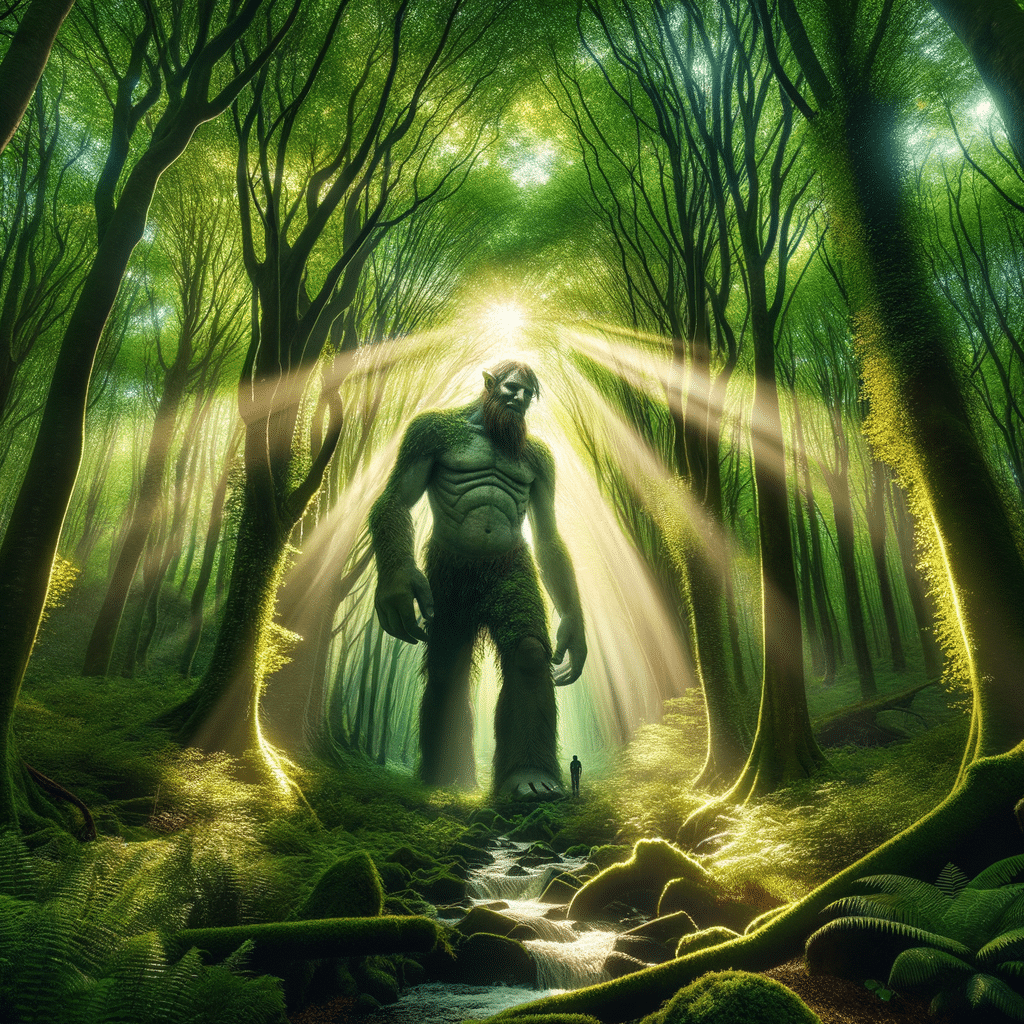
Legends of giants, powerful creatures believed to have sculpted the nation’s spectacular hills and beaches, have long entwined with Ireland’s beauty. Dating back to pre-Christian times, these tales have been passed down through the generations of storytellers and are an integral element of Irish mythology and folklore.
The old cycles of Irish mythology, especially those involving the Fomorians, a race of giant-like creatures believed to have been among the first people to live in Ireland, gave rise to Irish giant legends. Christian monks then added to these tales by preserving them in medieval manuscripts, fusing new religious narratives with pagan customs. Charles Byrne, also known as the Irish Giant, was the most well-known Irish giant in history. He lived in the 18th century and was 7 feet 7 inches tall (Evans, 1938).

Description
Irish folklore typically portrayed giants as enormous humanoid beings, often as tall as the trees themselves. They were typically characterized as having strong physiques, occasionally having several heads or eyes, and furious red or golden hair. According to some stories, they were more civilized creatures who lived in magnificent stone fortresses and wore exquisite clothing, while others showed them carrying enormous clubs or spears and dressed in animal hides.
In folklore, Irish giants exhibited a wide range of behaviors. Some were presented as sage and kind creatures who taught people different talents and shaped the terrain. They portrayed others as fierce fighters and raiders who engaged in epic conflicts. They portrayed Finn MacCool (Fionn mac Cumhaill), perhaps the most well-known of the Irish giants, as a multifaceted individual with immense strength and knowledge. Tales vary on whether he was actually a giant or just associated with them (McAnally, 1888).
During his youth, Finn worked for the druid Finnegas, who had been attempting to capture the Salmon of Knowledge for seven years. When Finn finally caught the Salmon of Knowledge, the druid instructed him to cook it but not to eat it. He unintentionally gained all the world’s wisdom when he burned his thumb on the fish while frying and placed it in his mouth. In the well-known story, Finn built the causeway to Scotland in preparation for his battle with Benandonner. His wife Oonagh disguised him as a baby once he realized how big he was. When Benandonner saw the size of the baby, he panicked, thinking the father must be massive, and destroyed the causeway on his way back to Scotland (MacKillop, 1985).
After solving a puzzle and demonstrating his intelligence, Finn rose to become the leader of the Fianna, Ireland’s finest combat band. While protecting Ireland from invaders and supernatural threats, he took them on innumerable adventures. On the summit of Slieve Gullion, a witch turned Finn into an elderly man. Finn eventually returned to his youth after sipping from a miraculous well, but his hair will always be white.

Giant’s Causeway
The Giant’s Causeway in Northern Ireland is the most notable geographical site associated with giant mythology. Folklore claims that Finn MacCool constructed this amazing geological feature as a bridge to Scotland in order to battle the Scottish giant Benjamin, his adversary. Scientifically, volcanic activity from millions of years ago explains the hexagonal basalt columns of the Causeway, yet the enormous tale remains deeply ingrained in Irish culture.
The Giant’s Causeway has significantly impacted Irish culture in a number of ways. It has been one of Ireland’s top tourist destinations since the Victorian era, attracting tourists from all over the world. The location has made the north shore a popular tourist destination and makes a substantial economic contribution to Northern Ireland.
The causeway has preserved the traditional Irish storytelling tradition. Tour guides and locals are still telling the Finn MacCool myth, preserving oral folklore practices that might otherwise have disappeared over time. Stamps, postcards, and promotional items now feature the location as a representation of Irish cultural history. It is a common symbol of both natural and mythological heritage in Irish literature and art (Crawford & Black, 2012).
The causeway helped shape modern geology by igniting discussions about the genesis of rocks in the 18th century. This led to a special nexus of folkloric and scientific curiosity that endures to this day. The group still serves as an inspiration to musicians, authors, and artists. Numerous poems, songs, paintings, and contemporary media, such as television and movies, have featured it. Since its designation as a UNESCO World Heritage site in 1986, the causeway has supported geological preservation and environmental protection in Ireland.
Giants Around the World
We can analyze the likelihood that giants roamed Ireland in the past from both historical and scientific perspectives. Archeological evidence has never confirmed the existence of a race of giants despite records of extraordinarily tall individuals like Charles Byrne throughout Irish history. Archeological evidence has never confirmed the existence of a race of giants as portrayed in legend. However, enormous stories may have developed as a result of the ancient discovery of large human bones, presumably from extinct megafauna.
Many civilizations around the world, despite geographical barriers, exhibit striking parallels in their giant legends. You can find an international perspective on giant folklore here. The Jötnar were a race of giants who predated the gods and frequently clashed with them in Norse mythology. Some of these fire and frost giants, like Ymir, were thought to be the origin of existence itself, while others were viewed as forces of nature and chaos.
Greek mythology contains a variety of giants, including the Titans, who ruled before the Olympian gods, and the Gigantes, who engaged in combat with the gods. Greek stories also frequently feature cyclopses, one-eyed giants like Polyphemus from Homer’s Odyssey. Some tribes told stories of massive ancestors who shaped the environment, while the Algonquian peoples told stories of the Wendigo, a giant evil ghost. The Paiute people of Nevada tell stories of red-haired giants known as Si-Te-Cah.
Chinese culture frequently mentions giants, particularly in creation myths. Perhaps most famous is Pangu, a giant who divided heaven and earth. After his death, his body transformed into rivers, mountains, and other natural elements. Polynesian and other Pacific Island nations have rich, gigantic traditions. In Hawaiian mythology, giants are said to have shifted mountains and formed valleys, while the Maori of New Zealand recount tales of huge creatures that sculpted the islands.
Middle Eastern folklore mentions giants and enormous jinn. Hebrew tradition records the Nephilim, giants recorded in the Book of Genesis, as the offspring of humans and angels. There are several enormous legends in African cultures. While several West African legends mention massive creatures that existed before humans, the Watusi people recount tales of large forefathers.
Common motifs across these global giant traditions include giants as frightening forces of nature, as ancestors of mankind, as bearers of ancient wisdom, or as landscape shapers. Just as the Irish employ vast mythology to elucidate the origins of the enormous, numerous other cultures also employ similar techniques to explain natural phenomena. The discovery of large fossilized bones, frequently from prehistoric mammals, human attempts to explain natural phenomena, and the universal human tendency to imagine beings larger and more powerful than ourselves could all be contributing factors to the similarities in giant folklore across cultures.
According to contemporary research, these pervasive giant myths may either be cultural recollections of interactions with megafauna during the last ice age or they may be tales of rival human populations in which one group was noticeably taller than the other. The widespread presence of enormous legends across various civilizations demonstrates the deep-rooted nature of these tales in people’s minds and imaginations. Whether they serve to explain natural wonders, impart moral lessons, or simply provide entertainment, giant stories continue to serve as an intriguing illustration of how various societies frequently create parallel mythical traditions (Motz, 1982).
Conclusion
Irish giant myths continue to reflect a deeper human impulse to preserve cultural identity and explain natural events. Even though these stories might not be entirely accurate, they offer important insights into how the ancient Irish people perceived the world and transmitted their cultural beliefs. These tales continue to enthrall audiences everywhere, bolstering Ireland’s thriving tourism sector and rich cultural legacy.
Despite probably never being actual in the physical sense, the giants of Irish folklore continue to have a significant cultural impact. They serve as a link between Ireland’s enigmatic past and present, amusing and motivating younger generations while preserving age-old wisdom. Irish giant legends demonstrate the power of narrative and the human search for meaning in the natural environment, whether viewed through the prisms of mythology, geology, or cultural history.
References
Crawford, K. R., & Black, R. (2012). Visitor understanding of the geodiversity and the geoconservation value of the Giant’s causeway world heritage site, northern Ireland. Geoheritage, 4, 115-126.
Evans, E. E. (1938). Giants’ Graves. Ulster Journal of Archaeology, 7-19.
McAnally, D. R. (1888). Irish Wonders: The Ghosts, Giants, Pookas, Demons, Leprechawns, Banshees, Fairies, Witches, Widows, Old Maids, and Other Marvels of the Emerald Isle. Houghton Mifflin.
MacKillop, J. (1985). Fionn mac Cumhail: Celtic Myth in English Literature. Syracuse University Press.
Motz, L. (1982). Giants in folklore and mythology: A new approach. Folklore, 93(1), 70-84.

Leave a Reply